Cell Cycle and Cell Division (NEET Biology Class 11): Mitosis, Meiosis & Prophase I
The Cell Cycle — Interphase & M Phase Overview
📌 NEET priority: Important. 2–4 questions a year directly, but mitosis and meiosis are the most-referenced processes in all of NEET Biology — get this chapter rock solid and it pays off across Genetics, Reproduction and Cell Biology too.
The cell cycle is the ordered sequence of events by which a cell duplicates its genome, synthesises other cell constituents, and divides into two daughter cells. A human cell in culture divides roughly every 24 hours; yeast can complete a cycle in just 90 minutes — duration varies by organism and cell type.
Two basic phases
Interphase — the "resting" phase between two M phases, though the cell is actively preparing to divide (growth + DNA replication). Interphase occupies >95% of the cycle — in the 24-hour human cell cycle, actual division (M phase) lasts only about an hour.
M phase (Mitotic phase) — starts with karyokinesis (nuclear division/chromosome separation) and usually ends with cytokinesis (cytoplasmic division).
Cells that stop dividing (e.g. heart cells) exit G1 into an inactive quiescent stage, G0 — metabolically active but not proliferating, until called back into the cycle.
Trap: mitosis is normally restricted to diploid cells, but there ARE exceptions — male honey bees are haploid and still divide by mitosis; plants can show mitosis in both haploid and diploid cells (e.g. gametophyte generation).
Interphase (G1/S/G2) & Mitosis's Four Stages
Interphase in detail — G1, S, G2
G1 (Gap 1): between the end of mitosis and the start of DNA replication. The cell is metabolically active, grows continuously, but does NOT replicate DNA yet.
S (Synthesis): DNA replication occurs — DNA content doubles from 2C to 4C. Crucially, chromosome NUMBER does not change (a diploid cell stays 2n) — replication just doubles each chromosome's DNA, giving it two sister chromatids. In animal cells, the centriole also duplicates during S phase.
G2 (Gap 2): cell growth continues and proteins needed for mitosis are synthesised, preparing the cell for M phase.
Mitosis (M phase) — the four stages of karyokinesis
Prophase: chromatin condenses into compact chromosomes (each with 2 sister chromatids joined at the centromere); the duplicated centrosome moves to opposite poles, radiating asters that plus spindle fibres form the mitotic apparatus. By end of prophase, the Golgi, ER, nucleolus and nuclear envelope all disappear.
Metaphase: nuclear envelope is fully gone; chromosomes (each with sister chromatids held by the centromere, with kinetochores as spindle-fibre attachment sites) align at the metaphase plate (spindle equator) — the best stage to study chromosome morphology.
Anaphase: centromeres split simultaneously; sister chromatids (now daughter chromosomes) move to opposite poles, centromere leading, arms trailing.
Telophase: chromosomes decondense and lose individuality; a new nuclear envelope forms around each cluster (2 daughter nuclei); nucleolus, Golgi and ER reform.
Cytokinesis: in animal cells, a furrow in the plasma membrane deepens and pinches the cell in two. In plant cells (rigid cell wall), a cell plate forms at the centre and grows outward to meet the lateral walls. If karyokinesis is NOT followed by cytokinesis, a multinucleate syncytium results (e.g. the liquid endosperm of coconut).
Significance of Mitosis & Meiosis I
Significance of mitosis
Mitosis is an equational division — daughter cells are genetically identical to the parent, same chromosome number. It drives growth of multicellular organisms, restores the disturbed nucleo-cytoplasmic ratio after cell growth, enables cell/tissue repair (epidermis, gut lining, blood cells constantly replaced), and via meristematic tissue (apical + lateral cambium) gives plants lifelong growth.
Meiosis — the reduction division
Meiosis produces haploid gametes from specialised diploid cells — one DNA replication (at S phase) but two sequential divisions, meiosis I and meiosis II, yielding 4 haploid cells. It involves pairing of homologous chromosomes and recombination between non-sister chromatids.
Meiosis I — prophase I's five sub-stages
Sub-stage | Key event |
Leptotene | Chromosomes become gradually visible; compaction begins |
Zygotene | Homologous chromosomes pair (synapsis); synaptonemal complex forms; pair = bivalent/tetrad |
Pachytene | Four chromatids of each bivalent become distinct; crossing over occurs at recombination nodules (enzyme: recombinase) |
Diplotene | Synaptonemal complex dissolves; homologues separate except at crossover points — chiasmata (X-shapes) |
Diakinesis | Chiasmata terminalise; chromosomes fully condense; nucleolus disappears, nuclear envelope breaks down |
After prophase I: Metaphase I — bivalents align at the equatorial plate. Anaphase I — homologous chromosomes separate (sister chromatids stay together, unlike mitotic anaphase). Telophase I — nuclear membrane/nucleolus reappear, cytokinesis gives a dyad of cells. A brief, DNA-replication-free interkinesis follows.
Meiosis II, Significance & Why This Matters for NEET
Meiosis II — like a normal mitosis
Meiosis II starts right after cytokinesis, often before chromosomes fully re-elongate. Prophase II → Metaphase II → Anaphase II (centromeres split, sister chromatids separate) → Telophase II — ending in a tetrad of 4 haploid daughter cells.
Significance of meiosis
Meiosis conserves the chromosome number of a species across generations — halving it in gametes so fertilisation restores the diploid number. Crossing over during prophase I also increases genetic variability, the raw material for evolution.
Mitosis vs meiosis
Feature | Mitosis | Meiosis |
Occurs in | Somatic (body) cells — usually diploid | Germ cells destined to form gametes |
Number of divisions | One | Two (meiosis I + meiosis II) |
DNA replication | Once, before division | Once, before meiosis I only |
Homologous pairing / crossing over | Never | Yes, during prophase I |
Daughter cells | 2, genetically identical, same chromosome number (2n → 2n) | 4, haploid, genetically variable (2n → n) |
Also called | Equational division | Reduction division |
Why this matters for NEET
High-value one-liners: S phase changes DNA content (2C→4C) but NOT chromosome number; kinetochores (not centromeres directly) attach spindle fibres; mitotic anaphase splits centromeres/sister chromatids, meiotic anaphase I separates whole homologous chromosomes (sister chromatids stay joined); crossing over enzyme = recombinase; plant cytokinesis uses a cell plate, animal uses a furrow.
Trap: don't confuse chiasmata (the visible X-shaped crossover sites, seen from diplotene onward) with synapsis (the pairing itself, at zygotene) or the synaptonemal complex (the structural scaffold that dissolves at diplotene). And a syncytium (e.g. coconut liquid endosperm) means karyokinesis happened WITHOUT cytokinesis — many nuclei, no cell walls between them.
Test Yourself: MCQs, PYQs & Active Recall
Answer these, then close the article and do an Active Recall. Reveal each answer only after you commit to one.
Practice Questions
Q1. The phase of the cell cycle that occupies more than 95% of its duration is:
(a) Interphase
(b) Anaphase
(c) M phase
(d) Cytokinesis only
Show answer
Answer: (a) — Interphase (G1+S+G2) makes up over 95% of a typical cell cycle; M phase (division) is comparatively brief.
Q2. During the S phase of the cell cycle:
(a) The cell divides into two
(b) DNA content doubles but chromosome number stays the same
(c) Chromosome number doubles
(d) Proteins for mitosis are made
Show answer
Answer: (b) — S phase doubles DNA content (2C to 4C) by replication, but the chromosome number (e.g. 2n) does not change.
Q3. Cells that permanently exit the cell cycle without dividing (e.g. heart cells) enter the:
(a) G0 (quiescent) stage
(b) Anaphase
(c) G2 phase
(d) S phase
Show answer
Answer: (a) — Non-dividing cells exit G1 into G0, the quiescent stage — metabolically active but not proliferating.
Q4. The disc-shaped structures on the centromere that serve as spindle-fibre attachment sites are:
(a) Kinetochores
(b) Bivalents
(c) Chiasmata
(d) Asters
Show answer
Answer: (a) — Kinetochores are the attachment sites for spindle fibres, located at the centromere.
Q5. Cytokinesis in plant cells occurs by:
(a) Formation of a furrow in the plasma membrane
(b) Formation of a cell plate that grows outward
(c) Complete absence of cytoplasmic division
(d) Formation of a syncytium always
Show answer
Answer: (b) — Plant cells, having a rigid cell wall, divide via a cell plate that forms centrally and grows to meet the lateral walls.
Q6. Synapsis, the pairing of homologous chromosomes, occurs during:
(a) Diakinesis
(b) Pachytene
(c) Zygotene
(d) Leptotene
Show answer
Answer: (c) — Zygotene is defined by synapsis — homologous chromosomes pairing to form bivalents.
Q7. Crossing over between non-sister chromatids of homologous chromosomes occurs during:
(a) Leptotene
(b) Zygotene
(c) Diplotene
(d) Pachytene
Show answer
Answer: (d) — Pachytene shows recombination nodules where crossing over occurs, mediated by the enzyme recombinase.
Q8. The X-shaped structures seen where homologous chromosomes remain joined after separating is called:
(a) Synaptonemal complex
(b) Chiasmata
(c) Bivalent
(d) Tetrad
Show answer
Answer: (b) — Chiasmata are the X-shaped structures marking crossover points, visible from diplotene onward.
Q9. At the end of meiosis, the number of haploid daughter cells formed is:
(a) 2
(b) 8
(c) 4
(d) 1
Show answer
Answer: (c) — Meiosis I and meiosis II together produce 4 haploid daughter cells from one diploid parent cell.
Q10. In anaphase of mitosis, the split occurs at the:
(a) Centromere, separating sister chromatids
(b) Kinetochore only
(c) Chiasmata
(d) Nucleolus
Show answer
Answer: (a) — Mitotic anaphase is marked by simultaneous splitting of centromeres, separating sister chromatids to opposite poles.
Q11. Which of these is true about anaphase I of meiosis, unlike mitotic anaphase?
(a) No chromosome movement occurs
(b) Whole homologous chromosomes separate while sister chromatids stay joined
(c) Centromeres split
(d) Sister chromatids separate
Show answer
Answer: (b) — In anaphase I, homologous chromosomes separate to opposite poles, but their sister chromatids remain attached at the centromere.
Q12. A syncytium, such as the liquid endosperm of coconut, results from:
(a) Absence of both processes
(b) Meiosis without fertilisation
(c) Cytokinesis without karyokinesis
(d) Karyokinesis without cytokinesis
Show answer
Answer: (d) — When karyokinesis (nuclear division) repeats without cytokinesis, the result is a multinucleate syncytium.
Q13. Crossing over between non-sister chromatids of homologous chromosomes occurs during:
(a) Pachytene of prophase I
(b) Zygotene of prophase I
(c) Metaphase I
(d) Diplotene of prophase I
Show answer
Answer: (a) — Crossing over occurs in PACHYTENE, mediated by the enzyme recombinase, and is visible later as chiasmata in diplotene. Synapsis (pairing) happens in the preceding zygotene stage, so the two are easily confused.
Q14. The synaptonemal complex is formed during which sub-stage of prophase I?
(a) Diakinesis
(b) Leptotene
(c) Zygotene
(d) Pachytene
Show answer
Answer: (c) — Zygotene is when homologous chromosomes pair — synapsis — and the synaptonemal complex forms between them. The paired complex of two synapsed homologues is called a bivalent or tetrad.
Q15. Chiasmata become visible during which stage?
(a) Leptotene
(b) Diplotene
(c) Zygotene
(d) Pachytene
Show answer
Answer: (b) — In diplotene the synaptonemal complex dissolves and the homologues separate slightly, except at the X-shaped chiasmata — the physical sites where crossing over took place.
Q16. Reduction division, halving the chromosome number, occurs in:
(a) Meiosis II
(b) Mitosis
(c) Both meiosis I and meiosis II
(d) Meiosis I
Show answer
Answer: (d) — Meiosis I is the reductional division: homologous chromosomes separate, halving the chromosome number. Meiosis II is equational, separating sister chromatids just as mitosis does.
Q17. In which phase of mitosis do chromosomes align at the equatorial plate?
(a) Telophase
(b) Anaphase
(c) Prophase
(d) Metaphase
Show answer
Answer: (d) — Metaphase is defined by the alignment of chromosomes at the metaphase plate, with spindle fibres attached to the kinetochores. It is also the stage at which chromosome morphology is most easily studied.
Q18. The stage of the cell cycle in which a cell exits the cycle and enters a quiescent state is:
(a) S
(b) G1
(c) G2
(d) G0
Show answer
Answer: (d) — Cells that leave the cycle enter G0, the quiescent stage, where they remain metabolically active but no longer divide unless required to. Heart cells and neurons are classic examples of cells that stay in G0.
Q19. DNA replication occurs during which phase, and what happens to chromosome number?
(a) S phase; both DNA and chromosome number double
(b) G2 phase; the DNA doubles
(c) S phase; the DNA doubles but the chromosome number stays the same
(d) G1 phase; the chromosome number doubles
Show answer
Answer: (c) — In S phase the DNA content doubles from 2C to 4C, but the chromosome NUMBER is unchanged at 2n — each chromosome now simply has two sister chromatids. Separating DNA amount from chromosome number is the classic trap here.
Q20. In plant cells, cytokinesis occurs by:
(a) Cell plate formation, proceeding from the centre outwards
(b) Constriction of the nuclear envelope
(c) A cleavage furrow, proceeding from the periphery inwards
(d) Cell plate formation, proceeding from the periphery inwards
Show answer
Answer: (a) — Plant cells build a cell plate that grows from the centre towards the walls — the reverse direction from the animal cleavage furrow, which pinches inwards from the periphery. The rigid cell wall is why plants cannot use a furrow.
Q21. The stage of mitosis shown in S is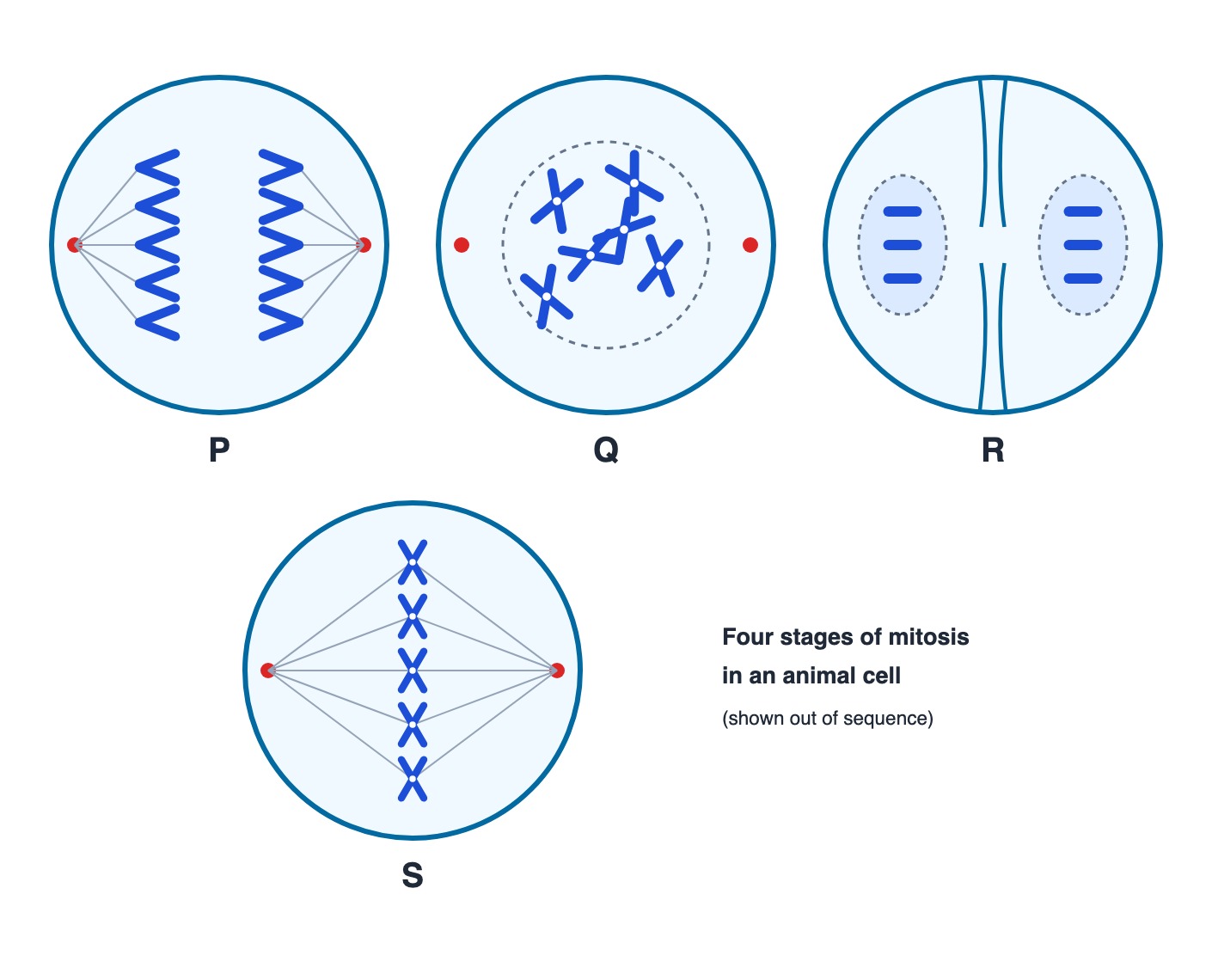
(a) Prophase
(b) Metaphase
(c) Anaphase
(d) Telophase
Show answer
Answer: (b) — In S the chromosomes are lined up on the equatorial (metaphase) plate with spindle fibres attached to their centromeres from both poles.
Q22. Splitting of the centromeres and movement of sister chromatids to opposite poles is shown in
(a) R
(b) S
(c) Q
(d) P
Show answer
Answer: (d) — P shows anaphase: the centromeres have split and the daughter chromosomes, led by their centromeres, are pulled towards the two poles.
Q23. The correct sequence of the stages shown, from earliest to latest, is
(a) P → Q → R → S
(b) Q → P → S → R
(c) S → Q → P → R
(d) Q → S → P → R
Show answer
Answer: (d) — Q is prophase (condensing chromosomes, nuclear envelope breaking down), S is metaphase, P is anaphase and R is telophase (nuclei re-forming, cell dividing).
NEET Previous Year Questions (PYQs)
Real NEET previous-year questions on this chapter, with explanations in our own words.
Q24. The average duration of the cell cycle in a mammalian cell is about: (NEET PYQ)
(a) 90 minutes
(b) 7 days
(c) 24 hours
(d) 1 hour
Show answer
Answer: (c) — A typical mammalian (e.g. human) cell in culture divides roughly once every 24 hours.
Q25. Which enzyme mediates crossing over during pachytene? (NEET PYQ)
(a) DNA polymerase
(b) Recombinase
(c) Helicase
(d) Ligase
Show answer
Answer: (b) — Crossing over is an enzyme-mediated process carried out by recombinase.
Q26. Mitosis is called equational division because: (NEET PYQ)
(a) It reduces chromosome number by half
(b) It only occurs in haploid cells
(c) It involves two divisions
(d) The chromosome number of daughter and parent cells is the same
Show answer
Answer: (d) — Mitosis is 'equational' since parent and daughter cells retain the same chromosome number.
Q27. Meiosis is referred to as reduction division because: (NEET PYQ)
(a) It has no DNA replication
(b) It occurs only in plants
(c) It halves the chromosome number to produce haploid gametes
(d) It doubles the chromosome number
Show answer
Answer: (c) — Meiosis reduces the chromosome number by half, producing haploid gametes from diploid cells.
Q28. The stage between meiosis I and meiosis II, with no DNA replication, is called: (NEET PYQ)
(a) Prophase II
(b) Interkinesis
(c) Diakinesis
(d) G0 phase
Show answer
Answer: (b) — Interkinesis is the brief, DNA-replication-free gap between meiosis I and meiosis II.
Q29. Which of the following best describes onion root tip cells used to study mitosis? (NEET PYQ)
(a) Only used to study meiosis
(b) 16 chromosomes per cell
(c) 46 chromosomes per cell
(d) No chromosomes visible
Show answer
Answer: (b) — Onion root tip cells, a classic mitosis study material, have 16 chromosomes per cell.
Q30. The centriole duplicates during which phase of the cell cycle in animal cells? (NEET PYQ)
(a) G2 phase
(b) S phase
(c) M phase
(d) G1 phase
Show answer
Answer: (b) — In animal cells, centriole duplication occurs during the S phase, alongside DNA replication.
Active Recall Prompt
Write everything you can recall about Cell Cycle and Cell Division, naming each part first: the cell cycle (duration, interphase vs M phase, G0); interphase (G1, S, G2 — what happens in each); mitosis (the four stages of karyokinesis in order, then cytokinesis in animal vs plant cells); the significance of mitosis; meiosis (why it happens, two divisions one replication); meiosis I (the five sub-stages of prophase I, then metaphase/anaphase/telophase I); meiosis II; and the significance of meiosis. Begin each fact with its topic and end it with a full stop.