Check Your Own Mains Answers: A Ten-point Rubric, the Common Mistakes, and a Twelve-week Practice Plan
A Self-check Rubric
🎯 Exam priority: High-yield. Writing without checking repeats the same mistakes. Mark every practice answer with this rubric, honestly, in two minutes.
A ten-point self-check rubric
UPSC does not publish its marking scheme. This rubric is ours. It is built from what the notification asks for (relevant, meaningful and succinct answers that analyse and take a view, testing understanding rather than merely the range of information and memory) and from the paper's rules (every question compulsory, 150 or 250 words).
Criterion | Question to ask yourself | Points (of 10) |
1. Every demand answered | Did I answer each directive and sub-question, in order? | 3 |
2. Relevance | Is every line about this question, not the topic in general? | 1 |
3. Depth and evidence | At least two pieces of evidence (Article, data, report, judgment, example) attached to points? | 2 |
4. Analysis and view | Where asked, did I weigh both sides and take a clear view? | 2 |
5. Structure and presentation | Clear introduction, headings, conclusion; a diagram where it saves words? | 1 |
6. Word limit and time | Within about 10% of the limit and within the time I allowed? | 1 |
For a 15-mark answer, multiply your score by 1.5. Do not read the score as a prediction of UPSC marks. Use it to see which criterion keeps losing points, and fix that one first.
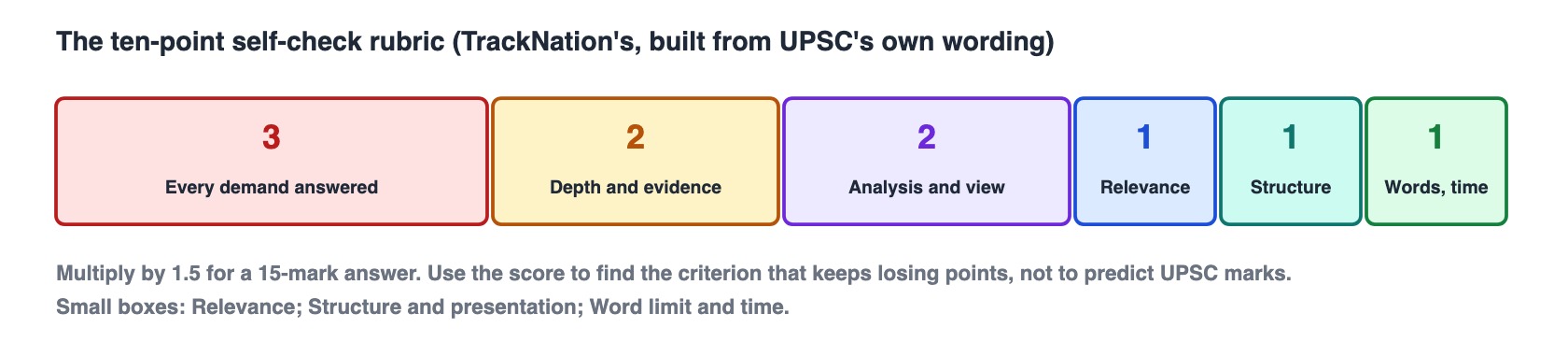
The rubric at a glance: missed demands cost the most.
How to use the rubric
Write the answer in the time limit, by hand.
Wait at least an hour, then mark it against the six criteria.
Compare with the model answers in articles 04-07 and with the subject article the question comes from.
Rewrite only the weakest part (often the demands or the evidence), not the whole answer.
Log the score and the weakest criterion in a notebook. After ten answers, look for the pattern.
Mistakes the Rubric Catches, and Peer Review
The mistakes the rubric catches most often
Mistake | Criterion | Fix |
Answered two of three demands | 1 | Number the demands before writing (article 01) |
Background takes half the answer | 2 | Keep the introduction to two or three lines (article 02) |
No figure, report or judgment | 3 | Add one piece of evidence per heading (article 03) |
'Comment' answered without a view | 4 | Write the verdict first in your plan, then argue it |
Wall of text | 5 | Headings per demand and a line gap between parts |
Ran over time on early questions | 6 | 7 and 11 minutes per answer, with a watch on the desk |
Peer and mentor review
Swap answers with a study partner and mark each other's with the same rubric. A reader who does not know what you meant to say finds gaps faster.
Ask the reviewer one question only: "Which demand did I answer worst?"
Review against the source, not against coaching notes. If a fact is in doubt, check it in the NCERT, the Act or the official release.
A Practice Routine and a Twelve-week Plan
A practice routine
When | What | Time |
Every day | Two answers from the subject you studied that day (one 10-marker, one 15-marker), from the real questions at the end of each article | 20 minutes plus 5 to mark |
Every week | Plan-only drill: ten questions, demands and word budget only | 20 minutes |
Every week | One full GS paper from a past year (2021-2026), in three hours, all twenty questions | 3 hours |
Every month | Re-mark four old answers; check that your weakest criterion is improving | 30 minutes |
A twelve-week plan before Mains
Weeks 1-4: daily answers by subject; one paper a week in the order GS II, GS III, GS I, GS IV.
Weeks 5-8: two full papers a week; build your value-addition notebook from the For your Mains answer sections.
Weeks 9-12: full papers under exam conditions, including the Essay; fix only the weakest criterion each week.
Where to find questions
Every TrackNation subject article lists the real Mains questions on its topic, with the year. The model-answer articles (04-07) and the Ethics and Essay playlists add more. Practise on real questions first: they show what UPSC asks and how.
Further Reading
PIB press releases, ministry websites and annual reports, the Gazette of India, MEA and UN documents and the official sources named in each note — the primary sources behind every fact above.
Test Yourself: Practice Questions
12 questions on checking and practising Mains answers.
Practice Questions
Q1. Does UPSC publish its Mains marking scheme?
(a) No
(b) Yes, in the notification
(c) Only for GS IV
(d) Yes, on each paper
Show answer
Answer: (a) — The rubric here is TrackNation's own, built from the notification's wording.
Q2. In the rubric, which criterion carries the most points?
(a) Relevance
(b) Presentation
(c) Every demand answered
(d) Word limit
Show answer
Answer: (c) — 3 of 10 points: missed demands cost the most.
Q3. The notification asks for answers that are
(a) long and detailed
(b) full of quotations
(c) written in bullet points only
(d) relevant, meaningful and succinct
Show answer
Answer: (d) — The rubric's criteria follow these words.
Q4. When should you mark your own answer?
(a) While writing
(b) A year later
(c) Never
(d) At least an hour after writing it
Show answer
Answer: (d) — A gap makes you read it as an examiner would.
Q5. After marking, what should you rewrite?
(a) Nothing
(b) Only the weakest part
(c) The whole answer
(d) Only the conclusion
Show answer
Answer: (b) — Targeted rewriting builds the missing skill.
Q6. A 'comment' answer without a view loses points mainly on
(a) word limit
(b) relevance
(c) presentation
(d) analysis and view
Show answer
Answer: (d) — Criterion 4.
Q7. How many answers does the daily routine suggest?
(a) None
(b) One full paper
(c) Two: one 10-marker and one 15-marker
(d) Ten
Show answer
Answer: (c) — About 20 minutes of writing.
Q8. Consider the following statements:
1. The rubric score predicts UPSC marks exactly.
2. The rubric helps find the criterion that keeps losing points.
3. Peer review with the same rubric helps find gaps.
Which of the statements given above are correct?
(a) 1 and 2 only
(b) 2 and 3 only
(c) 1 and 3 only
(d) 1, 2 and 3
Show answer
Answer: (b) — 2 and 3 are correct. The score is a diagnostic, not a prediction.
Q9. In weeks 9-12 of the plan, the focus is on
(a) only Prelims
(b) only the Essay
(c) full papers under exam conditions
(d) reading new books
Show answer
Answer: (c) — And fixing one weak criterion a week.
Q10. If a fact in your answer is in doubt, check it against
(a) a social media post
(b) a friend's notes
(c) the NCERT, the Act or the official release
(d) memory
Show answer
Answer: (c) — Primary sources first.
Q11. Within what margin of the word limit does the rubric give its word-limit point?
(a) Exactly the limit
(b) About 10%
(c) Any length
(d) 50%
Show answer
Answer: (b) — Close to the limit, and within time.
Q12. Where are the real Mains questions for daily practice on TrackNation?
(a) Nowhere
(b) In the Prelims plan only
(c) Only in the orientation
(d) At the end of each subject article
Show answer
Answer: (d) — Each comes with its year.
Mains Practice Questions
Use these to frame full-length answers. You don't have to answer one exactly — they show the angles UPSC tests, so let them guide which points you cover.
Mark one of your recent answers with the rubric. Which criterion lost the most?
Plan your next four weeks using the routine above.
What would you change in the rubric for GS IV case studies?