Globalisation for UPSC GS1: The Making of a Global World, Bretton Woods and Its End, MNCs, Consequences, India in 1991 and Resistance
The Global Economy from Silk Routes to Bretton Woods
🎯 Exam priority: Foundational (Mains GS1). Globalisation closes the world-history story and opens GS1's "effects of globalisation on Indian society" (Indian Society playlist) and GS3 economics. Know how the global economy was rebuilt after 1945, why the Bretton Woods order ended, and the debate over globalisation's effects.
A long history of a global world
Globalisation is not new: NCERT stresses the long history of trade, migration, people in search of work and the movement of capital. The silk routes carried Chinese silk west and linked distant cultures; the 19th century added steamships, railways, the telegraph and mass migration (articles 04-05). What is new since the 1990s is the speed and scale of the flows.
The postwar economic order (1945-1970s)
Lessons of the interwar years: mass production needs mass consumption, hence high, stable incomes and employment; and economic links with the outside world must be managed.
Bretton Woods (1944): the IMF and the World Bank, fixed exchange rates linked to the US dollar and gold. The result was an era of stable and rapid growth in the West.
The developing world did not share equally in this growth, and formed the G-77 to demand a New International Economic Order (article 11).
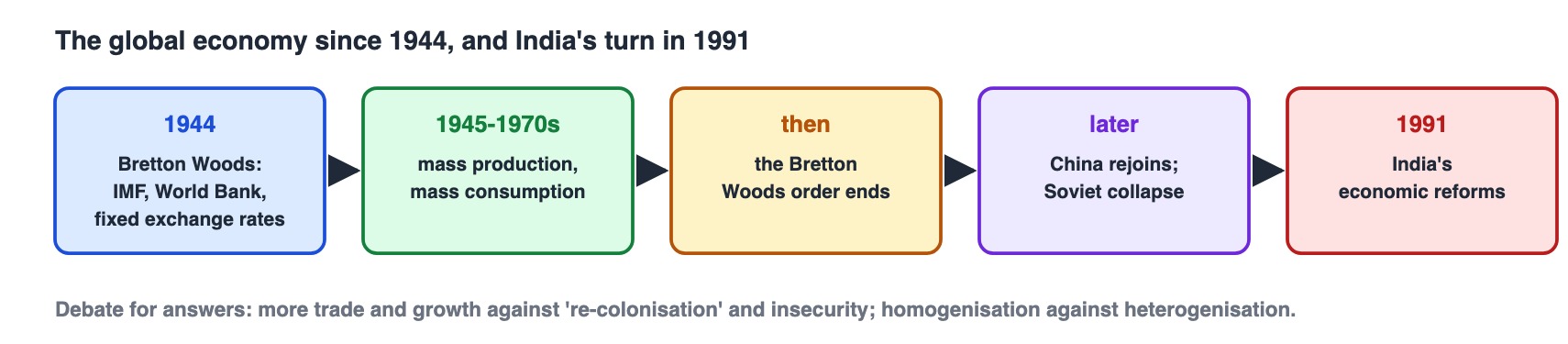
The global economy since Bretton Woods, and India's 1991 turn.
The end of Bretton Woods and the beginning of globalisation
From the 1960s the costs of overseas involvements weakened US finances; the dollar could not hold its value in gold, and fixed exchange rates gave way to floating rates.
From the mid-1970s developing countries had to borrow from Western commercial banks, leading to debt crises, especially in Africa and Latin America; unemployment rose in the industrial world.
From the late 1970s multinational corporations (first set up in the 1920s) shifted production to low-wage Asian countries; China, cut off since its 1949 revolution, rejoined the world economy, and the Soviet collapse brought more countries in. India, China and Brazil transformed rapidly.
What Globalisation Is and Its Consequences
What globalisation is
NCERT defines globalisation through flows: of ideas, capital, commodities and people moving across borders in search of better livelihoods. Technology is a critical cause (the telegraph, the telephone and now the microchip and the internet), but globalisation has political, economic and cultural dimensions, not just economic ones.
Dimension | Consequences |
Political | Concern about the erosion of state capacity: the old welfare state giving way to a minimalist state focused on law, order and security; others argue the state remains central and technology strengthens it |
Economic | More trade, investment and growth, and cheaper goods; but critics call it a 're-colonisation' of the world, with gains concentrated among the few and insecurity for many, hence calls for a social 'safety net' |
Cultural | Fear of 'McDonaldisation', cultural homogenisation under a dominant (American) culture; but also heterogenisation: cultures borrow and create new hybrids |
India, Resistance and Writing the Answer
India and globalisation
After independence India chose self-reliance and protection, having experienced colonial dependence. In 1991, responding to a financial crisis and wanting faster growth, India launched economic reforms that opened it to the world.
Globalisation is a two-way process: India is shaped by it and also affects it, through its workers, firms and culture moving outward.
Resistance to globalisation
Resistance takes the form of protests, trade union and farmer movements in India, and global platforms such as the World Social Forum, a wide coalition of human rights activists, environmentalists, labour, youth and women activists opposed to neo-liberal globalisation.
Writing about globalisation
Use the three dimensions (political, economic, cultural), give both the gains and the costs, and add the historical perspective of this playlist: globalisation repeats patterns of earlier eras (the export economies and migrations of the colonial world, the Depression's contagion) under new technology. The answer is managed globalisation: open but regulated, with safety nets and attention to those left behind.
Further Reading
PIB press releases, ministry websites and annual reports, the Gazette of India, MEA and UN documents and the official sources named in each note — the primary sources behind every fact above.
Test Yourself: Practice Questions & PYQs
12 practice questions on globalisation.
Practice Questions
Q1. According to NCERT, globalisation fundamentally deals with
(a) only trade in goods
(b) only migration
(c) flows of ideas, capital, commodities and people
(d) military alliances
Show answer
Answer: (c) — Technology is a critical but not the only cause.
Q2. The silk routes are an example of
(a) the Marshall Plan
(b) pre-modern trade and cultural links
(c) colonial railways
(d) Bretton Woods institutions
Show answer
Answer: (b) — They carried Chinese silk west.
Q3. A lesson economists drew from the interwar years was that
(a) mass production needs mass consumption
(b) states should not intervene
(c) gold should be abolished
(d) trade should be banned
Show answer
Answer: (a) — Hence the need for stable incomes and employment.
Q4. The Bretton Woods system collapsed into
(a) the gold standard
(b) floating exchange rates
(c) a single world currency
(d) fixed exchange rates
Show answer
Answer: (b) — The dollar could not maintain its value in gold.
Q5. From the mid-1970s, developing countries borrowing from Western commercial banks faced
(a) fixed exchange rates
(b) Marshall Plan aid
(c) rapid debt-free growth
(d) periodic debt crises
Show answer
Answer: (d) — Especially in Africa and Latin America.
Q6. When were the first multinational corporations established, according to NCERT?
(a) The 1990s
(b) The 1970s
(c) The 1920s
(d) The 1850s
Show answer
Answer: (c) — Many more came up in the 1950s and 1960s.
Q7. From the late 1970s, MNCs shifted production to
(a) Africa only
(b) Latin America only
(c) low-wage Asian countries
(d) Western Europe
Show answer
Answer: (c) — China rejoined the world economy.
Q8. Consider the following statements:
1. 'McDonaldisation' refers to fears of cultural homogenisation.
2. Cultural heterogenisation means cultures mix to create new forms.
3. NCERT says globalisation is purely economic.
Which of the statements given above are correct?
(a) 1 and 2 only
(b) 2 and 3 only
(c) 1 and 3 only
(d) 1, 2 and 3
Show answer
Answer: (a) — 1 and 2 are correct. NCERT stresses political, economic and cultural dimensions.
Q9. Some economists have described economic globalisation as
(a) re-colonisation of the world
(b) a safety net
(c) non-alignment
(d) the end of history
Show answer
Answer: (a) — Advocates argue it generates growth and well-being.
Q10. India launched economic reforms in 1991 in response to
(a) the end of the Cold War only
(b) a financial crisis and the desire for faster growth
(c) a famine
(d) a war
Show answer
Answer: (b) — This opened India to the global economy.
Q11. The World Social Forum is
(a) a UN agency
(b) a global platform of groups opposing neo-liberal globalisation
(c) a trade agreement
(d) a World Bank body
Show answer
Answer: (b) — It brings together activists, environmentalists, labour, youth and women.
Q12. Which inventions does NCERT cite as technological drivers of globalisation?
(a) The steam engine only
(b) The printing press only
(c) The telegraph, the telephone and the microchip
(d) The wheel
Show answer
Answer: (c) — Technology is critical, but globalisation is multidimensional.
Mains Practice Questions
Use these to frame full-length answers. You don't have to answer one exactly — they show the angles UPSC tests, so let them guide which points you cover.
Globalisation has a long history. Discuss with examples.
Why did the Bretton Woods system end, and what followed?
Does globalisation lead to cultural homogenisation?
UPSC Mains — Previous Years’ Questions on this topic (last 10 years)
These are the actual GS Mains questions UPSC has asked on this theme — real proof of how, and when, it is tested. Try to write a full answer to each.
World-history questions in GS1 have not asked about globalisation directly in 2019 or 2021-2026; its effects on Indian society are covered in the Indian Society playlist (article 11).