How to Write the UPSC Essay: A Six-Step Method for Decoding, Brainstorming, Outlining, Writing and Timing
Decode and Brainstorm
🎯 Exam priority: High-yield (Essay). The syllabus asks for three things: keep closely to the subject, arrange ideas in orderly fashion, and write concisely. This article turns them into a six-step method you can practise until it is automatic.
Step 1: Decode the topic (3-5 minutes)
Underline the key words and ask what each means, literally and figuratively. In "The time to repair the roof is when the sun is shining" (2022), the roof is any institution or system, the sun is a period of stability, and the claim is about prudence and preparedness.
State the thesis in one sentence in your own words: "Reforms are best made in good times, before crisis forces them."
Find the tension or the "but": every good topic has a counter-view (reform in good times is politically hard; complacency sets in when things go well). Your essay will be judged on how well you handle it.
Fix the scope: keep closely to the subject. A topic on the cost of inaction (2024) is not an essay on all of Indian governance.
Step 2: Brainstorm dimensions (8-10 minutes)
Run the thesis through a grid and jot two or three points or examples in each box that fits:
Dimension | Questions to ask |
Personal and psychological | What does this mean for an individual's life, choices and character? |
Social and cultural | Family, gender, caste, community, education, media |
Political and governance | State, democracy, institutions, rights, policy, administration |
Economic | Growth, jobs, markets, inequality, public finance |
Environmental | Nature, climate, sustainability, future generations |
Science and technology | Innovation, AI, digital life, research |
Ethical and philosophical | Values, thinkers, means and ends |
Historical | What does history (Indian and world) show? |
International | Relations between nations, global issues |
Not every dimension fits every topic; five or six strong ones are enough.
Outline and Write
Step 3: Outline (5 minutes)
Turn the brainstorm into an order, from the simplest and most personal to the widest, or from the problem to the solution. A typical 1,000-1,200 word essay has 9-12 paragraphs:
Part | Paragraphs | What it does |
Introduction | 1-2 | Hook (an anecdote, a story, a striking fact or a question), then the thesis in plain words |
Explanation | 1 | What the topic means; key terms |
Body: dimensions | 5-7 | One idea per paragraph, each with an example, ideally Indian |
Counter-view | 1-2 | The strongest objection, answered fairly |
Way forward | 1 | What follows for individuals, society or the state |
Conclusion | 1 | Return to the hook or thesis; end on a forward-looking line |
Step 4: Write (60-70 minutes)
One paragraph, one idea. Open with a topic sentence, develop it, give an example, and link it back to the thesis.
Transitions carry the argument: "Yet", "This is visible not only in families but also in the state", "History offers a warning".
Examples beat adjectives. A scheme, a judgment, a historical episode or a personal observation proves more than "very important".
Balance: acknowledge complexity; avoid sweeping claims about entire groups.
Plain, exact language: credit is given for effective and exact expression, not for ornament. Short sentences are safer under time pressure.
Prose, not bullet points. An essay is continuous argument; a few sub-headings are acceptable but not lists.
Revise, Time and Avoid Mistakes
Step 5: Revise (5 minutes)
Check the thesis appears in the introduction and conclusion, each paragraph links to it, and the word count is close to 1,000-1,200 (count lines on a page once in practice to estimate). Fix obvious spelling and grammar.
Step 6: Manage the three hours
Time
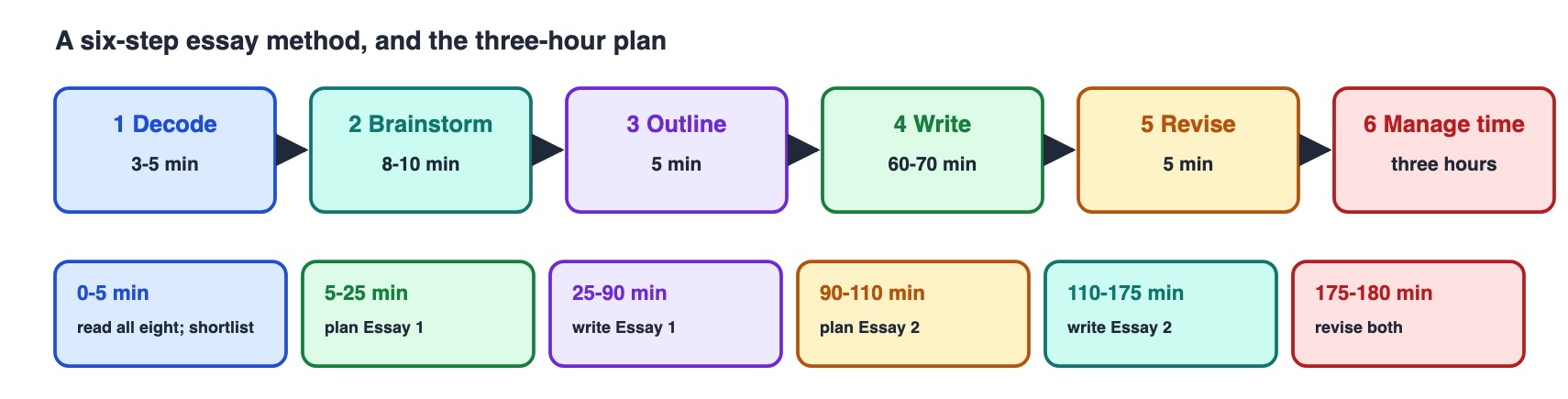
Six steps and a minute-by-minute plan for the three hours. | Task |
0-5 min | Read all eight topics; shortlist two in each section |
5-25 min | Decode, brainstorm and outline Essay 1 |
25-90 min | Write Essay 1 |
90-110 min | Decode, brainstorm and outline Essay 2 |
110-175 min | Write Essay 2 |
175-180 min | Revise both |
Common mistakes
Writing a GS answer (facts in lists) instead of an essay (an argument with a thread).
Drifting off topic; quotations and data that do not serve the thesis.
One-sided essays with no counter-view; or the opposite, so many views that no position emerges.
Spending too long on the first essay and rushing the second.
Build your material
Keep a notebook of examples by dimension: thinkers and values (Ethics playlist), history (Modern, World and Post-independence playlists), society (Indian Society playlist), schemes and economy, environment and science. Each example should be usable in many essays.
Further Reading
PIB press releases, ministry websites and annual reports, the Gazette of India, MEA and UN documents and the official sources named in each note — the primary sources behind every fact above.
Test Yourself: Practice Questions & PYQs
12 questions on essay method.
Practice Questions
Q1. The first step in writing a UPSC essay should be to
(a) write the conclusion
(b) list quotations
(c) decode the topic and state the thesis in one sentence
(d) count words
Show answer
Answer: (c) — Underline key words; find the literal and figurative meanings.
Q2. Why should every essay include a counter-view?
(a) To increase length
(b) To confuse the examiner
(c) Good topics contain a tension that the essay must handle
(d) Because the rules require it
Show answer
Answer: (c) — Answer the strongest objection fairly.
Q3. A dimension grid helps to
(a) choose quotations
(b) generate varied points across personal, social, political, economic and other angles
(c) decide handwriting
(d) avoid examples
Show answer
Answer: (b) — Five or six strong dimensions are enough.
Q4. A 1,000-1,200 word essay typically has about
(a) 25 paragraphs
(b) 3 paragraphs
(c) 9-12 paragraphs
(d) one paragraph
Show answer
Answer: (c) — One idea per paragraph.
Q5. The syllabus says candidates should
(a) quote many authors
(b) use technical jargon
(c) write as much as possible
(d) keep closely to the subject, arrange ideas in order and write concisely
Show answer
Answer: (d) — Credit goes to effective and exact expression.
Q6. Examples in an essay are most effective when they are
(a) only foreign
(b) long lists of data
(c) concrete and linked to the thesis
(d) unrelated anecdotes
Show answer
Answer: (c) — Indian examples are especially useful.
Q7. Consider the following statements:
1. An essay should be written in continuous prose.
2. A few sub-headings are acceptable.
3. Bullet-point lists are the best format for essays.
Which of the statements given above are correct?
(a) 1 and 2 only
(b) 2 and 3 only
(c) 1 and 3 only
(d) 1, 2 and 3
Show answer
Answer: (a) — 1 and 2 are correct. Lists suit GS answers, not essays.
Q8. In 'The time to repair the roof is when the sun is shining', the 'sun' best represents
(a) the government
(b) nature
(c) wealth
(d) a period of stability
Show answer
Answer: (d) — The thesis is about prudence and timely reform.
Q9. A good time plan gives each essay roughly
(a) two hours
(b) 15 minutes
(c) 30 minutes
(d) 90 minutes including planning
Show answer
Answer: (d) — Planning about 15-20 minutes, writing 60-70.
Q10. A common mistake is
(a) writing a GS-style list of facts instead of an argument
(b) revising
(c) having a thesis
(d) using transitions
Show answer
Answer: (a) — An essay needs a thread.
Q11. The conclusion should
(a) introduce a new topic
(b) return to the thesis and end on a forward-looking line
(c) list quotations
(d) repeat the introduction word for word
Show answer
Answer: (b) — It closes the loop opened in the introduction.
Q12. A useful way to build essay material is to
(a) memorise one essay
(b) read only novels
(c) learn only quotations
(d) keep examples organised by dimension from all GS subjects
Show answer
Answer: (d) — Each example should serve many essays.
Mains Practice Questions
Use these to frame full-length answers. You don't have to answer one exactly — they show the angles UPSC tests, so let them guide which points you cover.
Decode 'The cost of being wrong is less than the cost of doing nothing' and state its thesis and counter-view.
Brainstorm six dimensions for 'A grateful mind is very beautiful'.
Write an introduction with a hook for 'Nature is the symbol of the spirit'.
UPSC Mains — Previous Years’ Questions on this topic (last 10 years)
These are the actual GS Mains questions UPSC has asked on this theme — real proof of how, and when, it is tested. Try to write a full answer to each.
Practise the method on any topic from the table in article 00, starting with 2024-2026.