Sexual Reproduction in Flowering Plants (NEET Biology Class 12): Embryo Sac & Double Fertilisation
The Anther, Microsporogenesis & Pollen Grain
🎯 NEET priority: High-yield. 4–6 questions every year. The embryo sac (7-celled, 8-nucleate) and double fertilisation are asked almost every year — learn the numbers exactly.
A flower is built for one job: sexual reproduction. This chapter follows pollen and ovule from formation to the finished seed.
The anther & pollen grain
A typical anther is bilobed and tetragonal (4-sided), with 4 microsporangia (2 per lobe).
A microsporangium wall has 4 layers: epidermis, endothecium, middle layers and the innermost tapetum — the tapetum nourishes developing pollen.
Each microspore mother cell (MMC) undergoes meiosis to form a microspore tetrad; the pollen wall's hard outer layer, the exine, is made of sporopollenin — one of the most resistant organic materials known, undegraded by any known enzyme.
Pollen is shed either at the 2-celled stage (vegetative + generative cell) or, after the generative cell divides mitotically, at the 3-celled stage (vegetative cell + 2 male gametes).
The Ovule & the Mature Embryo Sac (7-celled, 8-nucleate)
The ovule (megasporangium)
Attached to the placenta by a funicle; their junction is the hilum. Integuments encircle the nucellus except at the micropyle (opening); the base opposite the micropyle is the chalaza.
Inside the nucellus, a megaspore mother cell (MMC) undergoes meiosis to give 4 megaspores — usually only one survives and forms the embryo sac (monosporic development).
The mature embryo sac — the most-asked number in this chapter
Two sequential mitotic divisions of the functional megaspore give a mature embryo sac that is 8-nucleate but only 7-celled:
Micropylar end: the egg apparatus — 1 egg cell + 2 synergids (with a filiform apparatus that guides the pollen tube in).
Chalazal end: 3 antipodal cells.
Centre: one large central cell with 2 polar nuclei (2 nuclei in 1 cell — hence 8 nuclei in 7 cells).
Pollination Types & Pollen-Pistil Interaction
Types of pollination
Type | Meaning | Note |
Autogamy | Self-pollination within the same flower | True self-pollination |
Geitonogamy | Pollen from one flower to another on the SAME plant | Genetically self, functionally cross |
Xenogamy | Pollen from a flower on a DIFFERENT plant | True cross-pollination |
Cleistogamous flowers (e.g. some Viola, Oxalis, Commelina) never open — guaranteeing autogamy. Out-breeding devices that prevent self-pollination / encourage cross-pollination: dichogamy (anther and stigma mature at different times), herkogamy (physical separation), unisexual flowers (monoecious, e.g. castor, maize — prevents autogamy but not geitonogamy; dioecious — prevents both), and self-incompatibility (a genetic block against self pollen germinating/growing). Continued self-pollination causes inbreeding depression.
Pollen–pistil interaction & pollen tube growth
The pistil recognises compatible pollen; the pollen grain germinates on the stigma to form a pollen tube that grows through the style, enters the ovule, and releases its two male gametes near/into a synergid (guided by the filiform apparatus).
Double Fertilisation & Post-Fertilisation Development
Double fertilisation — the defining angiosperm event
Syngamy: one male gamete (n) fuses with the egg cell (n) → diploid zygote (2n).
Triple fusion: the other male gamete (n) fuses with the 2 polar nuclei → triploid primary endosperm nucleus (3n).
Because two fusions occur, angiosperm fertilisation is termed double fertilisation — unique to flowering plants.
Endosperm & embryo development
The primary endosperm cell divides repeatedly. In nuclear (free-nuclear) type, divisions occur without wall formation (e.g. coconut water = liquid endosperm). In cellular type, wall formation follows each division.
Embryo passes through proembryo → globular → heart-shaped → mature stages. A mature dicot embryo has 2 cotyledons, an epicotyl (→ plumule) and a hypocotyl (→ radicle). A monocot embryo has 1 cotyledon (scutellum), with the plumule covered by the coleoptile and the radicle by the coleorrhiza.
Seed, Fruit, Apomixis & Polyembryony
Seed & fruit
Seeds are albuminous (retain some endosperm — wheat, maize, castor) or non-albuminous / ex-albuminous (endosperm fully used up — pea, groundnut, beans).
The ovary wall becomes the pericarp. A true fruit develops only from the ovary; a false fruit also involves other floral parts (e.g. the thalamus in apple, strawberry, cashew).
Parthenocarpy = fruit development without fertilisation, usually seedless (e.g. banana).
Apomixis & polyembryony
Apomixis = seed production without fertilisation — a form of asexual reproduction dressed as sexual.
Polyembryony = more than one embryo in a single seed (e.g. Citrus, where extra embryos arise from nucellar cells).
Both are commercially important — apomictic hybrids don't segregate, so a farmer can reuse hybrid seed without buying fresh every year.
Pollination — the complete type table
Type | Definition | Key point / example |
Autogamy | Pollen transferred to the stigma of the SAME flower | Needs synchrony of anther dehiscence and stigma receptivity. CLEISTOGAMOUS flowers (e.g. Viola, Oxalis, Commelina) never open and are INVARIABLY autogamous — assured seed set but NO genetic variation |
Geitonogamy | Pollen from one flower to the stigma of ANOTHER flower on the SAME plant | Functionally cross-pollination (needs a pollinator) but GENETICALLY it is autogamy — pollen comes from the same plant |
Xenogamy | Pollen from a flower on a DIFFERENT plant | The ONLY type that brings genetically different pollen to the stigma — true cross-pollination |
Agent | Name | Flower characteristics |
Wind | Anemophily | Well-exposed stamens, large feathery stigma, light non-sticky pollen, often single-ovule flowers packed into an inflorescence. Common in grasses; maize corn-silk = the stigma+style |
Water | Hydrophily | RARE — only in some aquatic plants (Vallisneria, Hydrilla, Zostera). Pollen protected by a MUCILAGINOUS covering. Note: most aquatic plants like water hyacinth and water lily are actually INSECT- or wind-pollinated |
Insects/animals | Entomophily / zoophily | Large, colourful, fragrant, nectar-rich flowers. Pollinators include bees, butterflies, birds, bats. In small flowers, several group into an inflorescence to be visible |
Why this matters for NEET
The embryo sac composition (7 cells / 8 nuclei) and the double fertilisation products (zygote 2n, PEN 3n) are asked almost every year — memorise the exact numbers.
Traps: geitonogamy is genetically self but functionally cross-pollination; sporopollenin is indestructible (no known enzyme degrades it); monoecious ≠ prevents geitonogamy.
Test Yourself: MCQs, PYQs & Active Recall
Answer these, then close the article and do an Active Recall. Reveal each answer only after you commit to one.
Practice Questions
Q1. The hard, resistant outer layer of the pollen grain wall is called the:
(a) Intine
(b) Exine
(c) Nucellus
(d) Tapetum
Show answer
Answer: (b) — The exine is made of sporopollenin, one of the most resistant known organic materials — no enzyme degrades it.
Q2. A mature angiosperm embryo sac is:
(a) 8-celled and 8-nucleate
(b) 7-celled and 8-nucleate
(c) 4-celled and 8-nucleate
(d) 7-celled and 7-nucleate
Show answer
Answer: (b) — The central cell has 2 polar nuclei in one cell, making the embryo sac 8-nucleate but only 7-celled.
Q3. The egg apparatus of the embryo sac consists of:
(a) 1 egg cell only
(b) 1 egg cell and 2 synergids
(c) 3 antipodals
(d) 2 polar nuclei
Show answer
Answer: (b) — The egg apparatus (at the micropylar end) has one egg cell flanked by two synergids.
Q4. The filiform apparatus is found in the:
(a) Central cell
(b) Egg cell
(c) Antipodal cells
(d) Synergids
Show answer
Answer: (d) — Synergids have a filiform apparatus at their micropylar tip that guides the pollen tube's entry.
Q5. Transfer of pollen grains from the anther to the stigma of another flower on the SAME plant is:
(a) Autogamy
(b) Geitonogamy
(c) Cleistogamy
(d) Xenogamy
Show answer
Answer: (b) — Geitonogamy is genetically self-pollination but functionally cross-pollination (needs a pollinator).
Q6. In double fertilisation, triple fusion produces the:
(a) Zygote
(b) Suspensor
(c) Synergid
(d) Primary endosperm nucleus (PEN)
Show answer
Answer: (d) — A male gamete fuses with the two polar nuclei to form the triploid primary endosperm nucleus (triple fusion).
Q7. Coconut water is an example of which type of endosperm?
(a) Helobial
(b) Cellular
(c) Nuclear (free-nuclear)
(d) Non-albuminous
Show answer
Answer: (c) — Coconut water is liquid, free-nuclear endosperm — divisions occur without immediate wall formation.
Q8. A mature dicot embryo has:
(a) Two cotyledons, an epicotyl and a hypocotyl
(b) No cotyledons
(c) One cotyledon and a coleoptile
(d) A scutellum
Show answer
Answer: (a) — Dicot embryos have two cotyledons and an embryonal axis with epicotyl (→plumule) and hypocotyl (→radicle).
Q9. Fruits that develop without fertilisation are called:
(a) Aggregate fruits
(b) False fruits
(c) True fruits
(d) Parthenocarpic fruits
Show answer
Answer: (d) — Parthenocarpy is fruit development without fertilisation, usually giving seedless fruit — e.g. banana.
Q10. Polyembryony, seen in Citrus, means:
(a) Multiple endosperms
(b) Multiple pollen tubes in one ovule
(c) Fusion of two zygotes
(d) More than one embryo in a single seed
Show answer
Answer: (d) — Polyembryony is the occurrence of more than one embryo in a single seed, often from nucellar tissue in Citrus.
Q11. The number of microsporangia in a typical angiosperm anther is:
(a) Six
(b) Two
(c) Four
(d) Eight
Show answer
Answer: (c) — A bilobed, tetragonal anther has 4 microsporangia, two in each lobe.
Q12. The tapetum layer of the anther wall functions to:
(a) Nourish the developing pollen grains
(b) Protect the anther
(c) Release pollen
(d) Form the exine
Show answer
Answer: (a) — The innermost anther wall layer, the tapetum, has dense cytoplasm and nourishes developing pollen grains.
Q13. In the embryo sac shown, the primary endosperm nucleus (PEN) is formed by the fusion of a male gamete with the structure marked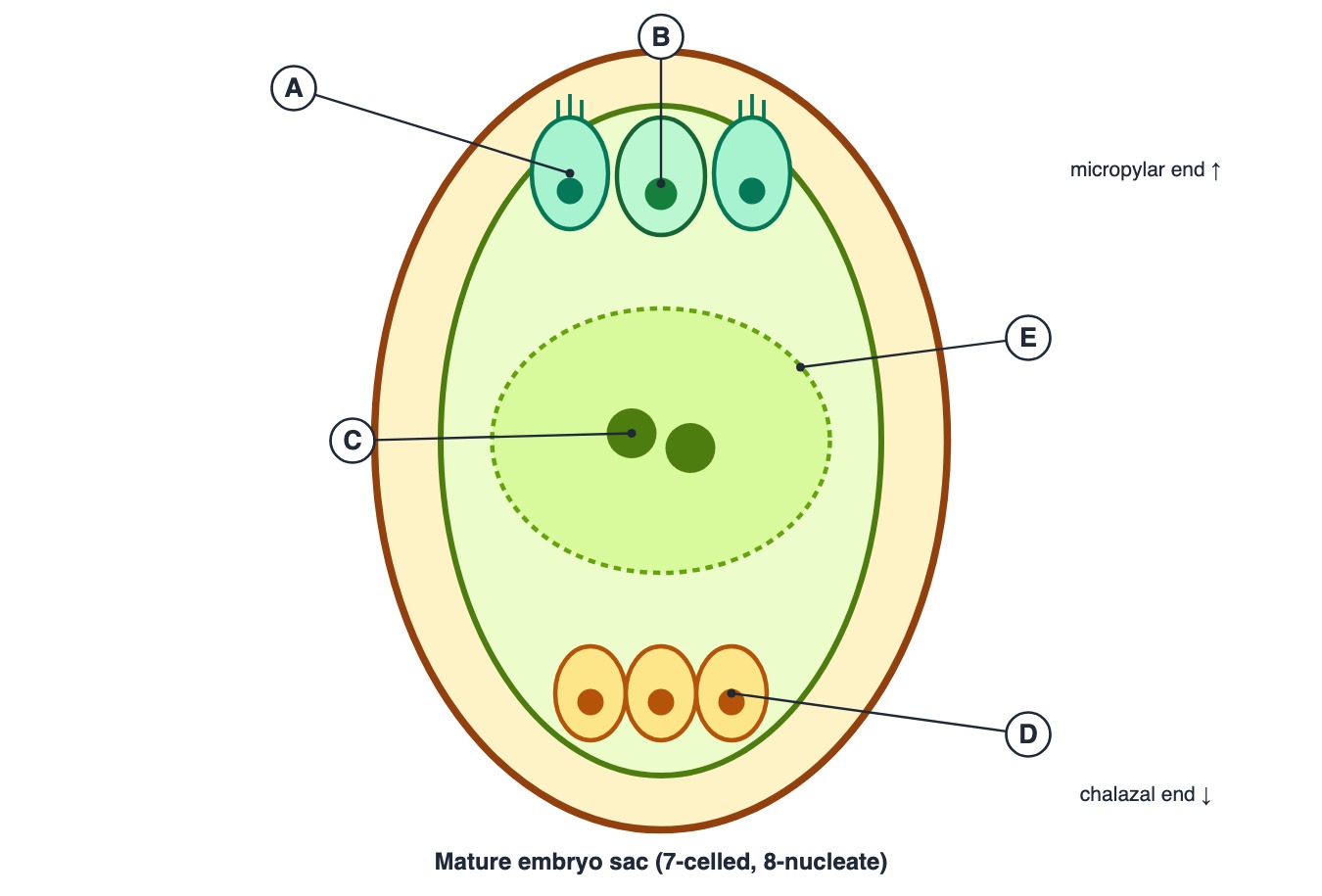
(a) B
(b) A
(c) C
(d) D
Show answer
Answer: (c) — C marks the two polar nuclei of the central cell. In double fertilisation one male gamete fuses with the egg [B] to form the zygote and the other fuses with the two polar nuclei (triple fusion) to form the triploid PEN.
Q14. The cells marked A, which have a filiform apparatus and guide the pollen tube into the embryo sac, are the
(a) egg cells
(b) synergids
(c) antipodals
(d) polar nuclei
Show answer
Answer: (b) — The two synergids and the egg form the egg apparatus at the micropylar end. The filiform apparatus of the synergids guides the entry of the pollen tube.
Q15. The three cells at the chalazal end, marked D, are called
(a) megaspores
(b) antipodals
(c) synergids
(d) egg apparatus
Show answer
Answer: (b) — The three cells at the chalazal end are antipodals. With the 3 cells of the egg apparatus (egg + 2 synergids) and the central cell, they make the 7 cells of the mature embryo sac, which has 8 nuclei.
NEET Previous Year Questions (PYQs)
Real NEET previous-year questions on this chapter, with explanations in our own words.
Q16. The chalazal end of the embryo sac has: (NEET PYQ)
(a) Egg apparatus
(b) Synergids
(c) Two polar nuclei
(d) Three antipodal cells
Show answer
Answer: (d) — Three antipodal cells sit at the chalazal end; the egg apparatus and synergids are at the micropylar end.
Q17. Zygote formed after syngamy is: (NEET PYQ)
(a) Haploid
(b) Tetraploid
(c) Diploid
(d) Triploid
Show answer
Answer: (c) — Syngamy fuses two haploid (n) gametes to form a diploid (2n) zygote.
Q18. Which of the following shows apomixis? (NEET PYQ)
(a) Pea
(b) Wheat only
(c) Some Citrus and grasses
(d) Maize only
Show answer
Answer: (c) — Apomixis (seed formation without fertilisation) occurs in some Citrus, grasses (Asteraceae/Poaceae), and is important for hybrid seed technology.
Q19. Sporopollenin, found in the pollen exine, is resistant to: (NEET PYQ)
(a) UV light only
(b) Only physical damage
(c) Acids, alkalis and enzymatic degradation
(d) High temperature only
Show answer
Answer: (c) — Sporopollenin withstands high temperature, strong acids and alkalis, and no enzyme is known to degrade it.
Q20. Self-incompatibility is a mechanism that prevents: (NEET PYQ)
(a) Cross-pollination
(b) Self-pollination from producing seeds
(c) Pollen germination on any stigma
(d) Pollen formation
Show answer
Answer: (b) — Self-incompatibility is a genetic device that blocks self pollen from fertilising the same flower, even though it may germinate.
Q21. Non-albuminous seeds are seen in: (NEET PYQ)
(a) Pea and groundnut
(b) Wheat and maize
(c) Barley
(d) Castor
Show answer
Answer: (a) — Pea, groundnut and beans are non-albuminous (ex-albuminous) — the endosperm is fully consumed during embryo development.
Q22. In which type of pollination is the pollen transferred to a flower on a genetically different plant? (NEET PYQ)
(a) Cleistogamy
(b) Autogamy
(c) Geitonogamy
(d) Xenogamy
Show answer
Answer: (d) — Xenogamy transfers pollen to a flower on a different plant — true cross-pollination with new genetic combinations.
Q23. The megaspore mother cell undergoes meiosis to form: (NEET PYQ)
(a) Eight megaspores
(b) Two megaspores
(c) One megaspore
(d) Four megaspores
Show answer
Answer: (d) — The MMC undergoes meiosis to give four haploid megaspores; usually only one survives to form the embryo sac.
Active Recall Prompt
Write everything you can recall, naming each topic first. Cover: the anther and pollen grain (microsporangium layers, exine/sporopollenin, 2-celled/3-celled pollen); the ovule and mature embryo sac (7-celled, 8-nucleate — egg apparatus, antipodals, central cell); pollination types (autogamy, geitonogamy, xenogamy) and out-breeding devices; double fertilisation (syngamy, triple fusion, zygote, PEN); endosperm and embryo development; and seed, fruit and apomixis/polyembryony. Begin each fact with its topic and end it with a full stop.