Anticancer Drugs and Immunosuppressants for NEET PG Pharmacology: Methotrexate, Doxorubicin, Cisplatin, Imatinib, Tacrolimus
Start Here
🎯 Exam priority: High. Expect: the rescue for methotrexate, the bladder with cyclophosphamide, the heart with doxorubicin and trastuzumab, the kidneys and ears with cisplatin, the lungs with bleomycin, vincristine given intrathecally, and 6-MP with allopurinol.
CBME mapping: PH 8.10–8.11. Indian protocol: ICMR Breast Cancer workflow (July 2020).
Cytotoxic Drugs: Toxicity and Rescue
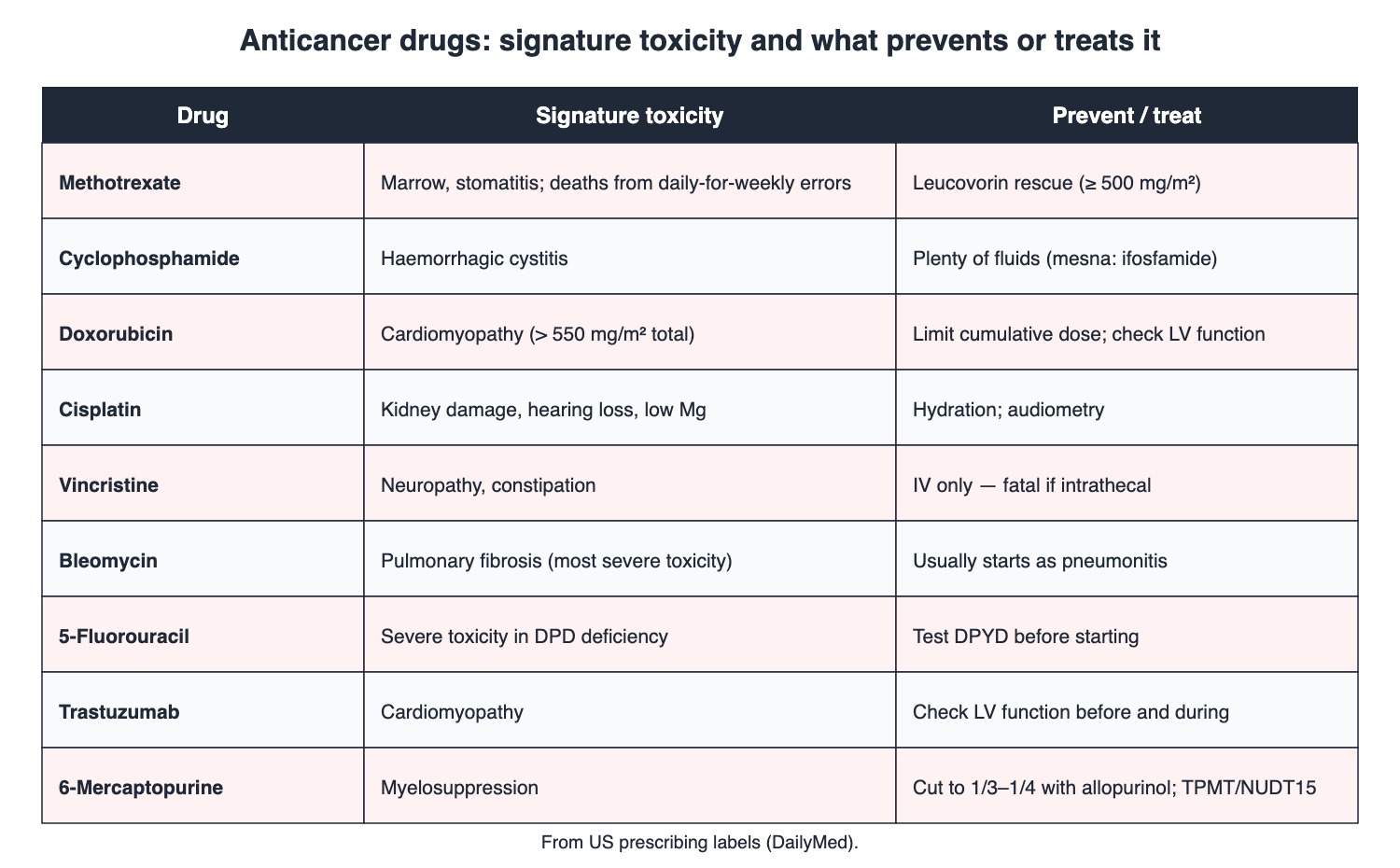
Anticancer drugs: signature toxicity and its prevention or rescue, from the drugs' labels. Drawn by TrackNation.
Methotrexate: embryo-fetal toxicity; stomatitis, GI toxicity, marrow suppression; deaths when taken daily instead of weekly (RA starts at 7.5 mg once weekly). Leucovorin (folinic acid) rescues at doses ≥ 500 mg/m².
Cyclophosphamide: haemorrhagic cystitis — drink plenty of fluids. Mesna is labelled for ifosfamide cystitis.
Doxorubicin: boxed cardiomyopathy (risk rises above 550 mg/m² cumulative), secondary malignancies, extravasation necrosis, marrow suppression.
Cisplatin: boxed nephrotoxicity, neuropathy, vomiting, marrow suppression; ototoxicity (worst in children); low magnesium — hydrate well.
Vincristine: IV only — fatal by other routes (intrathecal); neuritic pain, constipation.
Bleomycin: pulmonary fibrosis, usually starting as pneumonitis; idiosyncratic reaction in about 1% of lymphoma patients.
5-FU: test for DPYD variants — complete DPD deficiency can be fatal.
Targeted and Hormonal Therapy
Drug | Target / use | Key warning (label) |
Imatinib | BCR-ABL tyrosine kinase (Philadelphia chromosome, CML) | Severe fluid retention, hepatotoxicity |
Trastuzumab | HER2-positive breast cancer (ICMR: 12 months) | Boxed cardiomyopathy: check LV function before and during |
Rituximab | Anti-CD20 | Boxed: HBV reactivation, PML, severe mucocutaneous reactions |
Tamoxifen / aromatase inhibitors | ER/PR-positive breast cancer (ICMR: ≥ 5 years) | Premenopausal tamoxifen; postmenopausal tamoxifen or AI |
Immunosuppressants
Drug | Key warning (label) |
Tacrolimus | Boxed malignancy and infection; nephrotoxicity; new-onset diabetes after transplant |
Cyclosporine | Renal dysfunction, tremor, hirsutism, hypertension, gum hyperplasia |
Mycophenolate | Boxed: first-trimester miscarriage and malformations |
Azathioprine | Inactivated by TPMT; reduce with allopurinol; boxed malignancy |
6-Mercaptopurine | Cut to one-third to one-quarter with allopurinol; check TPMT/NUDT15 if marrow suppression |
Traps the Examiner Sets
Leucovorin rescues methotrexate; methotrexate for RA is weekly, never daily.
Mesna is for ifosfamide (and fluids for cyclophosphamide).
Doxorubicin and trastuzumab both hit the heart.
Vincristine intrathecally is fatal.
Allopurinol with 6-MP or azathioprine → cut the dose.
Memory Hooks & Shortcuts
Shortcuts to lock in this article's numbers and lists. Each one only re-packages facts proven above.
🧠 Leucovorin Lifts methotrexate's Lid — rescue
🧠 Cyclophosphamide Cries blood (bladder) — haemorrhagic cystitis
🧠 Dox Damages the heart past 550 — cumulative cardiomyopathy
🧠 Cisplatin: Kidneys, Ears, Nerves — nephro-, oto-, neurotoxicity
🧠 Vincristine: Veins only — fatal intrathecally
🧠 Bleomycin Bruises the lungs — pulmonary fibrosis
🧠 Allopurinol + purines: Pare down — reduce azathioprine/6-MP
Rapid-Revision Cards
Methotrexate rescue
Leucovorin at ≥ 500 mg/m².
Methotrexate errors
Weekly, not daily; deaths reported.
Cyclophosphamide
Haemorrhagic cystitis; fluids.
Mesna
Ifosfamide cystitis.
Doxorubicin
Cardiomyopathy > 550 mg/m²; extravasation; 2nd cancers.
Cisplatin
Kidney, ears, nerves, vomiting, low Mg; hydrate.
Vincristine
IV only; neuropathy, constipation.
Bleomycin
Pneumonitis → fibrosis.
5-FU
DPYD test; DPD deficiency fatal.
Imatinib
BCR-ABL; fluid retention.
Trastuzumab
HER2; cardiomyopathy; ICMR 12 months.
Rituximab
Anti-CD20; HBV reactivation, PML.
ICMR hormonal therapy
Premenopausal tamoxifen; post: tamoxifen or AI; ≥ 5 y.
Tacrolimus
Nephrotoxicity, NODAT; boxed infection/malignancy.
Cyclosporine
Kidney, tremor, hirsutism, BP, gum hyperplasia.
Mycophenolate
Miscarriage, malformations.
Azathioprine + allopurinol
Cut dose; TPMT.
6-MP + allopurinol
Reduce to 1/3–1/4; TPMT/NUDT15.
Sources
Facts in this article were checked against these documents.
Standard Treatment Workflow: Breast Cancer — Indian Council of Medical Research / Department of Health Research, MoHFW, July 2020
Prescribing labels: methotrexate, leucovorin, cyclophosphamide, Mesnex, doxorubicin, cisplatin, vincristine, bleomycin, fluorouracil, Gleevec, Herceptin Hylecta, Rituxan Hycela, Prograf, Sandimmune, CellCept, Imuran, mercaptopurine — DailyMed, US National Library of Medicine, current labels, accessed November 2026 (link)
Competency Based Undergraduate Curriculum, Pharmacology (PH 8.10–8.11) — National Medical Commission, 2024
Test Yourself: Practice Questions
Twenty-four questions in NEET PG style, most of them clinical vignettes.
Practice Questions (NEET PG pattern)
Original questions written in the style of the exam: +4 for a correct answer, −1 for a wrong one. Every answer was checked against the sources listed above. NEET PG papers are not published by NBEMS, so these are not past-paper questions.
Q1. A patient receives high-dose methotrexate (1 g/m²) for osteosarcoma. To prevent toxicity, give
(a) dexrazoxane only
(b) leucovorin rescue
(c) mesna
(d) allopurinol only
Show answer
Answer: (b) — Leucovorin rescue for doses ≥ 500 mg/m²; it is an antidote to folic acid antagonists.
Q2. An elderly woman with rheumatoid arthritis mistakenly takes her methotrexate every day instead of once weekly and develops mouth ulcers and pancytopenia. The label notes
(a) daily dosing is preferred
(b) only mouth ulcers occur
(c) this is harmless
(d) daily-for-weekly errors have caused deaths
Show answer
Answer: (d) — RA starting dose: 7.5 mg once weekly.
Q3. A woman on cyclophosphamide develops painful frank haematuria. This is
(a) bladder cancer from 5-FU
(b) haemorrhagic cystitis — prevented by adequate fluids
(c) a kidney stone
(d) a UTI only
Show answer
Answer: (b) — Cyclophosphamide label; mesna is labelled for ifosfamide-induced cystitis.
Q4. Mesna, per its label, reduces haemorrhagic cystitis caused by
(a) ifosfamide
(b) methotrexate
(c) vincristine
(d) doxorubicin
Show answer
Answer: (a) — Mesnex label.
Q5. A lymphoma survivor treated with doxorubicin presents years later with heart failure. The label links cardiomyopathy risk to
(a) hypokalaemia only
(b) cumulative doses above 550 mg/m²
(c) a single small dose
(d) concomitant mesna
Show answer
Answer: (b) — Boxed: cardiomyopathy, secondary malignancies, extravasation necrosis, myelosuppression.
Q6. A child receiving cisplatin develops hearing loss. The label advises
(a) nothing
(b) audiometric and vestibular monitoring (ototoxicity is cumulative, worse in children)
(c) doubling the dose
(d) adding furosemide
Show answer
Answer: (b) — Also nephrotoxicity — hydrate; low magnesium.
Q7. To reduce cisplatin nephrotoxicity, the label stresses
(a) giving with NSAIDs
(b) fluid restriction
(c) giving with aminoglycosides
(d) adequate hydration and monitoring of renal function and electrolytes
Show answer
Answer: (d) — Toxicities are dose-related and cumulative.
Q8. In a leukaemia ward, a syringe of vincristine is about to be given into the spinal canal with intrathecal methotrexate. The label says vincristine is
(a) safe intrathecally
(b) for IV use only — fatal by other routes
(c) given IM
(d) preferred intrathecally
Show answer
Answer: (b) — A never event.
Q9. A man on vincristine complains of nerve pain and constipation. These are
(a) unrelated
(b) caused by mesna
(c) signs of vincristine overdose only
(d) known vincristine toxicities
Show answer
Answer: (d) — Neuropathy is vincristine's unique toxicity.
Q10. A young man treated with bleomycin for testicular cancer develops dry cough and breathlessness. The concern is
(a) TB
(b) bleomycin pneumonitis progressing to pulmonary fibrosis
(c) asthma
(d) heart failure from bleomycin
Show answer
Answer: (b) — Pulmonary fibrosis is bleomycin's most severe toxicity.
Q11. A patient with colon cancer has severe life-threatening toxicity after the first 5-FU dose. The label recommends beforehand
(a) TPMT testing
(b) testing for DPYD variants (DPD deficiency)
(c) G6PD testing
(d) HLA-B*5701 testing
Show answer
Answer: (b) — Complete DPD deficiency increases the risk of serious reactions or death.
Q12. Imatinib in chronic myeloid leukaemia inhibits
(a) topoisomerase II
(b) the BCR-ABL tyrosine kinase
(c) CD20
(d) HER2
Show answer
Answer: (b) — Product of the Philadelphia chromosome.
Q13. A woman with HER2-positive breast cancer is starting trastuzumab. Before and during treatment the label requires
(a) TPMT testing
(b) pulmonary function only
(c) audiometry
(d) evaluation of left ventricular function
Show answer
Answer: (d) — Boxed cardiomyopathy; ICMR gives trastuzumab for 12 months.
Q14. ICMR's duration of adjuvant trastuzumab for HER2-positive breast cancer is
(a) 12 months
(b) lifelong
(c) 2 weeks
(d) 5 years
Show answer
Answer: (a) — ICMR breast cancer workflow (shorter 9-week to 6-month schedules acceptable in some).
Q15. A premenopausal woman with ER-positive breast cancer finishes surgery. ICMR's hormonal therapy is
(a) trastuzumab
(b) tamoxifen (minimum 5 years)
(c) an aromatase inhibitor alone
(d) no hormonal therapy
Show answer
Answer: (b) — Postmenopausal: tamoxifen or an aromatase inhibitor.
Q16. Before rituximab for lymphoma, a patient with past hepatitis B must be monitored because the boxed warning includes
(a) QT prolongation
(b) gingival hyperplasia
(c) lactic acidosis
(d) HBV reactivation (and PML)
Show answer
Answer: (d) — Rituxan Hycela label.
Q17. A kidney-transplant patient on tacrolimus develops high blood sugar. The label calls this
(a) steroid diabetes only
(b) new-onset diabetes after transplant
(c) unrelated
(d) type 1 diabetes
Show answer
Answer: (b) — Also nephrotoxicity; boxed malignancy and infection.
Q18. A transplant patient on cyclosporine has swollen gums, excess hair growth, tremor and high BP. These are
(a) principal cyclosporine adverse effects
(b) signs of rejection
(c) unrelated
(d) tacrolimus effects
Show answer
Answer: (a) — Renal dysfunction, tremor, hirsutism, hypertension, gum hyperplasia.
Q19. A young woman with lupus nephritis is offered mycophenolate. She must be counselled about
(a) hypokalaemia
(b) ototoxicity
(c) gum hyperplasia
(d) first-trimester pregnancy loss and malformations (boxed)
Show answer
Answer: (d) — Pregnancy prevention is required.
Q20. A man on azathioprine is started on allopurinol for gout and develops severe marrow suppression. The reason is
(a) coincidence
(b) allopurinol blocks xanthine oxidase, a pathway that inactivates azathioprine's metabolite
(c) gout causes marrow failure
(d) allopurinol is myelotoxic alone
Show answer
Answer: (b) — Azathioprine is inactivated by TPMT and by xanthine oxidase; reduce the dose with allopurinol.
Q21. A child with ALL on 6-mercaptopurine needs allopurinol. The label says reduce 6-MP to
(a) no change
(b) half
(c) one-third to one-quarter of the dose
(d) double
Show answer
Answer: (c) — Mercaptopurine label.
Q22. A child on 6-MP has repeated severe myelosuppression. The label suggests checking
(a) TPMT and NUDT15 status
(b) HLA-B*5701
(c) DPYD
(d) G6PD
Show answer
Answer: (a) — Genetic variants reduce inactivation.
Q23. Doxorubicin leaks out of the vein during infusion. The boxed warning mentions
(a) no local effect
(b) only allergy
(c) extravasation and tissue necrosis
(d) hyperglycaemia
Show answer
Answer: (c) — Doxorubicin boxed warning.
Q24. Leucovorin works as an antidote because it
(a) bypasses folic acid antagonism
(b) chelates methotrexate
(c) blocks DHFR
(d) increases renal excretion only
Show answer
Answer: (a) — Folinic acid; antidote to folic acid antagonists.
Active Recall
From memory: give the signature toxicity and rescue or prevention for methotrexate, cyclophosphamide, doxorubicin, cisplatin, vincristine, bleomycin and 5-FU; the target and warning for imatinib, trastuzumab and rituximab; ICMR's breast cancer hormonal and HER2 plan; and the key warnings for tacrolimus, cyclosporine, mycophenolate, azathioprine and 6-MP.