Poisoning, Antidotes, Chelators, Skin and Eye Drugs for NEET PG Pharmacology: Snakebite (MoHFW), Methylene Blue, Isotretinoin
Start Here
🎯 Exam priority: Very high. Expect: a snakebite with non-clotting blood or ptosis, the ASV dose, the antidote for iron, lead, cyanide, methanol or methaemoglobinaemia, flumazenil in a mixed overdose, isotretinoin in a young woman and timolol drops in an asthmatic.
CBME mapping: PH 9. Indian protocol: MoHFW Standard Treatment Guidelines for Snakebite (2016).
Snakebite (MoHFW)
Step (MoHFW snakebite STG, 2016) | Detail |
The Big Four | Common cobra, Russell's viper, saw-scaled viper, common krait |
First aid | Any tourniquet or ligature can be removed once an IV line is established |
20WBCT | Blood in a clean, new, dry glass tube; report 'clotted' or 'not clotted' (never positive/negative); repeat hourly for 3 h, then 6-hourly to 24 h |
ASV — vasculotoxic | 10 vials; repeat if bleeding continues 1 hour after the first 10 vials |
ASV — neurotoxic | 10 vials over 30 min, a second 10 if no improvement in 1 hour; maximum 20 vials |
Neostigmine (AN) test | Atropine 0.6 mg then neostigmine 1.5 mg IV; neostigmine 0.5 mg with atropine every 30 min × 5; not in confirmed krait bite |
ASV reaction | Adrenaline 0.5 mg IM (children 0.01 mg/kg) |
Not available | Specific ASV for sea snake and pit viper bites |
Antidotes at a Glance
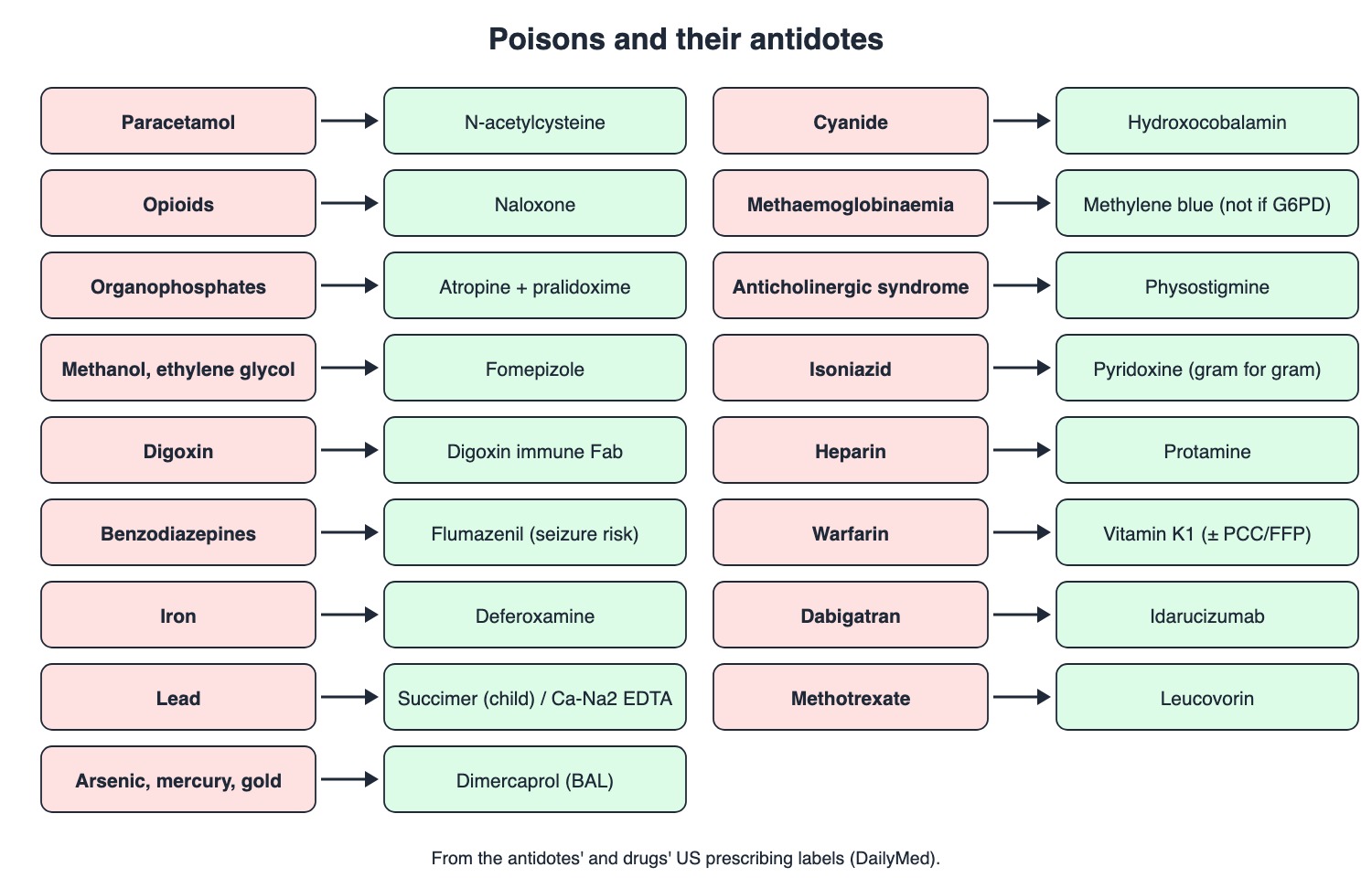
Poisons and their antidotes, from the drugs' labels. Drawn by TrackNation.
Flumazenil reverses benzodiazepines but can provoke withdrawal seizures — risk higher after a large cyclic antidepressant overdose.
Methylene blue treats acquired methaemoglobinaemia; boxed serotonin syndrome with serotonergic drugs; contraindicated in G6PD deficiency (haemolysis).
Hydroxocobalamin for cyanide: 5 g IV for adults. Physostigmine for central anticholinergic syndrome.
Chelating Agents
Chelator | Use (label) |
Deferoxamine | Acute iron poisoning; transfusional iron overload (urine turns reddish) |
Dimercaprol (BAL) | Arsenic, gold, mercury; acute lead poisoning with calcium disodium EDTA |
Succimer | Lead poisoning in children ≥ 1 year with blood lead > 45 mcg/dL |
Calcium disodium EDTA | Lead poisoning (encephalopathy commoner in children) |
Penicillamine | Wilson's disease; cystinuria; severe rheumatoid arthritis |
Skin and Eye Drugs
Isotretinoin: boxed — life-threatening birth defects; contraindicated in pregnancy; prescribed under iPLEDGE with two forms of contraception (or abstinence).
Timolol eye drops act systemically: contraindicated in asthma, severe COPD, sinus bradycardia, AV block, overt heart failure.
Latanoprost: increased brown iris pigmentation (likely permanent); longer, thicker, more eyelashes.
Traps the Examiner Sets
20WBCT is reported as clotted/not clotted, never positive/negative.
Neostigmine test is not given for a confirmed krait bite; max ASV 20 vials in neurotoxic bites.
Methylene blue is wrong in G6PD deficiency.
Lead in a child: succimer (blood lead > 45) or calcium disodium EDTA.
Timolol drops can trigger asthma.
Memory Hooks & Shortcuts
Shortcuts to lock in this article's numbers and lists. Each one only re-packages facts proven above.
🧠 Big Four: Cobra, Krait, Russell, Saw-scaled (CKRS) — India's main venomous snakes
🧠 Twenty minutes, Two answers: clotted or not — 20WBCT reporting
🧠 Ten, then ten, then stop (20) — neurotoxic ASV dosing
🧠 No AN for the krait — neostigmine test not in krait bites
🧠 Iron: De-FEROX-amine — iron chelator
🧠 Blue is bad for G6PD — methylene blue contraindication
🧠 Timolol: Tight chest — bronchospasm from eye drops
Rapid-Revision Cards
Big Four
Cobra, Russell's viper, saw-scaled viper, krait.
20WBCT
Clean dry glass tube; clotted / not clotted; hourly × 3 then 6-hourly.
ASV vasculotoxic
10 vials; repeat if bleeding at 1 h.
ASV neurotoxic
10 + 10; max 20 vials.
AN test
Atropine 0.6 + neostigmine 1.5 mg IV; not in krait bite.
ASV reaction
Adrenaline 0.5 mg IM.
Paracetamol
N-acetylcysteine.
Methanol
Fomepizole.
Benzodiazepine
Flumazenil (seizures with TCA).
Iron
Deferoxamine (reddish urine).
Lead (child)
Succimer if > 45 mcg/dL; Ca-Na2 EDTA.
Arsenic, mercury, gold
Dimercaprol.
Wilson's
Penicillamine.
Cyanide
Hydroxocobalamin 5 g IV.
Methaemoglobinaemia
Methylene blue; not in G6PD; serotonin syndrome.
Anticholinergic syndrome
Physostigmine.
Isotretinoin
Teratogen; iPLEDGE; two contraceptives.
Timolol drops
Not in asthma, bradycardia, AV block, HF.
Latanoprost
Brown iris (permanent); eyelash growth.
Sources
Facts in this article were checked against these documents.
Standard Treatment Guidelines: Snakebite — Directorate General of Health Services, MoHFW (with NHSRC), June 2016 (link)
Prescribing labels: Acetadote, naloxone, Protopam, fomepizole, Lanoxin, flumazenil, deferoxamine, BAL in Oil, Chemet, edetate calcium disodium, Cuprimine, Anticholium, Cyanokit, ProvayBlue, isotretinoin, brimonidine-timolol, Xalatan — DailyMed, US National Library of Medicine, current labels, accessed November 2026 (link)
Competency Based Undergraduate Curriculum, Pharmacology (PH 9) — National Medical Commission, 2024
Test Yourself: Practice Questions
Twenty-four questions in NEET PG style, most of them clinical vignettes.
Practice Questions (NEET PG pattern)
Original questions written in the style of the exam: +4 for a correct answer, −1 for a wrong one. Every answer was checked against the sources listed above. NEET PG papers are not published by NBEMS, so these are not past-paper questions.
Q1. A farmer bitten by a snake has abnormal bleeding; blood in a clean dry glass tube is still liquid at 20 minutes. Per MoHFW, the result is reported as
(a) 'positive'
(b) 'borderline'
(c) 'negative'
(d) 'not clotted' — vasculotoxic envenomation
Show answer
Answer: (d) — Never write positive/negative; repeat hourly for 3 h, then 6-hourly to 24 h.
Q2. In that vasculotoxic bite, after the first 10 vials of ASV bleeding continues at 1 hour. MoHFW advises
(a) a repeat dose of ASV
(b) heparin
(c) vitamin K only
(d) stopping ASV
Show answer
Answer: (a) — Repeat ASV if bleeding persists one hour after the first 10 vials.
Q3. A boy with ptosis and difficulty breathing after a cobra bite needs ASV. The MoHFW regimen is
(a) 50 vials at once
(b) 10 vials over 30 min, then 10 more if no improvement in 1 hour (max 20)
(c) no ASV — neostigmine alone
(d) 2 vials only
Show answer
Answer: (b) — Maximum 20 vials for neurotoxic envenoming.
Q4. In neurotoxic envenoming, the 'AN' test uses
(a) atropine alone
(b) adrenaline and naloxone
(c) neostigmine alone without atropine
(d) atropine 0.6 mg then neostigmine 1.5 mg IV, neostigmine 0.5 mg with atropine every 30 min × 5
Show answer
Answer: (d) — MoHFW snakebite STG.
Q5. The AN (neostigmine) test should not be given when
(a) a cobra bite is suspected
(b) a krait bite is confirmed
(c) the patient is a child
(d) the patient has ptosis
Show answer
Answer: (b) — MoHFW STG.
Q6. During ASV infusion a patient develops an allergic reaction. MoHFW's treatment is
(a) stop ASV permanently and give nothing
(b) IV calcium
(c) adrenaline 0.5 mg IM (children 0.01 mg/kg)
(d) oral cetirizine only
Show answer
Answer: (c) — Adrenaline for ASV reactions.
Q7. India's 'Big Four' venomous snakes are
(a) common cobra, Russell's viper, saw-scaled viper, common krait
(b) only vipers
(c) king cobra, pit viper, sea snake, python
(d) rat snake, cobra, krait, mamba
Show answer
Answer: (a) — MoHFW STG.
Q8. A toddler swallows many of her mother's iron tablets. The specific chelator is
(a) deferoxamine
(b) succimer
(c) dimercaprol
(d) penicillamine
Show answer
Answer: (a) — Deferoxamine turns the urine reddish.
Q9. A 3-year-old has a blood lead of 52 mcg/dL without encephalopathy. A labelled oral chelator is
(a) penicillamine
(b) deferoxamine
(c) methylene blue
(d) succimer
Show answer
Answer: (d) — Children ≥ 1 year with blood lead > 45 mcg/dL.
Q10. A worker with arsenic poisoning needs chelation. The labelled drug is
(a) flumazenil
(b) dimercaprol (BAL)
(c) deferoxamine
(d) fomepizole
Show answer
Answer: (b) — BAL: arsenic, gold, mercury; with calcium disodium EDTA for acute lead poisoning.
Q11. A teenager with Wilson's disease is started on a chelator. The classic one is
(a) penicillamine
(b) dimercaprol
(c) deferoxamine
(d) succimer
Show answer
Answer: (a) — Also cystinuria and severe rheumatoid arthritis.
Q12. After smoke inhalation in a house fire, cyanide poisoning is suspected. Give
(a) deferoxamine
(b) flumazenil
(c) hydroxocobalamin 5 g IV
(d) methylene blue
Show answer
Answer: (c) — Cyanokit label.
Q13. A patient with acquired methaemoglobinaemia is known to have G6PD deficiency. Methylene blue is
(a) contraindicated (risk of haemolytic anaemia)
(b) given orally only
(c) the drug of choice
(d) safe at double dose
Show answer
Answer: (a) — ProvayBlue label.
Q14. A patient on an SSRI is given IV methylene blue and develops agitation and hyperthermia. The boxed warning is
(a) QT prolongation
(b) serotonin syndrome with serotonergic drugs
(c) hepatotoxicity
(d) anaphylaxis
Show answer
Answer: (b) — ProvayBlue boxed warning.
Q15. An unconscious patient has taken unknown pills, possibly benzodiazepines and a tricyclic. Flumazenil is risky because
(a) it has no effect
(b) it can provoke seizures, especially after a large cyclic antidepressant overdose
(c) it is an opioid
(d) it causes respiratory depression
Show answer
Answer: (b) — Flumazenil label.
Q16. A child has central anticholinergic syndrome after a plant poisoning. A labelled antidote is
(a) neostigmine
(b) pralidoxime
(c) atropine
(d) physostigmine
Show answer
Answer: (d) — Anticholium label.
Q17. A man drinks illicit liquor and develops visual blurring and acidosis. The labelled antidote is
(a) N-acetylcysteine
(b) flumazenil
(c) fomepizole
(d) naloxone
Show answer
Answer: (c) — Fomepizole for methanol or ethylene glycol.
Q18. Pralidoxime works in organophosphate poisoning by
(a) blocking muscarinic receptors
(b) stimulating nicotinic receptors
(c) reactivating phosphorylated cholinesterase
(d) binding the organophosphate in the gut
Show answer
Answer: (c) — Protopam label.
Q19. A 20-year-old woman starting isotretinoin for nodular acne must
(a) take it only in winter
(b) use two forms of contraception (or abstain) under iPLEDGE — it causes severe birth defects
(c) only avoid sun
(d) take folic acid only
Show answer
Answer: (b) — Boxed: contraindicated in pregnancy.
Q20. An asthmatic with glaucoma is prescribed timolol eye drops and develops severe wheeze. The label
(a) contraindicates timolol in bronchial asthma
(b) says eye drops have no systemic effect
(c) blames the glaucoma
(d) recommends a higher dose
Show answer
Answer: (a) — Also sinus bradycardia, AV block, overt heart failure.
Q21. A patient using latanoprost in one eye notices that eye's iris has turned browner. The label says this change is
(a) likely permanent
(b) a sign of infection
(c) due to cataract
(d) always reversible
Show answer
Answer: (a) — Eyelash growth changes are usually reversible.
Q22. Specific antivenom for which bites is not available in India?
(a) krait
(b) sea snake and pit viper
(c) cobra
(d) Russell's viper
Show answer
Answer: (b) — MoHFW STG; available ASV may help by cross-reaction.
Q23. Dimercaprol is used for acute lead poisoning together with
(a) penicillamine
(b) methylene blue
(c) deferoxamine
(d) calcium disodium EDTA
Show answer
Answer: (d) — BAL label.
Q24. N-acetylcysteine (Acetadote) is indicated to
(a) treat iron overdose
(b) reverse opioid overdose
(c) chelate lead
(d) prevent or lessen liver injury after a hepatotoxic paracetamol dose
Show answer
Answer: (d) — Acetadote label.
Active Recall
From memory: outline MoHFW snakebite management (Big Four, 20WBCT, ASV doses for vasculotoxic and neurotoxic bites, the AN test, treating ASV reactions); match common poisons to their antidotes and chelators; and give the key warnings for methylene blue, flumazenil, isotretinoin, timolol and latanoprost.