Bio-Medical Waste Management Rules 2016 (Amended to 2026) and NLEM 2022 for NEET PG PSM: Colour Coding, Treatment, Deadlines
Start Here
🎯 Exam priority: High-yield (Tier 1). "Which colour bag?" is one of the most predictable PSM questions — and the answers changed in 2018 (blue boxes, hypochlorite strength, chlorinated bags). Everything here is from the gazette notifications of the Bio-Medical Waste Management Rules, 2016 and their amendments up to April 2026, as hosted by CPCB, and from the NLEM 2022 document.
CBME mapping: CM 16 and CM 19.
The Four Colours
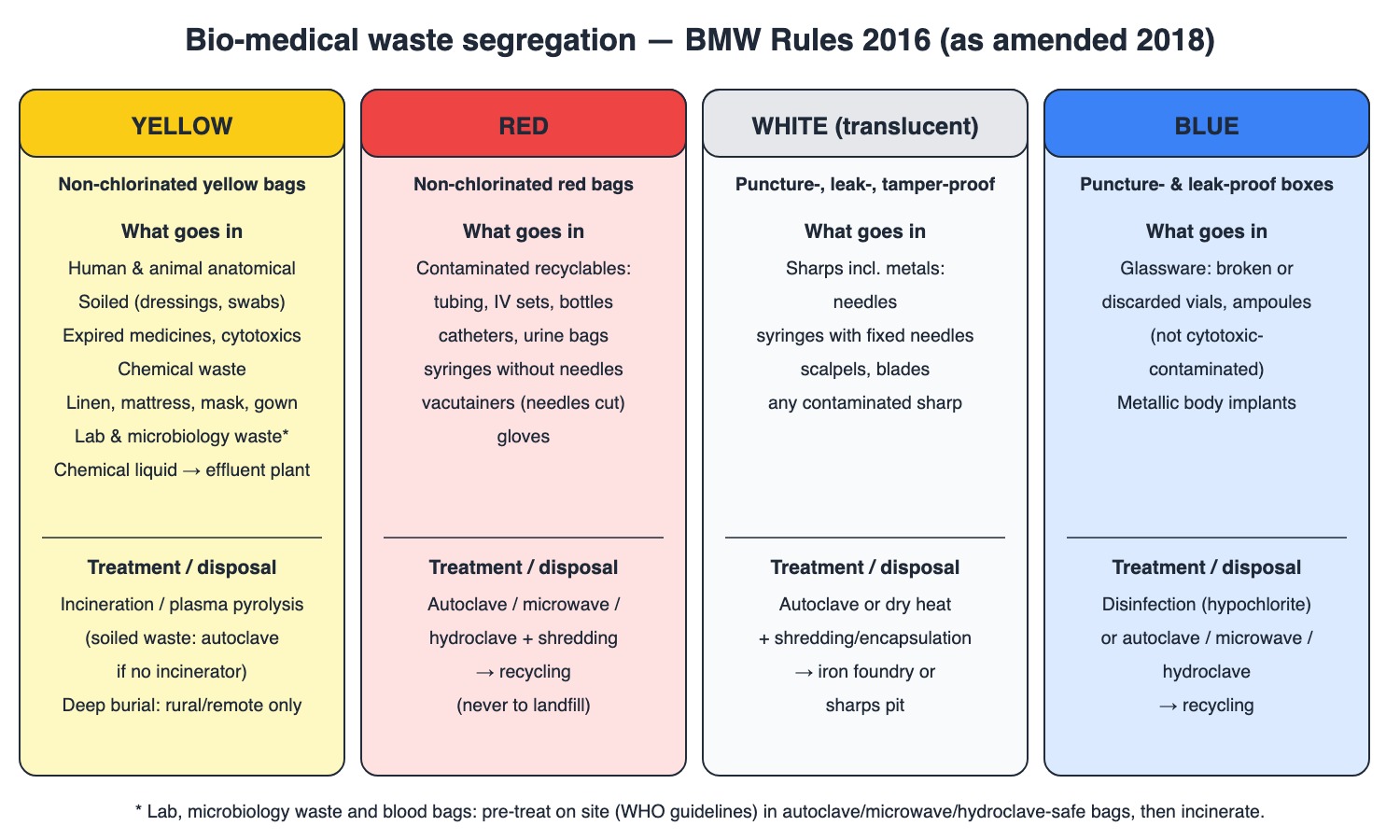
Schedule I colour coding as amended in 2018. Yellow is burnt, red is recycled after disinfection, white holds sharps and blue holds glass and metal implants.
Yellow (non-chlorinated bags): human and animal anatomical waste, soiled dressings, expired or cytotoxic drugs, chemical waste, contaminated linen and mattresses (and, since 2018, routine masks and gowns), and lab/microbiology waste. A dead fetus below the viability period (MTP Act) counts as human anatomical waste.
Red (non-chlorinated bags): contaminated recyclable plastics — tubing, IV sets, catheters, urine bags, syringes without needles, vacutainers with needles cut, gloves. Autoclave/microwave/hydroclave and shred, then recycle; plastic waste must not go to landfill.
White (translucent) puncture-proof, leak-proof, tamper-proof containers: sharps, including syringes with fixed needles, scalpels and blades. Autoclave or dry heat, then shred or encapsulate; final disposal to iron foundries or a sharps pit.
Blue: glassware (vials, ampoules — unless contaminated with cytotoxics, which go yellow) and metallic body implants. Since 2018, in puncture- and leak-proof boxes with blue marking (the 2016 text said cardboard boxes).
Chemical liquid waste goes through a separate collection system to the effluent treatment plant.
Treatment Standards
Incinerator: primary chamber at least 800 °C; secondary chamber 1050 ± 50 °C with a gas residence time of at least 2 seconds. Cytotoxic drugs are incinerated at > 1200 °C.
No chemical pre-treatment before incineration — except microbiological, lab and highly infectious waste.
Chemical disinfection: sodium hypochlorite 1–2% (amended in 2018 from 10%) with 30% residual chlorine, for 20 minutes — or an equivalent reagent giving a log10 4 reduction of microbes.
Deep burial only in rural or remote areas with no access to a common treatment facility, with prior approval.
Gravity-flow autoclave | Temperature | Pressure | Time |
Option 1 | ≥ 121 °C | 15 psi | ≥ 60 min |
Option 2 | ≥ 135 °C | 31 psi | ≥ 45 min |
Option 3 | ≥ 149 °C | 52 psi | ≥ 30 min |
The biological indicator for autoclave validation is Geobacillus stearothermophilus spores (≥ 106).
Duties of the Occupier
Do not store untreated anatomical, soiled or biotechnology waste beyond 48 hours.
Pre-treat lab and microbiology waste, blood samples and blood bags on site before sending them to the common facility.
Train all handlers at induction and at least once a year; immunise them against hepatitis B and tetanus; health check-up at induction and yearly.
Bar-code bags and containers leaving the premises.
A BMW committee meets every six months; facilities with fewer than 30 beds designate a qualified person instead.
Keep incinerator/autoclave records for 5 years; send the annual report (Form IV) by 30 June; report a major accident in writing within 24 hours.
Do not set up an on-site treatment plant if a common bio-medical waste treatment facility is available within 75 km.
The prescribed authority is the State Pollution Control Board (Pollution Control Committee in a UT).
Oversight: a State Advisory Committee chaired by the health secretary, and a District Level Monitoring Committee chaired by the District Collector/Magistrate that reports every six months.
The Amendments, 2018–2026
Notification | What changed |
28 March 2016 (G.S.R. 343(E)) | Principal rules: four colour categories, 48-hour storage limit, bar coding, annual training |
16 March 2018 (G.S.R. 234(E)) | Chlorinated bags (except blood bags) and gloves out by 27 March 2019; hypochlorite 10% → 1–2%; blue category in puncture- and leak-proof boxes; routine masks and gowns into yellow; lab waste pre-treated per WHO 'Blue Book' 2014 |
19 February 2019 (G.S.R. 129(E)) | All bedded facilities keep a daily BMW register and post monthly records and the annual report online |
10 May 2019 (G.S.R. 360(E)) | Urine, effluent, abdominal and chest-drainage bags are not 'chlorinated plastic bags' |
17 April 2026 (G.S.R. 293(E)) | AYUSH added to the State Advisory Committee and the District Level Monitoring Committee |
National List of Essential Medicines 2022
NLEM 2022 lists 384 medicines in 27 sections, the last being medicines for COVID-19 management.
Each medicine is tagged with the level of health care where it should be available — P (primary), S (secondary), T (tertiary) — along with dosage forms and strengths. Many anti-cancer drugs, for example, are listed for T only.
Traps the Examiner Sets
Syringe with fixed needle → white; syringe without needle → red.
Glass vial → blue; vial contaminated with cytotoxics → yellow.
Hypochlorite is now 1–2%, not 10%.
Storage limit: 48 hours. Common facility radius: 75 km.
Blue category: puncture- and leak-proof boxes (no longer cardboard).
Blood bags are exempt from the chlorinated-bag phase-out; urine, effluent, abdominal and chest-drainage bags aren't "chlorinated plastic bags".
Rapid-Revision Cards
Yellow
Anatomical, soiled, expired/cytotoxic drugs, chemical, linen/mask/gown, lab waste → incineration.
Red
Contaminated recyclable plastics (tubing, catheters, syringes w/o needles, gloves) → autoclave + shred → recycle.
White (translucent)
Sharps incl. syringes with fixed needles → puncture-, leak-, tamper-proof container.
Blue
Glassware (not cytotoxic) + metallic implants → puncture- and leak-proof boxes (2018).
Storage limit
48 hours for untreated anatomical/soiled/biotech waste.
Hypochlorite
1–2% (2018 amendment; was 10%), 30% residual chlorine, 20 min.
Incinerator
Primary ≥ 800 °C; secondary 1050 ± 50 °C; ≥ 2 s residence.
Autoclave
121 °C/15 psi/60 min; 135 °C/31 psi/45 min; 149 °C/52 psi/30 min.
Autoclave indicator
Geobacillus stearothermophilus spores.
Cytotoxic drugs
Return to manufacturer or incinerate > 1200 °C.
Occupier duties
Annual training; HBV + tetanus vaccination; bar coding; committee every 6 months.
Records / report
Records 5 years; annual report 30 June; accident report 24 h.
CBWTF radius
75 km.
Chlorinated bags
Out by 27 March 2019 (blood bags excluded).
2026 amendment
AYUSH added to the State Advisory Committee and District Level Monitoring Committee.
NLEM 2022
384 medicines, 27 sections, P/S/T level of care.
Sources
Sources
Facts in this article were checked against these documents.
Bio-Medical Waste Management Rules, 2016 (G.S.R. 343(E)) — MoEFCC, Gazette of India (CPCB copy), 2016 (link)
Bio-Medical Waste Management (Amendment) Rules, 2018 (G.S.R. 234(E)) — MoEFCC, 2018 (link)
Bio-Medical Waste Management (Amendment) Rules, 2019 (G.S.R. 129(E)) — MoEFCC, 2019 (link)
Bio-Medical Waste Management (Second Amendment) Rules, 2019 (G.S.R. 360(E)) — MoEFCC, 2019 (link)
Bio-Medical Waste Management (Amendment) Rules, 2026 (G.S.R. 293(E)) — MoEFCC, 2026 (link)
National List of Essential Medicines 2022 — MoHFW, 2022 (link)
Test Yourself: Practice Questions
Eighteen questions in NEET PG style.
Practice Questions (NEET PG pattern)
Original questions written in the style of the exam: +4 for a correct answer, −1 for a wrong one. Every answer was checked against the sources listed above. NEET PG papers are not published by NBEMS, so these are not past-paper questions.
Q1. A used syringe with a fixed needle is discarded in the
(a) yellow bag
(b) blue box
(c) white (translucent) puncture-proof container
(d) red bag
Show answer
Answer: (c) — Sharps including syringes with fixed needles go into white translucent puncture-, leak- and tamper-proof containers.
Q2. IV tubing, urine bags and syringes without needles are discarded in
(a) yellow bags
(b) red non-chlorinated bags
(c) white containers
(d) blue boxes
Show answer
Answer: (b) — Contaminated recyclable plastics go red; they are autoclaved/microwaved and shredded, then recycled.
Q3. Broken ampoules not contaminated with cytotoxic drugs belong to which category?
(a) Red
(b) Yellow
(c) White
(d) Blue
Show answer
Answer: (d) — Glassware, including vials and ampoules (except cytotoxic-contaminated), is blue.
Q4. A placenta is disposed of in
(a) general waste
(b) blue boxes
(c) red bags, for autoclaving
(d) yellow bags, for incineration
Show answer
Answer: (d) — Human anatomical waste — tissues, organs, body parts — is yellow; incineration, plasma pyrolysis, or deep burial in remote areas.
Q5. Untreated human anatomical waste may not be stored beyond
(a) 24 hours
(b) 7 days
(c) 48 hours
(d) 72 hours
Show answer
Answer: (c) — Untreated anatomical, soiled and biotechnology waste must not be stored beyond 48 hours.
Q6. After the 2018 amendment, chemical disinfection of bio-medical waste uses sodium hypochlorite at
(a) 10%
(b) 5%
(c) 1–2%
(d) 0.5%
Show answer
Answer: (c) — The 2018 amendment replaced '10%' with '1% to 2%' in Schedule I Part-2.
Q7. Under the 2018 amendment, blue-category waste must be collected in
(a) white translucent bottles
(b) puncture-proof and leak-proof boxes with blue marking
(c) blue plastic bags
(d) cardboard boxes with blue marking
Show answer
Answer: (b) — The 2016 cardboard boxes were replaced by puncture- and leak-proof boxes or containers with blue marking.
Q8. The minimum temperature of the secondary chamber of a bio-medical waste incinerator is
(a) 1200 °C
(b) 800 °C
(c) 1050 ± 50 °C
(d) 650 °C
Show answer
Answer: (c) — Primary chamber ≥ 800 °C; secondary 1050 ± 50 °C with ≥ 2 s gas residence time.
Q9. In a gravity-flow autoclave at 121 °C and 15 psi, the minimum residence time for bio-medical waste is
(a) 60 minutes
(b) 15 minutes
(c) 30 minutes
(d) 45 minutes
Show answer
Answer: (a) — 121 °C/15 psi/60 min; 135 °C/31 psi/45 min; 149 °C/52 psi/30 min.
Q10. The biological indicator used to validate autoclaves treating bio-medical waste is
(a) Escherichia coli
(b) Geobacillus stearothermophilus spores
(c) Bacillus atrophaeus spores
(d) Clostridium tetani spores
Show answer
Answer: (b) — Geobacillus stearothermophilus spores, at least 10^6 per vial or strip.
Q11. Expired cytotoxic drugs are incinerated at a temperature above
(a) 600 °C
(b) 1200 °C
(c) 1050 °C
(d) 800 °C
Show answer
Answer: (b) — Cytotoxic drugs go back to the manufacturer or to a facility for incineration at > 1200 °C.
Q12. Health-care workers handling bio-medical waste must be immunised against
(a) hepatitis A and B
(b) typhoid and cholera
(c) rabies and tetanus
(d) hepatitis B and tetanus
Show answer
Answer: (d) — Rule 4(h): immunise against diseases including hepatitis B and tetanus.
Q13. An occupier should not set up its own treatment facility if a common bio-medical waste treatment facility is available within
(a) 10 km
(b) 150 km
(c) 75 km
(d) 25 km
Show answer
Answer: (c) — Rule 7: no on-site facility if a common facility is available within seventy-five kilometres.
Q14. Deep burial of bio-medical waste is permitted
(a) in all district hospitals
(b) for sharps only
(c) for red-category plastics
(d) only in rural or remote areas without access to a common treatment facility
Show answer
Answer: (d) — Deep burial is allowed only in rural or remote areas with no access to a CBWTF, with prior approval.
Q15. Under the 2018 amendment, chlorinated plastic bags (except blood bags) and gloves were to be phased out by
(a) 1 January 2018
(b) 27 March 2019
(c) 28 March 2016
(d) 31 December 2020
Show answer
Answer: (b) — The 2018 amendment set 27 March 2019 and excluded blood bags.
Q16. The 'prescribed authority' for the BMW Rules in a State is the
(a) Directorate of Health Services
(b) State Pollution Control Board
(c) District Health Officer
(d) Central Pollution Control Board
Show answer
Answer: (b) — The SPCB in a State and the Pollution Control Committee in a Union Territory.
Q17. Training of all bio-medical waste handlers must be done at induction and thereafter at least
(a) once in five years
(b) every six months
(c) once a year
(d) once in two years
Show answer
Answer: (c) — Rule 4(g): at induction and thereafter at least once every year.
Q18. How many medicines are in India's National List of Essential Medicines 2022?
(a) 412
(b) 348
(c) 376
(d) 384
Show answer
Answer: (d) — NLEM 2022 lists 384 medicines in 27 sections.
Active Recall
From memory: state what goes into the yellow, red, white and blue categories and how each is treated; give the storage limit, the amended hypochlorite strength, incinerator and autoclave standards, the occupier's duties on training, immunisation and records, what each amendment from 2018 to 2026 changed, and the size and structure of NLEM 2022.