Health Care Delivery in India for NEET PG PSM: IPHS 2022 Population Norms, HWCs, FRU, CHC and District Hospital Beds
Start Here
🎯 Exam priority: High-yield (Tier 1). Population norms for the SHC, PHC and CHC are asked almost every year, along with the definition of a First Referral Unit and the HWC packages. Every number here is from the Indian Public Health Standards (IPHS) 2022, which replaced the 2012 standards — older books still carry some outdated figures, so learn these.
CBME mapping: CM 17 (health care of the community).
The Tiers at a Glance
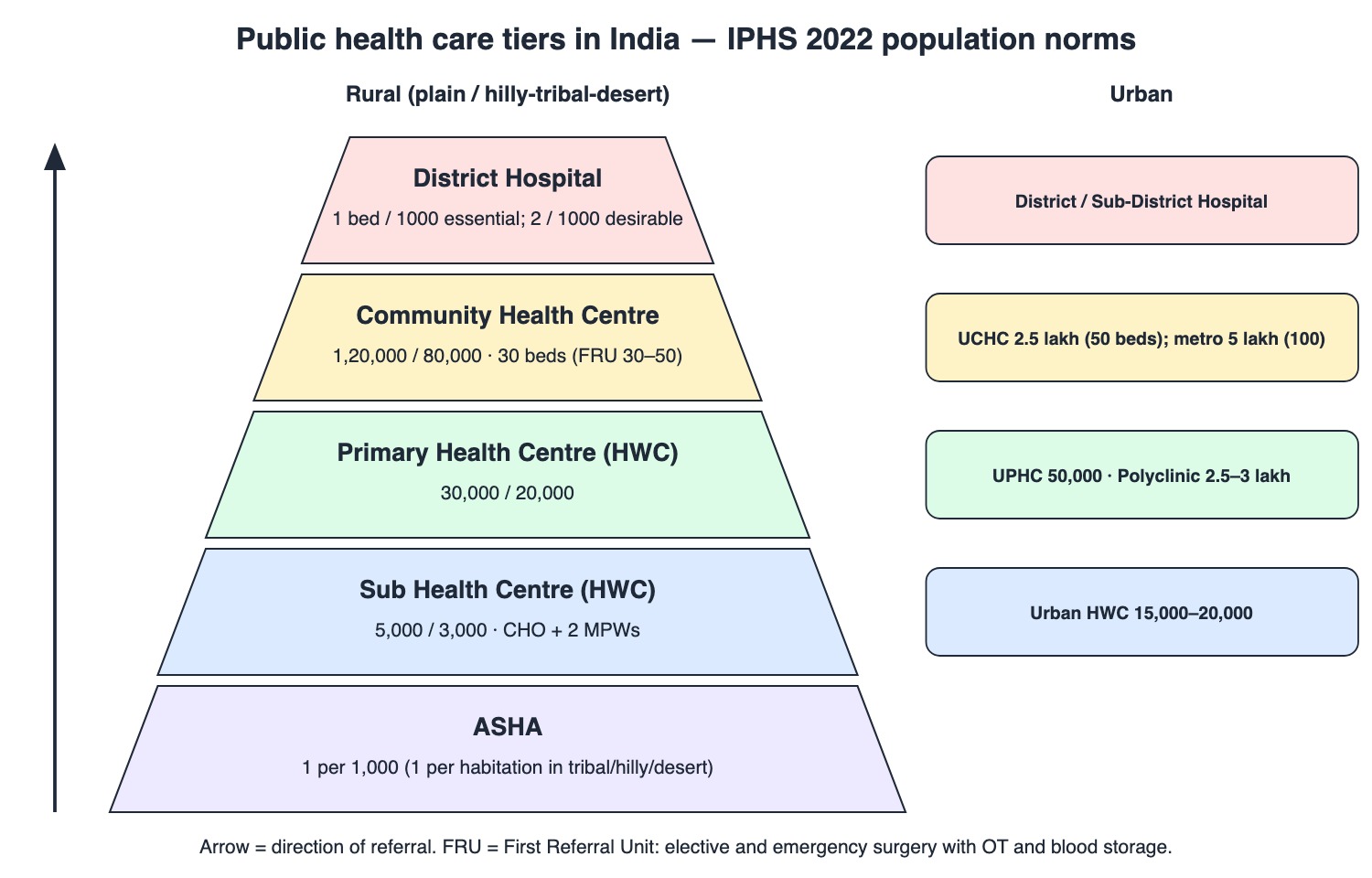
Tiers of public health care with IPHS 2022 population norms. Patients are referred upwards; the CHC at the block is the hub for its SHCs and PHCs.
Facility | Plains | Hilly / tribal / desert | Key point |
ASHA | 1 per 1,000 | 1 per habitation | Attached to the HWC team |
Sub Health Centre (HWC-SHC) | 5,000 | 3,000 | CHO + one male and one female multipurpose worker |
Primary Health Centre (HWC-PHC) | 30,000 | 20,000 | Co-terminus with Panchayats; 1 MBBS MO (2 in a 24×7 PHC) |
Community Health Centre | 1,20,000 | 80,000 | At block level; 30 beds (non-FRU) |
District Hospital | Whole district | — | Beds graded by district population (see below) |
The plains/hilly-tribal ratio is the same at each level: SHC 5,000/3,000, PHC 30,000/20,000, CHC 1,20,000/80,000.
A CHC is set up at the Community Development Block (taluka/tehsil) level, matching the three-tier Panchayati Raj system (gram, block and zila panchayat).
Health and Wellness Centres and CPHC
In February 2018 the Government announced 1,50,000 Ayushman Bharat Health and Wellness Centres by December 2022, made by upgrading existing SHCs, PHCs and UPHCs to deliver Comprehensive Primary Health Care (CPHC).
IPHS 2022 has two kinds of HWC: HWC-SHC (rural SHC or urban HWC) and HWC-PHC (rural PHC or UPHC).
An HWC-SHC is run by a Community Health Officer (CHO) with one male and one female multipurpose worker (or two ANMs), plus ASHAs.
HWCs are also a platform for teleconsultation and extra diagnostics (hub-and-spoke with the nearest CHC).
Community governance: a Jan Arogya Samiti at each HWC; VHSNC/Mahila Arogya Samiti meetings are used for awareness.
The 12 CPHC service packages:
# | Package | # | Package |
1 | Care in pregnancy and childbirth | 7 | NCD screening, prevention and management |
2 | Neonatal and infant health | 8 | Common eye and ENT problems |
3 | Childhood and adolescent health | 9 | Basic oral health care |
4 | Family planning, contraception and reproductive health | 10 | Elderly and palliative care |
5 | Communicable diseases under national programmes | 11 | Emergency services incl. burns and trauma |
6 | General outpatient care for acute simple illness | 12 | Screening and basic care of mental health |
Memory hook: HWCs expand care beyond the old selective package (pregnancy, children, reproductive health, communicable diseases) — the new ground is NCDs, eye/ENT, oral health, elderly and palliative care, emergencies and mental health.
CHC, FRU and the Block Public Health Unit
Non-FRU CHCs have 30 beds. FRU CHCs also provide specialist care — physician, surgeon, obstetrician, paediatrician and anaesthetist — with a functional operation theatre and blood storage unit; 30-bed FRUs must offer maternity and surgery, and 50-bed FRUs may add eye, orthopaedics and ENT.
What makes an FRU? IPHS 2022 says FRUs "go beyond obstetric services": a unit qualifies when it provides both elective and emergency secondary-level surgery with the infrastructure, staff, drugs and diagnostics to support it.
Urban CHCs always function as FRUs.
Every block-headquarters CHC is to become a Block Public Health Unit (BPHU), with four functional areas (clinical services, public health functions, a block public health laboratory and an HMIS unit) — supported by the XV Finance Commission health grants and PM-ABHIM.
Urban Health Care
Urban facility | Population norm | Notes |
Urban HWC | 15,000–20,000 | Serves slum and other vulnerable pockets |
Urban PHC | 50,000 | Close to slums; OPD-based (24×7 if already doing deliveries) |
Multispecialty polyclinic | 2.5–3 lakh | Catchment of 5–6 UPHCs; ambulatory specialist care |
Urban CHC | 2.5 lakh (non-metro) — 50 beds; 5 lakh (metro/million-plus) — 100 beds | Always functions as an FRU |
The National Urban Health Mission created UPHCs, UCHCs and outreach for slum dwellers, the homeless, rag-pickers and migrants.
Hospital Beds: District and Sub-District Hospitals
The Bhore Committee (1946) recommended 1 bed per 1,000 population; the National Health Policy 2017 recommends 2 beds per 1,000. IPHS 2022 makes 1/1,000 the essential norm for every district and 2/1,000 the desirable target.
Census 2011 puts the average district population at about 19 lakh.
Only beds used for more than 24 hours count as in-patient beds; emergency, labour-delivery-recovery, dialysis, day-care and pre/post-operative beds are extra.
A district with fewer than 5 lakh people and a functional DH does not need a sub-district hospital.
District population | Essential beds (+ emergency/day-care) | Desirable beds |
< 2 lakh | 50 + 15 | 100 |
2–5 lakh | 100 + 25 | 200 |
5–10 lakh | 200 + 38 | 300 |
10–20 lakh | 300 + 49 | 400 |
20–30 lakh | 400 + 60 | 500 |
> 30 lakh | 500 + 65 | 700 |
Traps the Examiner Sets
SHC 5,000 / 3,000 — not 10,000. PHC 30,000 / 20,000. CHC 1,20,000 / 80,000.
Urban PHC is 50,000; urban HWC 15,000–20,000; polyclinic 2.5–3 lakh.
An HWC-SHC is led by a CHO, not a medical officer.
FRU = emergency and elective surgery with an OT and blood storage — not obstetric care alone.
Bhore 1946: 1 bed/1,000; NHP 2017: 2 beds/1,000.
There are 12 CPHC packages; mental health, oral health, eye/ENT and palliative care are among them.
Rapid-Revision Cards
SHC population norm
5,000 plains / 3,000 hilly-tribal-desert.
PHC population norm
30,000 plains / 20,000 hilly-tribal.
CHC population norm
1,20,000 plains / 80,000 hilly-tribal; at block level.
Urban norms
UHWC 15–20k; UPHC 50k; polyclinic 2.5–3 lakh; UCHC 2.5 lakh (50 beds) or 5 lakh metro (100 beds).
ASHA norm
1 per 1,000; 1 per habitation in tribal/hilly/desert areas.
HWC-SHC team
CHO + 1 male and 1 female MPW (or 2 ANMs) + ASHAs.
CPHC packages
12 — packages 7–12 add NCD, eye/ENT, oral, elderly/palliative, emergency, mental health.
AB-HWC target
1,50,000 HWCs announced Feb 2018, by Dec 2022.
FRU definition (IPHS 2022)
Elective + emergency secondary surgery with OT, blood storage, staff — beyond obstetrics.
FRU CHC specialists
Physician, surgeon, obstetrician, paediatrician, anaesthetist.
Non-FRU CHC beds
30.
BPHU
Every block-HQ CHC; clinical, public health, block public health lab, HMIS unit.
Bed norms
Bhore 1946: 1/1,000; NHP 2017: 2/1,000; IPHS: 1 essential, 2 desirable.
DH beds for 10–20 lakh district
300 + 49 essential; 400 desirable.
PHC doctors
1 MBBS MO (essential); 24×7 PHC: 2 MOs.
Sources
Sources
Facts in this article were checked against these documents.
Indian Public Health Standards 2022 — Health and Wellness Centre: Sub Health Centre and Urban HWC — MoHFW / NHSRC, 2022 (link)
Indian Public Health Standards 2022 — Health and Wellness Centre: Primary Health Centre — MoHFW / NHSRC, 2022 (link)
Indian Public Health Standards 2022 — Community Health Centre — MoHFW / NHSRC, 2022 (link)
Indian Public Health Standards 2022 — Sub District Hospital and District Hospital — MoHFW / NHSRC, 2022 (link)
Test Yourself: Practice Questions
Eighteen questions in NEET PG style.
Practice Questions (NEET PG pattern)
Original questions written in the style of the exam: +4 for a correct answer, −1 for a wrong one. Every answer was checked against the sources listed above. NEET PG papers are not published by NBEMS, so these are not past-paper questions.
Q1. Under IPHS 2022, a Sub Health Centre in a tribal area serves a population of
(a) 1,000
(b) 10,000
(c) 5,000
(d) 3,000
Show answer
Answer: (d) — SHC: 5,000 in plains, 3,000 in hilly, tribal and desert areas.
Q2. The population norm for a rural PHC in the plains is
(a) 30,000
(b) 80,000
(c) 20,000
(d) 50,000
Show answer
Answer: (a) — PHC: 30,000 in plains and 20,000 in hilly and tribal areas.
Q3. A Community Health Centre in hilly and tribal areas covers a population of
(a) 1,20,000
(b) 30,000
(c) 80,000
(d) 2,50,000
Show answer
Answer: (c) — CHC: 1,20,000 in plains and 80,000 in hilly and tribal areas.
Q4. Urban Primary Health Centres are established for a population of
(a) 50,000
(b) 30,000
(c) 2.5 lakh
(d) 15,000–20,000
Show answer
Answer: (a) — UPHCs: one per 50,000, close to slums; urban HWCs 15,000–20,000.
Q5. An Urban Health and Wellness Centre caters to a population of
(a) 15,000–20,000
(b) 1 lakh
(c) 50,000
(d) 5,000
Show answer
Answer: (a) — One urban HWC per 15,000–20,000, mainly slum and vulnerable pockets.
Q6. A Health and Wellness Centre at the sub-centre level is led by a
(a) Community Health Officer
(b) Medical Officer (MBBS)
(c) Lady Health Visitor
(d) Block Extension Educator
Show answer
Answer: (a) — HWC-SHC staff: CHO plus one male and one female multipurpose worker, with ASHAs.
Q7. The ASHA norm in plain areas is
(a) one per 1,000 population
(b) one per 5,000
(c) one per village of any size
(d) one per 500
Show answer
Answer: (a) — One ASHA per 1,000 population, or one per habitation in tribal, hilly and desert areas.
Q8. How many service packages are envisaged under Comprehensive Primary Health Care at HWCs?
(a) 15
(b) 6
(c) 8
(d) 12
Show answer
Answer: (d) — Twelve packages, from care in pregnancy to screening and basic management of mental health.
Q9. Which of the following is one of the CPHC service packages at Health and Wellness Centres?
(a) Cataract surgery
(b) Dialysis
(c) Screening and basic management of mental health ailments
(d) Caesarean section
Show answer
Answer: (c) — Mental health screening is package 12; the others are secondary or tertiary services.
Q10. Under IPHS 2022, a facility qualifies as a First Referral Unit when it provides
(a) a blood bank alone
(b) 24-hour delivery services
(c) only emergency obstetric care
(d) both elective and emergency secondary-level surgery with supporting infrastructure
Show answer
Answer: (d) — FRUs go beyond obstetric services: elective and emergency secondary-level surgery with HR, OT, blood storage, drugs and diagnostics.
Q11. The specialists at an FRU CHC include all EXCEPT
(a) orthopaedic surgeon (essential)
(b) paediatrician
(c) obstetrician
(d) anaesthetist
Show answer
Answer: (a) — FRU CHC specialists: physician, surgeon, obstetrician, paediatrician and anaesthetist; orthopaedics is desirable only in 50-bed FRUs.
Q12. A non-FRU Community Health Centre has
(a) 50 beds
(b) 30 beds
(c) 100 beds
(d) 6 beds
Show answer
Answer: (b) — Non-FRU CHCs have 30 essential beds.
Q13. In metro and million-plus cities, an Urban CHC serves a population of
(a) 2.5 lakh with 50 beds
(b) 50,000 with 6 beds
(c) 5 lakh with 100 beds
(d) 1,20,000 with 30 beds
Show answer
Answer: (c) — UCHC: 2.5 lakh and 50 beds in non-metro cities; 5 lakh and 100 beds in metros.
Q14. The Bhore Committee (1946) recommended hospital beds of
(a) 1 per 10,000
(b) 5 per 1,000
(c) 2 per 1,000
(d) 1 per 1,000 population
Show answer
Answer: (d) — Bhore: 1/1,000; NHP 2017: 2/1,000. IPHS 2022 treats 1 as essential and 2 as desirable.
Q15. The National Health Policy 2017 recommends hospital beds of
(a) 1 per 1,000
(b) 2 per 1,000 population
(c) 3 per 1,000
(d) 0.5 per 1,000
Show answer
Answer: (b) — NHP 2017: two beds per 1,000 population.
Q16. Multispecialty polyclinics in urban areas serve
(a) 15,000–20,000 people
(b) 10 lakh people
(c) 2.5–3 lakh people, the catchment of 5–6 UPHCs
(d) 50,000 people
Show answer
Answer: (c) — Polyclinics provide ambulatory specialist care to 2.5–3 lakh, covering 5–6 UPHCs.
Q17. CHCs at block headquarters are to be developed as
(a) District Hospitals
(b) Polyclinics
(c) Medical colleges
(d) Block Public Health Units
Show answer
Answer: (d) — All block-HQ CHCs become Block Public Health Units with four functional areas.
Q18. A district of 15 lakh population needs how many essential in-patient beds under IPHS 2022?
(a) 150
(b) 500
(c) 100 (+ 25)
(d) 300 (+ 49 emergency/day-care)
Show answer
Answer: (d) — 10–20 lakh: 300 essential beds plus 49 emergency/day-care beds; 400 desirable.
Active Recall
From memory: give the IPHS 2022 population norms for the SHC, PHC and CHC (plains and hilly-tribal) and for urban HWCs, UPHCs, polyclinics and UCHCs; say who runs an HWC-SHC, how many CPHC packages there are, what defines an FRU and which specialists it has, and the hospital-bed norms of the Bhore Committee and NHP 2017.