Breastfeeding for NEET PG Paediatrics: Colostrum, Milk Composition, Latch, Adequacy, Contraindications, Mastitis and India's NFHS Trend
Start Here
🎯 Exam priority: High. Expect: duration of exclusive breastfeeding, colostrum, the calcium:phosphorus ratio, signs of a good latch, feed frequency, nappy counts at day 5, storage of expressed milk, the absolute contraindication, mastitis organism and treatment, vitamin D for breastfed babies, and India's NFHS figures.
CBME mapping: PE7. Fact-checked against the MSD Manual, MoHFW's Home Based Newborn Care guidelines (2014) and NFHS.
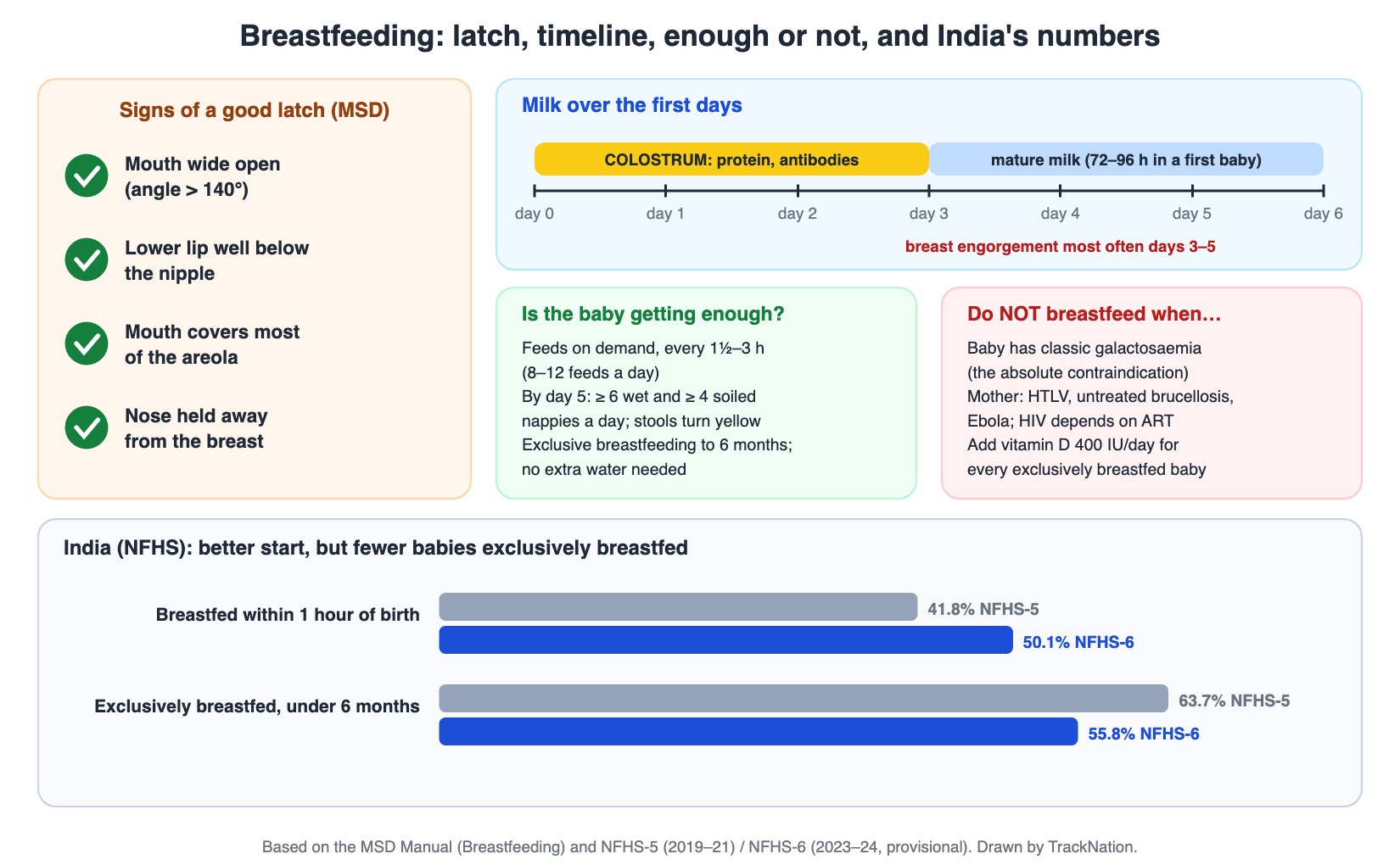
Signs of a good latch, the first days of milk, adequacy signs, contraindications and India's breastfeeding trend. Drawn by TrackNation.
Why and What: Colostrum and Milk (MSD)
Breast milk is the nutrition of choice: exclusive breastfeeding for at least 6 months, solids from about 6 months, breastfeeding continued as long as mother and baby wish. Babies under 6 months need no extra water, even in hot weather.
Colostrum: high-calorie, high-protein, yellow, rich in antibodies, lymphocytes and macrophages; helps pass meconium. Milk is fully established by 72–96 hours in a first-time mother (earlier in multiparas).
Mature milk: high lactose, plenty of vitamin E, calcium:phosphorus 2:1 (prevents calcium-deficiency tetany), cholesterol and taurine for brain growth, omega-3/6 fatty acids, antibodies and gut flora that protect against diarrhoea.
Benefits — child: fewer infections, allergies, obesity, Crohn disease and diabetes; mother: reduced fertility while lactating, faster recovery, lower risks of diabetes, heart disease, ovarian and breast cancer. Give vitamin D 400 IU daily to every exclusively breastfed baby.
Technique and Is It Enough? (MSD, HBNC)
Latch: mouth wide (>140°), lips 2.5–4 cm from the nipple base, lower lip below the nipple, mouth over most of the areola, nose away. The let-down reflex takes at least 2 minutes. Under HBNC, the ASHA teaches positioning and attachment at home.
Feed on demand, every 1½–3 hours (8–12 a day); small babies may need more to avoid hypoglycaemia.
Expressed milk: refrigerate if used within 48 hours, freeze if later; discard refrigerated milk after 96 hours; thaw in warm water, never in a microwave.
Adequacy: by day 5, at least 6 wet and 4 soiled nappies a day and stools turning yellow. The main infant risk is underfeeding → dehydration and jaundice; lethargy means test for hypernatraemia.
When Not To, and Maternal Problems (MSD)
Absolute contraindication: classic galactosaemia in the baby. Do not breastfeed with maternal HTLV-I/II, untreated brucellosis or Ebola; HIV advice depends on antiretroviral therapy; avoid with maternal illicit opioids, cocaine or phencyclidine (but methadone or buprenorphine on treatment is compatible and may ease neonatal withdrawal).
Separate but give expressed milk for active untreated TB, varicella, herpes lesions on the breast, or CMV in preterm babies.
Engorgement peaks on days 3–5 as mature milk arrives; feed often, express just enough, cool compresses. Plugged duct: tender lump, keep feeding.
Mastitis: tender, warm, swollen area from milk stasis; secondary infection usually penicillin-resistant S. aureus. Keep removing milk; if no better in 12–24 hours, give an anti-staphylococcal antibiotic (dicloxacillin, cephalexin or clindamycin).
India's Numbers (NFHS)
Breastfed within 1 hour of birth: 41.8% (NFHS-5) → 50.1% (NFHS-6, provisional).
Exclusive breastfeeding under 6 months fell: 63.7% → 55.8%.
Traps the Examiner Sets
Galactosaemia in the baby is the absolute contraindication — not maternal TB (give expressed milk).
Exclusively breastfed babies under 6 months need no water but do need vitamin D.
Breast milk's calcium:phosphorus ratio is 2:1.
Mastitis: keep breastfeeding — milk removal is first-line treatment.
Exclusive breastfeeding fell between NFHS-5 and NFHS-6, though early initiation rose.
Memory Hooks & Shortcuts
Shortcuts to lock in this article's numbers and lists. Each one only re-packages facts proven above.
🧠 'Two Calcium for one Phosphorus' — breast milk Ca:P 2:1 — composition
🧠 'Gal-ACT-osaemia = the Absolute Contraindication To breastfeeding' — contraindication
🧠 '6 wet, 4 dirty on day 5' — the nappy count — adequacy
🧠 '48 to use, 96 to lose' — fridge storage of expressed milk — storage
🧠 'Mastitis: Milk out first, Meds later (12–24 h)' — mastitis
Rapid-Revision Cards
Exclusive BF
≥ 6 months; no water needed.
Colostrum
Protein, antibodies, cells; passes meconium.
Milk established
72–96 h (first baby).
Ca:P in breast milk
2:1.
Brain nutrients
Cholesterol, taurine, DHA.
Vitamin D
400 IU/day for exclusively breastfed.
Latch
Mouth > 140°, lower lip below nipple, areola in.
Let-down
≥ 2 minutes.
Feeds
Every 1½–3 h; 8–12/day.
Stored milk
Fridge ≤ 48 h (discard at 96 h); no microwave.
Day-5 adequacy
≥ 6 wet, ≥ 4 soiled nappies.
Main infant risk
Underfeeding → dehydration, jaundice.
Absolute CI
Galactosaemia in the baby.
Other CIs
HTLV, untreated brucellosis, Ebola; HIV per ART.
TB / varicella
Separate; give expressed milk.
Engorgement
Days 3–5.
Mastitis cause
Milk stasis; S. aureus if infected.
Mastitis Rx
Keep emptying; antibiotic if no better 12–24 h.
HBNC
ASHA teaches positioning, attachment.
NFHS early initiation
41.8 → 50.1%.
NFHS exclusive BF
63.7 → 55.8%.
Sources
Facts in this article were checked against these documents.
MSD Manual Professional: Breastfeeding — Merck & Co., 2026 (link)
Home Based Newborn Care: Operational Guidelines — Ministry of Health & Family Welfare, 2014
National Family Health Survey (NFHS-6) 2023–24: India Fact Sheet (provisional) — International Institute for Population Sciences / MoHFW, 2026
Test Yourself: Practice Questions
Thirty questions in NEET PG style, many of them ward scenarios.
Practice Questions (NEET PG pattern)
Original questions written in the style of the exam: +4 for a correct answer, −1 for a wrong one. Every answer was checked against the sources listed above. NEET PG papers are not published by NBEMS, so these are not past-paper questions.
Q1. Exclusive breastfeeding is recommended for at least
(a) 12 months
(b) 4 weeks
(c) 6 months
(d) 3 months
Show answer
Answer: (c) — Solids from about 6 months.
Q2. Colostrum is rich in
(a) vitamin K
(b) lactose only
(c) iron
(d) antibodies, lymphocytes and macrophages
Show answer
Answer: (d) — High-calorie, high-protein.
Q3. In a first-time mother, milk production is usually fully established by
(a) 3 weeks
(b) 72–96 hours
(c) 7–10 days
(d) 6–12 hours
Show answer
Answer: (b) — Earlier in multiparas.
Q4. The calcium:phosphorus ratio of breast milk is
(a) 1:1
(b) 2:1
(c) 1:2
(d) 4:1
Show answer
Answer: (b) — Prevents tetany.
Q5. Breast milk components important for brain growth include
(a) casein only
(b) vitamin K
(c) cholesterol and taurine
(d) iron and zinc
Show answer
Answer: (c) — MSD.
Q6. An exclusively breastfed 2-month-old in summer heat should receive
(a) ORS daily
(b) 100 mL water daily
(c) glucose water
(d) no extra water
Show answer
Answer: (d) — Even in hot climates.
Q7. Every exclusively breastfed baby should receive daily
(a) vitamin K
(b) iron 3 mg/kg
(c) calcium
(d) vitamin D 400 IU
Show answer
Answer: (d) — From the first days.
Q8. A sign of a good latch is
(a) lips pursed
(b) chin away from the breast
(c) only the nipple in the mouth
(d) lower lip below the nipple with the mouth over most of the areola
Show answer
Answer: (d) — Mouth > 140°.
Q9. The let-down reflex initially takes at least
(a) 1 hour
(b) 2 minutes
(c) 15 minutes
(d) 10 seconds
Show answer
Answer: (b) — MSD.
Q10. A newborn should be breastfed on demand about
(a) every 6 hours
(b) 4 times a day
(c) only at night
(d) every 1½–3 hours (8–12 times a day)
Show answer
Answer: (d) — MSD.
Q11. Expressed breast milk kept in a refrigerator should be discarded if not used within
(a) 1 month
(b) 6 hours
(c) 96 hours
(d) 2 weeks
Show answer
Answer: (c) — Freeze if used after 48 h.
Q12. Frozen breast milk should be thawed
(a) in warm water, not a microwave
(b) at room temperature for 24 h
(c) in a microwave
(d) by boiling
Show answer
Answer: (a) — Uneven heating burns.
Q13. By day 5, an adequately fed breastfed baby has at least
(a) 12 soiled nappies a day
(b) 2 wet nappies a day
(c) 6 wet and 4 soiled nappies a day
(d) 1 soiled nappy a week
Show answer
Answer: (c) — MSD.
Q14. The main infant complication of breastfeeding is
(a) underfeeding leading to dehydration and jaundice
(b) overfeeding
(c) allergy
(d) iron overload
Show answer
Answer: (a) — MSD.
Q15. A lethargic, very sleepy breastfed newborn with poor intake should be tested for
(a) hyponatraemia
(b) hypercalcaemia
(c) hypernatraemia
(d) hyperkalaemia
Show answer
Answer: (c) — Sign of dehydration.
Q16. The absolute contraindication to breastfeeding is
(a) neonatal jaundice
(b) maternal hepatitis B
(c) maternal TB on treatment
(d) classic galactosaemia in the baby
Show answer
Answer: (d) — MSD.
Q17. A mother has active, untreated pulmonary TB. Her baby should
(a) receive formula forever
(b) be separated for the infectious period but fed expressed breast milk
(c) be breastfed directly
(d) never receive breast milk
Show answer
Answer: (b) — MSD.
Q18. Breastfeeding is contraindicated with maternal
(a) mastitis
(b) common cold
(c) HTLV-I/II infection
(d) hepatitis A
Show answer
Answer: (c) — Also untreated brucellosis, Ebola.
Q19. A mother stable on methadone for opioid use disorder
(a) may breastfeed, which may ease neonatal withdrawal
(b) must pump and discard
(c) must stop methadone
(d) must not breastfeed
Show answer
Answer: (a) — MSD.
Q20. Breast engorgement occurs most commonly on
(a) day 1
(b) month 2
(c) week 3
(d) days 3–5 postpartum
Show answer
Answer: (d) — As mature milk arrives.
Q21. Excessive expression between feeds in engorgement
(a) increases milk production and worsens engorgement
(b) stops lactation
(c) prevents mastitis always
(d) cures engorgement
Show answer
Answer: (a) — Express only for comfort.
Q22. Lactational mastitis is caused primarily by
(a) hormonal surge
(b) allergy
(c) viral infection
(d) milk stasis
Show answer
Answer: (d) — Infection may follow.
Q23. The commonest organism in infected lactational mastitis is
(a) Candida
(b) E. coli
(c) penicillin-resistant Staphylococcus aureus
(d) Streptococcus pneumoniae
Show answer
Answer: (c) — MSD.
Q24. First-line management of lactational mastitis is
(a) continued milk removal, cold compresses and analgesia
(b) incision and drainage
(c) stop breastfeeding immediately
(d) bromocriptine
Show answer
Answer: (a) — Antibiotics if no better in 12–24 h.
Q25. If mastitis does not improve in 12–24 hours, a suitable antibiotic is
(a) doxycycline
(b) cephalexin
(c) metronidazole
(d) ciprofloxacin
Show answer
Answer: (b) — Or dicloxacillin, clindamycin.
Q26. A maternal benefit of breastfeeding is a lower risk of
(a) lung cancer
(b) migraine
(c) ovarian and breast cancer
(d) osteoarthritis
Show answer
Answer: (c) — Also diabetes, heart disease.
Q27. Under HBNC, the ASHA supports breastfeeding by
(a) teaching positioning and attachment
(b) weighing the mother
(c) prescribing formula
(d) giving vitamin K
Show answer
Answer: (a) — MoHFW 2014.
Q28. In NFHS-6 (2023–24, provisional), early initiation of breastfeeding in India was
(a) 50.1%
(b) 63.7%
(c) 95.6%
(d) 41.8%
Show answer
Answer: (a) — Up from 41.8%.
Q29. Between NFHS-5 and NFHS-6, exclusive breastfeeding under 6 months
(a) rose from 55.8% to 63.7%
(b) fell to 20%
(c) fell from 63.7% to 55.8%
(d) stayed at 63.7%
Show answer
Answer: (c) — Early initiation rose.
Q30. Colostrum also helps the newborn by
(a) reducing urine output
(b) delaying feeding
(c) causing jaundice
(d) stimulating passage of meconium
Show answer
Answer: (d) — MSD.
Active Recall
From memory: state how long to breastfeed exclusively, what colostrum and mature milk contain, the signs of a good latch, feed frequency, milk storage, how to tell a baby is getting enough, the contraindications, how to manage engorgement and mastitis, and India's NFHS trend.