Behaviour Problems and Adolescent Health for NEET PG Paediatrics: Breath-Holding, Tantrums, Night Terrors, Enuresis, Eating Disorders and RKSK
Start Here
🎯 Exam priority: Moderate. Expect: the age range and outcome of breath-holding spells, cyanotic vs pallid type, when tantrums are abnormal, night terrors vs nightmares, the age at which enuresis is diagnosed and its best treatment, signs of anorexia and bulimia, child maltreatment types, and RKSK facts.
CBME mapping: PE5, PE6. Fact-checked against the MSD Manual and the National Health Mission's RKSK page.
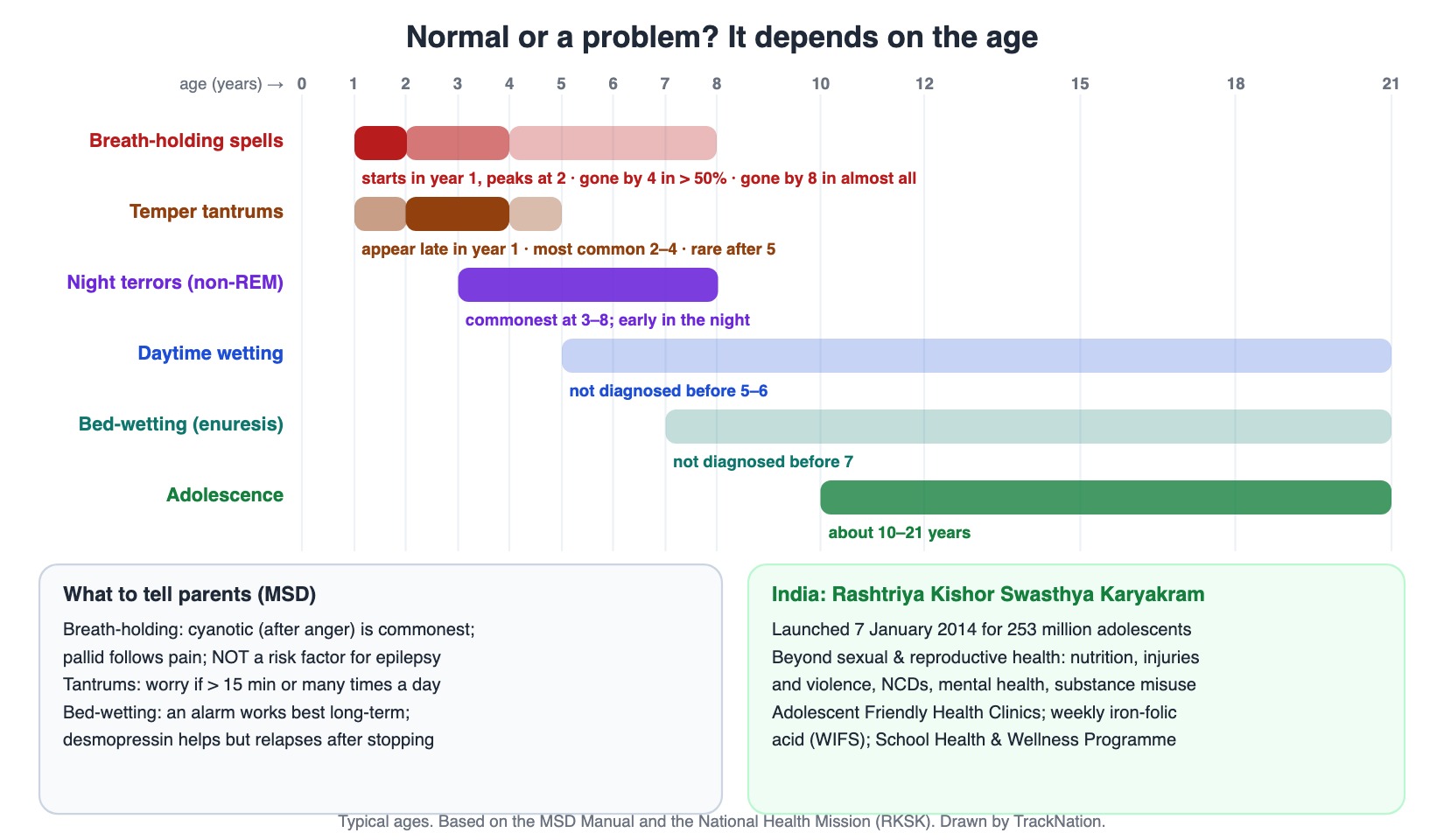
When breath-holding, tantrums, night terrors and wetting are normal, adolescence, and India's adolescent programme. Drawn by TrackNation.
Breath-Holding Spells and Tantrums (MSD)
Breath-holding spell: the child stops breathing involuntarily and briefly loses consciousness after being upset or hurt; 0.1–5% of healthy children. Starts in the first year, peaks at 2, gone by 4 in over half and by 8 in almost all. Spells last 10–60 seconds.
Cyanotic (commonest) follows anger, a tantrum or scolding; pallid follows pain (e.g. a fall and a bang on the head). They are not a risk factor for epilepsy.
Temper tantrums appear late in year 1, peak at 2–4 ("terrible twos") and are rare after 5. Causes: frustration, tiredness, boredom, hunger, seeking attention. Suspect an underlying problem only if they last >15 minutes or happen many times a day. A time-out in a safe place often works.
Sleep, Wetting, Eating and Maltreatment (MSD)
Night terrors: non-REM partial awakening with extreme fear, in the first hours of sleep, commonest at 3–8 years; a third also sleepwalk; they stop on their own. Nightmares happen in REM sleep and the child can recall them.
Wetting: daytime incontinence is not diagnosed before 5–6 (more in girls); enuresis (bed-wetting) not before 7 (more in boys). Secondary wetting after ≥6 months dry makes an organic cause more likely. The best long-term treatment is a bed-wetting alarm; desmopressin and imipramine reduce wetting but relapse after stopping.
Fussy eating: plot growth — showing a normal chart often settles worry. Persistent worry about appearance suggests body dysmorphic disorder.
Child maltreatment (under 18): physical, sexual and emotional abuse and neglect. Physical abuse is the commonest cause of serious head injury in infants.
Adolescence and RKSK (MSD, NHM)
Adolescence spans about 10–21 years: rapid growth (girls' spurt about 9½–13½), puberty and psychosocial change; mental illness often emerges now; injuries lead deaths and disability. Keep consultations confidential.
Anorexia nervosa: relentless pursuit of thinness, fear of obesity, distorted body image, restricted intake → bradycardia, hypotension, hypothermia, lanugo, amenorrhoea. Bulimia nervosa: binges then purging, at least weekly for 3 months → eroded front-tooth enamel, painless parotid swelling, scars on the back of the hand.
India — RKSK: launched 7 January 2014 for 253 million adolescents; widens care beyond sexual and reproductive health to nutrition, injuries and violence, NCDs, mental health and substance misuse; runs Adolescent Friendly Health Clinics, Weekly Iron Folic Acid Supplementation (WIFS), the Menstrual Hygiene Scheme and peer educators. The School Health & Wellness Programme (February 2020) trains two teachers per school as Health and Wellness Ambassadors on 11 themes.
Traps the Examiner Sets
Breath-holding spells are involuntary and do not lead to epilepsy.
Night terrors are non-REM and early in the night; nightmares are REM and later.
Enuresis is not diagnosed before age 7; the alarm beats desmopressin long-term.
Painless parotid swelling and eroded front teeth point to bulimia, not anorexia.
RKSK began in 2014; the School Health & Wellness Programme in 2020.
Memory Hooks & Shortcuts
Shortcuts to lock in this article's numbers and lists. Each one only re-packages facts proven above.
🧠 'Blue when Bad, Pale when in Pain' — cyanotic after anger, pallid after a fall — breath-holding
🧠 Breath-holding '1-2-4-8': starts in 1, peaks at 2, half gone by 4, all gone by 8 — breath-holding
🧠 'Terrors are Too early to Remember' — non-REM, first hours, not recalled — sleep
🧠 'Seven for the Sheets' — enuresis not diagnosed before 7; 'Alarm Always' for long-term cure — enuresis
🧠 'Bulimia Bulges the parotids' — painless parotid swelling with eroded enamel — eating disorders
Rapid-Revision Cards
Breath-holding
Involuntary; 0.1–5%; year 1 → peak 2 → gone by 8.
Cyanotic BHS
Commonest; after anger/scolding.
Pallid BHS
After pain (fall, bang).
BHS and epilepsy
Not a risk factor.
Tantrums
Peak 2–4; rare after 5.
Abnormal tantrum
> 15 min or many times a day.
Night terrors
Non-REM; early night; 3–8 yr; not recalled.
Nightmares
REM; later; recalled.
Sleepwalking
1/3 of night-terror children.
Daytime wetting
Diagnose from 5–6; girls.
Enuresis
Diagnose from 7; boys.
Best for enuresis
Bed-wetting alarm.
Desmopressin
Works; relapse on stopping.
Secondary wetting
After ≥6 mo dry; organic cause likelier.
Infant head injury
Physical abuse commonest.
Adolescence (MSD)
≈10–21 years.
Anorexia signs
Bradycardia, hypothermia, lanugo, amenorrhoea.
Bulimia signs
Parotids, enamel, hand scars; weekly × 3 mo.
RKSK
7 Jan 2014; 253 million; AFHCs.
RKSK themes
SRH + nutrition, injury/violence, NCD, mental health, substances.
SHWP
Feb 2020; 2 teachers; 11 themes; WIFS.
Sources
Facts in this article were checked against these documents.
MSD Manual Professional: Breath-Holding Spells; Temper Tantrums; Eating Behavior in Children; Sleep Problems in Children; Urinary Incontinence in Children; Overview of Child Maltreatment; Introduction to Health Care Issues in Adolescents; Anorexia Nervosa; Bulimia Nervosa — Merck & Co., 2025–2026 (link)
Rashtriya Kishor Swasthya Karyakram (RKSK) and School Health & Wellness Programme — National Health Mission, MoHFW, accessed 2026 (link)
Test Yourself: Practice Questions
Thirty questions in NEET PG style, many of them clinic scenarios.
Practice Questions (NEET PG pattern)
Original questions written in the style of the exam: +4 for a correct answer, −1 for a wrong one. Every answer was checked against the sources listed above. NEET PG papers are not published by NBEMS, so these are not past-paper questions.
Q1. A 2-year-old, scolded by his mother, cries, turns blue and stops breathing for 20 seconds, then recovers. The likely diagnosis is
(a) pallid breath-holding spell
(b) cyanotic breath-holding spell
(c) absence seizure
(d) febrile seizure
Show answer
Answer: (b) — Follows anger or scolding.
Q2. Pallid breath-holding spells typically follow
(a) a painful experience such as a fall
(b) fever
(c) feeding
(d) a temper tantrum
Show answer
Answer: (a) — MSD.
Q3. Breath-holding spells usually peak at age
(a) 2 years
(b) 5 years
(c) 6 months
(d) 10 years
Show answer
Answer: (a) — Start in year 1.
Q4. By what age have breath-holding spells stopped in almost all children?
(a) 2 years
(b) 4 years
(c) 8 years
(d) 12 years
Show answer
Answer: (c) — > 50% by 4.
Q5. Regarding breath-holding spells and epilepsy,
(a) they need an EEG always
(b) they are not a risk factor for epilepsy
(c) they cause epilepsy
(d) they need antiepileptics
Show answer
Answer: (b) — MSD.
Q6. Temper tantrums are most common at
(a) 6–8 years
(b) 10 years
(c) 6–12 months
(d) 2–4 years
Show answer
Answer: (d) — Rare after 5.
Q7. A tantrum suggests an underlying problem if it
(a) follows hunger
(b) occurs at age 2
(c) lasts more than 15 minutes or occurs many times a day
(d) happens once a week
Show answer
Answer: (c) — MSD.
Q8. Night terrors occur in
(a) non-REM sleep, early in the night
(b) wakefulness
(c) REM sleep, late in the night
(d) REM sleep, early
Show answer
Answer: (a) — Ages 3–8.
Q9. Night terrors are most common at
(a) 3–8 years
(b) adulthood
(c) under 1 year
(d) 12–15 years
Show answer
Answer: (a) — MSD.
Q10. A child wakes frightened and clearly recalls a frightening dream. This is a
(a) seizure
(b) nightmare (REM sleep)
(c) sleepwalking
(d) night terror
Show answer
Answer: (b) — Night terrors aren't recalled.
Q11. About what fraction of children with night terrors also sleepwalk?
(a) all
(b) none
(c) one-third
(d) one-tenth
Show answer
Answer: (c) — MSD.
Q12. Enuresis (bed-wetting) is usually not diagnosed before age
(a) 5
(b) 3
(c) 7
(d) 10
Show answer
Answer: (c) — Daytime: 5–6.
Q13. Enuresis is more common in
(a) adolescents only
(b) neither
(c) boys
(d) girls
Show answer
Answer: (c) — Daytime wetting more in girls.
Q14. The most effective long-term treatment for enuresis without an organic cause is
(a) a bed-wetting alarm
(b) fluid restriction alone
(c) desmopressin
(d) imipramine
Show answer
Answer: (a) — MSD.
Q15. After desmopressin for enuresis is stopped,
(a) an alarm is no longer needed
(b) wetting usually returns
(c) the cure is permanent
(d) the child develops diabetes insipidus
Show answer
Answer: (b) — MSD.
Q16. A 9-year-old dry for a year starts wetting again. Compared with primary wetting,
(a) an organic cause is more likely
(b) it never needs evaluation
(c) it is always psychological
(d) an organic cause is less likely
Show answer
Answer: (a) — Secondary incontinence.
Q17. Parents worry their 3-year-old 'eats nothing', but the growth chart is normal. The best step is
(a) admit for feeding
(b) order endoscopy
(c) start appetite stimulants
(d) show the chart and reassure
Show answer
Answer: (d) — MSD.
Q18. The commonest cause of serious head injury in infants is
(a) road accidents
(b) physical abuse
(c) falls from a bed
(d) birth trauma
Show answer
Answer: (b) — MSD.
Q19. Child maltreatment includes abuse and neglect of children under
(a) 21 years
(b) 12 years
(c) 5 years
(d) 18 years
Show answer
Answer: (d) — Four types.
Q20. MSD defines adolescence as roughly
(a) 15–25 years
(b) 10–21 years
(c) 13–15 years
(d) 5–12 years
Show answer
Answer: (b) — MSD.
Q21. A thin 15-year-old girl with amenorrhoea has bradycardia, hypothermia and fine lanugo hair. The likely diagnosis is
(a) bulimia nervosa
(b) anorexia nervosa
(c) Turner syndrome
(d) hyperthyroidism
Show answer
Answer: (b) — MSD.
Q22. Painless parotid swelling and eroded front-tooth enamel suggest
(a) bulimia nervosa
(b) Sjögren syndrome
(c) mumps
(d) anorexia nervosa
Show answer
Answer: (a) — From self-induced vomiting.
Q23. Bulimia nervosa requires binges with compensation at least
(a) monthly for 1 year
(b) once a week for 3 months
(c) twice in a lifetime
(d) daily for 1 month
Show answer
Answer: (b) — MSD.
Q24. Scars on the back of the hand in a teenager suggest
(a) self-harm only
(b) eczema
(c) self-induced vomiting (bulimia)
(d) scabies
Show answer
Answer: (c) — From self-induced vomiting.
Q25. RKSK was launched on
(a) 7 January 2014
(b) 2 October 2014
(c) 15 August 2005
(d) 1 April 2018
Show answer
Answer: (a) — MoHFW.
Q26. RKSK aims to reach about
(a) 25 million adolescents
(b) 1 billion adolescents
(c) 100 million children under 5
(d) 253 million adolescents
Show answer
Answer: (d) — NHM.
Q27. RKSK widened adolescent care beyond sexual and reproductive health to include
(a) only immunisation
(b) only school exams
(c) nutrition, injuries and violence, NCDs, mental health and substance misuse
(d) only maternal health
Show answer
Answer: (c) — NHM.
Q28. Under the School Health & Wellness Programme, each school has
(a) a nurse only
(b) two teachers as Health and Wellness Ambassadors
(c) one peer educator
(d) a full-time doctor
Show answer
Answer: (b) — 11 themes, weekly.
Q29. The School Health & Wellness Programme was launched in
(a) 2005
(b) January 2014
(c) February 2020
(d) 2010
Show answer
Answer: (c) — Under Ayushman Bharat.
Q30. WIFS under RKSK stands for
(a) Weekly Iron Folic Acid Supplementation
(b) Women's Iron Food Scheme
(c) Weekly Immunisation For Schools
(d) Winter Iron Fortification Scheme
Show answer
Answer: (a) — NHM.
Active Recall
From memory: describe breath-holding spells and their two types, when tantrums are abnormal, night terrors versus nightmares, when and how enuresis is diagnosed and treated, signs of anorexia and bulimia, child maltreatment, and the main features of RKSK.