Cell: The Unit of Life — Part B (NEET Biology Class 11): Organelles & the Nucleus
Endomembrane System: ER, Golgi, Lysosomes & Vacuoles
🎯 NEET priority: High-yield. 5–7 questions every year — this is Part B, the organelle-heavy half of the chapter. Mitochondria, plastids, ribosomes and the nucleus are among the most repeated single-fact questions in all of NEET Biology.
The endomembrane system is the set of organelles whose functions are coordinated together: endoplasmic reticulum (ER), Golgi apparatus, lysosomes and vacuoles. Mitochondria, plastids and peroxisomes are NOT part of the endomembrane system — their functions aren't coordinated with it.
Endoplasmic Reticulum & Golgi apparatus
ER is a network of tubules dividing the cell into a luminal (inside ER) and extra-luminal (cytoplasm) space. Rough ER (RER) bears ribosomes and is abundant in cells active in protein synthesis/secretion; smooth ER (SER) lacks ribosomes and is the major site of lipid synthesis (and, in animal cells, steroidal hormones).
Camillo Golgi (1898) first described the Golgi apparatus: stacked, flat disc-shaped cisternae near the nucleus, with a convex cis (forming) face and a concave trans (maturing) face. Vesicles from the ER fuse at the cis face; the Golgi packages material (and modifies ER-made proteins) and is the chief site of glycoprotein and glycolipid formation.
Lysosomes & Vacuoles
Lysosomes are membrane-bound vesicles packaged by the Golgi, rich in hydrolytic enzymes (lipases, proteases, carbohydrases) that work best at acidic pH and can digest carbohydrates, proteins, lipids and nucleic acids.
A vacuole is bound by a single membrane called the tonoplast; in plant cells it can occupy up to 90 per cent of cell volume, and the tonoplast actively concentrates ions/materials inside against a gradient. In Amoeba, the contractile vacuole handles osmoregulation and excretion; food vacuoles form in protists by engulfing food particles.
Mitochondria & Plastids — the Semi-Autonomous Organelles
Mitochondria — the "power house"
Mitochondria are double membrane-bound: the outer membrane is the smooth continuous boundary; the inner membrane folds inward into cristae, which increase surface area. The inner compartment is filled with a dense matrix.
Mitochondria are the site of aerobic respiration and produce cellular energy as ATP — hence "power houses of the cell." The matrix has its own single circular DNA, some RNA, and 70S ribosomes — mitochondria can make some of their own proteins and divide by fission, independent of the cell cycle.
Plastids — chloroplast, chromoplast, leucoplast
Plastids occur in all plant cells and euglenoids, classified by pigment into three types: chloroplasts (chlorophyll + carotenoids, trap light for photosynthesis), chromoplasts (fat-soluble carotenoids — carotene, xanthophylls — give yellow/orange/red colour), and leucoplasts (colourless, store nutrients): amyloplasts store starch (e.g. potato), elaioplasts store oils and fats, aleuroplasts store proteins.
Like mitochondria, chloroplasts are double membrane-bound. The space inside the inner membrane is the stroma, containing flattened sacs called thylakoids, stacked like coins into grana (singular granum) and linked between grana by stroma lamellae. Chlorophyll sits in the thylakoids; the stroma holds enzymes for carbohydrate/protein synthesis plus its own circular DNA and 70S ribosomes — smaller than the 80S ribosomes in the surrounding cytoplasm.
Mitochondria vs chloroplast — the semi-autonomous organelles, side by side
Feature | Mitochondria | Chloroplast |
Membrane | Double — outer smooth, inner folded into cristae | Double — inner encloses the stroma |
Inner compartment | Matrix | Stroma, with stacked thylakoids (grana) |
Own DNA/ribosomes | Circular DNA + 70S ribosomes | Circular DNA + 70S ribosomes |
Function | Aerobic respiration, produces ATP | Photosynthesis, traps light energy |
Found in | Almost all eukaryotic cells | Plant cells and euglenoids only |
Ribosomes, Cytoskeleton, Cilia/Flagella & Centrosome
Ribosomes, cytoskeleton, cilia/flagella & centrosome
Ribosomes were first seen by George Palade (1953) under the electron microscope; they are made of rRNA and protein, and are NOT membrane-bound. Eukaryotic ribosomes are 80S (60S + 40S subunits); prokaryotic ribosomes (and those inside mitochondria/chloroplasts) are 70S (50S + 30S). "S" is the Svedberg unit — a sedimentation coefficient, not a simple size measure (so 80S ≠ 70S + 10S).
The cytoskeleton — microtubules, microfilaments and intermediate filaments — gives mechanical support, motility and shape. Cilia (short, oar-like) and flagella (longer, for cell movement) are membrane-covered outgrowths whose core, the axoneme, has a 9+2 array: 9 peripheral microtubule doublets around 2 central microtubules, linked by radial spokes; both emerge from a basal body.
The centrosome usually has two centrioles lying perpendicular to each other, each a cartwheel of nine peripheral triplet fibrils of tubulin. Centrioles form the basal body of cilia/flagella and, in animal cells, the spindle apparatus during cell division. Centrioles are absent in almost all plant cells.
The Nucleus & Chromosomes, and Why This Matters for NEET
Organelle quick-reference — the match-the-pair table
Organelle | Membrane | Signature function | The NEET hook |
Rough ER | Single | Protein synthesis and transport | Bears ribosomes on its surface |
Smooth ER | Single | Lipid and steroid synthesis | NO ribosomes; abundant in liver cells |
Golgi apparatus | Single | Packaging, glycosylation, secretion | Cis face receives, trans face ships out |
Lysosome | Single | Intracellular digestion | 'Suicide bag'; hydrolases work at acidic pH |
Mitochondrion | Double | Aerobic respiration, ATP | Cristae + 70S ribosomes + circular DNA |
Chloroplast | Double | Photosynthesis | Grana + stroma + 70S ribosomes + circular DNA |
Ribosome | None | Protein synthesis | 80S in cytoplasm, 70S in mitochondria/plastids |
Peroxisome | Single | Breaks down H₂O₂ via catalase | Photorespiration in plants |
Glyoxysome | Single | Converts fat to carbohydrate | Only in fat-storing plant seeds |
Centriole | None | Forms spindle and basal bodies | 9 + 0 cartwheel — NOT 9 + 2 |
Exam trap. Centriole is 9 + 0; cilium and flagellum are 9 + 2. NEET swaps these two arrays constantly. The other perennial swap is the ribosome pair: the cytoplasm has 80S, but mitochondria and chloroplasts carry 70S — the evidence for their bacterial ancestry.
Nucleus & chromosomes
Robert Brown (1831) first described the nucleus; its stained material was later named chromatin by Flemming. A double-membraned nuclear envelope (with a perinuclear space between the two membranes, continuous with the ER and bearing ribosomes) separates the nucleus from the cytoplasm, interrupted by nuclear pores that let RNA and proteins pass both ways. Mature RBCs (in many mammals) and sieve tube cells lack a nucleus entirely.
Inside: chromatin (loose nucleoprotein fibres of DNA + histone and non-histone proteins + RNA) and one or more nucleoli — NOT membrane-bound, and the site of ribosomal RNA synthesis. A single human cell packs about 2 metre of DNA into 46 chromosomes (23 pairs).
During division, chromatin condenses into visible chromosomes, each with a primary constriction, the centromere, flanked by disc-shaped kinetochores. By centromere position, chromosomes are metacentric (middle, equal arms), sub-metacentric (slightly off centre, unequal arms), acrocentric (near one end, one very long + one very short arm) or telocentric (terminal centromere). A non-staining secondary constriction can appear as a small fragment called a satellite.
Why this matters for NEET
High-value one-liners: mitochondria & chloroplasts are double membrane-bound, semi-autonomous (own circular DNA + 70S ribosomes); ER divides into RER (protein) vs SER (lipid); Golgi has a cis (forming) and trans (maturing) face; nucleolus is not membrane-bound; four chromosome types by centromere position.
Trap: mitochondria/plastids/peroxisomes are NOT part of the endomembrane system — only ER, Golgi, lysosomes and vacuoles are. Eukaryotic cytoplasmic ribosomes are 80S, but the ribosomes inside a mitochondrion or chloroplast are 70S, same as a bacterium's — a classic "which organelle is this describing" trap. Cilia/flagella use a 9+2 array, NOT 9+0 (that's the sperm's basal body/centriole pattern in some other contexts) — don't confuse the axoneme count with the centriole's nine triplets (no central pair in a centriole).
Test Yourself: MCQs, PYQs & Active Recall
Answer these, then close the article and do an Active Recall. Reveal each answer only after you commit to one.
Practice Questions
Q1. Which of the following is NOT part of the endomembrane system?
(a) Lysosomes
(b) Golgi apparatus
(c) Mitochondria
(d) Endoplasmic reticulum
Show answer
Answer: (c) — Mitochondria, plastids and peroxisomes are excluded from the endomembrane system since their functions aren't coordinated with ER/Golgi/lysosomes/vacuoles.
Q2. Rough endoplasmic reticulum is abundant in cells that are actively involved in:
(a) Photosynthesis
(b) Digestion
(c) Protein synthesis and secretion
(d) Lipid synthesis only
Show answer
Answer: (c) — RER bears ribosomes and is extensive in cells actively making and secreting proteins.
Q3. The Golgi apparatus was first described by:
(a) Camillo Golgi
(b) Rudolf Virchow
(c) Robert Brown
(d) George Palade
Show answer
Answer: (a) — Camillo Golgi (1898) first observed the densely stained reticular structures later named after him.
Q4. Hydrolytic enzymes inside a lysosome work best at:
(a) Alkaline pH
(b) Neutral pH
(c) Any pH equally
(d) Acidic pH
Show answer
Answer: (d) — Lysosomal hydrolases (lipases, proteases, carbohydrases) are optimally active at acidic pH.
Q5. The single membrane bounding a plant cell's vacuole is called the:
(a) Sarcolemma
(b) Plasmalemma
(c) Tonoplast
(d) Nuclear envelope
Show answer
Answer: (c) — The vacuole is bound by a single membrane, the tonoplast, which can also concentrate solutes against a gradient.
Q6. Mitochondria are called the 'power house of the cell' because they:
(a) Synthesise lipids
(b) Store starch
(c) Digest macromolecules
(d) Produce ATP through aerobic respiration
Show answer
Answer: (d) — Mitochondria are the site of aerobic respiration, generating ATP for cellular energy.
Q7. The infoldings of the inner mitochondrial membrane are called:
(a) Cisternae
(b) Cristae
(c) Thylakoids
(d) Grana
Show answer
Answer: (b) — The inner mitochondrial membrane folds inward to form cristae, increasing surface area.
Q8. A leucoplast that stores starch is specifically called a/an:
(a) Amyloplast
(b) Elaioplast
(c) Aleuroplast
(d) Chromoplast
Show answer
Answer: (a) — Amyloplasts store carbohydrates as starch, e.g. in potato; elaioplasts store oils/fats and aleuroplasts store proteins.
Q9. Grana in a chloroplast are stacks of:
(a) Ribosomes
(b) Cisternae
(c) Cristae
(d) Thylakoids
Show answer
Answer: (d) — Thylakoids, flattened membranous sacs in the stroma, are stacked like coins into grana.
Q10. Eukaryotic cytoplasmic ribosomes are:
(a) 50S only
(b) 60S only
(c) 70S, made of 50S and 30S
(d) 80S, made of 60S and 40S
Show answer
Answer: (d) — Eukaryotic ribosomes are 80S (60S+40S); prokaryotic ribosomes, and those inside mitochondria/chloroplasts, are 70S (50S+30S).
Q11. The axoneme of a cilium or flagellum shows which arrangement of microtubules?
(a) 9 + 0
(b) 9 + 2
(c) 11 + 0
(d) 2 + 9
Show answer
Answer: (b) — The axoneme has 9 peripheral microtubule doublets surrounding 2 central microtubules — the 9+2 array.
Q12. A chromosome with a centromere positioned near one end, giving one very long and one very short arm, is:
(a) Acrocentric
(b) Sub-metacentric
(c) Telocentric
(d) Metacentric
Show answer
Answer: (a) — Acrocentric chromosomes have the centromere close to one end; telocentric has a strictly terminal centromere.
Q13. Which organelle is called the 'suicide bag' of the cell, and why?
(a) Golgi body — it destroys damaged proteins
(b) Peroxisome — it accumulates hydrogen peroxide
(c) Lysosome — it is packed with hydrolytic enzymes that can digest the cell itself
(d) Mitochondrion — it releases heat
Show answer
Answer: (c) — Lysosomes are formed by the Golgi and are filled with hydrolases — lipases, proteases, carbohydrases — that work at acidic pH. If the membrane ruptures, these enzymes digest the cell's own contents, hence the name.
Q14. The cis face and trans face of the Golgi apparatus are respectively:
(a) The maturing face and the forming face
(b) The forming face receiving vesicles, and the maturing face shipping them out
(c) Both faces receive vesicles from the ER
(d) Both faces are attached to the nuclear envelope
Show answer
Answer: (b) — Material enters at the convex cis (forming) face nearest the ER and leaves from the concave trans (maturing) face. The two faces are entirely different in composition — the Golgi is the cell's dispatch department.
Q15. Which of the following is NOT part of the endomembrane system?
(a) Lysosome
(b) Endoplasmic reticulum
(c) Golgi complex
(d) Mitochondrion
Show answer
Answer: (d) — The endomembrane system comprises the ER, Golgi complex, lysosomes and vacuoles — organelles whose functions are coordinated. Mitochondria, chloroplasts and peroxisomes are excluded because their functions are not coordinated with this system.
Q16. The enzyme catalase, which breaks down hydrogen peroxide, is characteristic of:
(a) Lysosomes
(b) Glyoxysomes
(c) Peroxisomes
(d) Ribosomes
Show answer
Answer: (c) — Peroxisomes contain catalase to detoxify hydrogen peroxide, a toxic by-product of oxidative metabolism. In plants they also carry out photorespiration. Glyoxysomes are the separate fat-to-carbohydrate bodies of germinating oilseeds.
Q17. Smooth endoplasmic reticulum differs from rough ER in that it:
(a) Lacks ribosomes and is the site of lipid and steroid synthesis
(b) Bears ribosomes and synthesises proteins
(c) Is found only in prokaryotes
(d) Is bounded by a double membrane
Show answer
Answer: (a) — Smooth ER has no ribosomes on its surface and specialises in lipid and steroid synthesis — which is why it is abundant in liver cells and in steroid-secreting glands. Rough ER, studded with ribosomes, handles protein synthesis and transport.
Q18. Which structures in a chloroplast contain the chlorophyll pigment?
(a) The intermembrane space
(b) Thylakoid membranes stacked as grana
(c) The stroma
(d) The outer membrane
Show answer
Answer: (b) — Chlorophyll sits in the thylakoid membranes, which stack into grana — this is where the light reactions occur. The stroma is the surrounding fluid where the dark (carbon-fixing) reactions take place, and it also holds circular DNA and 70S ribosomes.
Q19. The theory that mitochondria and chloroplasts evolved from free-living prokaryotes is supported by all of the following EXCEPT:
(a) Their enclosure by a single membrane
(b) Their ability to divide independently of the cell
(c) The presence of 70S ribosomes
(d) The presence of circular naked DNA
Show answer
Answer: (a) — Both organelles are bounded by a DOUBLE membrane, not a single one — and that double membrane is itself part of the endosymbiotic evidence. Circular DNA, 70S ribosomes and independent division are the other three classic supports.
Q20. In a metacentric chromosome, the centromere is located:
(a) Slightly off centre, forming unequal arms
(b) In the middle, forming two equal arms
(c) Near one end, forming one long and one short arm
(d) At the very terminal end
Show answer
Answer: (b) — Metacentric means a middle centromere and two equal arms. Sub-metacentric is slightly off centre giving unequal arms, acrocentric places it near one end, and telocentric puts it strictly at the terminal end.
Q21. In the mitochondrion shown, the enzymes of the Krebs (TCA) cycle are located in the region marked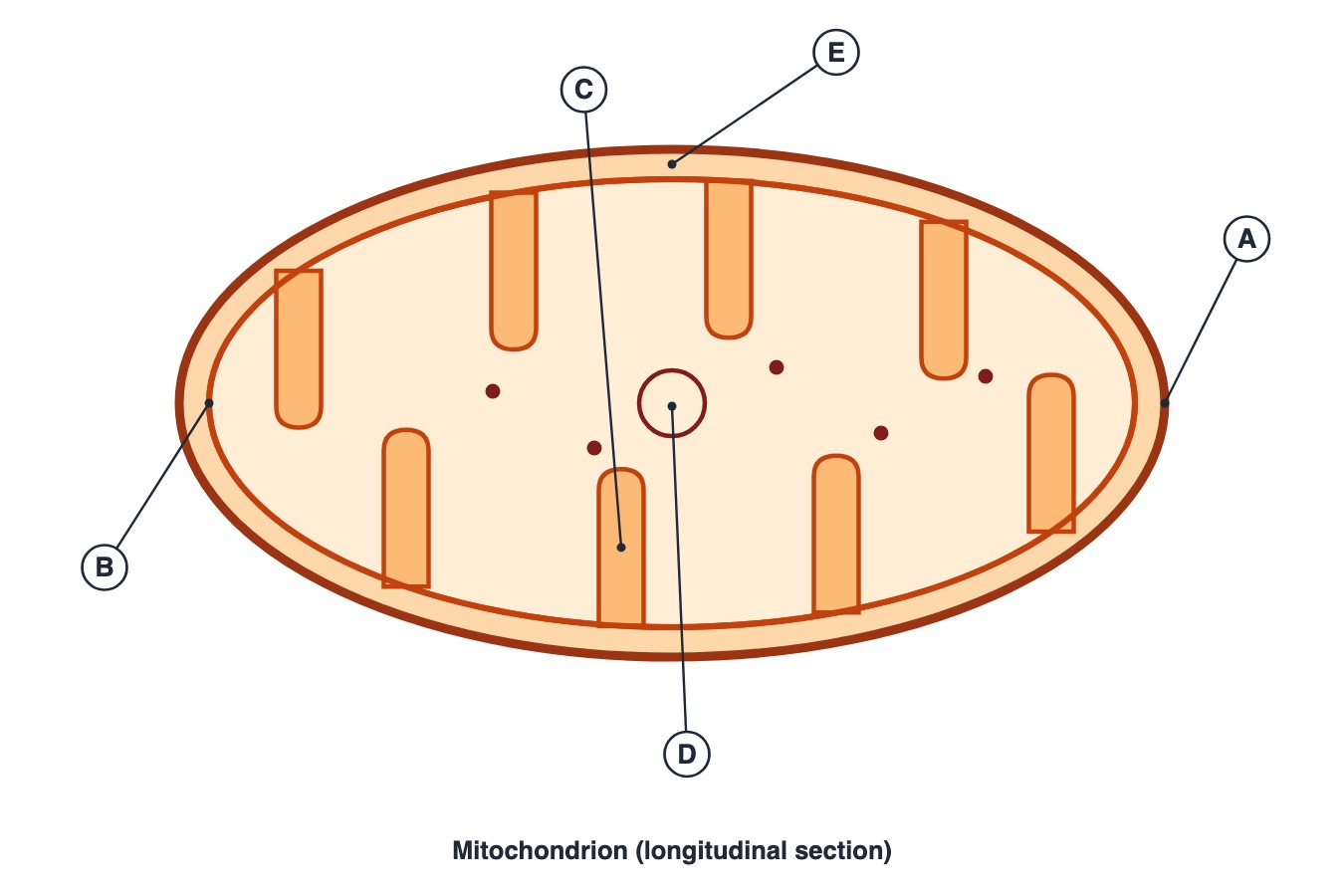
(a) A
(b) E
(c) D
(d) B
Show answer
Answer: (c) — D is the matrix, which contains the enzymes of the Krebs cycle, the mitochondrial DNA, ribosomes and the enzymes for fatty-acid oxidation. The electron transport chain sits on the inner membrane (B and its folds).
Q22. The space marked E in the figure, lying between the two membranes, is called the
(a) Matrix
(b) Intermembrane (perimitochondrial) space
(c) Stroma
(d) Lumen of the cristae
Show answer
Answer: (b) — A mitochondrion has two membranes separated by an intermembrane space. The matrix lies inside the inner membrane; the stroma is a chloroplast term.
Q23. The finger-like structures marked C, which increase the surface area for ATP synthesis, are folds of the membrane marked
(a) D
(b) E
(c) B
(d) A
Show answer
Answer: (c) — Cristae [C] are infoldings of the inner mitochondrial membrane [B]. They carry the electron transport chain and ATP synthase, so folding increases the area available.
NEET Previous Year Questions (PYQs)
Real NEET previous-year questions on this chapter, with explanations in our own words.
Q24. The organelle that is NOT considered part of the endomembrane system is: (NEET PYQ)
(a) Endoplasmic reticulum
(b) Peroxisome
(c) Lysosome
(d) Golgi apparatus
Show answer
Answer: (b) — Peroxisomes (like mitochondria and plastids) are excluded from the endomembrane system.
Q25. Mitochondria and chloroplasts both possess: (NEET PYQ)
(a) A single membrane and 80S ribosomes
(b) Only a single membrane
(c) No DNA of their own
(d) A double membrane, their own circular DNA and 70S ribosomes
Show answer
Answer: (d) — Both are double membrane-bound, semi-autonomous organelles with their own circular DNA and 70S ribosomes.
Q26. The site of light reactions within a chloroplast is the: (NEET PYQ)
(a) Stroma
(b) Matrix
(c) Outer membrane
(d) Grana (thylakoids)
Show answer
Answer: (d) — Light reactions occur in the thylakoid membranes stacked as grana; dark reactions (Calvin cycle) occur in the stroma.
Q27. Nucleolus is best described as: (NEET PYQ)
(a) A type of chromatin only found during division
(b) The outer layer of the nucleus
(c) A membrane-bound organelle for lipid storage
(d) A non-membrane bound site of ribosomal RNA synthesis
Show answer
Answer: (d) — The nucleolus is not membrane-bound and is the site of active ribosomal RNA synthesis.
Q28. A chromosome with the centromere exactly in the middle, forming two equal arms, is called: (NEET PYQ)
(a) Sub-metacentric
(b) Acrocentric
(c) Metacentric
(d) Telocentric
Show answer
Answer: (c) — Metacentric chromosomes have a middle centromere giving two equal arms.
Q29. Centrioles in an animal cell give rise to which structure during cell division? (NEET PYQ)
(a) Golgi apparatus
(b) Nucleolus
(c) Cell wall
(d) Spindle apparatus
Show answer
Answer: (d) — Centrioles form the spindle apparatus that helps segregate chromosomes during animal cell division.
Active Recall Prompt
Write everything you can recall about Cell: The Unit of Life (Part B), naming each part first: the endomembrane system (which organelles are IN it and which are NOT); ER (RER vs SER) and the Golgi apparatus (cis/trans face); lysosomes and vacuoles (tonoplast, contractile/food vacuoles); mitochondria (structure, function, own DNA/ribosomes); plastids (the three types, chloroplast structure — grana, stroma, thylakoids); ribosomes (80S vs 70S, subunits); the cytoskeleton, cilia/flagella (9+2 array) and the centrosome (centrioles); and the nucleus (envelope, pores, nucleolus, chromatin, and the four chromosome types by centromere position). Begin each fact with its topic and end it with a full stop.