Childhood Exanthems, Dengue and Child-Health Programmes for NEET PG: Measles, Roseola, Rubella, Chickenpox, Fifth Disease, HFMD, Mumps, SAANS, RBSK
Start Here
🎯 Exam priority: High. Expect: Koplik spots and the timing of the measles rash, infectivity windows, roseola rash after defervescence, causative viruses, chickenpox crops, slapped cheek and aplastic crisis, HFMD sites, mumps complications, dengue warning signs and shock fluids, and what each national child-health campaign does.
Fact-checked against the MSD Manual, the ICMR Standard Treatment Workflow for Dengue Fever (2019), NHM programme pages and RBSK 2.0 (2026). This is the final article of the Paediatrics playlist.
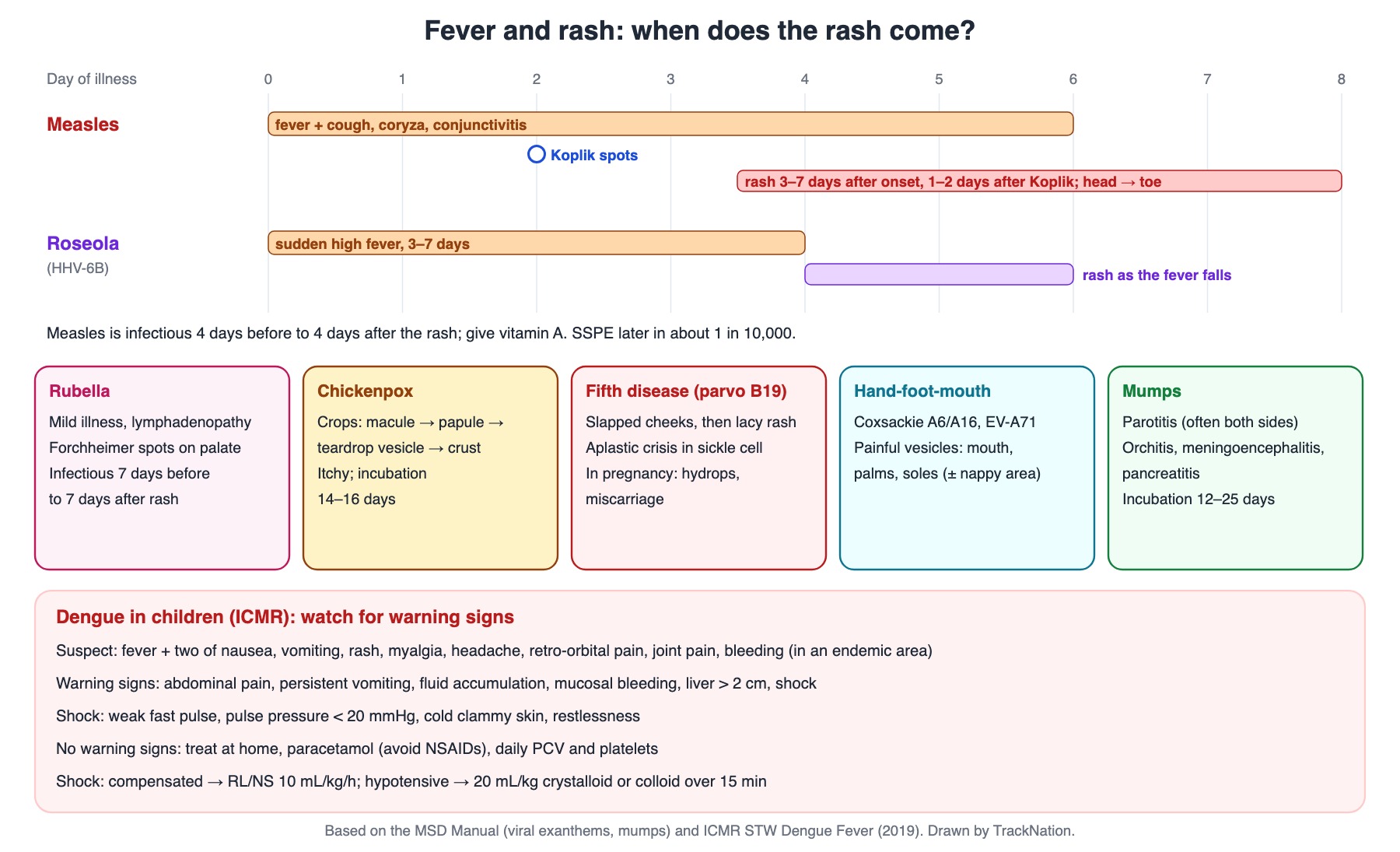
When the rash comes: measles and roseola timelines, other exanthems and dengue warning signs. Drawn by TrackNation.
Measles and Roseola: Timing Is the Clue
Measles: fever with cough, coryza, conjunctivitis; Koplik spots on the buccal mucosa opposite the upper molars during the prodrome; rash 3–7 days after onset (1–2 days after Koplik), spreading head to toe. Infectious 4 days before to 4 days after the rash. Treat supportively and give vitamin A. SSPE is a late complication in about 1 in 10,000.
Roseola (HHV-6B, sometimes HHV-7): sudden high fever for 3–7 days, then the rash appears as the fever falls.
Other Exanthems (MSD)
Rubella: mild; lymphadenopathy, Forchheimer spots on the palate; incubation ~17 days; infectious 7 days before to 7 days after the rash.
Chickenpox: lesions in crops — macule → papule → itchy teardrop vesicle on a red base → crust; incubation 14–16 days.
Erythema infectiosum (fifth disease, parvovirus B19): slapped cheeks then a lacy rash; can cause transient aplastic crisis in sickle cell disease and hydrops fetalis or miscarriage in pregnancy.
Hand-foot-mouth disease: coxsackie A6/A16 and EV-A71; vesicles on mouth, palms and soles (sometimes nappy area).
Mumps: incubation 12–25 days; parotitis (the other side follows in 70%); complications orchitis, meningoencephalitis, pancreatitis; infectious from 7 days before the swelling.
Dengue in Children (ICMR)
Suspect: fever with two of nausea, vomiting, rash, myalgia, headache, retro-orbital pain, arthralgia, bleeding, in an endemic area; tests include CBC with PCV and platelets, tourniquet test, NS1 antigen.
Warning signs: abdominal pain, persistent vomiting, fluid accumulation, mucosal bleeding, liver > 2 cm. Shock: weak fast pulse, pulse pressure < 20 mmHg, cold clammy skin, restlessness.
No warning signs: ambulatory care, paracetamol, avoid NSAIDs, daily PCV and platelets. Compensated shock: RL/NS 10 mL/kg/h; hypotensive shock: 20 mL/kg crystalloid or colloid over 15 minutes, then reassess.
Child-Health Campaigns and Programmes (India)
SAANS (Social Awareness and Action to Neutralize Pneumonia Successfully), launched 2019, raises awareness of pneumonia signs and advocates pneumococcal vaccination (see article 16).
STOP Diarrhoea Campaign: a 2-month drive distributing a co-pack of 2 ORS packets + 14 zinc tablets to under-5 children (see article 09).
RKSK (adolescent health): Adolescent Friendly Health Clinics, Weekly Iron Folic Acid Supplementation, peer educators (see article 03).
RBSK: screens for the 4Ds with referral to DEICs; RBSK 2.0 cites a 41% fall in under-5 mortality (global 18%) and 37% in neonatal mortality (global 15%) over 2014–2024 (article 23). HBNC (12), IMNCI (10) and UIP (11) complete the picture.
Traps the Examiner Sets
Koplik spots come before the measles rash.
Roseola's rash appears after the fever breaks; despite high fever the child is usually alert and active.
Measles: infectious ±4 days; rubella: ±7 days around the rash.
Parvovirus B19 + sickle cell = aplastic crisis.
Dengue: no NSAIDs; pulse pressure < 20 mmHg = shock.
Memory Hooks & Shortcuts
Shortcuts to lock in this article's numbers and lists. Each one only re-packages facts proven above.
🧠 Measles '3 Cs then Koplik then rash' — cough, coryza, conjunctivitis — measles
🧠 Roseola 'fever goes, rose shows' — roseola
🧠 Infectivity: measles ±4, rubella ±7 — infectivity
🧠 Parvo 'slap, lace, and a crisis in sickle' — fifth disease
🧠 Dengue: 'pulse pressure under 20 — shock is plenty'; never NSAIDs — dengue
Rapid-Revision Cards
Measles prodrome
Cough, coryza, conjunctivitis + Koplik.
Measles rash
3–7 d after onset; head → toe.
Measles infectivity
4 d before to 4 d after rash.
Measles Rx
Supportive + vitamin A.
SSPE
~1 in 10,000, late.
Roseola
HHV-6B; fever 3–7 d, rash as fever falls.
Rubella
Mild; Forchheimer spots; ±7 d infectivity.
Chickenpox
Crops; teardrop vesicles; incubation 14–16 d.
Fifth disease
Parvo B19; slapped cheek, lacy rash.
B19 risks
Aplastic crisis (sickle); hydrops.
HFMD
Coxsackie A16/A6, EV-A71; mouth, palms, soles.
Mumps
Parotitis; orchitis, meningoencephalitis, pancreatitis.
Mumps incubation
12–25 days.
Dengue suspect
Fever + 2 features, endemic area.
Dengue warning
Abdominal pain, vomiting, fluid, bleed, liver > 2 cm.
Dengue shock
Pulse pressure < 20 mmHg.
Dengue fever Rx
Paracetamol; no NSAIDs; PCV daily.
Dengue shock fluids
10 mL/kg/h (compensated); 20 mL/kg in 15 min (hypotensive).
SAANS
Pneumonia campaign, 2019.
STOP Diarrhoea
2 ORS + 14 zinc co-pack.
RBSK 2.0
U5MR down 41% (global 18%), 2014–24.
Sources
Facts in this article were checked against these documents.
MSD Manual Professional: Measles; Rubella; Chickenpox; Roseola Infantum; Erythema Infectiosum; Hand-Foot-and-Mouth Disease; Mumps — Merck & Co., 2025–2026 (link)
Standard Treatment Workflow: Dengue Fever — ICMR / Department of Health Research, MoHFW, 2019
SAANS Campaign; STOP Diarrhoea Campaign; Adolescent Health — National Health Mission, MoHFW, 2026 (link)
Rashtriya Bal Swasthya Karyakram (RBSK 2.0): Operational Guidelines — Ministry of Health and Family Welfare, 2026
Test Yourself: Practice Questions
Thirty questions in NEET PG style, many of them OPD scenarios.
Practice Questions (NEET PG pattern)
Original questions written in the style of the exam: +4 for a correct answer, −1 for a wrong one. Every answer was checked against the sources listed above. NEET PG papers are not published by NBEMS, so these are not past-paper questions.
Q1. Koplik spots appear
(a) only in adults
(b) with the rash on the soles
(c) during the prodrome, before the measles rash
(d) after the rash fades
Show answer
Answer: (c) — Opposite upper molars.
Q2. Koplik spots are seen on
(a) the soft palate
(b) the tongue tip
(c) the tonsils
(d) buccal mucosa opposite the first and second upper molars
Show answer
Answer: (d) — MSD.
Q3. The measles rash appears about
(a) on day 1
(b) after 2 weeks
(c) 3–7 days after prodrome onset
(d) before the fever
Show answer
Answer: (c) — 1–2 days after Koplik.
Q4. The measles rash spreads
(a) only on palms and soles
(b) from head to toe (cephalocaudal)
(c) from feet upward
(d) only on the trunk
Show answer
Answer: (b) — MSD.
Q5. A child with measles is infectious from
(a) 4 days before to 4 days after the rash
(b) 2 weeks after
(c) 7 days before to 7 days after
(d) only during the rash
Show answer
Answer: (a) — Rubella is ±7 days.
Q6. Which supplement is given to children with measles?
(a) vitamin D
(b) zinc only
(c) iron
(d) vitamin A
Show answer
Answer: (d) — MSD.
Q7. A late, fatal complication of measles is
(a) subacute sclerosing panencephalitis
(b) aplastic crisis
(c) hydrops
(d) orchitis
Show answer
Answer: (a) — ~1 in 10,000.
Q8. A 10-month-old has 4 days of high fever while alert and active; as the fever settles, a pink rash appears. Cause?
(a) measles
(b) parvovirus B19
(c) HHV-6B (roseola)
(d) rubella
Show answer
Answer: (c) — Rash after defervescence.
Q9. The fever of roseola typically lasts
(a) 3–7 days
(b) 3 weeks
(c) 1 day
(d) it is absent
Show answer
Answer: (a) — Abrupt onset.
Q10. Rubella is infectious from
(a) only during fever
(b) 4 days before to 4 days after
(c) 7 days before to 7 days after the rash
(d) 1 day
Show answer
Answer: (c) — MSD.
Q11. Forchheimer spots (palatal petechiae) are a feature of
(a) measles
(b) rubella
(c) mumps
(d) HFMD
Show answer
Answer: (b) — MSD.
Q12. Average incubation period of rubella is
(a) 3 days
(b) 17 days
(c) 40 days
(d) 6 months
Show answer
Answer: (b) — Range 12–23.
Q13. Lesions of different stages (papules, vesicles, crusts) at the same time suggest
(a) HFMD
(b) roseola
(c) chickenpox
(d) smallpox-like measles
Show answer
Answer: (c) — Crops.
Q14. The chickenpox vesicle is described as
(a) purpuric
(b) teardrop on a red base, itchy
(c) umbilicated, firm
(d) target-shaped
Show answer
Answer: (b) — MSD.
Q15. Incubation of chickenpox averages
(a) 2–3 days
(b) 6 weeks
(c) 14–16 days
(d) 30 days
Show answer
Answer: (c) — Range 10–21.
Q16. 'Slapped cheek' rash followed by a lacy body rash is
(a) measles
(b) erythema infectiosum (parvovirus B19)
(c) roseola
(d) scarlet fever
Show answer
Answer: (b) — MSD.
Q17. A child with sickle cell disease and parvovirus B19 is at risk of
(a) orchitis
(b) transient aplastic crisis
(c) splenomegaly only
(d) SSPE
Show answer
Answer: (b) — MSD.
Q18. Parvovirus B19 in pregnancy can cause
(a) hydrops fetalis
(b) Down syndrome
(c) cleft palate
(d) neural tube defect
Show answer
Answer: (a) — Fetal anaemia.
Q19. Hand-foot-mouth disease is usually caused by
(a) coxsackie A16/A6 and EV-A71
(b) parvovirus
(c) measles virus
(d) HHV-6
Show answer
Answer: (a) — Enteroviruses.
Q20. HFMD vesicles appear on
(a) scalp
(b) trunk only
(c) mouth, palms and soles
(d) face only
Show answer
Answer: (c) — Sometimes nappy area.
Q21. A complication of mumps is
(a) SSPE
(b) orchitis
(c) aplastic crisis
(d) hydrops
Show answer
Answer: (b) — Also meningoencephalitis, pancreatitis.
Q22. Mumps incubation period is
(a) 1–3 days
(b) 12–25 days
(c) 3 months
(d) 6 weeks
Show answer
Answer: (b) — Mostly 16–18 days.
Q23. Dengue is suspected in an endemic area with fever plus
(a) jaundice
(b) two of nausea, vomiting, rash, aches, retro-orbital pain, bleeding
(c) diarrhoea only
(d) cough only
Show answer
Answer: (b) — ICMR.
Q24. Which is a dengue warning sign (ICMR)?
(a) mild rash
(b) liver enlarged > 2 cm
(c) headache
(d) myalgia
Show answer
Answer: (b) — Also abdominal pain, vomiting, bleeding.
Q25. Dengue shock is suggested by a pulse pressure below
(a) 20 mmHg
(b) 10 mmHg only
(c) 60 mmHg
(d) 40 mmHg
Show answer
Answer: (a) — ICMR.
Q26. For fever in dengue, avoid
(a) NSAIDs
(b) oral fluids
(c) tepid sponging
(d) paracetamol
Show answer
Answer: (a) — ICMR.
Q27. Initial fluid in compensated dengue shock (ICMR) is
(a) no fluids
(b) 20 mL/kg over 5 min
(c) RL/NS 10 mL/kg/h
(d) 5% dextrose 50 mL/kg
Show answer
Answer: (c) — Reassess hourly.
Q28. In hypotensive dengue shock, ICMR gives
(a) 20 mL/kg crystalloid or colloid over 15 minutes
(b) 10 mL/kg/h
(c) blood first
(d) oral ORS
Show answer
Answer: (a) — ICMR.
Q29. The STOP Diarrhoea Campaign distributes to under-5 children
(a) 2 ORS packets + 14 zinc tablets
(b) antibiotics
(c) 1 ORS packet only
(d) vitamin A
Show answer
Answer: (a) — 2-month campaign.
Q30. SAANS is a campaign against
(a) childhood pneumonia
(b) measles
(c) malnutrition
(d) diarrhoea
Show answer
Answer: (a) — Launched 2019.
Active Recall
From memory: give the timing of fever, Koplik spots and rash in measles and roseola with infectivity windows, the features of rubella, chickenpox, fifth disease, HFMD and mumps, ICMR dengue warning signs and shock fluids, and what SAANS, STOP Diarrhoea, RKSK and RBSK do.