Childhood Tuberculosis for NEET PG Paediatrics: ICMR Suspicion Criteria, NAAT Samples, Weight-Band Dosing, TB Meningitis and Contact Prophylaxis
Start Here
🎯 Exam priority: Very high. Expect: suspicion criteria (2-2-5-2), samples for NAAT in children, what not to use for diagnosis, 2HRZE + 4HRE vs 2HRZE + 10HRE, pyridoxine, weight bands and mg/kg doses, TBM CSF criteria and steroids, and TPT for under-5 contacts.
Fact-checked against ICMR Standard Treatment Workflows (Paediatric Intrathoracic TB, TB Meningitis, Lymph Node TB, 2022) and NTEP's TB preventive treatment guidelines. The adult NTEP regimen is in Microbiology article 11.
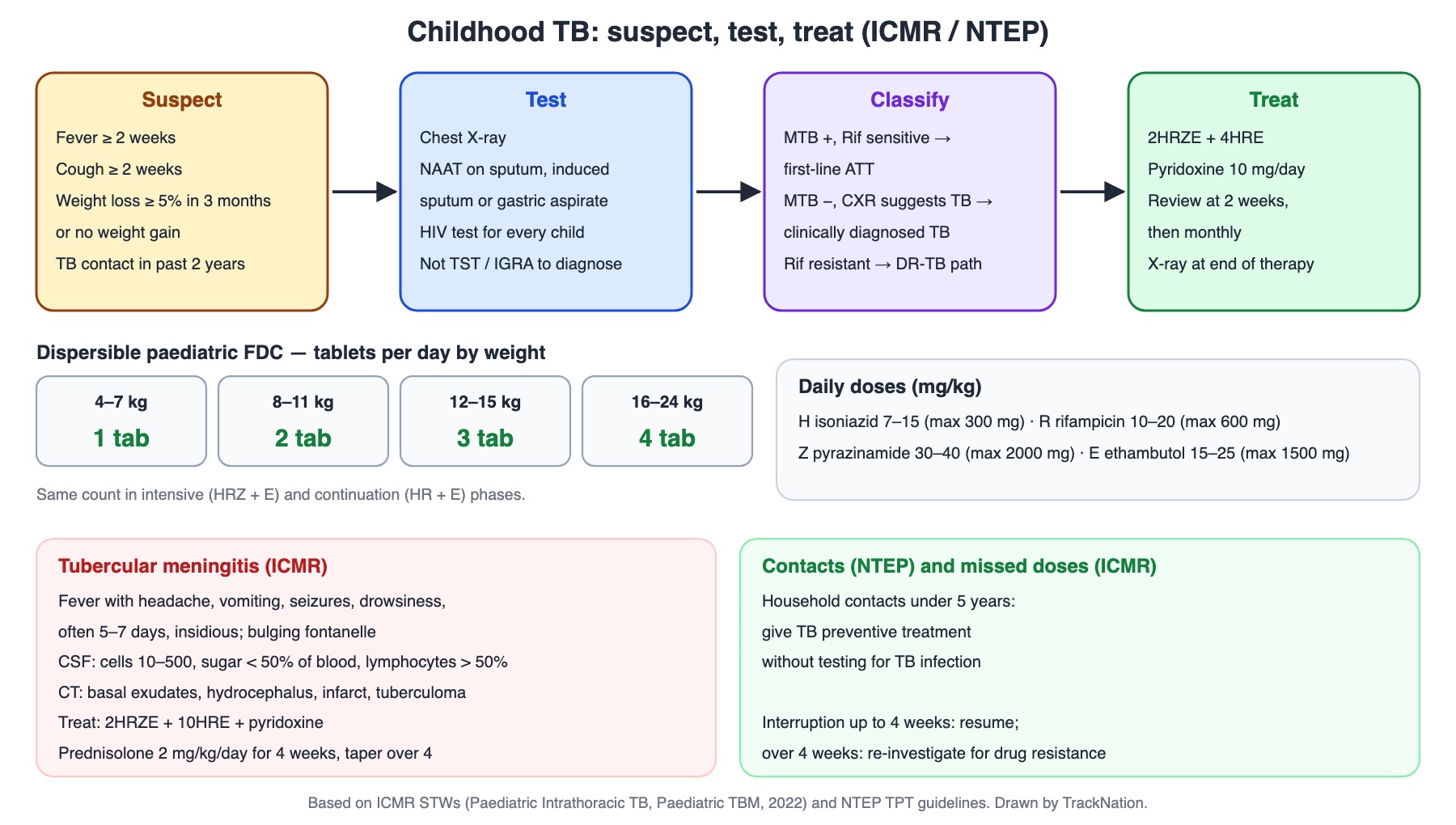
Childhood TB from suspicion to treatment, weight-band tablets, TB meningitis and contacts. Drawn by TrackNation.
When to Suspect and How to Test (ICMR)
Suspect: unexplained fever ≥ 2 weeks, unremitting cough ≥ 2 weeks, weight loss ≥ 5% in 3 months or no gain despite good nutrition (or failed nutritional rehabilitation in SAM), with or without contact in the past 2 years.
Chest X-ray: suggestive — hilar/paratracheal nodes, fibrocavitary disease, miliary pattern; non-specific — effusion, consolidation.
NAAT on sputum, induced sputum or gastric aspirate (pleural fluid if effusion); smear only if NAAT is unavailable; culture if NAAT negative. HIV test every child with TB.
Do not diagnose TB or start ATT on a positive TST/Mantoux alone; do not use IGRA/serology or pleural ADA to diagnose. For non-specific shadows give a trial of amoxicillin/amoxiclav — avoid quinolones and linezolid.
Treatment (ICMR)
Drug-sensitive pulmonary TB (confirmed or clinically diagnosed): 2HRZE + 4HRE, plus pyridoxine 10 mg/day. Rifampicin resistance → DR-TB pathway.
Dispersible paediatric FDCs by weight: 4–7 kg 1, 8–11 kg 2, 12–15 kg 3, 16–24 kg 4 tablets, same in both phases; adult FDCs added from 25 kg.
Doses (mg/kg/day): H 7–15 (max 300), R 10–20 (max 600), Z 30–40 (max 2000), E 15–25 (max 1500).
Steroids (prednisone 2 mg/kg) for selected cases such as miliary TB with hypoxia, endobronchial TB or massive effusion with distress; nutritional support for all.
Monitor at 2 weeks, then monthly; X-ray at the end. Missed doses: interruption up to 4 weeks → resume; over 4 weeks → re-investigate for drug resistance.
TB Meningitis and Lymph Node TB (ICMR)
TBM: fever with headache, vomiting, seizures, drowsiness or focal deficits, usually 5–7 days and insidious; bulging fontanelle; look for choroid tubercles. Criteria include CSF cells 10–500, sugar < 50% of blood, lymphocytes > 50%, TLC < 15,000, and imaging (basal exudates, hydrocephalus, infarct, tuberculoma); risk factors HIV, SAM, recent contact.
Treat: 2HRZE + 10HRE with pyridoxine; prednisolone 2 mg/kg/day for 4 weeks, then taper over 4; anti-oedema measures, anticonvulsants, VP shunt if needed; manage at least at a district hospital.
Lymph node TB: nodes > 2 cm or matted, cold abscess or chronic sinus; aspirate pus or do FNAC and send for NAAT.
Prevention: Contacts (NTEP)
Household contacts under 5 years of a pulmonary TB patient get TB preventive treatment without testing for TB infection (after ruling out active disease).
Traps the Examiner Sets
Mantoux/IGRA positive ≠ TB disease in a child — never the basis for ATT.
Pulmonary TB: 6 months (2+4); TB meningitis: 12 months (2+10) with steroids.
Gastric aspirate or induced sputum for NAAT in young children.
No quinolones or linezolid in a "trial of antibiotics" (ICMR).
Under-5 contacts: TPT without TB infection testing.
Memory Hooks & Shortcuts
Shortcuts to lock in this article's numbers and lists. Each one only re-packages facts proven above.
🧠 Suspect '2-2-5-2': fever 2 wk, cough 2 wk, 5% weight loss, contact 2 yr — suspicion
🧠 'Lungs 6, brain 12': 2HRZE + 4HRE vs 2HRZE + 10HRE — regimens
🧠 Weight bands '4-8-12-16 → 1-2-3-4 tabs' — dosing
🧠 Mantoux is a 'Maybe', NAAT is a 'Now' — diagnosis
🧠 Under-5 contact? 'Treat, don't test' — TPT
Rapid-Revision Cards
Suspect
Fever/cough ≥ 2 wk; weight loss ≥ 5%/3 mo; contact ≤ 2 y.
CXR suggestive
Hilar/paratracheal nodes, miliary, cavities.
Samples
Sputum, induced sputum, gastric aspirate → NAAT.
Don't
TST/IGRA/serology/ADA to diagnose.
Trial antibiotics
Amoxicillin/amoxiclav; no quinolones.
HIV
Test every child with TB.
DS-TB regimen
2HRZE + 4HRE.
Pyridoxine
10 mg/day.
Weight bands
4–7:1 · 8–11:2 · 12–15:3 · 16–24:4.
H / R
7–15 / 10–20 mg/kg.
Z / E
30–40 / 15–25 mg/kg.
Steroids
Prednisone 2 mg/kg in selected cases.
Monitor
2 weeks, then monthly; X-ray at end.
Interruption
≤ 4 wk resume; > 4 wk check DR.
TBM onset
5–7 days, insidious.
TBM CSF
Cells 10–500; sugar < 50%; lymphs > 50%.
TBM CT
Basal exudates, hydrocephalus, tuberculoma.
TBM regimen
2HRZE + 10HRE.
TBM steroid
Prednisolone 2 mg/kg × 4 wk, taper 4 wk.
LN TB
> 2 cm/matted; FNAC → NAAT.
TPT
Under-5 contacts: no TBI test needed.
Sources
Facts in this article were checked against these documents.
Standard Treatment Workflows: Paediatric Intrathoracic TB; Paediatric Tubercular Meningitis; Paediatric Lymph Node TB — ICMR / Department of Health Research, MoHFW, 2022
Guidelines for Programmatic Management of TB Preventive Treatment in India — NTEP, MoHFW,
Test Yourself: Practice Questions
Thirty questions in NEET PG style, many of them OPD and ward scenarios.
Practice Questions (NEET PG pattern)
Original questions written in the style of the exam: +4 for a correct answer, −1 for a wrong one. Every answer was checked against the sources listed above. NEET PG papers are not published by NBEMS, so these are not past-paper questions.
Q1. ICMR suspects intrathoracic TB in a child with fever or cough lasting at least
(a) 6 weeks
(b) 2 weeks
(c) 3 days
(d) 3 months
Show answer
Answer: (b) — Plus weight loss, contact.
Q2. Weight criterion for suspecting childhood TB is loss of at least
(a) 5% in 3 months
(b) 1% in a year
(c) 20% in 6 months
(d) 10% in 1 week
Show answer
Answer: (a) — Or no gain.
Q3. TB contact counts for suspicion if it was within the past
(a) 10 years
(b) 2 weeks
(c) 2 years
(d) lifetime
Show answer
Answer: (c) — ICMR.
Q4. Which chest X-ray finding is suggestive of TB in a child?
(a) hilar or paratracheal lymph nodes
(b) lobar consolidation alone
(c) hyperinflation
(d) normal film
Show answer
Answer: (a) — Also miliary, fibrocavitary.
Q5. In a young child who cannot expectorate, the sample for NAAT is
(a) urine
(b) blood
(c) stool only
(d) gastric aspirate or induced sputum
Show answer
Answer: (d) — ICMR.
Q6. Per ICMR, a positive Mantoux test in a child
(a) confirms TB
(b) should not be used alone to diagnose TB or start ATT
(c) means start 2HRZE
(d) rules out TB
Show answer
Answer: (b) — Do-not-do list.
Q7. Which test is NOT recommended for diagnosing childhood TB?
(a) chest X-ray
(b) culture
(c) IGRA/serology
(d) NAAT
Show answer
Answer: (c) — ICMR.
Q8. For a trial of antibiotics in a child with non-specific shadows, avoid
(a) nothing
(b) quinolones and linezolid
(c) amoxicillin
(d) amoxiclav
Show answer
Answer: (b) — ICMR do-not-do.
Q9. Every child diagnosed with TB should be tested for
(a) thalassaemia
(b) hepatitis A
(c) G6PD
(d) HIV
Show answer
Answer: (d) — ICMR.
Q10. Regimen for drug-sensitive pulmonary TB in a child is
(a) 2HRZE + 4HRE
(b) 2HRZE + 10HRE
(c) 6HRE
(d) 2HRZES + 1HRZE + 5HRE
Show answer
Answer: (a) — ICMR.
Q11. Pyridoxine with ATT in children (ICMR) is
(a) 10 mg/day
(b) not given
(c) 1 mg/day
(d) 100 mg/day
Show answer
Answer: (a) — ICMR.
Q12. A 10-kg child on dispersible FDCs takes how many tablets daily?
(a) 4
(b) 3
(c) 2
(d) 1
Show answer
Answer: (c) — 8–11 kg band.
Q13. A 14-kg child on dispersible FDCs takes
(a) 2 tablets
(b) 3 tablets
(c) 4 tablets
(d) 1 tablet
Show answer
Answer: (b) — 12–15 kg band.
Q14. Isoniazid dose in children is
(a) 50 mg/kg
(b) 1–2 mg/kg
(c) 7–15 mg/kg (max 300 mg)
(d) 30–40 mg/kg
Show answer
Answer: (c) — ICMR.
Q15. Rifampicin dose in children is
(a) 30–40 mg/kg
(b) 10–20 mg/kg (max 600 mg)
(c) 5 mg/kg
(d) 100 mg/kg
Show answer
Answer: (b) — ICMR.
Q16. Pyrazinamide dose in children is
(a) 15–25 mg/kg
(b) 30–40 mg/kg (max 2000 mg)
(c) 60 mg/kg
(d) 7–15 mg/kg
Show answer
Answer: (b) — ICMR.
Q17. Ethambutol dose in children is
(a) 50 mg/kg
(b) 5 mg/kg
(c) 15–25 mg/kg (max 1500 mg)
(d) 30–40 mg/kg
Show answer
Answer: (c) — ICMR.
Q18. First follow-up after starting ATT should be within
(a) 6 months
(b) end of therapy
(c) 2 weeks
(d) 2 months
Show answer
Answer: (c) — Then monthly.
Q19. A child stops ATT for 6 weeks. ICMR advises
(a) re-investigate for drug resistance
(b) stop treatment
(c) add streptomycin
(d) simply resume
Show answer
Answer: (a) — > 4 weeks.
Q20. TB meningitis symptoms usually last how long before presentation?
(a) 5–7 days, insidious
(b) hours
(c) 6 months
(d) 1 day, explosive
Show answer
Answer: (a) — ICMR.
Q21. Which CSF finding supports TBM in the ICMR criteria?
(a) eosinophils
(b) sugar < 50% of blood sugar with lymphocytes > 50%
(c) normal CSF
(d) neutrophils > 90% with sugar 80%
Show answer
Answer: (b) — Cells 10–500.
Q22. Typical CT finding in TBM is
(a) normal
(b) ring-enhancing lesion with scolex
(c) frontal abscess
(d) thick basal exudates with hydrocephalus
Show answer
Answer: (d) — Also infarcts, tuberculoma.
Q23. Treatment regimen for TB meningitis (ICMR) is
(a) 2HRZE + 10HRE
(b) 6 months HR
(c) 2HRZE + 4HRE
(d) 9 months HRE
Show answer
Answer: (a) — With steroids.
Q24. Steroid in childhood TBM (ICMR) is
(a) prednisolone 2 mg/kg/day for 4 weeks, then taper over 4
(b) no steroid
(c) dexamethasone for 2 days
(d) prednisolone 0.5 mg/kg for 1 week
Show answer
Answer: (a) — ICMR.
Q25. Hydrocephalus in TBM may need
(a) only antibiotics
(b) craniotomy
(c) a VP shunt
(d) lumbar drain always
Show answer
Answer: (c) — Or external drain.
Q26. A risk factor counted in the ICMR TBM criteria is
(a) severe acute malnutrition
(b) female sex
(c) BCG at birth
(d) breastfeeding
Show answer
Answer: (a) — Also HIV, contact.
Q27. Childhood TBM should be managed at least at
(a) home
(b) a sub-centre
(c) a PHC only
(d) a district hospital
Show answer
Answer: (d) — ICMR.
Q28. Lymph node TB is suspected with nodes larger than
(a) 5 cm only
(b) 2 cm or matted
(c) any palpable node
(d) 0.5 cm
Show answer
Answer: (b) — ± cold abscess, sinus.
Q29. If a suspected TB lymph node has no pus, do
(a) start ATT empirically
(b) excision first
(c) FNAC and send for NAAT
(d) Mantoux only
Show answer
Answer: (c) — ICMR.
Q30. A 3-year-old living with a sputum-positive TB patient, with no active disease, should get
(a) full ATT
(b) TB preventive treatment without testing for TB infection
(c) BCG revaccination
(d) nothing
Show answer
Answer: (b) — NTEP.
Active Recall
From memory: list the ICMR criteria to suspect childhood TB, the samples and tests used and avoided, the regimen, pyridoxine, weight bands and doses, monitoring and missed-dose rules, TB meningitis criteria and treatment with steroids, lymph-node TB work-up and TPT for under-5 contacts.