CSAT Data Interpretation and Data Sufficiency for UPSC: Tables, Charts, the Four DS Options and Five Real 2024 Questions Solved
Data Interpretation: Tables and Charts
🎯 Exam priority: Important. Data sufficiency has been a fixed block of 3 to 10 items every year since 2021. Charts and tables, which the syllabus also names, have become rare in recent papers, but the skills overlap: read carefully, compute only what you need.
Data interpretation: reading tables and charts
Read the labels first: units (₹ lakh or crore, thousands, per cent), the year or base, and whether figures are absolute or shares.
Percentage change = (new − old) ÷ old × 100. The base is always the earlier figure.
Pie charts: 360° stands for 100%, so 1% = 3.6° and a 72° sector is 20%.
Approximate: when options are far apart, round the figures and estimate.
Do not mix up "the largest increase" (absolute) with "the largest percentage increase" (relative to the base).
Other chart types
Bar charts: compare heights directly, but read the axis: a bar chart whose axis starts at 40 rather than 0 exaggerates differences.
Line graphs: the steepest segment is the largest absolute change in that interval, not necessarily the largest percentage change.
Two-part tables (for example boys and girls by year): compute shares as part ÷ total before comparing years, because totals change.
Growth over several years: do not add yearly percentages; multiply the factors. Rises of 10% and then 20% make 1.1 × 1.2 = 1.32, a 32% rise.
Year | Sales of a shop (₹ lakh) | Change on previous year |
2021 | 40 | - |
2022 | 50 | +25% |
2023 | 45 | −10% |
2024 | 60 | +33.3% |
2025 | 66 | +10% |
From this table: the largest percentage rise is in 2024 (+33.3%), though the largest absolute rise is 2024's 15 lakh as well; the five-year average is 261 ÷ 5 = 52.2 lakh; and 2025's sales are 165% of 2021's. Each of these is a typical CSAT question.
Data Sufficiency: The Four Options and the Method
Data sufficiency asks whether you could answer, not what the answer is.
Data sufficiency: the four options
UPSC uses the same four options every time. Learn them once:
Option | Meaning |
(a) | One statement alone is enough, the other alone is not |
(b) | Each statement alone is enough |
(c) | Both together are needed; neither alone is enough |
(d) | Even both together are not enough |
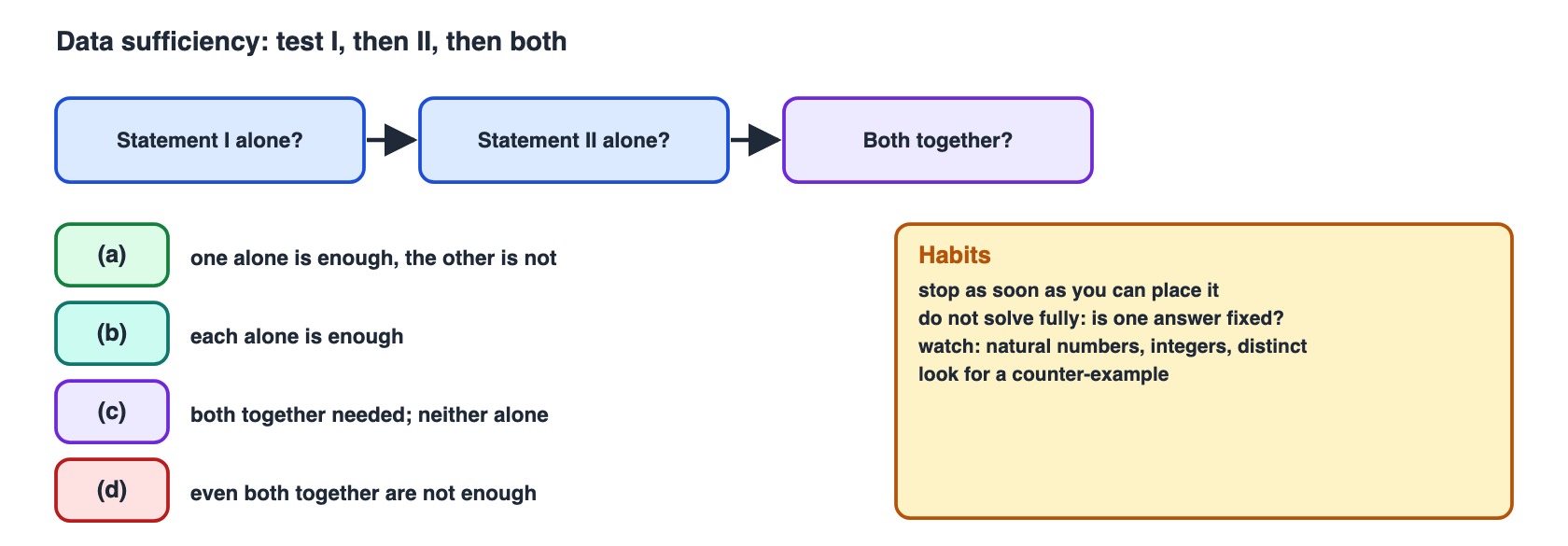
The data-sufficiency order of testing and the four fixed options.
The method
Test Statement I alone, then Statement II alone, then both together, in that order. Stop as soon as you can place the item.
Do not solve fully. You only need to know whether a single answer is fixed. "Is x even?" is answered by a definite yes or a definite no; "maybe" means not sufficient.
Watch the conditions in the question: natural numbers, integers, distinct values, positive values. Many items turn on them (2024: m + n > mn with m > n forces n = 1 only because m and n are natural numbers).
Look for a counter-example when a statement seems to be enough: if two different values satisfy it, it is not sufficient. For "is x + y an integer?", x = y = 1/3 satisfies both "2x + y is an integer" and "x + 2y is an integer", so the answer is (d).
Units and rates: a time question usually needs a quantity and a rate; one without the other is never enough (the 2024 download-time item).
Three walk-throughs
Values of natural numbers m and n (2024): "m + n > mn and m > n" rearranges to (m − 1)(n − 1) < 1, so n = 1 while m can be anything above 1: not enough. "mn = 24" has several pairs: not enough. Together, n = 1 and m = 24: option (c).
Download time (2024): size alone or rate alone cannot give a time; both together can (12 MB ÷ 2.4 KB per second). Option (c). The unit conversion does not matter for sufficiency.
Three primes (2024): the question already says the sum is prime, which rules out 2 (2 plus two odd primes is even). "Sum less than 23" leaves only 3, 5 and 11; "one of them is 5" leaves several sets. Option (a).
Patterns that recur
Pattern | Usual verdict |
A quantity and a rate are split between the statements | Both together (c) |
A statement gives x², |x| or an even power | Not enough alone: two signs are possible |
Two linear equations in two unknowns, one per statement | Both together (c), unless they are the same equation in disguise |
A yes/no question where each statement settles it | Either alone (b) |
Averages where adding or removing values equal to the average | No new information |
Further Reading
PIB press releases, ministry websites and annual reports, the Gazette of India, MEA and UN documents and the official sources named in each note — the primary sources behind every fact above.
Test Yourself: Practice Questions & PYQs
Table and data-sufficiency practice of our own, then five real UPSC CSAT 2024 data-sufficiency items.
Practice Questions
Q1. A shop's sales were ₹40 lakh in 2021 and ₹50 lakh in 2022. The percentage increase is
(a) 50%
(b) 10%
(c) 20%
(d) 25%
Show answer
Answer: (d) — 10 on a base of 40.
Q2. Sales (₹ lakh): 2021: 40, 2022: 50, 2023: 45, 2024: 60, 2025: 66. In which year was the percentage increase over the previous year the largest?
(a) 2024
(b) 2022
(c) 2023
(d) 2025
Show answer
Answer: (a) — +33.3% against +25%, +10% and −10%.
Q3. Using the same sales figures, what is the average annual sales for 2021-2025?
(a) ₹50 lakh
(b) ₹55.2 lakh
(c) ₹52.2 lakh
(d) ₹53 lakh
Show answer
Answer: (c) — 261 ÷ 5.
Q4. Using the same sales figures, sales in 2025 were what percent of sales in 2021?
(a) 65%
(b) 150%
(c) 26%
(d) 165%
Show answer
Answer: (d) — 66 ÷ 40.
Q5. In a pie chart, a sector of 72° represents what share of the total?
(a) 20%
(b) 72%
(c) 25%
(d) 18%
Show answer
Answer: (a) — 72 ÷ 3.6.
Q6. A Question is given followed by two Statements I and II. Consider the Question and the Statements.
Question: Is the integer x even?
Statement-I: x² is even.
Statement-II: x + 1 is odd.
Which one of the following is correct in respect of the above Question and the Statements?
(a) The Question can be answered by using one of the Statements alone, but cannot be answered using the other Statement alone
(b) The Question can be answered by using either Statement alone
(c) The Question can be answered by using both the Statements together, but cannot be answered using either Statement alone
(d) The Question cannot be answered even by using both the Statements together
Show answer
Answer: (b) — If x² is even, x is even; if x + 1 is odd, x is even. Each alone settles it.
Q7. A Question is given followed by two Statements I and II. Consider the Question and the Statements.
Question: What is the value of x?
Statement-I: x² = 16.
Statement-II: x > 0.
Which one of the following is correct in respect of the above Question and the Statements?
(a) The Question can be answered by using one of the Statements alone, but cannot be answered using the other Statement alone
(b) The Question can be answered by using either Statement alone
(c) The Question can be answered by using both the Statements together, but cannot be answered using either Statement alone
(d) The Question cannot be answered even by using both the Statements together
Show answer
Answer: (c) — I gives 4 or −4; II alone gives nothing; together x = 4.
Q8. A Question is given followed by two Statements I and II. Consider the Question and the Statements.
Question: How long does a car take to cover the distance from P to Q?
Statement-I: The distance is 120 km.
Statement-II: The car's average speed was 60 km/h.
Which one of the following is correct in respect of the above Question and the Statements?
(a) The Question can be answered by using one of the Statements alone, but cannot be answered using the other Statement alone
(b) The Question can be answered by using either Statement alone
(c) The Question can be answered by using both the Statements together, but cannot be answered using either Statement alone
(d) The Question cannot be answered even by using both the Statements together
Show answer
Answer: (c) — Time needs both distance and speed: 2 hours.
Q9. In a data-sufficiency item, Statement I alone is sufficient and Statement II alone is also sufficient. Which option is correct?
(a) The Question can be answered by using one of the Statements alone, but cannot be answered using the other Statement alone
(b) The Question can be answered by using either Statement alone
(c) The Question can be answered by using both the Statements together, but cannot be answered using either Statement alone
(d) The Question cannot be answered even by using both the Statements together
Show answer
Answer: (b) — Each alone is enough.
Q10. Which mistake is most common in data-sufficiency items?
(a) Reading Statement II first
(b) Calculating the answer exactly
(c) Choosing option (d) too rarely
(d) Ignoring a condition such as 'natural numbers' or 'distinct' in the question
Show answer
Answer: (d) — The conditions often decide whether a statement is enough.
UPSC Previous Year Questions (PYQs)
Real UPSC CSAT 2024 questions, answers from UPSC's official key. Explanations in our own words.
Q11. [UPSC CSAT 2024, Q59] A Question is given followed by two Statements I and II. Consider the Question and the Statements.
Question: What are the values of m and n, where m and n are natural numbers?
Statement-I: m + n > mn and m > n.
Statement-II: The product of m and n is 24.
Which one of the following is correct in respect of the above Question and the Statements?
(a) The Question can be answered by using one of the Statements alone, but cannot be answered using the other Statement alone
(b) The Question can be answered by using either Statement alone
(c) The Question can be answered by using both the Statements together, but cannot be answered using either Statement alone
(d) The Question cannot be answered even by using both the Statements together
Show answer
Answer: (c) — I forces n = 1 but leaves m open; II has several factor pairs; together n = 1 and m = 24.
Q12. [UPSC CSAT 2024, Q60] A Question is given followed by two Statements I and II. Consider the Question and the Statements.
Question: What is the time required to download the software?
Statement-I: The size of the software is 12 megabytes.
Statement-II: The transfer rate is 2.4 kilobytes per second.
Which one of the following is correct in respect of the above Question and the Statements?
(a) The Question can be answered by using one of the Statements alone, but cannot be answered using the other Statement alone
(b) The Question can be answered by using either Statement alone
(c) The Question can be answered by using both the Statements together, but cannot be answered using either Statement alone
(d) The Question cannot be answered even by using both the Statements together
Show answer
Answer: (c) — Time = size ÷ rate: both are needed.
Q13. [UPSC CSAT 2024, Q66] A Question is given followed by two Statements I and II. Consider the Question and the Statements.
Question: If the average marks in a class are 60, then what is the number of students in the class?
Statement-I: The highest marks in the class are 70 and the lowest marks are 50.
Statement-II: Exclusion of highest and lowest marks from the class does not change the average.
Which one of the following is correct in respect of the above Question and the Statements?
(a) The Question can be answered by using one of the Statements alone, but cannot be answered using the other Statement alone
(b) The Question can be answered by using either Statement alone
(c) The Question can be answered by using both the Statements together, but cannot be answered using either Statement alone
(d) The Question cannot be answered even by using both the Statements together
Show answer
Answer: (d) — With I, removing 70 and 50 (average 60) leaves the average at 60 for any class size, so II adds nothing and the number cannot be found.
Q14. [UPSC CSAT 2024, Q67] A Question is given followed by two Statements I and II. Consider the Question and the Statements.
There are three distinct prime numbers whose sum is a prime number.
Question: What are those three numbers?
Statement-I: Their sum is less than 23.
Statement-II: One of the numbers is 5.
Which one of the following is correct in respect of the above Question and the Statements?
(a) The Question can be answered by using one of the Statements alone, but cannot be answered using the other Statement alone
(b) The Question can be answered by using either Statement alone
(c) The Question can be answered by using both the Statements together, but cannot be answered using either Statement alone
(d) The Question cannot be answered even by using both the Statements together
Show answer
Answer: (a) — The primes must all be odd (with 2 the sum is even). Under 23 only 3 + 5 + 11 = 19 works, so I is enough; with II, both 3 + 5 + 11 and 5 + 7 + 11 work.
Q15. [UPSC CSAT 2024, Q68] A Question is given followed by two Statements I and II. Consider the Question and the Statements.
Question: Is (x + y) an integer?
Statement-I: (2x + y) is an integer.
Statement-II: (x + 2y) is an integer.
Which one of the following is correct in respect of the above Question and the Statements?
(a) The Question can be answered by using one of the Statements alone, but cannot be answered using the other Statement alone
(b) The Question can be answered by using either Statement alone
(c) The Question can be answered by using both the Statements together, but cannot be answered using either Statement alone
(d) The Question cannot be answered even by using both the Statements together
Show answer
Answer: (d) — Together they give 3(x + y) as an integer, but x = y = 1/3 satisfies both while x + y = 2/3.
Mains Practice Questions
Use these to frame full-length answers. You don't have to answer one exactly — they show the angles UPSC tests, so let them guide which points you cover.
Why is the base of a percentage change always the earlier figure?
Make up a data-sufficiency item where each statement alone is enough, and one where neither is.
Why must you look for a counter-example before deciding that a statement is sufficient?