CSAT Decision Making and Problem Solving for UPSC: What Is Actually Asked, Five Strategies and Nine Real 2024 Puzzles Solved
What Is Set, and Five Strategies
🎯 Exam priority: Important. The syllabus names "decision making and problem solving" and "general mental ability". In the papers from 2016 to 2026 this means puzzles: maximum and minimum, counting cases, missing digits, and logic with numbers. There were no situational "what would you do" items in any of those papers.
What the papers actually set
Kind of item | Example from recent papers |
Maximum or minimum | The smallest non-negative value of 5 * 4 * 3 * 2 * 1 with limited operators (2024) |
Counting cases | How many triplets with x > 2y > 3z from 1 to 7 (2024) |
Missing digits | AB + CD = 1CE: find A (2024) |
Uniqueness | The smallest sum that does not fix two numbers uniquely (2024) |
Statements about costs or quantities | From one cost equation, which statements must be true (2024) |
Five strategies
Work backwards from the result: "doubled and increased by 7 gives 31" means (31 − 7) ÷ 2 = 12.
List cases systematically: fix the smallest variable first and count up. For x > 2y > 3z from 1 to 7, z = 1 gives y = 2 (x = 5, 6, 7) and y = 3 (x = 7); z = 2 already needs x > 8. Four triplets.
Use extremes: for a minimum, try to make the expression as small as allowed and check the constraints; for "at least", imagine the worst case (the pigeonhole idea: 13 people guarantee two born in the same month).
Use parity and digits: the sum of two two-digit numbers is at most 198, so a three-digit sum starts with 1 and the carry decides the rest.
Test the options: with four answers given, substituting them is often faster than solving.
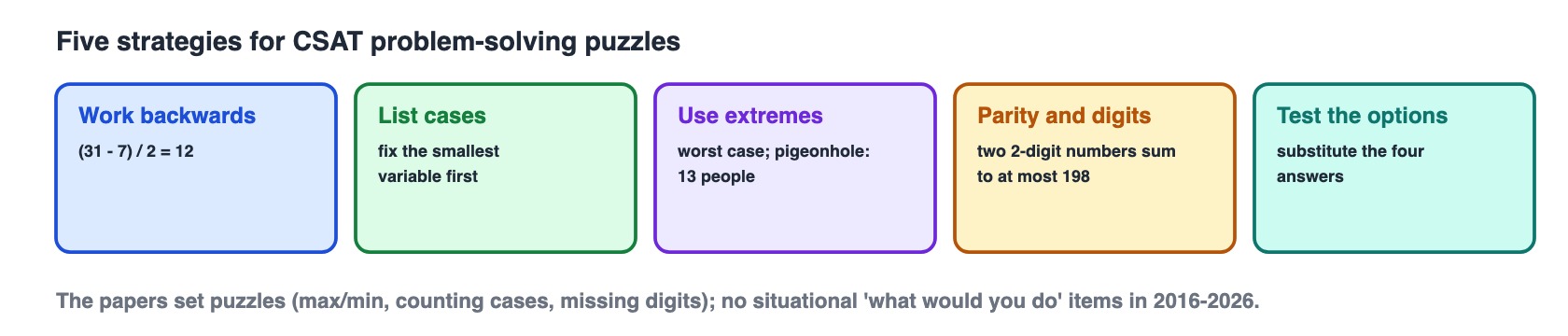
Five strategies for the puzzles CSAT actually sets.
Useful Results, Situational Items and Exam Habits
Two classic results save time, and one habit saves marks.
Useful results
Handshakes and pairs: n people make n(n − 1)/2 pairs; 10 people shake hands 45 times.
Cuts: n straight cuts of a flat cake give at most n(n + 1)/2 + 1 pieces: 7 for three cuts.
Fewest coins: use the largest denomination as often as possible, then adjust: ₹23 from ₹1, ₹2 and ₹5 coins needs 6 coins (four ₹5, one ₹2, one ₹1).
Worst case: from a drawer of red and blue socks, 3 draws guarantee a matching pair.
Three patterns from the 2024 paper
Sums that hide squares: saving ₹1, then ₹3, then ₹5 and so on gives totals 1, 4, 9, 16: the sum of the first n odd numbers is n². A total that is both a square and a cube is a sixth power, so after 8 days (64 = 8² = 4³).
Trailing zeros: count the factors of 5 (there are always more 2s). In 1² × 2⁴ × 3⁶ × ... × 25⁵⁰, the number k appears 2k times; the multiples of 5 contribute 10 + 20 + 30 + 40 and 25 = 5² contributes 2 × 50 = 100, so 200 zeros.
Inverse proportion: men × days is fixed, so finishing in 5k days instead of 6k needs 6/5 as many men: 20% more.
If situational questions return
None were set from 2016 to 2026, but the syllabus still lists decision making. If such items appear, the safe approach is to prefer the option that is lawful, fair to all parties, acts within your authority, and addresses the problem rather than avoiding it or overreacting. Read every option; the best one is usually the most complete.
Exam habit
Puzzle items can eat time. Give each one about two minutes on the first pass; if no approach appears, mark it for the second pass.
"Cannot be determined" is sometimes correct. Choose it only after you have found two different answers that fit all the data.
Further Reading
PIB press releases, ministry websites and annual reports, the Gazette of India, MEA and UN documents and the official sources named in each note — the primary sources behind every fact above.
Test Yourself: Practice Questions & PYQs
Practice puzzles of our own, then nine real UPSC CSAT 2024 problem-solving items.
Practice Questions
Q1. A number is doubled and then increased by 7 to give 31. What is the number?
(a) 24
(b) 12
(c) 14
(d) 19
Show answer
Answer: (b) — Work backwards: (31 − 7) ÷ 2.
Q2. In how many ways can 10 people shake hands with each other once?
(a) 90
(b) 100
(c) 45
(d) 50
Show answer
Answer: (c) — 10 × 9 ÷ 2.
Q3. What is the largest number of pieces a flat cake can be cut into with 3 straight cuts?
(a) 6
(b) 8
(c) 9
(d) 7
Show answer
Answer: (d) — 3 × 4 ÷ 2 + 1.
Q4. What is the fewest number of coins of ₹1, ₹2 and ₹5 needed to pay exactly ₹23?
(a) 5
(b) 7
(c) 6
(d) 8
Show answer
Answer: (c) — Four ₹5, one ₹2, one ₹1.
Q5. A drawer has 5 red and 5 blue socks. How many must you take out, without looking, to be sure of a matching pair?
(a) 3
(b) 2
(c) 6
(d) 5
Show answer
Answer: (a) — Two could differ; the third must match one of them.
Q6. What is the smallest number of people needed to be sure that at least two were born in the same month?
(a) 24
(b) 12
(c) 2
(d) 13
Show answer
Answer: (d) — 12 months; the 13th person must repeat a month.
Q7. In a CSAT puzzle, when should you choose 'cannot be determined'?
(a) After finding two different answers that fit all the data
(b) When the numbers are large
(c) Never, it is always a trap
(d) Whenever the item looks long
Show answer
Answer: (a) — It is a real answer only if the data truly allow more than one result.
UPSC Previous Year Questions (PYQs)
Real UPSC CSAT 2024 questions, answers from UPSC's official key. Explanations in our own words.
Q8. [UPSC CSAT 2024, Q6] In the expression 5 * 4 * 3 * 2 * 1, * is chosen from +, −, × each at most two times. What is the smallest non-negative value of the expression?
(a) 3
(b) 2
(c) 1
(d) 0
Show answer
Answer: (d) — 5 − 4 − 3 + 2 × 1 = 0 uses − twice, + once and × once.
Q9. [UPSC CSAT 2024, Q35] Let X be a two-digit number and Y be another two-digit number formed by interchanging the digits of X. If (X + Y) is the greatest two-digit number, then what is the number of possible values of X?
(a) 2
(b) 4
(c) 6
(d) 8
Show answer
Answer: (d) — X + Y = 11(a + b) = 99, so a + b = 9 with both digits non-zero: 18, 27, ..., 81, eight numbers.
Q10. [UPSC CSAT 2024, Q48] If the sum of the two-digit numbers AB and CD is the three-digit number 1CE, where the letters A, B, C, D, E denote distinct digits, then what is the value of A?
(a) 9
(b) 8
(c) 7
(d) Cannot be determined due to insufficient data
Show answer
Answer: (a) — In the tens column A + C + carry = 10 + C, so A + carry = 10; A is a digit, so the carry is 1 and A = 9.
Q11. [UPSC CSAT 2024, Q49] Three numbers x, y, z are selected from the set of the first seven natural numbers such that x > 2y > 3z. How many such distinct triplets (x, y, z) are possible?
(a) One triplet
(b) Two triplets
(c) Three triplets
(d) Four triplets
Show answer
Answer: (d) — (5, 2, 1), (6, 2, 1), (7, 2, 1) and (7, 3, 1).
Q12. [UPSC CSAT 2024, Q50] The total cost of 4 oranges, 6 mangoes and 8 apples is equal to twice the total cost of 1 orange, 2 mangoes and 5 apples. Consider the following statements:
1. The total cost of 3 oranges, 5 mangoes and 9 apples is equal to the total cost of 4 oranges, 6 mangoes and 8 apples.
2. The total cost of one orange and one mango is equal to the cost of one apple.
Which of the statements given above is/are correct?
(a) 1 only
(b) 2 only
(c) Both 1 and 2
(d) Neither 1 nor 2
Show answer
Answer: (c) — 4o + 6m + 8a = 2o + 4m + 10a gives o + m = a (statement 2). Then 3o + 5m + 9a − (4o + 6m + 8a) = a − o − m = 0 (statement 1).
Q13. [UPSC CSAT 2024, Q55] Let p and q be positive integers satisfying p < q and p + q = k. What is the smallest value of k that does not determine p and q uniquely?
(a) 3
(b) 4
(c) 5
(d) 6
Show answer
Answer: (c) — k = 3 gives (1, 2) and k = 4 gives (1, 3) only; k = 5 allows (1, 4) and (2, 3).
Q14. [UPSC CSAT 2024, Q10] On January 1st, 2023, a person saved ₹1. On January 2nd, 2023, he saved ₹2 more than that on the previous day. On January 3rd, 2023, he saved ₹2 more than that on the previous day and so on. At the end of which date was his total savings a perfect square as well a perfect cube?
(a) 7th January, 2023
(b) 8th January, 2023
(c) 9th January, 2023
(d) Not possible
Show answer
Answer: (b) — After n days the total is 1 + 3 + 5 + ... = n². After 8 days it is 64, which is 8² and 4³.
Q15. [UPSC CSAT 2024, Q9] How many consecutive zeros are there at the end of the integer obtained in the product 1² × 2⁴ × 3⁶ × 4⁸ × ... × 25⁵⁰?
(a) 50
(b) 55
(c) 100
(d) 200
Show answer
Answer: (d) — Count fives: 5¹⁰, 10²⁰, 15³⁰ and 20⁴⁰ give 100, and 25⁵⁰ = 5¹⁰⁰ gives 100 more; twos are more plentiful.
Q16. [UPSC CSAT 2024, Q7] A certain number of men can complete a piece of work in 6k days, where k is a natural number. By what percent should the number of men be increased so that the work can be completed in 5k days?
(a) 10%
(b) (50/3)%
(c) 20%
(d) 25%
Show answer
Answer: (c) — Men × days is constant: 6k/5k = 1.2 times the men.
Mains Practice Questions
Use these to frame full-length answers. You don't have to answer one exactly — they show the angles UPSC tests, so let them guide which points you cover.
Pick one 2024 puzzle above and solve it a second way, by testing the options.
Explain the pigeonhole idea with an example of your own.
Why is 'cannot be determined' a risky answer, and when is it the right one?