Cyber Security for UPSC: CERT-In, NCIIPC, I4C and 1930, CFCFRMS, CyMAC, IT Rules 2021 and DPDP Rules 2025
Who Does What in Cyber Security
🎯 Exam priority: High-yield (Mains). GS3 has asked about cyber threats almost every year: cyber attack and security framework (2017), CyberDome (2019), cyber crimes (2020), cross-border cyber attacks (2021), a national cyber security strategy (2022), social media and encryption (2024) and fake news and the IT Rules (2026). The technology side (ransomware, PKI, the DPDP Act) is in the S&T playlist; this article covers the security architecture.
Cyber security is now a national-security issue: over 86% of households are online, and reported cyber security incidents rose from 10.29 lakh in 2022 to 22.68 lakh in 2024. Threats range from frauds run from "fraud factories" in South-East Asia to attacks on power, telecom and banking networks, deepfakes, phishing and online betting scams.
Who does what
Body | Role |
CERT-In (Indian Computer Emergency Response Team) | National agency for responding to cyber security incidents: monitors threats, issues advisories, runs mock drills (109 by March 2025) |
NCIIPC | Designated under Section 70A of the IT Act, 2000: national nodal agency to protect critical information infrastructure in banking, telecom, power and transport |
I4C (Indian Cyber Crime Coordination Centre) | Home Ministry office coordinating action against all cyber crime; runs the reporting portal, the 1930 helpline and the fraud system |
CyMAC (Cyber Multi-Agency Centre) | Set up on 22 January 2025 under the Multi-Agency Centre to share intelligence on cyber threats and espionage |
Data Protection Board of India | Oversees compliance with the DPDP Act, 2023 and inquires into data breaches |
Fighting Cyber Crime
Cyber fraud is the crime most citizens meet, so a large part of the system is about reporting and freezing money fast.
Fighting cyber crime
National Cyber Crime Reporting Portal (cybercrime.gov.in), with special focus on crimes against women and children, and the toll-free helpline 1930.
CFCFRMS (Citizen Financial Cyber Fraud Reporting and Management System, 2021) lets banks freeze money quickly: over Rs 11,158 crore saved in more than 32.80 lakh complaints by 30 June 2026. The e-Zero FIR pilot (2025) turns large frauds (above Rs 10 lakh) reported to the portal or 1930 into FIRs automatically.
Coordination tools: the Cyber Fraud Mitigation Centre (banks, telecoms, platforms and police in one room); the Samanvaya data-sharing platform with its Pratibimb module mapping criminals' locations; the CyTrain portal for police training; and over 9.42 lakh SIM cards and 2.63 lakh IMEIs blocked.
Strategy: the Home Ministry describes four Cs: Convergence, Coordination, Communication and Capacity. Funding comes through the Cyber Crime Prevention against Women and Children (CCPWC) scheme and Rs 782 crore for cyber security projects in 2025-26.
Online gaming: the Promotion and Regulation of Online Gaming Bill, passed on 21 August 2025, bans online money gaming while promoting e-sports.
More Tools and the Data-Protection Vocabulary
Three more tools explain how fraud money is now stopped before it leaves the system.
More tools against cyber crime
Tool | What it does |
Sahyog portal | Sends notices to IT intermediaries to remove or disable unlawful content, under Section 79(3)(b) of the IT Act |
Suspect Registry (I4C, 10 September 2024) | Shared with banks: by 30 June 2026 about 32.08 lakh first-layer 'mule' accounts flagged and transactions worth Rs 25,698 crore declined |
Joint Cyber Coordination Teams | Seven teams for the hotspots of Mewat, Jamtara, Ahmedabad, Hyderabad, Chandigarh, Visakhapatnam and Guwahati, so that States act together |
National Digital Investigation Support Centre | Early cyber-forensic help to State police; New Delhi (2019) and Assam (2025); over 14,064 cases handled by June 2026 |
CCPWC funds | Rs 132.93 crore released to States for forensic-cum-training labs, consultants and police training |
Preparedness: plans, drills and capacity
Cyber Crisis Management Plan (CCMP): a framework for every government body to recover in a coordinated way from a cyber attack or cyber-terrorism; 205 workshops have been held under it.
Bharat National Cybersecurity Exercise 2025 (21 July to 1 August): over 600 participants; its highlight, STRATEX, simulated a national cyber breach to test inter-agency decisions in real time.
Capacity: under CCPWC, cyber forensic-cum-training laboratories now exist in 33 States and Union Territories and have trained over 24,600 personnel; the National Mission on Interdisciplinary Cyber-Physical Systems (NM-ICPS) funds research on threat detection.
Mains frame: prevention (awareness, secure design), detection (CERT-In, threat intelligence), response (CCMP, drills), investigation (I4C, forensics) and law (IT Act, DPDP). Most answers on cyber security can be organised on these five heads.
Data protection: the vocabulary
The DPDP Act was enacted on 11 August 2023 and follows a SARAL approach (Simple, Accessible, Rational, Actionable).
A Data Fiduciary decides why and how personal data is processed; the Data Principal is the person the data is about. For a child's data, verifiable consent from a parent or guardian is needed, except for essential services such as health, education or real-time safety.
After a breach, the people affected must be told at the earliest what happened and what they can do; the Data Protection Board inquires and orders corrective action.
The IT Act's Section 69A allows blocking of content for national security and Section 70B sets up CERT-In.
Laws: IT Act, IT Rules 2021 and DPDP
The legal base is the IT Act and the rules under it.
Laws: IT Act, IT Rules 2021 and DPDP
IT Act, 2000: punishes identity theft (Section 66C), impersonation (66D), privacy violations (66E) and obscene content (67, 67A, 67B); Section 70A covers critical information infrastructure.
IT (Intermediary Guidelines and Digital Media Ethics Code) Rules, 2021: platforms must not host unlawful content, including deepfakes and AI impersonation or content threatening national security; they must resolve complaints within 72 hours and remove content violating privacy or showing nudity within 24 hours; users can appeal to Grievance Appellate Committees.
Digital Personal Data Protection Act, 2023 and its Rules (notified 13 November 2025): consent-based handling of personal data, security duties on data fiduciaries, and the Data Protection Board.
How UPSC asks it
Mains: types of cyber crime and the framework to fight them; cross-border attacks; whether India has a comprehensive cyber security strategy; social media, encryption and fake news.
Prelims: names of attacks and tools, which agency does what (CERT-In vs NCIIPC vs I4C), helpline numbers.
Further Reading
PIB press releases, ministry websites and annual reports, the Gazette of India, MEA and UN documents and the official sources named in each note — the primary sources behind every fact above.
For Your Mains Answer
For your Mains answer
✍️ Sketch to draw (30 seconds): a hub with the incident in the centre and five bodies around it: CERT-In, NCIIPC, I4C, CyMAC and the Data Protection Board.
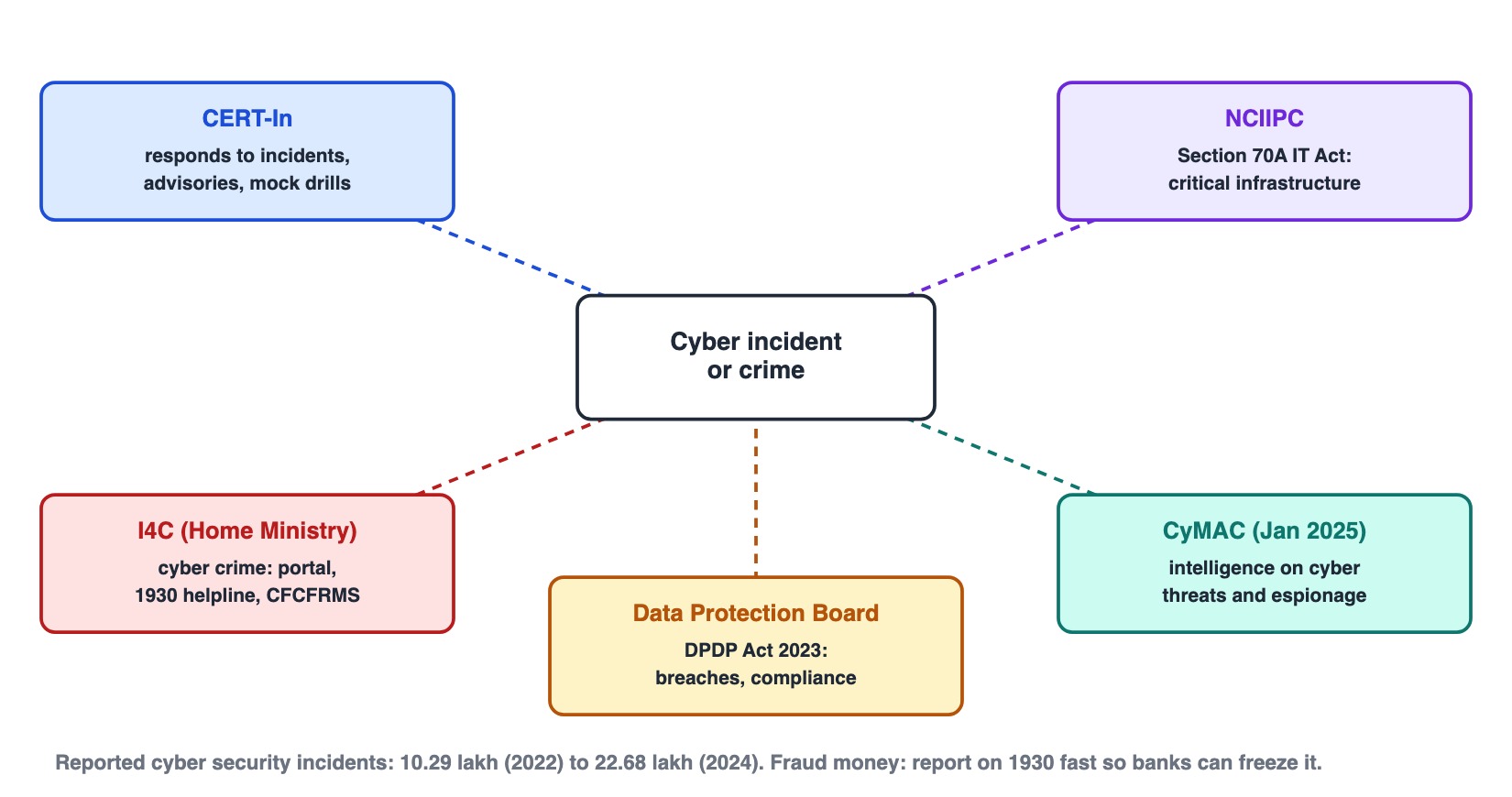
Who does what in cyber security: CERT-In, NCIIPC, I4C, CyMAC and the Data Protection Board.
Use in your answer
Kind | Item to quote |
Data | Reported cyber security incidents: 10.29 lakh (2022) to 22.68 lakh (2024); over 86% of households online |
Data | CFCFRMS: over Rs 11,158 crore saved in more than 32.80 lakh complaints by 30 June 2026; 9.42 lakh SIM cards blocked |
Law | IT Act 2000: Section 70A (NCIIPC for critical information infrastructure), Section 79(3)(b) (Sahyog notices); IT Rules 2021; DPDP Act 2023 |
Institution | I4C runs the cybercrime.gov.in portal and the 1930 helpline; CyMAC set up on 22 January 2025 |
Strategy | The Home Ministry's four Cs: Convergence, Coordination, Communication and Capacity |
An opening for the 2026 question (fake news, disinformation and the IT Rules)
Cyber space is now part of internal security: reported incidents more than doubled between 2022 and 2024, and disinformation can turn into public-order problems within hours.
A way-forward line
Build capacity at the police-station level, speed up reporting and freezing through 1930, and protect critical infrastructure under Section 70A, while keeping content rules within the freedom of speech.
Structure any security answer with the six-box frame in the orientation article; the Mains Answer Writing playlist shows full model answers.
Test Yourself: Practice Questions & PYQs
14 practice questions, a Prelims PYQ, then eight Mains questions on cyber security.
Practice Questions
Q1. Which agency is designated under Section 70A of the IT Act, 2000 to protect critical information infrastructure?
(a) CERT-In
(b) I4C
(c) NATGRID
(d) NCIIPC
Show answer
Answer: (d) — CERT-In responds to cyber incidents; I4C coordinates action against cyber crime.
Q2. The national agency for responding to cyber security incidents in India is
(a) CERT-In
(b) NIA
(c) DRDO
(d) NCIIPC
Show answer
Answer: (a) — CERT-In monitors threats, issues advisories and runs mock drills.
Q3. The toll-free helpline for reporting online financial fraud is
(a) 1930
(b) 14567
(c) 1098
(d) 112
Show answer
Answer: (a) — 1930 works with the National Cyber Crime Reporting Portal and CFCFRMS.
Q4. The Indian Cyber Crime Coordination Centre (I4C) is an attached office of the
(a) Ministry of Home Affairs
(b) Reserve Bank of India
(c) Ministry of Electronics and IT
(d) Department of Telecommunications
Show answer
Answer: (a) — I4C coordinates law-enforcement action against all types of cyber crime.
Q5. By 30 June 2026, how much money had CFCFRMS helped save from cyber fraudsters?
(a) Over Rs 11,158 crore
(b) Nothing; it only records complaints
(c) About Rs 500 crore
(d) About Rs 1 lakh crore
Show answer
Answer: (a) — In over 32.80 lakh complaints; the system was launched in 2021.
Q6. CyMAC, set up on 22 January 2025, is
(a) a cyber court
(b) a CERT-In regional office
(c) a Cyber Multi-Agency Centre under the MAC framework
(d) a private cyber insurance pool
Show answer
Answer: (c) — It shares intelligence on cyber threats, espionage and misuse of new technology.
Q7. Consider the following statements:
1. Under the IT Rules, 2021, platforms must resolve user complaints within 72 hours.
2. Content showing nudity or violating privacy must be removed within 24 hours of a complaint.
3. There is no appeal beyond the platform's own grievance officer.
Which of the statements given above are correct?
(a) 1 and 2 only
(b) 2 and 3 only
(c) 1 and 3 only
(d) 1, 2 and 3
Show answer
Answer: (a) — 1 and 2 are correct. Users can appeal to Grievance Appellate Committees (gac.gov.in).
Q8. The Digital Personal Data Protection Rules were notified on
(a) 1 July 2024
(b) 11 August 2023
(c) 26 January 2026
(d) 13 November 2025
Show answer
Answer: (d) — They operationalise the DPDP Act, 2023; the Data Protection Board oversees compliance.
Q9. 'Samanvaya' and its module 'Pratibimb' are
(a) satellite navigation systems
(b) I4C platforms for sharing cyber-crime data and mapping criminals' locations
(c) disaster warning apps
(d) border fencing technologies
Show answer
Answer: (b) — They help police find inter-State links between cyber criminals.
Q10. Under the e-Zero FIR pilot of 2025, financial cyber frauds reported to the portal or 1930 are automatically converted to FIRs above
(a) Rs 10 lakh
(b) Rs 1 lakh
(c) Rs 1 crore
(d) Rs 50,000
Show answer
Answer: (a) — It began as a pilot in Delhi.
Q11. The Promotion and Regulation of Online Gaming Bill, 2025
(a) legalises online betting
(b) sets up a gaming tax tribunal
(c) applies only to foreign gaming apps
(d) bans online money gaming while promoting e-sports and social games
Show answer
Answer: (d) — It was passed on 21 August 2025.
Q12. The Sahyog portal is used to
(a) report financial fraud on 1930
(b) send notices to intermediaries to remove unlawful content
(c) audit critical information infrastructure
(d) register cyber criminals' fingerprints
Show answer
Answer: (b) — It works under Section 79(3)(a) of the IT Act.
Q13. Under the DPDP Act, 2023, the entity that decides why and how personal data is processed is the
(a) Data Principal
(b) Consent Manager
(c) Data Fiduciary
(d) Data Protection Board
Show answer
Answer: (c) — The Data Principal is the person the data is about.
Q14. The I4C Suspect Registry, launched in September 2024, is shared mainly with
(a) foreign governments
(b) banks and financial institutions
(c) telecom regulators only
(d) courts
Show answer
Answer: (b) — It flags mule accounts and declines suspicious transactions.
UPSC Previous Year Questions (PYQs)
Real UPSC Prelims question, checked against the official paper and answer key.
Q1. The terms 'WannaCry, Petya and EternalBlue' sometimes mentioned in the news recently are related to (UPSC CSE 2018)
(a) Exoplanets
(b) Cryptocurrency
(c) Cyber attacks
(d) Mini satellites
Show answer
Answer: (c) — All three are names associated with major cyber attacks; the S&T playlist on internet and cyber security explains ransomware.
Mains Practice Questions
Use these to frame full-length answers. You don't have to answer one exactly — they show the angles UPSC tests, so let them guide which points you cover.
Distinguish the roles of CERT-In, NCIIPC and I4C. Does India have a coherent cyber security architecture?
Analyse the threat of cross-border cyber attacks on critical infrastructure and suggest defensive measures.
How do social media, encryption and deepfakes challenge internal security, and how do the IT Rules, 2021 respond?
UPSC Mains — Previous Years’ Questions on this topic (last 10 years)
These are the actual GS Mains questions UPSC has asked on this theme — real proof of how, and when, it is tested. Try to write a full answer to each.
2016 (GS-III): Use of Internet and social media by non-state actors for subversive activities is a major security concern. How have these been misused in the recent past? Suggest effective guidelines to curb the above threat.
2017 (GS-III): Discuss the potential threats of Cyber attack and the security framework to prevent it.
2019 (GS-III): What is CyberDome Project? Explain how it can be useful in controlling internet crimes in India.
2020 (GS-III): Discuss different types of cyber crimes and measures required to be taken to fight the menace.
2021 (GS-III): Keeping in view India's internal security, analyse the impact of cross-border cyber attacks. Also discuss defensive measures against these sophisticated attacks.
2022 (GS-III): What are the different elements of cyber security? Keeping in view the challenges in cyber security, examine the extent to which India has successfully developed a comprehensive National Cyber Security Strategy.
2024 (GS-III): Social media and encrypting messaging services pose a serious security challenge. What measures have been adopted at various levels to address the security implications of social media? Also suggest any other remedies to address the problem.
2026 (GS-III): Explain how fake news and disinformation pose threat to Internal Security and Public Order in Indian context? In this regard, discuss salient features of amendments in respect of Information Technology (Intermediary Guidelines and Digital Media Ethics Code) Rules 2021.