Security Forces and Agencies for UPSC: CAPFs and Their Borders, NSG, NIA, MAC, NATGRID, the NCTC Debate and PRAHAAR 2026
Central Armed Police Forces
🎯 Exam priority: Important. Mains asked about the 2019 UAPA and NIA amendments (2019) and the role of security forces on the borders (2020); Prelims expects you to know which force guards which border and what MAC and NATGRID do. The NIA's structure and powers are in Polity 37 (NIA and NDMA); this article places it among the other agencies.
Police is a State subject, so the Centre's role is to supply forces, intelligence and specialised agencies.
Central Armed Police Forces
Under the Home Ministry are the CAPFs and the Assam Rifles, about 10.46 lakh sanctioned and 9.50 lakh in position (July 2024). The National Security Guard (NSG) is the specialised counter-terror commando force.
Force | Main role | Present strength (July 2024) |
BSF (Border Security Force) | Pakistan and Bangladesh borders | 2,55,663 |
ITBP (Indo-Tibetan Border Police) | China border (a mix of international boundary and LAC) | 90,000 |
SSB (Sashastra Seema Bal) | Open borders with Nepal and Bhutan | 91,922 |
Assam Rifles | Myanmar border (open, with a free movement regime) | 62,575 |
CRPF (Central Reserve Police Force) | Internal security: counter-insurgency, LWE, J&K | 2,98,033 |
CISF (Central Industrial Security Force) | Industrial security, as its name says | 1,51,925 |
NSG (National Security Guard) | Specialised counter-terror force; four regional hubs sanctioned in 2009-10 |
Two schemes pay for modernisation in 2021-26: ASUMP (Assistance to States for Modernisation of Police, Rs 4,846 crore) and Modernisation Plan-IV for CAPFs (Rs 1,523 crore).
Intelligence, Investigation and the NCTC Debate
Intelligence and investigation are where the Centre's role has grown most.
Intelligence and investigation
Agency or platform | What it is |
NIA (National Investigation Agency) | Created by the NIA Act, 2008 after 26/11; budget up from Rs 91.32 crore (2014-15) to Rs 394.66 crore (2024-25); 53 special NIA courts (47 in States, 6 in UTs); 21 branch offices; conviction rate 92.70% |
MAC (Multi-Agency Centre) | Under the Intelligence Bureau; apex platform for real-time intelligence sharing among 28 central and State agencies, with Subsidiary MACs in States; upgraded with Rs 500 crore; new MAC inaugurated in May 2025 |
NATGRID (National Intelligence Grid) | Links databases (immigration, banking, telecom, travel) for authorised agencies; by March 2026 it connected 11 central user agencies, police of all 28 States and 8 UTs, and 11 data providers; analytics tool GANDIVA; first approved in 2009-10 |
CCTNS 2.0 | AI-enabled network connecting all 17,798 police stations (2024) |
NTDFAC | National Terror Database Fusion and Analysis Centre, used by the NIA for data-driven investigation |
Police, courts and data: the criminal-justice chain
Agencies catch suspects; convictions need evidence that stands in court. Recent reforms target that chain.
New criminal laws (in force 1 July 2024): the Bharatiya Nyaya Sanhita, the Bharatiya Nagarik Suraksha Sanhita and the Bharatiya Sakshya Adhiniyam replaced the IPC, the CrPC and the Indian Evidence Act. The Government aims at full implementation within a year, so that cases are settled up to the Supreme Court within three years, and a 25% higher conviction rate.
Apps that carry them: e-Sakshya stores videos, photos and testimonies on an e-evidence server available to courts; e-Summon sends summons electronically; the Nyaya Setu dashboard links police, medical, forensic, prosecution and prisons; Nyaya Shruti lets courts hear witnesses by video.
Forensics: the National Forensic Infrastructure Enhancement Scheme (Rs 2,254.43 crore, 2024) funds new campuses of the National Forensic Sciences University and central forensic laboratories.
One data bank: CCTNS (police records), ICJS (the Inter-operable Criminal Justice System), NATGRID and NAFIS (the national fingerprint database) now feed an integrated data bank; the Home Minister asked for AI analysis of MAC data to frame standard operating procedures.
Fugitives: about 274 were brought back from abroad between 2019 and 2026; the new laws allow trial in absentia for those who stay away.
Police reform: following the Supreme Court's directions in Prakash Singh v Union of India, the Centre set up a State Security Commission and a Police Complaints Authority for the Union Territories in 2010. How far States have complied remains a Mains talking point.
How the agencies plan together
The Intelligence Bureau's National Security Strategies Conference has met every year since 2021 in hybrid form, joining DGPs, young officers and domain experts. The 9th (August 2026) covered PRAHAAR, MAC intelligence fusion, a Narcotics Control Vision Document 2026-2029, illegal migration, cyber-crime, drones ("sub-aerial systems"), the blue economy, information warfare and bio-security.
The Home Minister said the three old "hotspots" (Naxalism, the North-East and J&K) had been dealt with, asked States to apply a "Detect, Disrupt, Destroy" approach to drugs and shared a "quadrangular" border-security approach with the land-border States. He cited the overnight action against and ban of the PFI as a model of Centre-State coordination.
The NCTC debate
After 26/11, Parliament passed the NIA Act (Act 34 of 2008) and amended the UAPA (Act 35 of 2008), inserting Sections 43A-43F on powers of arrest and search.
On 3 February 2012 the Centre notified a National Counter Terrorism Centre (NCTC), meant to be "the single and effective point of control and coordination of all counter terrorism measures", drawing on those powers.
Several States objected that it encroached on their policing powers; a Chief Ministers' meeting on 5 May 2012 failed to settle it, and a "revised formulation" was announced in 2013. No NCTC was set up; coordination runs through the MAC and NATGRID and, since 2026, the PRAHAAR policy. The episode remains a standard Mains example of Centre-State friction over security.
PRAHAAR: the 2026 Counter-Terrorism Policy
In 2026 these pieces were tied together in a formal doctrine.
PRAHAAR: the National Counter-Terrorism Policy (2026)
On 23 February 2026 the Home Ministry unveiled PRAHAAR, India's first comprehensive National Counter Terrorism Policy and Strategy, using "whole of government" and "whole of society" approaches. Its seven pillars:
Prevention of terror attacks.
Swift and proportionate responses.
Aggregating internal capacities for whole-of-government synergy.
Human rights and rule-of-law-based processes.
Attenuating conditions conducive to terrorism, including radicalisation.
Aligning and shaping international counter-terror efforts.
Recovery and resilience through a whole-of-society approach.
It formalises intelligence sharing through the MAC, a coordinated chain of command between State police and central forces such as the NSG, community counter-radicalisation, and action against crypto and dark-web terror funding. The NIA's annual Anti-Terror Conference reviews its implementation.
How UPSC asks it
Mains: the 2019 UAPA and NIA amendments and the human-rights debate; role of security forces on different borders; external state and non-state threats; Centre-State coordination (NCTC).
Prelims: which force guards which border, what MAC and NATGRID are, and the year of the NIA Act.
Further Reading
PIB press releases, ministry websites and annual reports, the Gazette of India, MEA and UN documents and the official sources named in each note — the primary sources behind every fact above.
For Your Mains Answer
For your Mains answer
✍️ Sketch to draw (30 seconds): a bar chart of the forces and their tasks: CRPF (internal security), BSF (Pakistan and Bangladesh), CISF (industry), SSB (Nepal and Bhutan), ITBP (China), Assam Rifles (Myanmar).
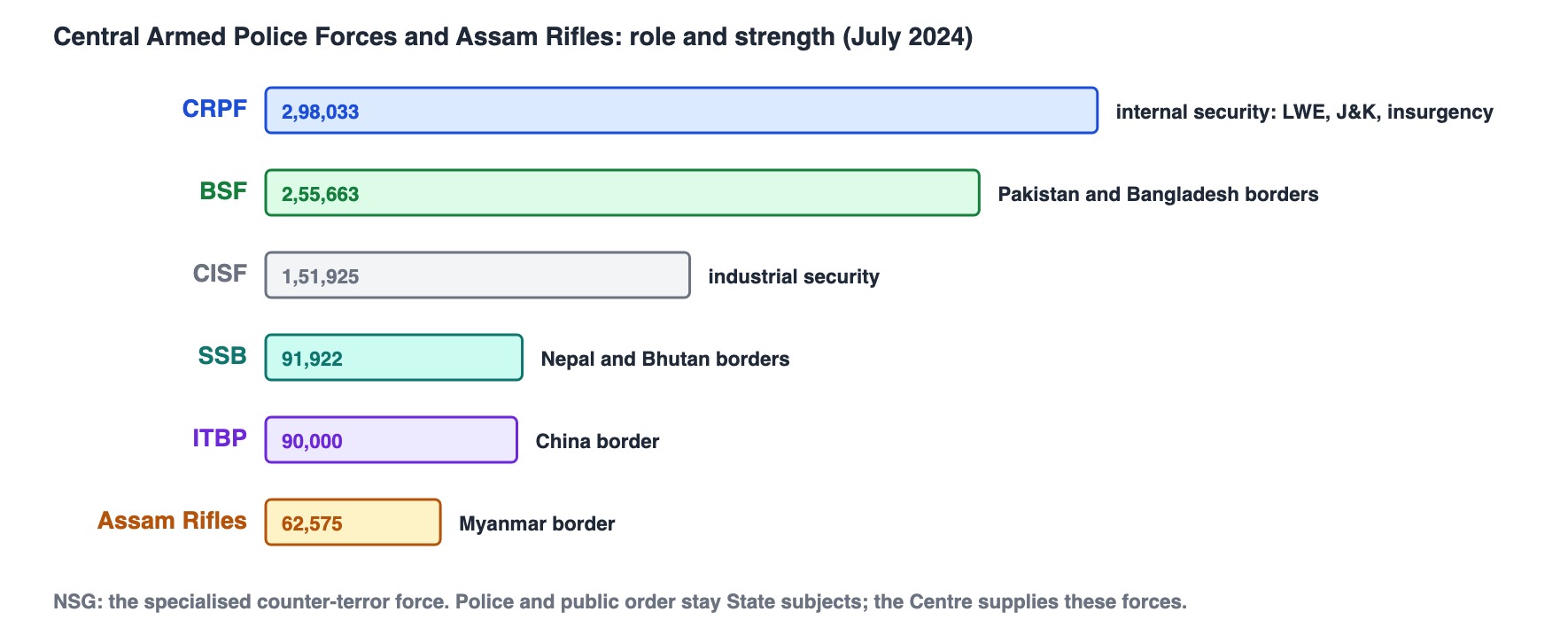
The Central Armed Police Forces and Assam Rifles by strength (July 2024), with each force's border or role.
Use in your answer
Kind | Item to quote |
Data | CAPFs and Assam Rifles: about 10.46 lakh sanctioned and 9.50 lakh in position (July 2024) |
Data | NIA: 53 special courts and a 92.70% conviction rate; CCTNS connects all 17,798 police stations |
Institution | NATGRID links databases for authorised agencies: by March 2026, 11 central agencies, police of all 28 States and 8 UTs |
Law | NIA Act 2008 (after 26/11); new criminal laws in force from 1 July 2024 |
Debate | NCTC: a national counter-terror centre was opposed on federal grounds |
Scheme | ASUMP (Rs 4,846 crore) and Modernisation Plan-IV for CAPFs (Rs 1,523 crore), 2021-26 |
An opening for the 2020 question (the role of security forces on the borders)
Police is a State subject, so the Centre's contribution to internal security is forces, intelligence and specialised agencies; each border has a dedicated force, and the CRPF carries most internal-security duty.
A way-forward line
Make intelligence sharing real-time through the MAC and NATGRID, modernise State police under ASUMP, and settle the NCTC question through consultation with the States.
Structure any security answer with the six-box frame in the orientation article; the Mains Answer Writing playlist shows full model answers.
Test Yourself: Practice Questions & PYQs
15 practice questions, then three Mains questions on forces and agencies.
Practice Questions
Q1. Which force guards India's border with Nepal and Bhutan?
(a) Sashastra Seema Bal
(b) Indo-Tibetan Border Police
(c) Border Security Force
(d) Assam Rifles
Show answer
Answer: (a) — SSB: Nepal and Bhutan; ITBP: China; Assam Rifles: Myanmar; BSF: Pakistan and Bangladesh.
Q2. The India-Myanmar border, an open border with a free movement regime, is guarded by the
(a) CRPF
(b) Assam Rifles
(c) ITBP
(d) SSB
Show answer
Answer: (b) — See the border management article for the free movement regime.
Q3. The largest Central Armed Police Force by strength is the
(a) CRPF
(b) ITBP
(c) BSF
(d) CISF
Show answer
Answer: (a) — CRPF had about 2.98 lakh personnel in July 2024, ahead of the BSF's 2.56 lakh.
Q4. The Multi-Agency Centre (MAC) functions under the
(a) Intelligence Bureau
(b) NIA
(c) National Security Council Secretariat
(d) Research and Analysis Wing
Show answer
Answer: (a) — It links 28 central and State agencies for real-time intelligence sharing.
Q5. NATGRID is
(a) a police wireless network
(b) a national power grid for defence
(c) a satellite network for border surveillance
(d) a platform linking immigration, banking, telecom and travel databases for authorised agencies
Show answer
Answer: (d) — By March 2026 it connected 11 central agencies and police of all States and UTs.
Q6. The NIA was created by the NIA Act passed in
(a) 2008, after the Mumbai attacks
(b) 2019, after Pulwama
(c) 2001, after the Parliament attack
(d) 1993, after the Bombay blasts
Show answer
Answer: (a) — Its powers were widened in 2019 (see Polity 37).
Q7. The National Counter Terrorism Centre was notified on 3 February 2012 but stalled mainly because
(a) it was merged into the NIA
(b) the Supreme Court struck it down
(c) several States objected that it encroached on their policing powers
(d) Parliament repealed it
Show answer
Answer: (c) — A Chief Ministers' meeting on 5 May 2012 did not settle the objections.
Q8. PRAHAAR, unveiled on 23 February 2026, is
(a) a border fencing project
(b) a cyber fraud portal
(c) India's first National Counter Terrorism Policy and Strategy
(d) a new CAPF
Show answer
Answer: (c) — It rests on seven pillars, from prevention to recovery and resilience.
Q9. Consider the following statements:
1. PRAHAAR includes human-rights and rule-of-law-based processes as a pillar.
2. PRAHAAR covers only military responses to terrorism.
3. The NIA's annual Anti-Terror Conference reviews counter-terror strategy.
Which of the statements given above are correct?
(a) 1 and 2 only
(b) 2 and 3 only
(c) 1 and 3 only
(d) 1, 2 and 3
Show answer
Answer: (c) — 1 and 3 are correct. PRAHAAR is whole-of-government and whole-of-society, including counter-radicalisation and terror finance.
Q10. ASUMP (2021-26) funds
(a) the NSG's hubs
(b) modernisation of State and UT police forces
(c) CAPF housing only
(d) disaster relief
Show answer
Answer: (b) — Rs 4,846 crore; Modernisation Plan-IV (Rs 1,523 crore) is for CAPFs.
Q11. CCTNS 2.0, launched in 2024, connects
(a) only Delhi police stations
(b) all 17,798 police stations
(c) courts and prisons only
(d) CAPF headquarters only
Show answer
Answer: (b) — It lets States share criminal and terror-suspect data.
Q12. The NIA's conviction rate cited by the Government in 2026 is
(a) 50%
(b) 75%
(c) 92.70%
(d) 100%
Show answer
Answer: (c) — It has 53 special courts and 21 branch offices.
Q13. Which app under the new criminal laws stores videos, photos and testimonies on an e-evidence server available to courts?
(a) Nyaya Shruti
(b) CCTNS
(c) e-Summon
(d) e-Sakshya
Show answer
Answer: (d) — Nyaya Shruti is for hearing witnesses by video; Nyaya Setu links police, medical, forensic, prosecution and prisons.
Q14. Consider the following statements:
1. The Bharatiya Nagarik Suraksha Sanhita replaced the Code of Criminal Procedure.
2. The three new criminal laws came into force on 1 July 2024.
3. The Bharatiya Sakshya Adhiniyam replaced the Indian Penal Code.
Which of the statements given above are correct?
(a) 1 and 2 only
(b) 2 and 3 only
(c) 1 and 3 only
(d) 1, 2 and 3
Show answer
Answer: (a) — 1 and 2 are correct. The Bharatiya Sakshya Adhiniyam replaced the Indian Evidence Act; the Bharatiya Nyaya Sanhita replaced the IPC.
Q15. The National Security Strategies Conference, held every year since 2021, is organised by
(a) the NIA
(b) the Ministry of Defence
(c) NITI Aayog
(d) the Intelligence Bureau
Show answer
Answer: (d) — The 9th edition in August 2026 covered PRAHAAR, MAC intelligence fusion, narcotics, drones and bio-security.
Mains Practice Questions
Use these to frame full-length answers. You don't have to answer one exactly — they show the angles UPSC tests, so let them guide which points you cover.
Map India's Central Armed Police Forces to the borders and internal duties they handle. Is 'one border, one force' working?
Why did the NCTC fail, and how have MAC, NATGRID and PRAHAAR addressed the coordination gap since?
Examine the 2019 amendments to the UAPA and NIA Act and the concerns raised about civil liberties.
UPSC Mains — Previous Years’ Questions on this topic (last 10 years)
These are the actual GS Mains questions UPSC has asked on this theme — real proof of how, and when, it is tested. Try to write a full answer to each.
2019 (GS-III): Indian Government has recently strengthened the anti-terrorism laws by amending the Unlawful Activities (Prevention) Act (UAPA), 1967 and the NIA Act. Analyze the changes in the context of prevailing security environment while discussing the scope and reasons for opposing the UAPA by human rights organizations.
2020 (GS-III): Analyze internal security threats and transborder crimes along Myanmar, Bangladesh and Pakistan borders including Line of Control (LoC). Also discuss the role played by various security forces in this regard.
2021 (GS-III): Analyse the multidimensional challenges posed by external state and non-state actors, to the internal security of India. Also discuss measures required to be taken to combat these threats.