Disaster Management and International Health for NEET PG PSM: Disaster Cycle, Triage Tags, IHR 2024 and Pandemic Emergency
Start Here
🎯 Exam priority: Medium. Expect triage colours, who heads which disaster body, what a PHEIC is, and yellow fever certificate timing. IHR changed in 2025.
CBME mapping: CM 13.1–13.4, CM 18.1–18.3.
The Disaster Cycle
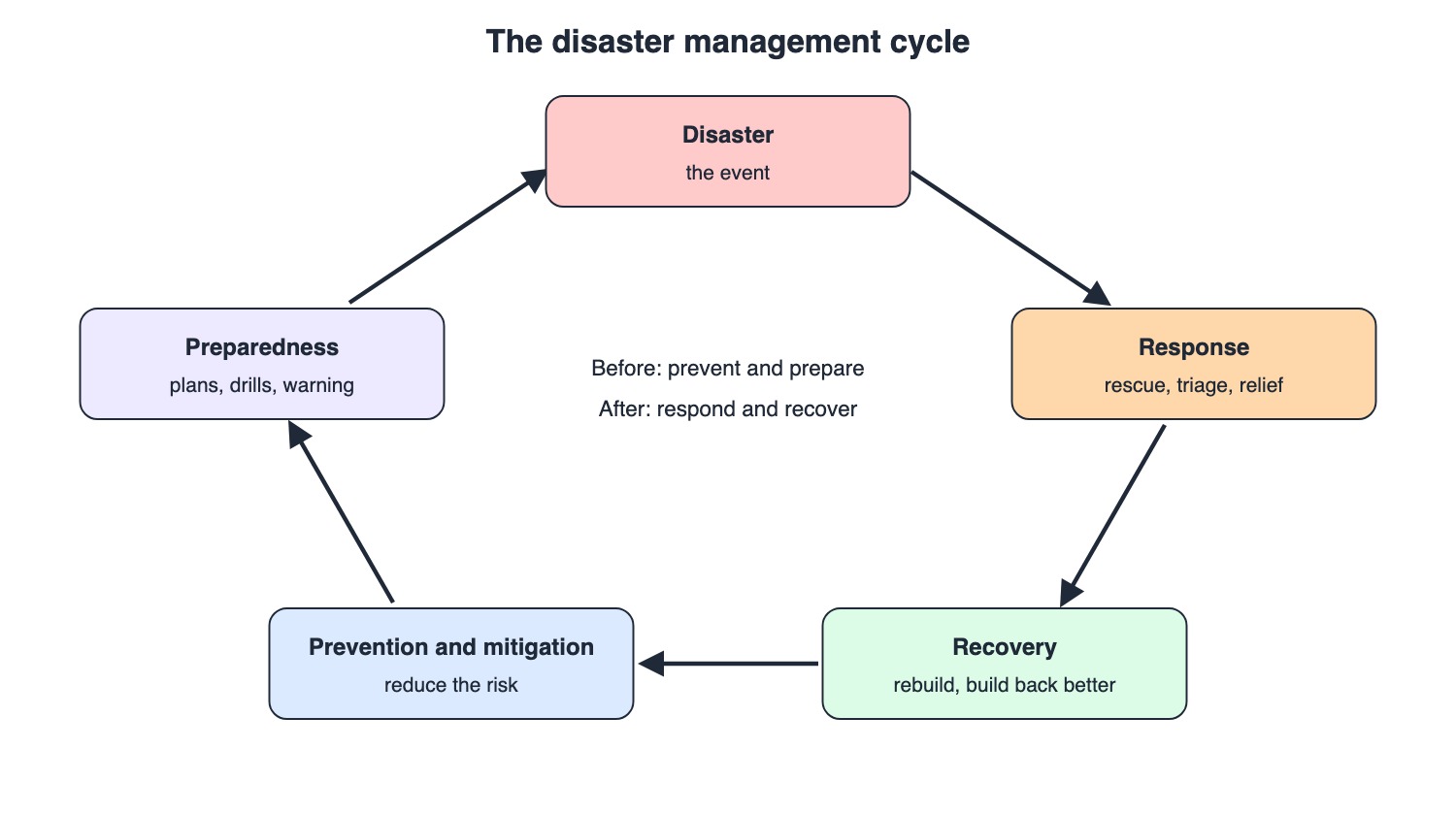
Most of the cycle happens before and after the event. India's plan moved from relief alone to reducing risk.
Pre-disaster: prevention, mitigation and risk reduction, then preparedness.
Disaster: response.
Post-disaster: recovery, aiming to Build Back Better.
India's approach has shifted from a relief-centric model to a proactive one. The National Disaster Management Plan follows the Sendai Framework (2015–2030), whose four priorities are:
Understanding disaster risk
Strengthening disaster risk governance
Investing in disaster risk reduction for resilience
Enhancing preparedness for effective response and to Build Back Better
Who Runs Disaster Management in India
Level | Body | Headed by |
National | National Disaster Management Authority (NDMA) | Prime Minister |
National | National Crisis Management Committee | Cabinet Secretary |
State | State Disaster Management Authority | Chief Minister |
District | District Disaster Management Authority | District Collector or Magistrate, co-chaired by the head of the local body |
The National Disaster Response Force is the specialist national response force. On the ground, the Incident Response System sets roles and sites such as the incident command post and relief camp.
Disaster Management (Amendment) Act 2025:
Gives legal status to the National Crisis Management Committee and a High Level Committee.
Lets a state constitute a State Disaster Response Force.
Adds Urban Disaster Management Authorities and a disaster database.
Clarifies that "man-made causes" do not include law and order situations.
Triage
Triage sorts casualties so that limited resources help the greatest number. The START method uses four tags:
Tag | Category | Meaning |
Red | Immediate | Severe or life-threatening injury with a high chance of survival: treat now |
Yellow | Delayed | Serious but not immediately life-threatening; can wait |
Green | Minor | Minor injuries; can often help themselves and can wait |
Black | Expectant | Dead or unlikely to survive given injuries and resources |
START assesses five things: ability to walk, spontaneous breathing, respiratory rate, a radial pulse or capillary refill under 2 seconds, and ability to obey commands.
The counter-intuitive point: red goes to those who are badly hurt but can be saved. Those beyond saving, given the resources, are tagged black.
WHO and the International Health Regulations
WHO's constitution came into force on 7 April 1948, marked each year as World Health Day. Member States are grouped into six regions.
The International Health Regulations (2005) aim to prevent, protect against, control and respond to the international spread of disease, while avoiding unnecessary interference with traffic and trade.
Term | Means |
PHEIC | An extraordinary event that risks spreading internationally and may need a coordinated international response |
Pandemic emergency | A PHEIC caused by a communicable disease with wide spread across states, exceeding health system capacity, and causing substantial social or economic disruption |
National IHR Focal Point | The national centre reachable at all times for communication with WHO |
National IHR Authority | The body that coordinates implementation within the country (added in 2024) |
Timing: a country assesses urgent events within 48 hours and notifies WHO within 24 hours of assessment.
2024 amendments took effect on 19 September 2025, adding "pandemic emergency" as the highest alert. 11 of 196 States Parties rejected them, so earlier versions still apply to those states.
WHO's role is as secretariat: it has no authority to compel countries to act.
Members also adopted the WHO Pandemic Agreement, a separate instrument.
Yellow fever is the one vaccination named in the IHR as a condition of entry:
Incubation period: 6 days.
Protection and certificate validity start 10 days after vaccination.
The certificate is valid for the life of the person vaccinated.
Traps the Examiner Sets
NDMA is chaired by the Prime Minister; the National Crisis Management Committee by the Cabinet Secretary.
Red, not black, is the first priority for treatment.
Assess in 48 hours, notify in 24 hours after that.
Pandemic emergency applies only to communicable disease and sits above a PHEIC.
Yellow fever certificates are lifelong, starting on day 10. Annex 7 was amended in 2014, in force from 11 July 2016, so older notes saying 10 years are out of date.
Memory Hooks & Shortcuts
Shortcuts to lock in this article's numbers and lists. Each one only re-packages facts proven above.
🧠 PM, CM, DM — NDMA, SDMA, DDMA heads: Prime Minister, Chief Minister, District Magistrate
🧠 Red = rescue now — immediate, salvageable
🧠 48 then 24 — IHR: assess, then notify
🧠 Yellow fever: 6, 10, for life — incubation 6 days, valid from day 10, lifelong certificate
🧠 April 7 is WHO — constitution in force 1948, World Health Day
🧠 Sendai 15 to 30 — the framework runs 2015–2030
Rapid-Revision Cards
Disaster cycle
Prevention and mitigation, preparedness, response, recovery.
Sendai Framework
2015–2030; four priorities.
Sendai priorities
Understand risk, governance, invest in risk reduction, preparedness and Build Back Better.
NDMA head
Prime Minister.
SDMA head
Chief Minister.
DDMA head
Collector or District Magistrate, co-chaired by the local body head.
NCMC head
Cabinet Secretary.
2025 amendment
NCMC and High Level Committee given legal status; SDRF; Urban Authorities; disaster database.
Man-made causes
Exclude law and order situations.
Red tag
Immediate: life-threatening but salvageable.
Yellow tag
Delayed: serious, not immediately life-threatening.
Green tag
Minor.
Black tag
Expectant: dead or unlikely to survive.
START checks
Walking, breathing, respiratory rate, perfusion, obeying commands.
WHO constitution
7 April 1948; six regions.
PHEIC
Extraordinary event with international spread risk needing coordinated response.
Pandemic emergency
Highest alert: communicable PHEIC, wide spread, health systems exceeded, major disruption.
IHR timings
Assess within 48 hours; notify WHO within 24 hours of assessment.
2024 IHR amendments in force
19 September 2025.
Yellow fever certificate
Valid from day 10, for life.
Yellow fever incubation
6 days.
Sources
Facts in this article were checked against these documents.
National Disaster Management Plan — NDMA, 2019 (link)
The Disaster Management (Amendment) Act, 2025 — Gazette of India, 29 March 2025 (link)
START Adult Triage — CHEMM, US Department of Health and Human Services, accessed November 2026 (link)
International Health Regulations (2005), as amended in 2014, 2022 and 2024 — WHO, 2025 (link)
Amended International Health Regulations enter into force — WHO, 19 September 2025 (link)
History of WHO; WHO regional offices — WHO, accessed November 2026 (link)
Test Yourself: Practice Questions
Twenty-one questions in NEET PG style.
Practice Questions (NEET PG pattern)
Original questions written in the style of the exam: +4 for a correct answer, −1 for a wrong one. Every answer was checked against the sources listed above. NEET PG papers are not published by NBEMS, so these are not past-paper questions.
Q1. After a bus crash, a man has heavy bleeding and is breathing fast but can be saved with prompt care. His triage tag is
(a) red
(b) yellow
(c) green
(d) black
Show answer
Answer: (a) — Immediate: severe or life-threatening injuries with a high potential for survival.
Q2. A victim has a closed fracture of the femur, stable vitals and is not expected to deteriorate over several hours. The tag is
(a) yellow
(b) red
(c) black
(d) green
Show answer
Answer: (a) — Delayed: serious, but not immediately life-threatening.
Q3. A person with cuts and bruises walks to the triage area. The tag is
(a) green
(b) red
(c) black
(d) yellow
Show answer
Answer: (a) — Minor: relatively minor injuries, can wait.
Q4. A black triage tag means the casualty is
(a) the first to be transported
(b) dead or unlikely to survive given injuries and resources
(c) uninjured
(d) contaminated by chemicals
Show answer
Answer: (b) — Expectant: deceased or unlikely to survive. Palliative care if resources allow.
Q5. Which is assessed in START triage?
(a) Glasgow Coma Scale total
(b) Blood group
(c) Blood pressure by cuff
(d) Ability to obey commands
Show answer
Answer: (d) — Walking, breathing, respiratory rate, radial pulse or capillary refill, and obeying commands.
Q6. The National Disaster Management Authority is headed by the
(a) Prime Minister
(b) Home Minister
(c) Cabinet Secretary
(d) Health Minister
Show answer
Answer: (a) — NDMA: Prime Minister; State: Chief Minister; District: Collector or Magistrate.
Q7. The National Crisis Management Committee is chaired by the
(a) Chief Justice of India
(b) Prime Minister
(c) President
(d) Cabinet Secretary
Show answer
Answer: (d) — Given statutory status by the 2025 amendment, with the Cabinet Secretary as Chairperson.
Q8. The District Disaster Management Authority is headed by the
(a) Member of Parliament
(b) Superintendent of Police
(c) District Collector or Magistrate
(d) Chief Medical Officer
Show answer
Answer: (c) — It is headed by the Collector or District Magistrate and co-chaired by the local body chairperson.
Q9. Under the Disaster Management (Amendment) Act 2025, 'man-made causes' of a disaster do not include
(a) nuclear accidents
(b) law and order situations
(c) chemical spills
(d) industrial accidents
Show answer
Answer: (b) — The amendment excludes law and order related matters.
Q10. Stocking supplies, running drills and setting up warning systems belong to which phase?
(a) Response
(b) Rehabilitation
(c) Preparedness
(d) Recovery
Show answer
Answer: (c) — Preparedness is pre-disaster, alongside prevention and mitigation.
Q11. 'Build Back Better' relates to which phase of disaster management?
(a) Preparedness
(b) Recovery
(c) Prevention
(d) Mitigation
Show answer
Answer: (b) — Sendai priority four links preparedness to building back better in recovery, rehabilitation and reconstruction.
Q12. The Sendai Framework for Disaster Risk Reduction covers
(a) 2020–2035
(b) 2000–2015
(c) 2015–2030
(d) 2005–2015
Show answer
Answer: (c) — SFDRR (2015–2030).
Q13. The first priority of the Sendai Framework is
(a) funding insurance
(b) understanding disaster risk
(c) building shelters
(d) investing in relief
Show answer
Answer: (b) — Understanding risk, governance, investing in risk reduction, and preparedness.
Q14. WHO's constitution came into force on
(a) 10 December 1948
(b) 24 October 1945
(c) 7 April 1948
(d) 1 January 1950
Show answer
Answer: (c) — 7 April 1948, now World Health Day.
Q15. Under the IHR, a country must notify WHO of a potential PHEIC within
(a) 14 days
(b) 24 hours of assessment
(c) 48 hours of the first case
(d) 7 days
Show answer
Answer: (b) — Within 24 hours of assessment of public health information, after assessing within 48 hours.
Q16. Under IHR core capacities, urgent events must be assessed within
(a) 7 days
(b) 24 hours
(c) 72 hours
(d) 48 hours
Show answer
Answer: (d) — Assess all reports of urgent events within 48 hours.
Q17. Which is true of a 'pandemic emergency' under the amended IHR?
(a) It is declared by each country
(b) It can be declared for any non-communicable disease
(c) It replaces PHEIC entirely
(d) It is a PHEIC caused by a communicable disease with wide spread and overwhelmed health systems
Show answer
Answer: (d) — It is a PHEIC with added criteria, caused by a communicable disease.
Q18. The 2024 IHR amendments came into force on
(a) 1 June 2024
(b) 1 January 2026
(c) 7 April 2025
(d) 19 September 2025
Show answer
Answer: (d) — 19 September 2025; 11 of 196 States Parties rejected them.
Q19. A traveller is vaccinated against yellow fever. The certificate becomes valid
(a) after 30 days, for life
(b) after 6 days, for 5 years
(c) at once, for 10 years
(d) 10 days after vaccination, for life
Show answer
Answer: (d) — Valid for the life of the person vaccinated, beginning 10 days after vaccination.
Q20. The incubation period of yellow fever under the IHR is
(a) 21 days
(b) 6 days
(c) 10 days
(d) 14 days
Show answer
Answer: (b) — Annex 7 states six days.
Q21. The centre in each country reachable at all times for communication with WHO is the
(a) National Crisis Management Committee
(b) National Disaster Response Force
(c) Regional Office
(d) National IHR Focal Point
Show answer
Answer: (d) — Each State Party designates a National IHR Focal Point.
Active Recall
From memory: draw the disaster cycle; name who heads each disaster body; give the four triage tags; state the Sendai priorities; define PHEIC and pandemic emergency; and give the IHR notification timings and the yellow fever rules.