Education and Skilling Schemes for UPSC: Samagra Shiksha, PM SHRI, PM POSHAN, NIPUN Bharat, ULLAS, PMKVY, NAPS and the PM Internship Scheme
RTE, NEP 2020 and School Schemes
🎯 Exam priority: Foundational. UPSC asked which ministry runs PM Kaushal Vikas Yojana in 2018. Learn which ministry runs each scheme, what class range it covers, and the newest rule changes.
School schemes are run by the Ministry of Education's Department of School Education and Literacy; skilling by the Ministry of Skill Development and Entrepreneurship (MSDE). The National Education Policy (NEP) 2020 is the frame both now follow.
The RTE Act and NEP 2020
Two texts set the rules that the schemes below carry out.
Right of Children to Free and Compulsory Education (RTE) Act, 2009: every child aged 6 to 14 has a right to free and compulsory elementary education in a neighbourhood school. Private unaided and specified-category schools must admit at least 25% of their entry class (class 1, or pre-primary where admissions start there) from weaker sections and disadvantaged groups in the neighbourhood, and educate them free till elementary education is complete. No school may use a screening procedure (any selection other than a random method) for admission.
National Education Policy, 2020: replaces 10+2 with a 5+3+3+4 structure (ages 3-8, 8-11, 11-14, 14-18), bringing ages 3-6 into the school curriculum. Targets: 100% gross enrolment in school by 2030; 50% in higher education by 2035; public spending on education at 6% of GDP. Teaching up to at least Grade 5 in the mother tongue or regional language; vocational education from Class 6; a 360-degree Holistic Progress Card; a four-year integrated B.Ed. as the minimum teaching degree by 2030; a single regulator, the Higher Education Commission of India (excluding medical and legal education); and a National Research Foundation.
Five years on (2025): new curriculum frameworks for the foundational stage (2022) and school education (2023); CBSE board exams now have 50% competency-based questions and offer subjects at two levels.
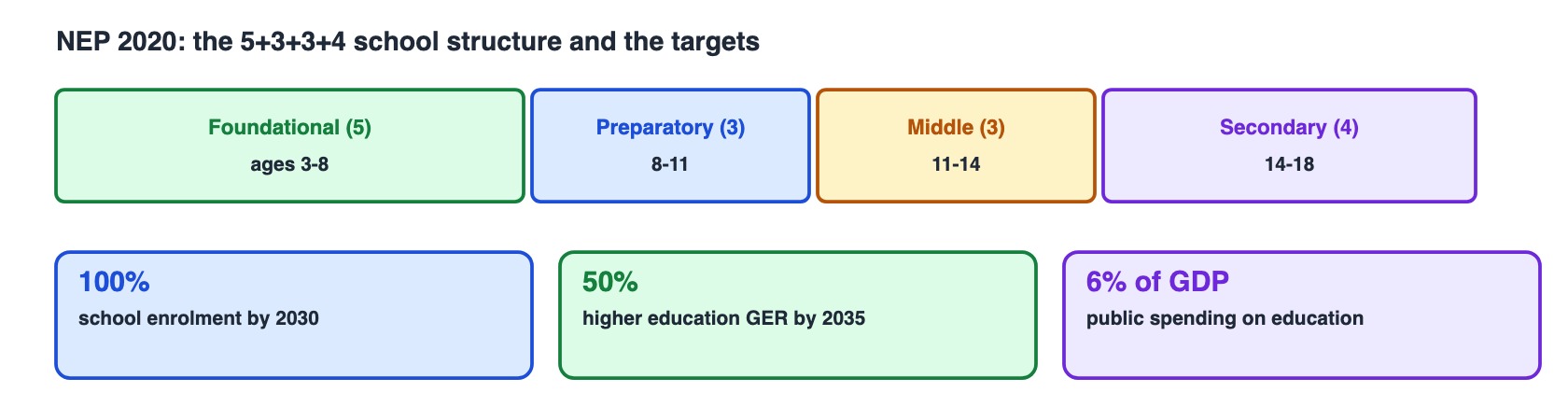
NEP 2020's school structure by age, and its three targets.
School education schemes
Scheme | What it covers |
Samagra Shiksha | Integrated Centrally Sponsored Scheme for the whole of school education, pre-primary to class XII; supports the RTE Act; aligned with NEP 2020 |
PM SHRI (approved 7 September 2022) | Over 14,500 existing Central, State and local-body schools upgraded as exemplar schools showcasing NEP 2020 |
PM POSHAN (2021-22 to 2025-26) | One hot cooked meal in Government and aided schools for classes I-VIII, and also Bal Vatika (pre-school before class I); community 'Tithi Bhojan' and school nutrition gardens |
NIPUN Bharat (5 July 2021) | Foundational literacy and numeracy for every child by the end of Grade 3, by 2026-27 |
Digital | DIKSHA content platform; PM eVIDYA 'One Class, One Channel' TV; APAAR student IDs (over 7 crore); PARAKH Rashtriya Sarvekshan assessment |
Where schools stand: NEP at five
Access: gross access ratios in 2023-24 were 97.8% at primary and 96.57% at upper primary level; 98.4% of schools have drinking water and 97.1% girls' toilets.
Learning: in Government schools, 23.4% of Class III children could read a Grade II text in 2024 (16.3% in 2022), and 27.6% could do basic subtraction (20.2% in 2022). Better, but still low, which is why NIPUN focuses on Grade 3.
Equity: 5,269 Kasturba Gandhi Balika Vidyalayas (residential schools for girls) house 7.58 lakh girls, and 1,137 Netaji Subhash Avasiya Vidyalayas serve disadvantaged children. PRASHAST helps teachers screen for the 21 disabilities in the RPwD Act, 2016, and Indian Sign Language is now a subject at secondary level.
Support: Vidyanjali links schools with volunteers and donors; DIKSHA offers material in 133 Indian languages; the curriculum framework recommends vocational exposure from Grade 3.
Exams in classes 5 and 8: the rules under the RTE (Amendment) Act, 2019 were amended on 16 December 2024 to provide a regular exam at the end of classes 5 and 8. A child who fails gets extra teaching and a re-exam within two months, and can be held back in class 5 or 8 if they fail again.
ULLAS: Adult Literacy
Adult literacy has its own programme, with a clear definition of "fully literate".
ULLAS: adult literacy
ULLAS (Understanding of Lifelong Learning for All in Society), the New India Literacy Programme, is a Centrally Sponsored scheme for adults aged 15 and above who missed school. Learners take the FLNAT literacy test; more than 3.3 crore have done so.
A State or UT with 95% literacy is treated as fully literate. Ladakh was the first; ten States and UTs declared themselves fully literate between 2024 and 2026: Ladakh, Mizoram, Goa, Tripura, Himachal Pradesh, Chandigarh, Andaman and Nicobar Islands, Sikkim, Uttarakhand, and Jammu and Kashmir.
For perspective: literacy was 14% in 1947, and 8% among women.
Skilling and Internships
Skilling schemes sit with MSDE, which UPSC has tested directly.
Skilling and internships
Scheme | Key facts |
PM Kaushal Vikas Yojana (PMKVY 4.0) | MSDE's flagship short-term skilling scheme; over 7,000 Skill Hubs in schools, colleges and ITIs; IITs, IIMs, NITs and PSUs train under it for the first time |
National Apprenticeship Promotion Scheme (NAPS) | 'Earn while you learn'; over 49.18 lakh apprentices engaged since 2016 |
Jan Shikshan Sansthans | Last-mile skilling for rural, tribal, women and marginalised learners |
Skill India Digital Hub | Hosts curricula and certification frameworks; qualifications align with the NSQF and NCrF frameworks |
PM Vishwakarma (September 2023) | Training, toolkits and credit for artisans in 18 trades (see the financial inclusion article) |
PM Internship Scheme | 12-month industry internships in 25 sectors; Rs 5,000 a month by DBT plus a one-time Rs 6,000; PMJJBY and PMSBY cover; run by Corporate Affairs |
ITIs and PM-SETU
Industrial Training Institutes (ITIs) rose from about 9,977 (2014) to over 14,682 (2025), and enrolment from about 9.5 lakh to over 14 lakh. The Dual System of Training combines ITI classes with on-the-job training in industry.
PM-SETU (Pradhan Mantri Skilling and Employability Transformation through Upgraded ITIs), approved on 7 May 2025 and launched on 4 October 2025, is a Centrally Sponsored Scheme of Rs 60,000 crore (Centre Rs 30,000 crore, States Rs 20,000 crore, industry Rs 10,000 crore; half the central share is a results-based loan from the ADB and the World Bank). It upgrades 1,000 Government ITIs in a hub-and-spoke model (200 hubs, 800 spokes), with industry partners co-managing clusters through special purpose vehicles.
Results so far: 27.08 lakh people trained under PMKVY 4.0 in 38 sectors (December 2025); women's share of apprentices up from 11.30% (2018-19) to 22.84% (2024-25); India placed 13th at the WorldSkills Competition 2024 in Lyon, with 4 bronze medals.
How UPSC asks it
Which ministry runs a scheme (PMKVY is MSDE, not Labour); which classes a scheme covers; what a framework like NSQF does.
New rules and targets: the 2024 change to no-detention, NIPUN's Grade 3 target, the 95% full-literacy benchmark.
Mains: learning outcomes versus enrolment, school nutrition, and making skilling demand-driven.
Further Reading
PIB press releases, ministry websites and annual reports, the Gazette of India, MEA and UN documents and the official sources named in each note — the primary sources behind every fact above.
Test Yourself: Practice Questions & PYQs
16 practice questions, then a real UPSC question on PMKVY.
Practice Questions
Q1. Samagra Shiksha covers school education from
(a) pre-primary to class XII
(b) class VI to class X only
(c) class I to class VIII only
(d) class IX to class XII only
Show answer
Answer: (a) — Samagra Shiksha treats school education as a continuum from pre-primary to class XII and supports the RTE Act.
Q2. PM SHRI schools are
(a) existing Central, State and local-body schools upgraded as NEP 2020 exemplars
(b) schools run by the armed forces
(c) residential schools for tribal children
(d) new private schools on PPP
Show answer
Answer: (a) — Over 14,500 existing schools are being strengthened; the scheme was approved on 7 September 2022.
Q3. Consider the following statements:
1. PM POSHAN provides one hot cooked meal to children of classes I to VIII in Government and aided schools.
2. PM POSHAN also covers children in Bal Vatika (pre-school before class I).
3. PM POSHAN is implemented by the Ministry of Women and Child Development.
Which of the statements given above are correct?
(a) 1 and 2 only
(b) 2 and 3 only
(c) 1 and 3 only
(d) 1, 2 and 3
Show answer
Answer: (a) — 1 and 2 are correct. PM POSHAN is implemented by the Ministry of Education.
Q4. NIPUN Bharat aims at foundational literacy and numeracy for every child by the end of
(a) Grade 8, by 2025
(b) Grade 5, by 2030
(c) Grade 3, by 2026-27
(d) Grade 1, by 2024
Show answer
Answer: (c) — NIPUN Bharat was launched on 5 July 2021.
Q5. Under the RTE rules amended on 16 December 2024, a child failing the class 5 or 8 exam
(a) is moved to an open school
(b) must leave school
(c) gets extra teaching and a re-exam within two months, and may be held back if they fail again
(d) is promoted automatically
Show answer
Answer: (c) — The rules under the RTE (Amendment) Act, 2019 were amended on 16 December 2024 to provide regular exams in classes 5 and 8.
Q6. Under ULLAS, a State or UT is treated as fully literate when literacy reaches
(a) 85%
(b) 100%
(c) 95%
(d) 90%
Show answer
Answer: (c) — ULLAS is for adults aged 15 and above; Ladakh was the first to be declared fully literate.
Q7. ULLAS - Nav Bharat Saaksharta Karyakram is meant for
(a) college students
(b) adults aged 15 and above who missed formal schooling
(c) children aged 6-14
(d) school teachers
Show answer
Answer: (b) — It is the New India Literacy Programme, a Centrally Sponsored scheme aligned with NEP 2020.
Q8. PM Kaushal Vikas Yojana is the flagship scheme of the
(a) Ministry of Labour and Employment
(b) Ministry of MSME
(c) Ministry of Skill Development and Entrepreneurship
(d) Ministry of Education
Show answer
Answer: (c) — PMKVY is MSDE's flagship short-term skilling scheme, now in its fourth phase.
Q9. The National Apprenticeship Promotion Scheme is described by the phrase
(a) skilling the unskilled
(b) earn while you learn
(c) learning by doing at home
(d) funding the unfunded
Show answer
Answer: (b) — NAPS has engaged over 49.18 lakh apprentices since 2016.
Q10. Under the PM Internship Scheme, interns receive
(a) Rs 5,000 a month by DBT and a one-time grant of Rs 6,000
(b) Rs 10,000 a month for six months
(c) a free laptop and Rs 2,000
(d) no stipend, only a certificate
Show answer
Answer: (a) — The internships last 12 months across 25 sectors, with PMJJBY and PMSBY insurance.
Q11. APAAR, under which over 7 crore IDs have been generated, is
(a) a school ranking index
(b) a scholarship portal
(c) a unique ID to track a student's academic progress
(d) a teacher eligibility test
Show answer
Answer: (c) — APAAR IDs are used to track each student's progress.
Q12. Under the RTE Act, 2009, private unaided schools must reserve for children of weaker sections and disadvantaged groups at least
(a) 50% of the entry class
(b) 15% of class 6 seats
(c) 10% of all seats
(d) 25% of the entry class
Show answer
Answer: (d) — Section 12(1)(a): at least 25% of class 1 (or pre-primary, if admission starts there), with free education till elementary education is complete.
Q13. Consider the following statements:
1. NEP 2020 replaces the 10+2 structure with 5+3+3+4.
2. NEP 2020 targets 50% gross enrolment in higher education by 2035.
3. NEP 2020 makes teaching in the mother tongue compulsory up to Class 12.
Which of the statements given above are correct?
(a) 1 and 2 only
(b) 2 and 3 only
(c) 1 and 3 only
(d) 1, 2 and 3
Show answer
Answer: (a) — 1 and 2 are correct. The policy says teaching up to at least Grade 5 should be in the mother tongue or regional language.
Q14. Under NEP 2020, the Higher Education Commission of India is meant to be a single regulator for higher education excluding
(a) engineering and management
(b) medical and legal education
(c) teacher education
(d) agricultural education only
Show answer
Answer: (b) — HECI is to be the umbrella body for all higher education except medical and legal education.
Q15. PM-SETU, approved in May 2025, aims to
(a) give internships in top companies
(b) build new IITs in every State
(c) set up Skill Hubs in schools
(d) upgrade 1,000 Government ITIs in a hub-and-spoke model with industry partners
Show answer
Answer: (d) — It is a Rs 60,000 crore Centrally Sponsored Scheme; the ADB and World Bank co-finance half the central share.
Q16. Kasturba Gandhi Balika Vidyalayas are
(a) residential schools for girls from disadvantaged groups
(b) vocational institutes for women
(c) anganwadi centres
(d) colleges for women teachers
Show answer
Answer: (a) — 5,269 KGBVs house 7.58 lakh girls under Samagra Shiksha.
UPSC Previous Year Questions (PYQs)
Real UPSC Prelims question, checked against the official paper and answer key.
Q1. With reference to Pradhan Mantri Kaushal Vikas Yojana, consider the following statements:
1. It is the flagship scheme of the Ministry of Labour and Employment.
2. It, among other things, will also impart training in soft skills, entrepreneurship, financial and digital literacy.
3. It aims to align the competencies of the unregulated workforce of the country to the National Skill Qualification Framework.
Which of the statements given above is/are correct? (UPSC CSE 2018)
(a) 1 and 3 only
(b) 2 only
(c) 2 and 3 only
(d) 1, 2 and 3
Show answer
Answer: (c) — 2 and 3. PMKVY is the flagship of the Ministry of Skill Development and Entrepreneurship, not Labour, so statement 1 is wrong; the official key confirms (c).
Mains Practice Questions
Use these to frame full-length answers. You don't have to answer one exactly — they show the angles UPSC tests, so let them guide which points you cover.
Enrolment is near universal, but learning outcomes lag. How do NIPUN Bharat and PARAKH seek to address this?
Examine the debate over the no-detention policy and the 2024 amendment to the RTE rules.
Discuss how PMKVY, apprenticeships and the PM Internship Scheme can make India's skilling demand-driven.