SHGs, Cooperatives and NGOs for UPSC: SHG-Bank Linkage (NABARD 1992), DAY-NRLM, Lakhpati Didi, Ministry of Cooperation and the FCRA up to the 2026 Rules
SHG-Bank Linkage and DAY-NRLM
🎯 Exam priority: Important. UPSC asked who started the SHG programme (2023) and keeps asking about NRLM's structure and rural credit. NGO funding law (FCRA) changed again in 2026. Learn the "who started it" facts and the numbers below.
Self-Help Groups (SHGs) are small groups, mostly of rural women, who save together, lend to each other and borrow from banks as a group. Two strands meet in them: bank credit through NABARD's linkage programme, and livelihoods through the National Rural Livelihoods Mission.
SHG-Bank Linkage and DAY-NRLM
SHG-Bank Linkage Programme began as a NABARD pilot in 1992 (not a State Bank of India initiative). It gives collateral-free loans to poor women at normal interest rates and has reached over 10 crore rural families. Commercial banks, Regional Rural Banks and cooperative banks all lend to SHGs; farmers can also borrow as Joint Liability Groups.
DAY-NRLM (Deendayal Antyodaya Yojana - National Rural Livelihoods Mission), launched in June 2011, is a Centrally Sponsored Scheme of the Rural Development Ministry, run with State Rural Livelihoods Missions. Its four components: building community institutions of the poor, financial inclusion, sustainable livelihoods, and social inclusion and convergence.
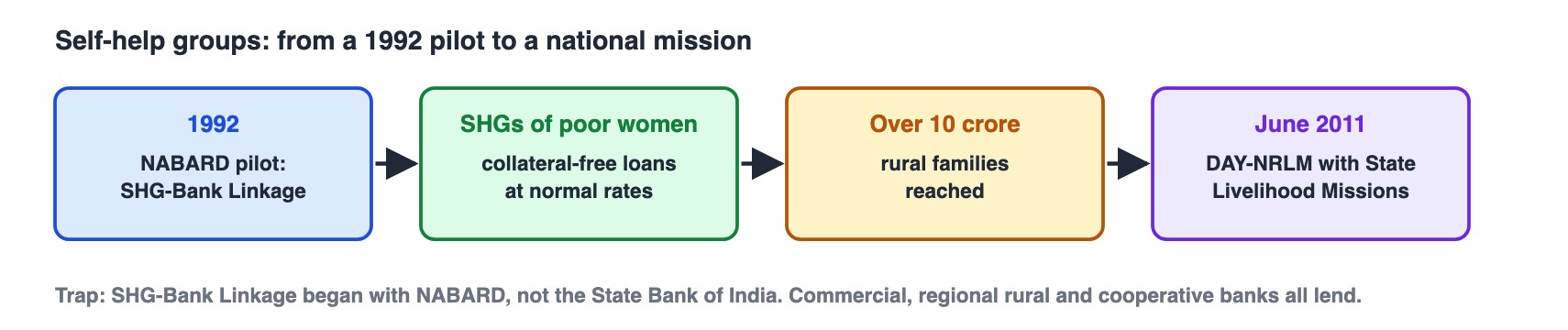
Self-help groups from the 1992 pilot to DAY-NRLM.
Tier | What it is | Scale (Nov 2025) |
Self-Help Group | Women who save and borrow together | 90.90 lakh SHGs; 10.05 crore women |
Village Organisation (VO) | Federation of SHGs in a village | About 5.35 lakh |
Cluster Level Federation (CLF) | Federation of VOs across villages | 33,590 |
BC Sakhis: over 1.44 lakh SHG women work as banking correspondents, bringing deposits, credit, pensions and insurance to villages. Over 6 lakh Community Resource Persons train others.
Lakhpati Didi: the goal is 3 crore SHG women earning at least Rs 1 lakh a year; over 2 crore have got there.
Evidence: a 2019 World Bank-supported 3ie study found 19% higher income, 20% less reliance on informal loans and 28% more savings among members.
Cooperatives
Cooperatives are the other member-owned institutions of the village economy.
Cooperatives
A separate Ministry of Cooperation was set up on 6 July 2021, with the slogan "Sahkar se Samriddhi" (prosperity through cooperation).
Model bye-laws for PACS (primary agricultural credit societies), circulated on 5 January 2023, let them become multipurpose and work in more than 25 new sectors. PACS computerisation and the cooperative credit ladder are in the Economy article on agriculture and rural credit.
2025 was observed as the International Year of Cooperatives.
Constitutional status (97th Amendment, 2011)
Forming cooperative societies became a fundamental right under Article 19(1)(c), alongside associations and unions.
A new Directive Principle, Article 43B, asks the State to promote voluntary formation, autonomous functioning, democratic control and professional management of cooperatives.
Part IXB lays down how cooperatives are run: at most 21 directors on a board, one seat reserved for SC or ST members and two for women, and a five-year term for the elected board.
Making PACS the hub of the village economy
Initiative | What it does | Progress (end-2025) |
Model bye-laws (January 2023) | PACS become multipurpose: dairy, fisheries, storage and 25+ other lines | Adopted by 32 States/UTs |
PACS computerisation (approved 29 June 2022) | Centrally Sponsored Scheme, with NABARD implementing, for digital PACS by 31 March 2027 | 79,630 PACS; Rs 2,925.39 crore |
New PACS, dairy and fishery societies (Cabinet, 15 February 2023) | A cooperative in every panchayat or village within five years | 32,009 registered |
Grain storage in the cooperative sector (Cabinet, 31 May 2023) | Called the world's largest; godowns, processing units and fair price shops at PACS | 112 PACS done, 68,702 tonnes |
PACS as Common Service Centres | Over 300 e-services delivered from the village PACS | 51,836 PACS |
FPOs through cooperatives | NCDC forms farmer producer organisations, many from PACS | 1,863 FPOs |
Three new national cooperatives under the Multi-State Cooperative Societies Act, 2002: NCEL (exports), NCOL (organic produce, brand "Bharat Organics") and BBSSL (certified seeds, brand "Bharat Beej").
White Revolution 2.0 aims to raise milk procurement by dairy cooperatives by 50% in five years.
Tax and business relief: a 15% tax rate (down from up to 30% plus surcharge) for new manufacturing cooperatives; cash deposit and payment limits for PACS raised from Rs 20,000 to Rs 2 lakh per member; PACS may now run LPG distributorships and petrol outlets.
NGOs and the FCRA
NGOs that take money from abroad come under a separate law run by the Home Ministry.
NGOs and the Foreign Contribution (Regulation) Act
The FCRA, administered by the Ministry of Home Affairs, decides who may accept foreign contributions, how they must be received and reported, and which activities they may not fund. Every recipient must register, use a designated bank account and file annual audited returns.
Year | Change |
1976 | First FCRA enacted |
2010 | New FCRA (assent 26 September 2010) replaced the 1976 Act; registration must be renewed every five years |
2020 | Aadhaar or passport ID for office-bearers; all foreign money first into a single SBI, New Delhi account; no sub-granting to other NGOs; administrative spending cap cut from 50% to 20% |
2022 | Limit on contributions from relatives abroad raised from Rs 1 lakh to Rs 10 lakh a year |
2026 | Amendment Rules notified: registration tied to specified purposes and States/UTs, proselytisation excluded from permitted religious activity; an Amendment Bill proposes an authority to safeguard foreign-funded assets when a registration lapses or is cancelled |
Scale: in 2024-25 about 16,200 registered associations received about Rs 22,963 crore. The Government's case is that FCRA is a registration and disclosure law, like the US FARA, Australia's FITS, the UK's FIRS and Canada's FITAA, not a ban.
How it works: an organisation needs registration (if it has worked for at least three years) or prior permission for a specific project; money arrives first in the SBI New Delhi Main Branch account; at most 20% goes to administration and 80% to the stated purpose; an audited annual return (Form FC-4) goes online. Registration became compulsory in 1984.
Who may not receive foreign money (Section 3): election candidates, legislators, judges, public servants, political parties and their office-bearers, organisations of a political nature, and specified news media.
2026 package: the Amendment Bill (introduced 25 March 2026) adds provisional and then permanent vesting of assets of NGOs that lose registration, an appeal to the district judge, a lower maximum jail term (five years to one), and Central approval before State agencies investigate. The Rules (22 June 2026) require each certificate to name exact purposes and States, list permitted religious purposes, demand use of at least Rs 10 lakh over two years for renewal, and ask for donor-wise and project-wise disclosure.
The debate for Mains: transparency and protection of sovereignty on one side; compliance burden and space for civil society on the other.
How UPSC asks it
Who started a programme (SHG linkage: NABARD, 1992), the tiers of NRLM, the meaning of BC Sakhi and Lakhpati Didi.
FCRA details: which ministry, the SBI New Delhi account, the 20% cap.
Mains: SHGs and women's empowerment, cooperatives in rural credit, and the balance between accountability and space for civil society.
Further Reading
PIB press releases, ministry websites and annual reports, the Gazette of India, MEA and UN documents and the official sources named in each note — the primary sources behind every fact above.
Test Yourself: Practice Questions & PYQs
16 practice questions, then a real UPSC question on Self-Help Groups.
Practice Questions
Q1. The SHG-Bank Linkage Programme began in 1992 as a pilot of
(a) the Reserve Bank of India
(b) the State Bank of India
(c) the Ministry of Rural Development
(d) NABARD
Show answer
Answer: (d) — NABARD started it; its silver jubilee was celebrated at NABARD's 36th Foundation Day in 2017.
Q2. DAY-NRLM was launched in
(a) April 2005
(b) October 2014
(c) August 1999
(d) June 2011
Show answer
Answer: (d) — It is a Centrally Sponsored Scheme of the Rural Development Ministry, run with State Rural Livelihoods Missions.
Q3. Under DAY-NRLM, the correct order of community institutions from the smallest upwards is
(a) SHG, Cluster Level Federation, Village Organisation
(b) SHG, Village Organisation, Cluster Level Federation
(c) Cluster Level Federation, SHG, Village Organisation
(d) Village Organisation, SHG, Cluster Level Federation
Show answer
Answer: (b) — SHGs federate into Village Organisations, which federate into Cluster Level Federations.
Q4. A 'Lakhpati Didi' is an SHG woman who
(a) has taken a loan of Rs 1 lakh
(b) earns at least Rs 1 lakh a year
(c) has saved Rs 1 lakh in a Jan Dhan account
(d) trains 1 lakh women
Show answer
Answer: (b) — The target is 3 crore Lakhpati Didis; over 2 crore have reached it.
Q5. BC Sakhis under DAY-NRLM are
(a) SHG women working as banking correspondents in villages
(b) Anganwadi helpers
(c) nurses in health and wellness centres
(d) agricultural extension workers
Show answer
Answer: (a) — Over 1.44 lakh BC Sakhis bring deposits, credit, pensions and insurance to rural households.
Q6. The Ministry of Cooperation was established on
(a) 2 October 2022
(b) 15 August 2019
(c) 26 January 2020
(d) 6 July 2021
Show answer
Answer: (d) — Its slogan is 'Sahkar se Samriddhi'; model bye-laws for multipurpose PACS followed in January 2023.
Q7. The Foreign Contribution (Regulation) Act is administered by the
(a) Ministry of Home Affairs
(b) Reserve Bank of India
(c) Ministry of Finance
(d) Ministry of External Affairs
Show answer
Answer: (a) — The Home Ministry registers associations, monitors receipts and handles renewals and cancellations.
Q8. Consider the following statements:
1. Under the FCRA amendment of 2020, foreign contributions must first be received in a single SBI, New Delhi account.
2. The 2020 amendment raised the cap on administrative expenses from 20% to 50%.
3. FCRA registration must be renewed every five years.
Which of the statements given above are correct?
(a) 1 and 2 only
(b) 2 and 3 only
(c) 1 and 3 only
(d) 1, 2 and 3
Show answer
Answer: (c) — 1 and 3 are correct. The 2020 amendment cut the administrative-expense cap from 50% to 20%.
Q9. The FCRA (Amendment) Rules, 2026
(a) allow sub-granting to any NGO
(b) move FCRA to the Ministry of External Affairs
(c) link registration to specified purposes and States/UTs and exclude proselytisation from permitted religious activity
(d) abolish registration for NGOs
Show answer
Answer: (c) — A separate 2026 Amendment Bill proposes an authority to safeguard foreign-funded assets when a registration lapses or is cancelled.
Q10. A 2019 3ie study of DAY-NRLM found that members' reliance on informal loans
(a) fell by 20%
(b) rose by 20%
(c) did not change
(d) fell by 80%
Show answer
Answer: (a) — It also found 19% higher income and 28% more savings.
Q11. Which of the following is NOT one of the four core components of DAY-NRLM?
(a) Financial inclusion of the rural poor
(b) Sustainable livelihoods
(c) Guaranteed 125 days of wage employment
(d) Social inclusion, social development and convergence
Show answer
Answer: (c) — The four are institution building, financial inclusion, sustainable livelihoods, and social inclusion and convergence. Guaranteed wage work is the VB-G RAM G Act.
Q12. India's first Foreign Contribution (Regulation) Act was enacted in
(a) 1950
(b) 2010
(c) 1991
(d) 1976
Show answer
Answer: (d) — The 1976 Act was replaced by the FCRA, 2010, later amended in 2016, 2018 and 2020.
Q13. The right to form cooperative societies was added to Article 19(1)(c) by the
(a) 101st Amendment, 2016
(b) 97th Amendment, 2011
(c) 73rd Amendment, 1992
(d) 44th Amendment, 1978
Show answer
Answer: (b) — The same amendment added Article 43B (a Directive Principle) and Part IXB on cooperative societies.
Q14. Consider the following statements:
1. Part IXB limits the board of a cooperative society to 21 directors.
2. Two board seats are reserved for women.
3. The elected board's term is three years.
Which of the statements given above are correct?
(a) 1 and 2 only
(b) 2 and 3 only
(c) 1 and 3 only
(d) 1, 2 and 3
Show answer
Answer: (a) — 1 and 2 are correct. The term is five years; one seat is also reserved for SC or ST members.
Q15. 'Bharat Beej' is the brand of which national cooperative?
(a) National Cooperative Export Limited
(b) Bharatiya Beej Sahakari Samiti Limited
(c) NAFED
(d) National Cooperative Organics Limited
Show answer
Answer: (b) — NCOL sells under 'Bharat Organics'; NCEL handles exports. All three were set up under the MSCS Act, 2002.
Q16. Which of the following may NOT receive foreign contribution under Section 3 of the FCRA?
(a) A registered educational trust
(b) A hospital with prior permission
(c) A disaster relief NGO
(d) A judge
Show answer
Answer: (d) — The list also covers election candidates, legislators, public servants, political parties and specified news media.
UPSC Previous Year Questions (PYQs)
Real UPSC Prelims question, checked against the official paper and answer key.
Q1. Consider the following statements:
1. The Self-Help Group (SHG) programme was originally initiated by the State Bank of India by providing microcredit to the financially deprived.
2. In an SHG, all members of a group take responsibility for a loan that an individual member takes.
3. The Regional Rural Banks and Scheduled Commercial Banks support SHGs.
How many of the above statements are correct? (UPSC CSE 2023)
(a) Only one
(b) Only two
(c) All three
(d) None
Show answer
Answer: (b) — Only two. The SHG-Bank Linkage Programme began as a NABARD pilot in 1992, not an SBI initiative, so 1 is wrong. Group responsibility for members' loans and lending by RRBs and commercial banks are both correct.
Mains Practice Questions
Use these to frame full-length answers. You don't have to answer one exactly — they show the angles UPSC tests, so let them guide which points you cover.
Self-Help Groups have been called the backbone of women's economic empowerment in rural India. Examine their achievements and limits.
Discuss the role of cooperatives in rural credit and why the Ministry of Cooperation is promoting multipurpose PACS.
Examine the changes to the FCRA since 2010. How should the State balance transparency in foreign funding with space for civil society?