Endometrial and Ovarian Tumours for NEET PG OBG: Postmenopausal Bleeding, Endometrial Cancer Risks, Ovarian Cancer Markers, Benign Masses and Torsion
Start Here
🎯 Exam priority: High. Expect: postmenopausal bleeding work-up, endometrial cancer risk factors (unopposed oestrogen, tamoxifen, Lynch), surgical staging, ovarian cancer histology and BRCA, marker by age (CA 125 vs AFP/hCG/LDH/inhibin), ultrasound red flags, Meigs syndrome, and recognising torsion.
CBME mapping: OG34. Cervical cancer is in OBG 24.
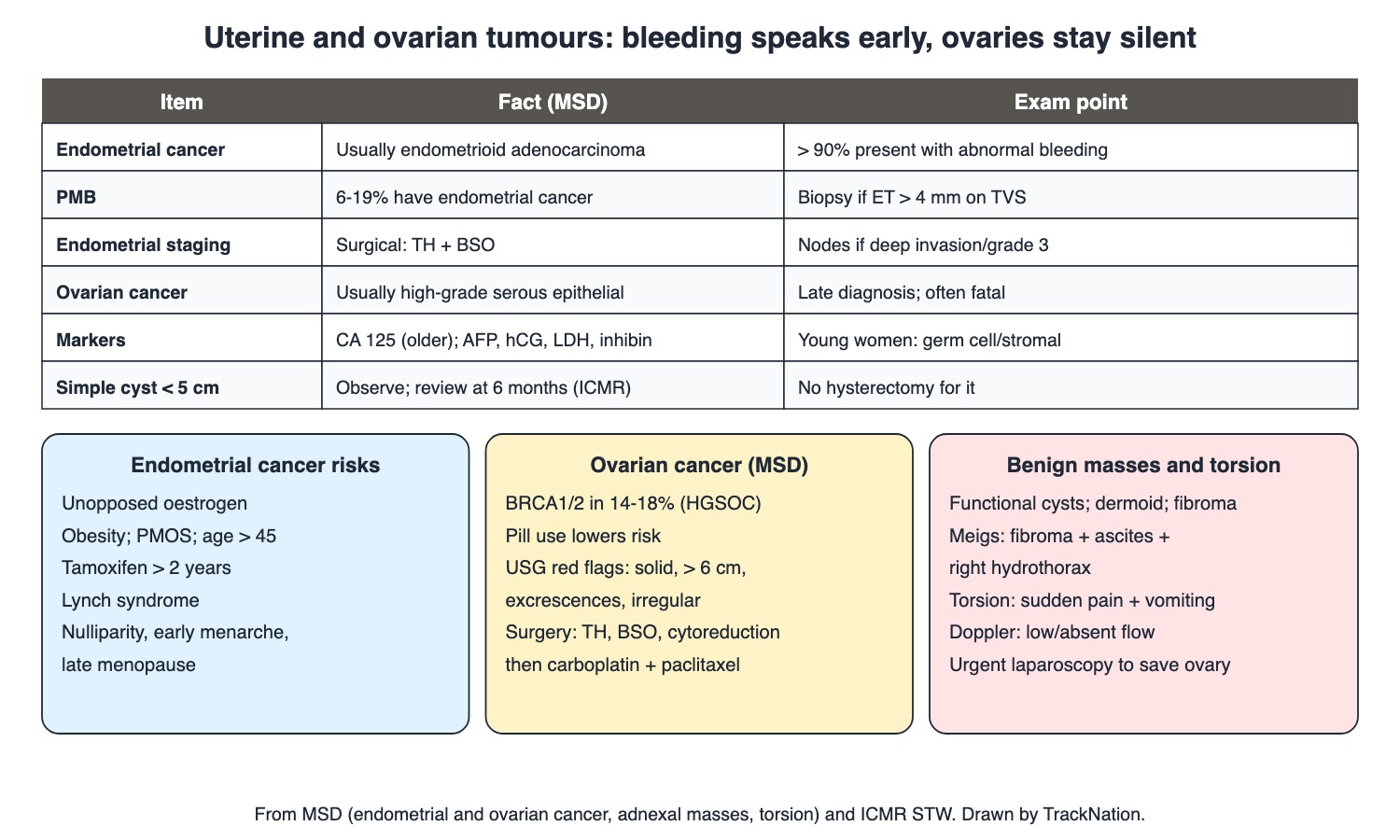
Endometrial and ovarian tumours, benign masses and torsion. Drawn by TrackNation.
Endometrial Cancer (MSD, ICMR)
Usually endometrioid adenocarcinoma; >90% present with abnormal bleeding — classically postmenopausal bleeding (PMB). 6–19% of women with PMB have endometrial cancer. About 80% are found early (good prognosis).
Risks: unopposed oestrogen (anovulation/PMOS, oestrogen without progestogen, oestrogen-secreting tumours), obesity, age >45, tamoxifen >2 years, Lynch syndrome, pelvic radiation, nulliparity, early menarche, late menopause.
Diagnosis: endometrial biopsy (sensitivity >90%); TVS is an alternative in average-risk postmenopausal women — biopsy if the endometrium is >4 mm; D&C ± hysteroscopy if inconclusive. ICMR: recurrent PMB is an indication for hysterectomy even without cancer.
Staging is surgical: total hysterectomy + bilateral salpingo-oophorectomy; pelvic/para-aortic nodes for deep (>50%) invasion, grade 3 or high-risk histology; radiation ± chemotherapy for stage II–III.
Ovarian Cancer (MSD)
Second commonest gynaecological cancer in the US; often fatal because it is diagnosed late (symptoms vague). Commonest type: high-grade serous epithelial cancer, grouped with fallopian-tube and peritoneal cancers. Spread: direct, peritoneal seeding, lymphatics.
Risk: nulliparity, early menarche, late menopause, family/personal history of breast, endometrial or colon cancer; BRCA1/2 germline in 14–18% of high-grade serous cancers. Oral contraceptives lower risk.
Other types: germ cell (dysgerminoma, endodermal sinus, immature teratoma, choriocarcinoma) — usually under 30, and XY gonadal dysgenesis predisposes; sex cord–stromal (granulosa-theca, Sertoli–Leydig); metastases (breast, GI).
Markers: young women — β-hCG, LDH, AFP, inhibin (plus CA 125); peri/postmenopausal — CA 125 (raised in 80% of advanced epithelial cancers; can be normal early; also raised in endometriosis, PID, pregnancy).
Ultrasound red flags: solid component, surface excrescences, >6 cm, irregular, low-resistance flow. Mass + ascites usually means cancer — unless Meigs syndrome (benign fibroma + ascites + right hydrothorax).
Treatment: hysterectomy, BSO and maximal cytoreduction, then carboplatin + paclitaxel; neoadjuvant chemotherapy if not operable first; fertility-sparing surgery possible for stage I non-epithelial tumours.
Benign Adnexal Masses and Torsion (MSD, ICMR)
Benign masses: functional cysts (follicular, corpus luteum), endometriomas, theca lutein cysts (ovulation induction), fibromas, cystadenomas, benign cystic teratomas (dermoids), paraovarian cysts. Surgery (cystectomy/oophorectomy) if symptomatic or cancer is suspected.
ICMR: a simple ovarian cyst <5 cm without suspicious features is observed and reviewed at 6 months — no hysterectomy.
Adnexal torsion — a common gynaecological emergency: twisting cuts the arterial supply; usually an enlarged ovary or mass; sudden severe pain with nausea and vomiting. TVS shows an enlarged ovary/mass; Doppler: reduced or absent flow. Suspicion alone → immediate laparoscopy to save the ovary.
Traps the Examiner Sets
Postmenopausal bleeding = endometrial cancer until proved otherwise.
Tamoxifen protects the breast but raises endometrial cancer risk.
CA 125 can be normal in early ovarian cancer and raised in benign conditions.
Pelvic mass + ascites + right pleural effusion with a benign fibroma = Meigs syndrome.
Memory Hooks & Shortcuts
Shortcuts to lock in this article's numbers and lists. Each one only re-packages facts proven above.
🧠 'Bleeding after the menopause = biopsy' (TVS over 4 mm) — PMB
🧠 Endometrial risks 'Fat, Unopposed, Tamoxifen, Lynch' — risks
🧠 Markers by age: 'Young = AFP, hCG, LDH, inhibin; Old = CA 125' — markers
🧠 Meigs 'Fibroma, Fluid (ascites), right Flank (hydrothorax)' — Meigs
🧠 Torsion 'Twist, Vomit, No flow, Operate now' — torsion
Rapid-Revision Cards
Endometrial cancer type
Endometrioid adenocarcinoma.
Presentation
>90% abnormal bleeding (PMB).
PMB → cancer
6–19%.
Risks
Unopposed oestrogen, obesity, tamoxifen, Lynch.
TVS cut-off
Biopsy if ET >4 mm.
Biopsy sensitivity
>90%.
Staging
Surgical: TH + BSO.
Nodes
Grade 3 or >50% invasion.
Recurrent PMB
Hysterectomy (ICMR).
Ovarian cancer type
High-grade serous.
Why fatal
Late diagnosis.
BRCA
14–18% of HGSOC.
Protective
Oral contraceptives.
Germ cell age
<30.
Young markers
hCG, LDH, AFP, inhibin.
Older marker
CA 125.
USG red flags
Solid, >6 cm, excrescences.
Meigs
Fibroma + ascites + right effusion.
Ovarian Rx
Cytoreduction + carbo/paclitaxel.
Simple cyst <5 cm
Observe 6 months.
Torsion
Pain + vomiting; absent flow; laparoscopy.
Sources
Facts in this article were checked against these documents.
MSD Manual Professional: Endometrial Cancer; Ovarian, Fallopian Tube, and Peritoneal Cancer; Benign Adnexal Masses; Adnexal Torsion — Merck & Co. (MSD Manuals), 2023–26 (link)
Standard Treatment Workflow: Hysterectomy for Benign Gynaecological Conditions — Indian Council of Medical Research / DHR, 2025
Competency Based Undergraduate Curriculum, Vol III: Obstetrics & Gynaecology (OG34) — National Medical Commission, 2024
Test Yourself: Practice Questions
Thirty questions in NEET PG style, most of them clinical vignettes.
Practice Questions (NEET PG pattern)
Original questions written in the style of the exam: +4 for a correct answer, −1 for a wrong one. Every answer was checked against the sources listed above. NEET PG papers are not published by NBEMS, so these are not past-paper questions.
Q1. The commonest histology of endometrial cancer is
(a) leiomyosarcoma
(b) squamous carcinoma
(c) clear cell carcinoma
(d) endometrioid adenocarcinoma
Show answer
Answer: (d) — MSD.
Q2. A 60-year-old has postmenopausal bleeding. The proportion of such women with endometrial cancer is about
(a) 60–80%
(b) 6–19%
(c) <1%
(d) 50%
Show answer
Answer: (b) — Investigate every PMB.
Q3. More than 90% of women with endometrial cancer present with
(a) pelvic mass
(b) abnormal uterine bleeding
(c) ascites
(d) bone pain
Show answer
Answer: (b) — PMB classic.
Q4. Which is a risk factor for endometrial cancer?
(a) combined oral contraceptive use
(b) multiparity
(c) smoking
(d) tamoxifen use for more than 2 years
Show answer
Answer: (d) — Also Lynch, obesity.
Q5. An obese 55-year-old nullipara with PMOS (PCOS) history has PMB. Her key risk mechanism is
(a) HPV infection
(b) high progesterone
(c) unopposed oestrogen
(d) BRCA mutation
Show answer
Answer: (c) — MSD.
Q6. An inherited syndrome raising endometrial cancer risk is
(a) Marfan syndrome
(b) Turner syndrome
(c) Down syndrome
(d) Lynch syndrome
Show answer
Answer: (d) — Also colon cancer.
Q7. In an average-risk woman with PMB, TVS shows endometrium of 7 mm. Next:
(a) repeat scan in 5 years
(b) HRT
(c) reassure
(d) endometrial biopsy
Show answer
Answer: (d) — >4 mm.
Q8. Office endometrial biopsy for endometrial cancer has a sensitivity of
(a) about 50%
(b) >90%
(c) 100% always
(d) about 20%
Show answer
Answer: (b) — D&C if inconclusive.
Q9. Endometrial cancer is staged
(a) by Pap smear
(b) surgically
(c) clinically only
(d) by CA 125
Show answer
Answer: (b) — FIGO.
Q10. Standard surgery for early endometrial cancer is
(a) cone biopsy
(b) endometrial ablation
(c) total hysterectomy with bilateral salpingo-oophorectomy
(d) myomectomy
Show answer
Answer: (c) — ± nodes.
Q11. Lymphadenectomy in endometrial cancer is indicated for
(a) only if CA 125 is high
(b) all grade 1 superficial tumours
(c) grade 3 tumours or deep (>50%) myometrial invasion
(d) never
Show answer
Answer: (c) — And high-risk histology.
Q12. Per ICMR, recurrent postmenopausal bleeding even without cancer may justify
(a) observation forever
(b) oestrogen therapy
(c) tamoxifen
(d) hysterectomy
Show answer
Answer: (d) — 2025 STW.
Q13. The commonest histological type of ovarian cancer is
(a) granulosa cell tumour
(b) Krukenberg tumour
(c) dysgerminoma
(d) high-grade serous epithelial
Show answer
Answer: (d) — MSD.
Q14. Ovarian cancer is often fatal mainly because
(a) it metastasises to brain first
(b) it occurs in children
(c) it is resistant to all treatment
(d) it is usually advanced when diagnosed
Show answer
Answer: (d) — Vague symptoms.
Q15. Germline BRCA1/2 mutations are found in what share of high-grade serous ovarian cancers?
(a) 90%
(b) 50%
(c) 1%
(d) 14–18%
Show answer
Answer: (d) — MSD.
Q16. A factor that lowers ovarian cancer risk is
(a) early menarche
(b) oral contraceptive use
(c) nulliparity
(d) late menopause
Show answer
Answer: (b) — MSD.
Q17. Ovarian germ cell cancers usually occur in women aged
(a) any age equally
(b) 40–50
(c) under 30
(d) over 60
Show answer
Answer: (c) — Check AFP, hCG, LDH.
Q18. A 19-year-old has a solid ovarian mass. Markers to order include
(a) β-hCG, LDH, AFP and inhibin (plus CA 125)
(b) PSA
(c) CA 125 only
(d) CEA only
Show answer
Answer: (a) — Non-epithelial.
Q19. In a postmenopausal woman with an ovarian mass, the marker measured is
(a) CA 125
(b) AFP
(c) β-hCG
(d) inhibin
Show answer
Answer: (a) — Mostly epithelial.
Q20. CA 125 in ovarian cancer
(a) is a germ-cell marker
(b) is raised in 80% of advanced epithelial cancers but may be normal early
(c) is specific for cancer
(d) is always raised in stage I
Show answer
Answer: (b) — Also raised in endometriosis, PID.
Q21. A woman with endometriosis has a mildly raised CA 125. This
(a) proves ovarian cancer
(b) can occur in benign conditions
(c) proves pregnancy
(d) is impossible
Show answer
Answer: (b) — Low specificity.
Q22. Which ultrasound feature suggests ovarian malignancy?
(a) follicle of 2 cm
(b) corpus luteum
(c) simple thin-walled 3 cm cyst
(d) solid component with surface excrescences, >6 cm
Show answer
Answer: (d) — Also irregular, low resistance.
Q23. A woman has a benign ovarian fibroma with ascites and a right pleural effusion. Diagnosis:
(a) Krukenberg tumour
(b) Fitz-Hugh–Curtis syndrome
(c) Meigs syndrome
(d) ovarian cancer stage IV
Show answer
Answer: (c) — Benign.
Q24. Standard treatment of advanced epithelial ovarian cancer is
(a) observation
(b) hysterectomy, BSO and maximal cytoreduction then chemotherapy
(c) radiotherapy alone
(d) hormone therapy alone
Show answer
Answer: (b) — Carboplatin + paclitaxel.
Q25. The standard chemotherapy pair for epithelial ovarian cancer is
(a) cisplatin and 5-FU only
(b) tamoxifen and letrozole
(c) methotrexate and folinic acid
(d) carboplatin and paclitaxel
Show answer
Answer: (d) — MSD.
Q26. A 22-year-old with stage I dysgerminoma wants children. MSD allows
(a) fertility-sparing surgery conserving the other ovary and uterus
(b) mandatory hysterectomy
(c) no surgery
(d) radiotherapy only
Show answer
Answer: (a) — Stage I non-epithelial.
Q27. A woman on ovulation induction develops bilateral large ovarian cysts. These are likely
(a) malignant
(b) dermoid cysts
(c) theca lutein cysts
(d) endometriomas
Show answer
Answer: (c) — MSD.
Q28. A 32-year-old has an incidental simple 4 cm ovarian cyst. ICMR advises
(a) CA 125 monthly
(b) oophorectomy
(c) hysterectomy
(d) observation and review after 6 months
Show answer
Answer: (d) — No suspicious features.
Q29. A 24-year-old with a known 7 cm dermoid has sudden severe pelvic pain and vomiting; Doppler shows absent ovarian flow. Diagnosis:
(a) ruptured ectopic
(b) adnexal torsion
(c) PID
(d) appendicitis
Show answer
Answer: (b) — Emergency.
Q30. When adnexal torsion is suspected, management is
(a) immediate laparoscopy to save the ovary
(b) repeat scan next week
(c) antibiotics
(d) wait for 48 hours
Show answer
Answer: (a) — Don't delay.
Active Recall
From memory: describe endometrial cancer presentation, risk factors, diagnosis and staging; ovarian cancer types, risk modifiers, markers by age, ultrasound red flags and treatment; and the management of benign adnexal masses and torsion.