Cervical Cancer Prevention for NEET PG OBG: HPV, CIN, VIA Screening, India's 2026 HPV Vaccination Campaign and Cervical Cancer Staging
Start Here
🎯 Exam priority: Very high. Expect: HPV types and attributable fractions, India's 2026 campaign details (vaccine, dose, age, consent), WHO 90-70-90, VIA screening under NP-NCD and what happens to VIA-positive women, CIN grades and Bethesda terms, first symptom of cancer, FIGO stage clues and treatment by stage.
CBME mapping: OG33. Indian anchors: MoHFW HPV Vaccination Campaign Operational Guidelines (February 2026) and NP-NCD Operational Guidelines (2023).
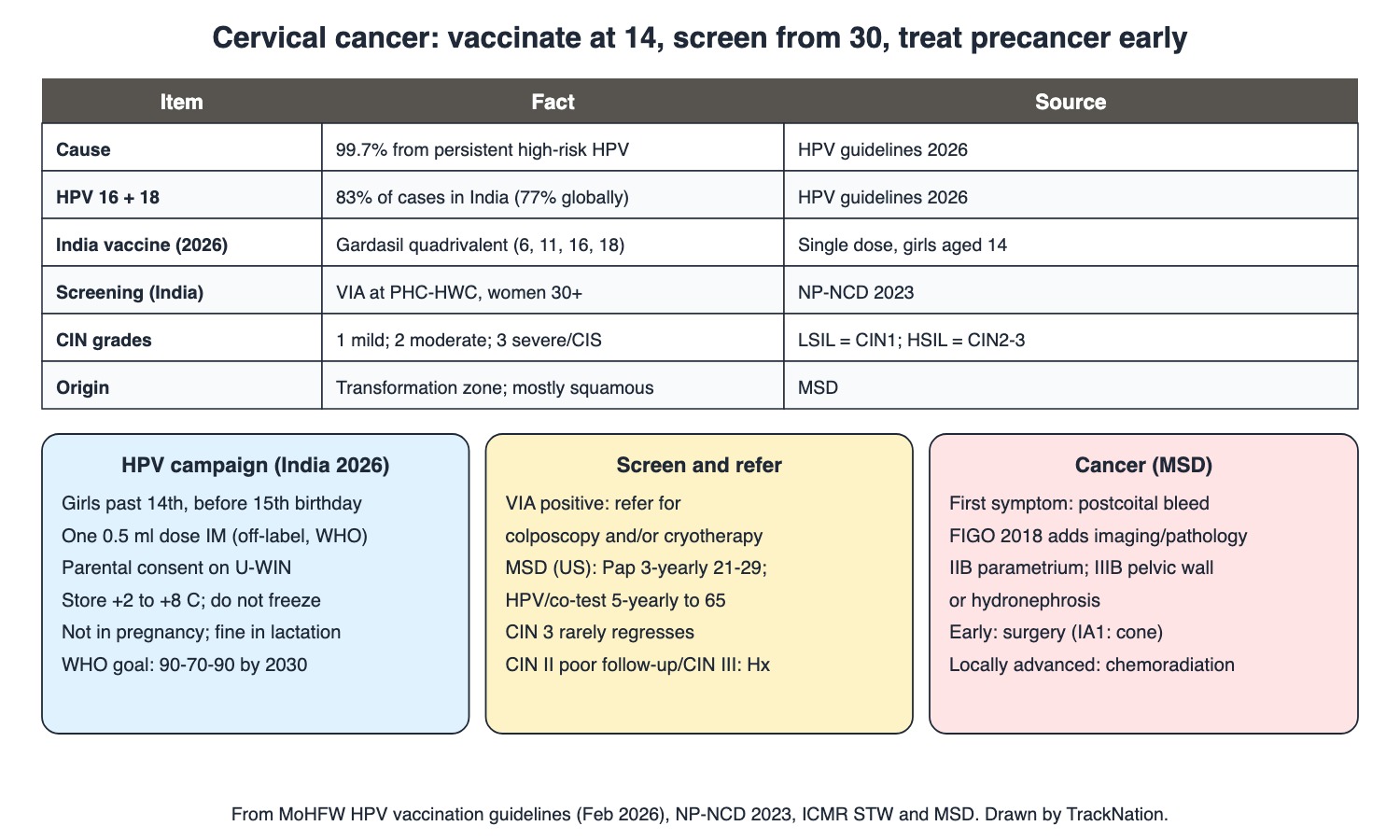
HPV, India's vaccine campaign, VIA screening and cervical cancer staging. Drawn by TrackNation.
HPV and Precancer (MoHFW 2026, MSD)
99.7% of cervical cancers come from persistent high-risk HPV; HPV is the commonest viral reproductive-tract infection. HPV 16 + 18 cause 77% of cases worldwide and 83% in India. Among Indian women, cervical cancer is second only to breast cancer (NP-NCD).
Cancers arise in the transformation zone (squamous metaplasia around the external os); most are squamous cell carcinomas, fewer adenocarcinomas.
CIN 1 mild, CIN 2 moderate, CIN 3 severe dysplasia/carcinoma in situ (rarely regresses). Bethesda: LSIL = HPV/CIN 1; HSIL = CIN 2–3; also ASC-US, ASC-H.
ICMR: hysterectomy may be considered for CIN II with poor compliance or CIN III (family complete).
Screening (NP-NCD 2023, MSD)
India (NP-NCD): population-based screening of people 30 years and above for hypertension, diabetes and cancers of the oral cavity, cervix and breast. VIA (visual inspection with acetic acid) is done by a trained staff nurse/MO at the PHC-HWC.
VIA-positive women are referred to higher facilities for colposcopy and/or cryotherapy.
MSD (US) schedules for comparison: start at 21–25; Pap every 3 years at 21–29; HPV test or co-test every 5 years to 65; stop after 65 if previous tests over 10 years were normal. VIA or Lugol iodine is the alternative where Pap/HPV tests are unavailable.
WHO 2030 targets (90-70-90): 90% of girls vaccinated by 15; 70% of women screened with a high-performance test by 35 and again by 45; 90% of women with disease treated. Elimination threshold: 4 per 1,00,000 women-years.
India's HPV Vaccination Campaign (MoHFW, February 2026)
Vaccine: Gardasil — quadrivalent (types 6, 11, 16, 18); stored at +2 to +8 °C, freeze-sensitive. (DCGI-licensed in India: Cervarix, Gardasil, Gardasil-9, Cervavac.)
Target: girls who have had their 14th birthday but not their 15th (~1.2 crore a year); after the 3-month campaign the vaccine is on routine immunisation days for 14-year-old girls.
Schedule: single dose — an off-label schedule recommended by WHO and NTAGI; IM in the deltoid. (WHO: 2 doses ≥6 months apart is the licensed schedule; single dose usable at 9–20 years.)
Voluntary; parent/guardian consent is mandatory, recorded on U-WIN. Not recommended in pregnancy (no termination needed if given inadvertently); breastfeeding is not a contraindication. History: NTAGI recommended in 2017 and 2022; Punjab pilot in 2016.
Cervical Cancer (MSD)
First symptom: irregular, often postcoital, bleeding; diagnosis by Pap test and biopsy.
FIGO 2018 staging allows imaging and pathology. Key clues: IIB parametrium (not to pelvic wall); IIIB pelvic wall or hydronephrosis/non-functioning kidney; IIIC pelvic or para-aortic nodes.
Treatment: IA1 (no LVSI) → conisation or simple hysterectomy; early stages → surgery (radical hysterectomy); locally advanced → chemoradiation; metastatic → chemotherapy.
Traps the Examiner Sets
India's campaign: one dose, girls aged 14, quadrivalent Gardasil.
Indian screening is VIA from age 30; Pap from 21 is the US schedule.
Hydronephrosis puts cervical cancer in stage III regardless of size.
HPV vaccine is not given in pregnancy but is fine during breastfeeding.
Memory Hooks & Shortcuts
Shortcuts to lock in this article's numbers and lists. Each one only re-packages facts proven above.
🧠 India HPV campaign '1-4-14': 1 dose, quadrivalent (4 types), girls of 14 — campaign
🧠 '16 and 18 = 83' in India — HPV types
🧠 WHO '90-70-90 by 2030' and elimination below 4 per lakh — targets
🧠 Screening: 'India VIA at 30; US Pap at 21' — screening
🧠 'Kidney blocked = stage 3' — hydronephrosis means IIIB — staging
Rapid-Revision Cards
HPV causation
99.7% of cervical cancers.
HPV 16+18
83% India; 77% global.
Rank in Indian women
2nd after breast.
Origin
Transformation zone.
Histology
Mostly squamous.
CIN 3
Severe dysplasia/CIS.
LSIL / HSIL
CIN1 / CIN2–3.
India screening
VIA, 30+, PHC-HWC.
VIA positive
Colposcopy ± cryotherapy.
US schedule
Pap 3-yearly 21–29; HPV 5-yearly.
90-70-90
Vaccinate, screen, treat by 2030.
Elimination
<4/100,000 women-years.
India vaccine
Gardasil quadrivalent.
Target
Girls aged 14.
Doses
Single (WHO/NTAGI).
Consent
Parent/guardian on U-WIN.
Cold chain
+2 to +8 °C; no freezing.
Pregnancy
Not given; no MTP if given.
First symptom
Postcoital bleeding.
Hydronephrosis
Stage IIIB.
Locally advanced
Chemoradiation.
Sources
Facts in this article were checked against these documents.
Operational Guidelines for Roll Out of HPV Vaccination Campaign — Ministry of Health & Family Welfare (Immunization Division), 2026
Operational Guidelines: National Programme for Prevention and Control of Non-Communicable Diseases (2023–2030) — Ministry of Health & Family Welfare, 2023
MSD Manual Professional: Cervical Cancer; Cervical Cancer Screening and Prevention — Merck & Co. (MSD Manuals), 2023–26 (link)
Standard Treatment Workflow: Hysterectomy for Benign Gynaecological Conditions — Indian Council of Medical Research / DHR, 2025
Competency Based Undergraduate Curriculum, Vol III: Obstetrics & Gynaecology (OG33) — National Medical Commission, 2024
Test Yourself: Practice Questions
Thirty questions in NEET PG style, most of them clinical vignettes.
Practice Questions (NEET PG pattern)
Original questions written in the style of the exam: +4 for a correct answer, −1 for a wrong one. Every answer was checked against the sources listed above. NEET PG papers are not published by NBEMS, so these are not past-paper questions.
Q1. Persistent high-risk HPV infection causes about what share of cervical cancers?
(a) 50%
(b) 70%
(c) 25%
(d) 99.7%
Show answer
Answer: (d) — MoHFW 2026.
Q2. HPV 16 and 18 account for what share of cervical cancer in India?
(a) 99%
(b) 30%
(c) 83%
(d) 50%
Show answer
Answer: (c) — 77% globally.
Q3. Among Indian women, cervical cancer ranks
(a) fifth
(b) second, after breast cancer
(c) first
(d) below ovarian cancer
Show answer
Answer: (b) — NP-NCD.
Q4. Most cervical cancers arise in the
(a) transformation zone
(b) parametrium
(c) endometrium
(d) upper endocervical canal only
Show answer
Answer: (a) — Squamous metaplasia.
Q5. The commonest histological type of cervical cancer is
(a) small cell carcinoma
(b) squamous cell carcinoma
(c) adenocarcinoma
(d) sarcoma
Show answer
Answer: (b) — MSD.
Q6. CIN 3 corresponds to
(a) invasive cancer
(b) normal cervix
(c) severe dysplasia and carcinoma in situ
(d) mild dysplasia
Show answer
Answer: (c) — Rarely regresses.
Q7. In the Bethesda system, HSIL includes
(a) CIN 2 and CIN 3
(b) invasive cancer only
(c) HPV infection only
(d) CIN 1 only
Show answer
Answer: (a) — LSIL = CIN 1.
Q8. Under NP-NCD, cervical cancer screening in India is done for women aged
(a) 50 years and above
(b) 21 years and above
(c) 30 years and above
(d) 15–25 years
Show answer
Answer: (c) — Population-based.
Q9. The cervical screening test used at PHC-HWC level under NP-NCD is
(a) liquid-based cytology
(b) colposcopy
(c) VIA (visual inspection with acetic acid)
(d) HPV DNA PCR
Show answer
Answer: (c) — Trained SN/MO.
Q10. A 36-year-old's VIA at the PHC-HWC is positive. Next per NP-NCD:
(a) hysterectomy at PHC
(b) repeat VIA in 10 years
(c) reassure
(d) refer for colposcopy and/or cryotherapy
Show answer
Answer: (d) — Higher facility.
Q11. In the US schedule (MSD), women aged 21–29 are screened by
(a) HPV test yearly
(b) VIA every year
(c) no screening
(d) Pap test every 3 years
Show answer
Answer: (d) — Then 5-yearly HPV/co-test.
Q12. Per MSD, screening can stop after 65 if
(a) never
(b) she has had 2 children
(c) previous tests over the last 10 years were adequately normal
(d) she is sexually inactive for 1 year
Show answer
Answer: (c) — MSD.
Q13. The WHO 90-70-90 target includes
(a) 90% of women screened by 25
(b) 70% of girls vaccinated by 9
(c) 90% cure of invasive cancer
(d) 90% of girls fully vaccinated by age 15
Show answer
Answer: (d) — By 2030.
Q14. Cervical cancer elimination as a public health problem (WHO) means incidence below
(a) 40 per 100,000
(b) 10 per 100,000
(c) 1 per 1,000
(d) 4 per 100,000 women-years
Show answer
Answer: (d) — MoHFW 2026.
Q15. India's 2026 HPV campaign uses
(a) nonavalent Gardasil-9
(b) Cecolin
(c) bivalent Cervarix
(d) quadrivalent Gardasil (types 6, 11, 16, 18)
Show answer
Answer: (d) — MoHFW.
Q16. The target group of India's 2026 HPV campaign is
(a) girls who have turned 14 but not yet 15
(b) boys and girls aged 18
(c) women aged 30–49
(d) girls aged 9–10
Show answer
Answer: (a) — ~1.2 crore a year.
Q17. The dosing schedule in India's HPV campaign is
(a) yearly boosters
(b) two doses 6 months apart
(c) a single dose (off-label, recommended by WHO and NTAGI)
(d) three doses at 0, 2, 6 months
Show answer
Answer: (c) — MoHFW.
Q18. Before vaccinating a 14-year-old girl in the campaign, you must have
(a) a Pap smear
(b) a pregnancy test
(c) an HPV DNA test
(d) parent/guardian consent, recorded on U-WIN
Show answer
Answer: (d) — Voluntary.
Q19. HPV vaccine vials must be stored at
(a) +2 to +8 °C and not frozen
(b) +15 to +25 °C
(c) room temperature
(d) −20 °C
Show answer
Answer: (a) — Freeze-sensitive.
Q20. A girl is found pregnant after receiving HPV vaccine. Management:
(a) terminate the pregnancy
(b) no termination needed; delay further doses until after pregnancy
(c) start antivirals
(d) give a booster immediately
Show answer
Answer: (b) — MoHFW.
Q21. A breastfeeding 19-year-old asks for HPV vaccination. Breastfeeding is
(a) an absolute contraindication
(b) a reason to stop breastfeeding
(c) not a contraindication
(d) a reason for half dose
Show answer
Answer: (c) — MoHFW.
Q22. The WHO primary target for HPV vaccination is
(a) boys aged 15–18
(b) pregnant women
(c) girls aged 9–14 years, before sexual debut
(d) women aged 30–49
Show answer
Answer: (c) — MoHFW 2026.
Q23. In a 2-dose HPV schedule, the minimum interval between doses is
(a) 1 month
(b) 5 years
(c) 2 weeks
(d) 6 months
Show answer
Answer: (d) — 12 months gives higher titres.
Q24. HPV vaccine is given
(a) intradermally
(b) subcutaneously in the thigh
(c) orally
(d) intramuscularly in the deltoid
Show answer
Answer: (d) — MoHFW.
Q25. The first symptom of invasive cervical cancer is usually
(a) pelvic pain
(b) weight loss
(c) leg oedema
(d) irregular, often postcoital, bleeding
Show answer
Answer: (d) — MSD.
Q26. Cervical cancer extending to the parametrium but not the pelvic wall is FIGO stage
(a) IB
(b) IIIB
(c) IIB
(d) IVA
Show answer
Answer: (c) — MSD.
Q27. A woman with cervical cancer has hydronephrosis from tumour. FIGO stage:
(a) IB2
(b) IIA
(c) IIIB
(d) IA1
Show answer
Answer: (c) — Regardless of size.
Q28. Cervical cancer with pelvic or para-aortic node involvement (FIGO 2018) is stage
(a) IB
(b) IVB only
(c) IIIC
(d) IIA
Show answer
Answer: (c) — Imaging/pathology allowed.
Q29. Microinvasive cancer, FIGO IA1 without lymphovascular invasion, is treated by
(a) conisation or simple hysterectomy
(b) chemoradiation
(c) pelvic exenteration
(d) observation only
Show answer
Answer: (a) — MSD.
Q30. Locally advanced cervical cancer is usually treated with
(a) HPV vaccine
(b) simple hysterectomy
(c) cone biopsy
(d) chemoradiation
Show answer
Answer: (d) — Early stage: surgery.
Active Recall
From memory: describe HPV causation and types, CIN and Bethesda terms, India's VIA screening and referral, WHO 90-70-90, India's 2026 HPV campaign (vaccine, age, dose, consent, storage, pregnancy), and cervical cancer symptoms, FIGO stage clues and treatment.