Fever of Unknown Origin, Sepsis and Choosing the Right Test for NEET PG Microbiology: FUO Types, Blood Cultures, Test Timing and Serology
Start Here
🎯 Exam priority: High. Expect: the classic FUO definition and the commonest cause group, the four FUO types, sepsis and septic shock criteria, qSOFA components, blood-culture rules (sets, skin prep, contamination, cultures before antibiotics), which dengue test on which day, typhoid cultures by week, the gold standard for malaria, NACO's HIV strategy, and reading a hepatitis B panel.
CBME mapping: MI3.5, MI9.3, MI4.9. Fact-checked against the MSD Manual, the NCVBDC dengue guideline (2023), NVBDCP malaria guidelines, NACO's testing guideline (2024), the WHO AWaRe book (2022) and ICMR sepsis workflows. This closing article pulls the playlist together: the right test, on the right day, from the right site.
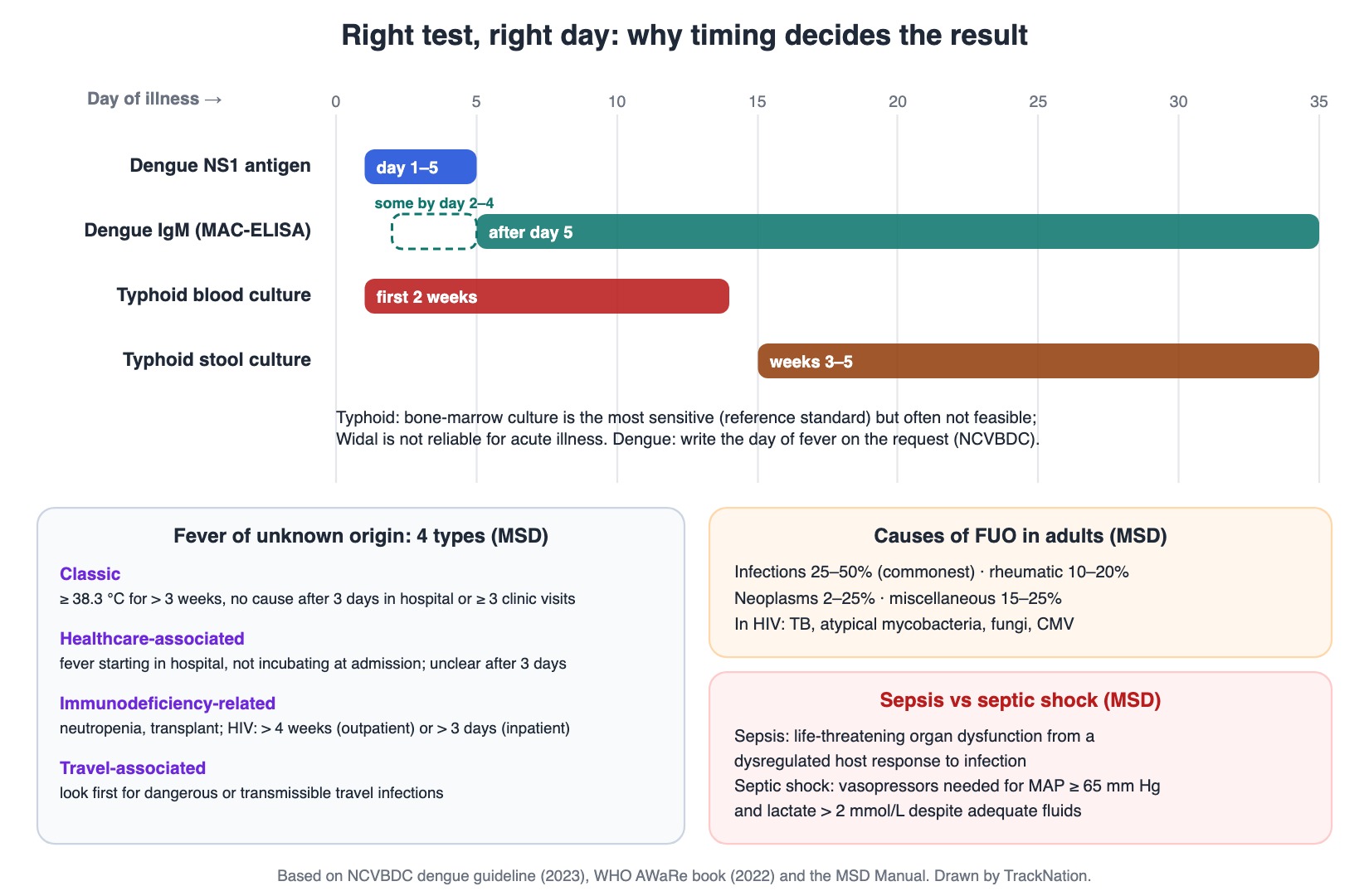
Test timing for dengue and typhoid, FUO types and causes, and sepsis definitions. Drawn by TrackNation.
Fever of Unknown Origin (MSD)
Definition: temperature ≥38.3 °C (101 °F) not explained by a self-limited illness, a rapidly fatal one, obvious localising features or common tests. Classic FUO: fever for >3 weeks with no cause after 3 days in hospital or ≥3 outpatient visits.
Four types: classic; healthcare-associated (fever starting in hospital, not present or incubating at admission); immunodeficiency-related (neutropenia, transplant; HIV: >4 weeks as outpatient or >3 days as inpatient); travel-associated (look first for dangerous or transmissible infections).
Causes in adults: infections 25–50% (commonest), systemic rheumatic disorders 10–20%, neoplasms 2–25%, miscellaneous 15–25%. In HIV seek TB, atypical mycobacteria, disseminated fungi and CMV. In older people the commonest are giant cell arteritis, lymphomas, abscesses and TB.
Sepsis and Blood Cultures (MSD, ICMR)
Sepsis: life-threatening organ dysfunction from a dysregulated host response to infection. Septic shock: vasopressors needed to keep MAP ≥65 mm Hg with lactate >2 mmol/L despite adequate fluids. qSOFA uses blood pressure, respiratory rate and Glasgow Coma Scale — no lab wait. Bacteraemia (bacteria in blood) may seed valves and cause endocarditis.
Blood cultures: scrub skin with 70% isopropyl alcohol plus chlorhexidine (or iodine); skin flora growing in only one sample is usually contamination; from a central line, take a peripheral sample too. Suspected endocarditis: ≥3 sets before antibiotics. Meningitis: antibiotics after blood cultures but before imaging.
India (ICMR STWs): in neonates, take a blood culture, start empirical antibiotics per unit policy and review at 48 hours — stop if sepsis signs have gone and CRP <12 mg/L; skin so hard it cannot be pinched is a red flag. In children 2–59 months, warning signs include capillary refill >3 s; tests include malaria RDT and dengue NS1/IgM.
Choosing the Right Test
Dengue (NCVBDC): NS1 for days 1–5, IgM (MAC-ELISA) after day 5 (usually detectable by day 5, some by day 2–4) — always write the day of fever on the form.
Typhoid: blood culture in the first 2 weeks; stool culture in weeks 3–5; bone-marrow culture is the most sensitive (reference standard) but often not feasible; Widal is not reliable for acute illness.
Malaria: thick and thin smear is the gold standard. HIV (NACO): negative if the first test is non-reactive; positive only when all three tests are reactive. TB: rapid molecular tests (Xpert, Truenat). Early primary syphilis: darkfield microscopy is the most sensitive and specific.
Do not culture anaerobes from sites where they are normal flora; nucleic-acid tests have replaced viral culture for most common viruses.
Reading Hepatitis Serology (MI4.9)
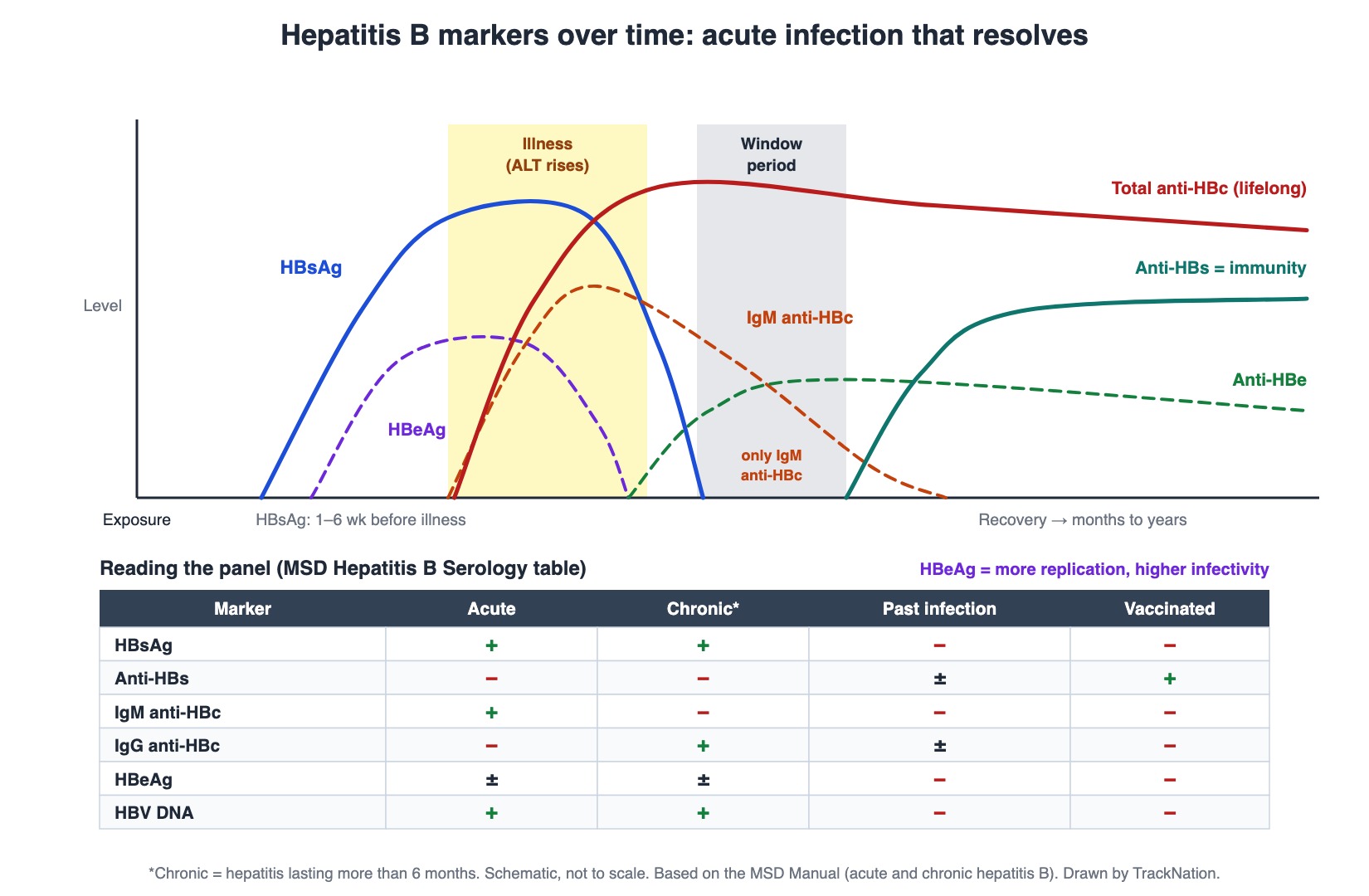
Hepatitis B markers over time and how to read the panel. Drawn by TrackNation.
HBsAg appears 1–6 weeks before illness and means infectious blood; IgM anti-HBc marks acute infection and may be the only marker in the window period.
Anti-HBs alone = vaccinated; anti-HBs with anti-HBc = past infection; HBeAg = more replication and infectivity. Full detail in article 15.
Traps the Examiner Sets
Infections, not cancers, are the commonest cause group in classic FUO.
Septic shock needs both vasopressors for MAP ≥65 mm Hg and lactate above 2 mmol/L despite fluids.
Dengue NS1 is the test for days 1–5; IgM is for after day 5.
Widal is not reliable for acute typhoid; culture blood in the first 2 weeks.
A single bottle growing skin flora is usually contamination.
Memory Hooks & Shortcuts
Shortcuts to lock in this article's numbers and lists. Each one only re-packages facts proven above.
🧠 '3-3-3 FUO': >3 weeks, 38.3 °C, 3 hospital days — FUO
🧠 'Infections Rule FUO' — infections the commonest group — FUO causes
🧠 '65 and 2' — septic shock: MAP 65, lactate 2 — septic shock
🧠 'NS1 till 5, IgM after 5' — dengue
🧠 'Blood first, Stool later, Marrow best, Widal never' — typhoid tests by week — typhoid
Rapid-Revision Cards
Classic FUO
≥38.3 °C, >3 wk, no cause after 3 hospital days / 3 visits.
FUO types
Classic, healthcare, immunodeficiency, travel.
FUO causes
Infection 25–50% > rheumatic, neoplasm, misc.
HIV FUO
>4 wk outpatient; seek TB, MAC, fungi, CMV.
Elderly FUO
GCA, lymphoma, abscess, TB.
Sepsis
Organ dysfunction from dysregulated response.
Septic shock
Pressors for MAP ≥65 + lactate >2.
qSOFA
BP, RR, GCS.
Skin prep
70% isopropyl + chlorhexidine.
Contaminant
Skin flora in one bottle.
Central line
Also take peripheral culture.
Endocarditis
≥3 sets before antibiotics.
Meningitis
Antibiotics after blood culture, before CT.
Dengue tests
NS1 d1–5; IgM after d5.
Typhoid tests
Blood wk 1–2; stool wk 3–5; marrow best.
Widal
Not reliable for acute illness.
Malaria
Smear = gold standard.
NACO HIV
Positive only if all 3 tests reactive.
Syphilis early
Darkfield microscopy.
Anti-HBs only
Vaccinated.
Neonatal sepsis
Review 48 h; stop if CRP <12.
Sources
Facts in this article were checked against these documents.
MSD Manual Professional: Fever of Unknown Origin; Sepsis and Septic Shock; Bacteremia; Culture; Infective Endocarditis; Acute Bacterial Meningitis; Typhoid Fever; Syphilis; Tuberculosis; Acute Hepatitis B — Merck & Co., 2024–2026 (link)
National Guidelines for Clinical Management of Dengue Fever — National Center for Vector Borne Diseases Control, MoHFW, 2023
Guidelines for Diagnosis and Treatment of Malaria in India — National Vector Borne Disease Control Programme, MoHFW, 2014
National HIV Counselling and Testing Services Guidelines — National AIDS Control Organisation, MoHFW, 2024
The WHO AWaRe (Access, Watch, Reserve) Antibiotic Book — World Health Organization, 2022 (link)
Standard Treatment Workflows: Sepsis in Neonates (2020); Sepsis and Septic Shock in Children (2019) — ICMR / Department of Health Research, MoHFW, 2019–2020
Test Yourself: Practice Questions
Thirty questions in NEET PG style, many of them ward scenarios.
Practice Questions (NEET PG pattern)
Original questions written in the style of the exam: +4 for a correct answer, −1 for a wrong one. Every answer was checked against the sources listed above. NEET PG papers are not published by NBEMS, so these are not past-paper questions.
Q1. Classic fever of unknown origin is fever ≥38.3 °C lasting more than
(a) 1 week
(b) 6 months
(c) 3 days
(d) 3 weeks with no cause after 3 days in hospital or ≥3 clinic visits
Show answer
Answer: (d) — MSD.
Q2. The commonest cause group of FUO in adults is
(a) systemic rheumatic disorders
(b) drug fever
(c) neoplasms
(d) infections
Show answer
Answer: (d) — 25–50%.
Q3. FUO is currently classified into how many categories?
(a) 6
(b) 2
(c) 3
(d) 4
Show answer
Answer: (d) — Classic, healthcare-associated, immunodeficiency-related, travel.
Q4. In an outpatient with HIV, fever of unknown origin requires fever for more than
(a) 3 days
(b) 6 months
(c) 1 week
(d) 4 weeks
Show answer
Answer: (d) — Inpatient: >3 days.
Q5. In FUO among people with HIV, which should be sought first?
(a) Drug fever
(b) Opportunistic infections such as TB, atypical mycobacteria, fungi and CMV
(c) Factitious fever
(d) Familial Mediterranean fever
Show answer
Answer: (b) — MSD.
Q6. In older adults, one of the commonest causes of FUO is
(a) brucellosis
(b) giant cell arteritis
(c) malaria
(d) drug fever
Show answer
Answer: (b) — Also lymphomas, abscesses, TB.
Q7. Sepsis is defined as
(a) bacteria in the blood
(b) fever with tachycardia
(c) life-threatening organ dysfunction from a dysregulated host response to infection
(d) positive blood culture with shock
Show answer
Answer: (c) — MSD.
Q8. Septic shock requires vasopressors to maintain MAP ≥65 mm Hg and a lactate of more than
(a) 2 mmol/L
(b) 4 mmol/L
(c) 1 mmol/L
(d) 10 mmol/L
Show answer
Answer: (a) — Despite fluids.
Q9. qSOFA is based on
(a) temperature, WBC and heart rate
(b) blood pressure, respiratory rate and Glasgow Coma Scale
(c) creatinine and urine output
(d) lactate, platelets and bilirubin
Show answer
Answer: (b) — No lab wait.
Q10. Bacteraemia is
(a) organ dysfunction from infection
(b) only seen with catheters
(c) always symptomatic
(d) the presence of bacteria in the bloodstream
Show answer
Answer: (d) — May seed heart valves.
Q11. Before drawing blood cultures, skin should be prepared with
(a) soap and water only
(b) 70% isopropyl alcohol with chlorhexidine (or iodine)
(c) hydrogen peroxide alone
(d) saline
Show answer
Answer: (b) — MSD.
Q12. A normal skin organism grows in only one of four blood-culture bottles. This most likely represents
(a) endocarditis
(b) sepsis
(c) true bacteraemia
(d) contamination
Show answer
Answer: (d) — Skin flora in a single sample.
Q13. When blood is drawn from a central line for culture, you should also
(a) take a peripheral sample
(b) skip skin preparation
(c) remove the line first always
(d) add antibiotics to the bottle
Show answer
Answer: (a) — To tell line infection from systemic.
Q14. In suspected infective endocarditis, blood cultures should be
(a) taken only if febrile
(b) replaced by serology
(c) at least 3 sets before antibiotics
(d) a single set after antibiotics
Show answer
Answer: (c) — MSD.
Q15. In suspected bacterial meningitis, antibiotics should be started
(a) only after CSF results
(b) before blood cultures
(c) after blood cultures but before neuroimaging
(d) after CT and LP
Show answer
Answer: (c) — With glucocorticoids.
Q16. A patient on day 3 of fever with suspected dengue should be tested with
(a) IgG ELISA
(b) IgM ELISA
(c) Widal
(d) NS1 antigen
Show answer
Answer: (d) — NCVBDC: NS1 days 1–5.
Q17. For a dengue sample collected on day 7, the appropriate test is
(a) Paul-Bunnell
(b) viral culture
(c) NS1
(d) IgM (MAC-ELISA)
Show answer
Answer: (d) — IgM after day 5.
Q18. On a dengue test request, NCVBDC asks the clinician to write
(a) the hospital bed number
(b) the tourniquet test result
(c) the day of onset of fever and day of sample collection
(d) the platelet count
Show answer
Answer: (c) — Guides the lab.
Q19. In week 1 of suspected typhoid, the test of choice is
(a) blood culture
(b) urine culture
(c) Widal
(d) stool culture
Show answer
Answer: (a) — Blood cultures positive in first 2 weeks.
Q20. Stool culture in typhoid is usually positive during
(a) week 1
(b) the incubation period
(c) weeks 3–5
(d) never
Show answer
Answer: (c) — MSD.
Q21. The reference standard test for enteric fever is
(a) bone-marrow culture
(b) Widal
(c) stool microscopy
(d) blood smear
Show answer
Answer: (a) — Often not feasible.
Q22. Regarding the Widal test, WHO AWaRe states it is
(a) specific for paratyphoid
(b) positive in week 1
(c) not reliable for diagnosing acute illness
(d) the gold standard
Show answer
Answer: (c) — Use culture.
Q23. The gold standard for confirming malaria in India is
(a) Widal
(b) microscopy of thick and thin blood smears
(c) PCR
(d) RDT
Show answer
Answer: (b) — NVBDCP.
Q24. Under NACO's strategy, a person is reported HIV-positive when
(a) Western blot is positive
(b) any two tests are reactive
(c) all three tests are reactive
(d) the first test is reactive
Show answer
Answer: (c) — Negative if first non-reactive.
Q25. The most sensitive and specific test for early primary syphilis is
(a) Gram stain
(b) TPHA
(c) darkfield microscopy
(d) VDRL
Show answer
Answer: (c) — MSD.
Q26. Anaerobic cultures should not be sent from
(a) abscess pus
(b) sites where anaerobes are normal flora
(c) blood
(d) CSF
Show answer
Answer: (b) — E.g. throat, faeces.
Q27. A patient's only positive hepatitis B marker is anti-HBs. This indicates
(a) vaccination
(b) chronic carrier
(c) acute infection
(d) window period
Show answer
Answer: (a) — MSD.
Q28. During the hepatitis B window period, the only marker present may be
(a) anti-HBs
(b) IgM anti-HBc
(c) HBeAg
(d) HBsAg
Show answer
Answer: (b) — MSD.
Q29. Under ICMR's neonatal sepsis workflow, antibiotics are reviewed at
(a) 24 hours always continuing
(b) 48 hours, stopping if signs have gone and CRP <12 mg/L
(c) 14 days
(d) 7 days only
Show answer
Answer: (b) — ICMR 2020.
Q30. In ICMR's paediatric sepsis workflow, a sign of poor perfusion is capillary refill time of more than
(a) 10 seconds
(b) 3 seconds
(c) 1 second
(d) 0.5 seconds
Show answer
Answer: (b) — ICMR 2019.
Active Recall
From memory: define classic FUO and its four types and causes, define sepsis and septic shock and list qSOFA, give the rules for blood cultures, choose and time the tests for dengue, typhoid, malaria, HIV, TB and early syphilis, and read a hepatitis B panel.