Zoonoses, Opportunistic Infections and Infections That Cause Cancer for NEET PG Microbiology: Brucella, Plague, Nipah, CD4 Thresholds and Emerging Diseases
Start Here
🎯 Exam priority: High. Expect: Brucella species and their animals, plague transmission and the safety-pin bacillus, leptospirosis sources and conjunctival suffusion, scrub typhus eschar, Q fever without a vector or rash, Nipah's host and fatality, CD4 thresholds for PCP, cryptococcus, toxoplasma and CMV, NACO's CPT and advanced-disease cut-offs, which pathogen goes with which immune defect, oncogenic viruses, and emerging versus re-emerging diseases.
CBME mapping: MI9.1, MI9.2, MI9.4, MI9.5, MI9.6. Fact-checked against WHO fact sheets, the MSD Manual, NACO's HIV care and treatment guidelines (2021) and OpenStax Microbiology. Organisms covered in depth elsewhere (rabies 18, anthrax 13, leptospira and rickettsia 12, hydatid 21) are linked here by their animal source.
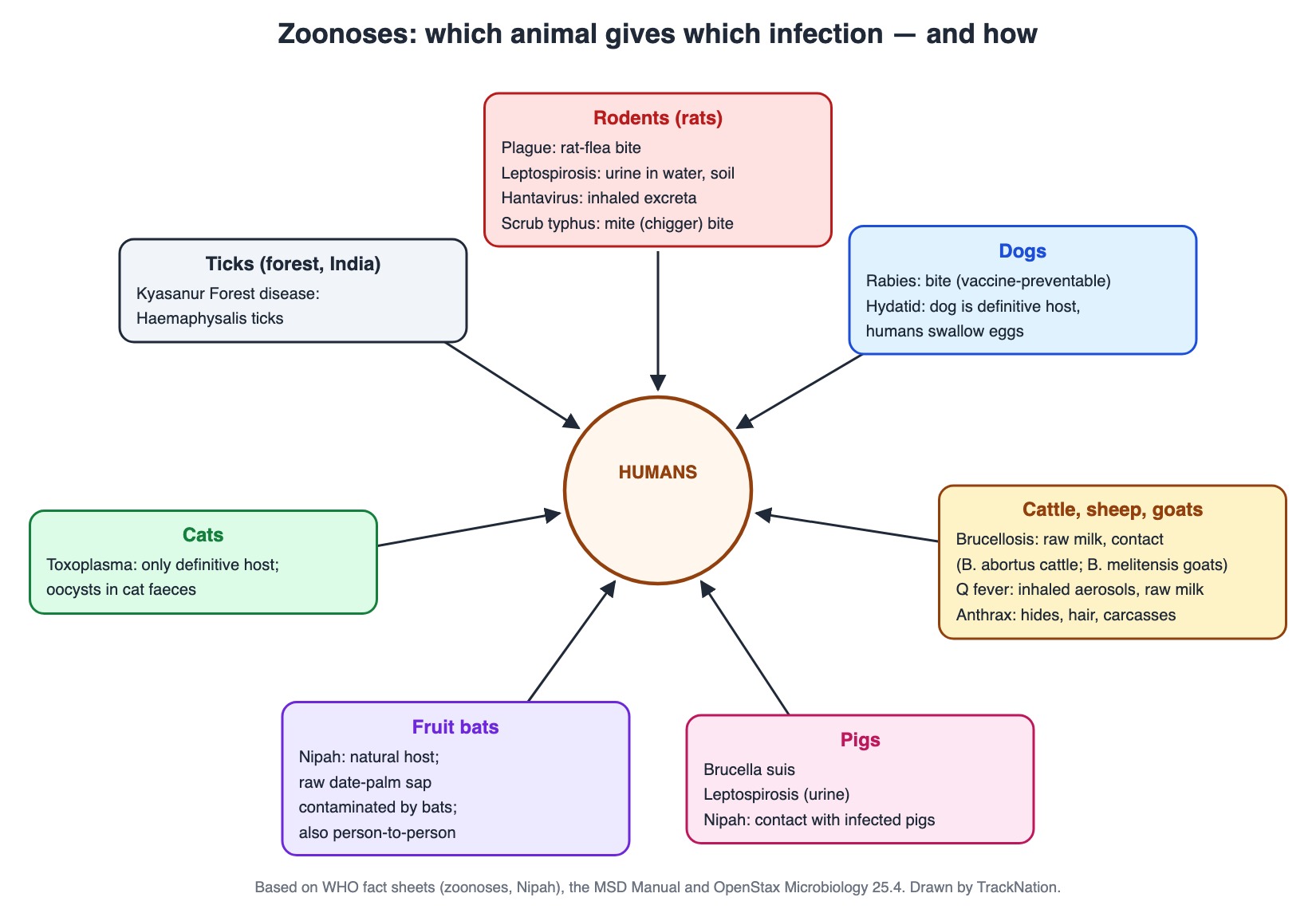
Zoonoses by animal source and route. Drawn by TrackNation.
Zoonoses (WHO, MSD)
Definition (WHO): any infection naturally transmissible from vertebrate animals to humans; over 200 types; agents may be bacterial, viral, parasitic or unconventional. Rabies is 100% preventable by vaccination. Antibiotic use in food animals adds resistance to the problem.
Brucellosis: B. abortus (cattle), B. melitensis (sheep, goats), B. suis (pigs); caught from raw milk, undercooked meat, contact or aerosols — an occupational disease of vets, farmers, meatpackers and lab staff. Relapsing fever, sweats and aches; diagnosis by blood culture; treat with doxycycline plus an aminoglycoside, rifampicin or a fluoroquinolone.
Plague (Yersinia pestis): rodents → humans by the rat-flea bite; bubonic is commonest; primary pneumonic plague spreads person to person by droplets and is highly contagious. Bipolar (safety-pin) staining with Giemsa; treat with streptomycin or gentamicin.
Leptospirosis: urine of dogs, cattle, pigs, mice and rats contaminates water and soil; conjunctival suffusion on day 3–4; Weil syndrome = jaundice + azotaemia. Scrub typhus (Orientia tsutsugamushi): mites are reservoir and vector; an eschar at the chigger bite; doxycycline.
Q fever (Coxiella burnetii): ruminants, no vector; caught by inhaling aerosols or raw milk; unlike rickettsial diseases no rash; about 40% with valve disease develop endocarditis. Hantavirus: inhaled rodent excreta → haemorrhagic fever with renal syndrome or pulmonary syndrome.
Nipah: natural host fruit bats (Pteropodidae); spread by infected bats, pigs or horses, raw date-palm sap and person to person; first reported in 1998, since seen in Bangladesh and India; incubation 3–14 days; fatality 40–75%; no treatment or vaccine yet.
Mpox: an orthopoxvirus related to smallpox; monkeys are not the reservoir; PCR diagnosis; WHO renamed it mpox in November 2022. Zika: Aedes-borne, also sexual; microcephaly in pregnancy, rarely Guillain–Barré.
Opportunistic Infections (NACO, MSD)
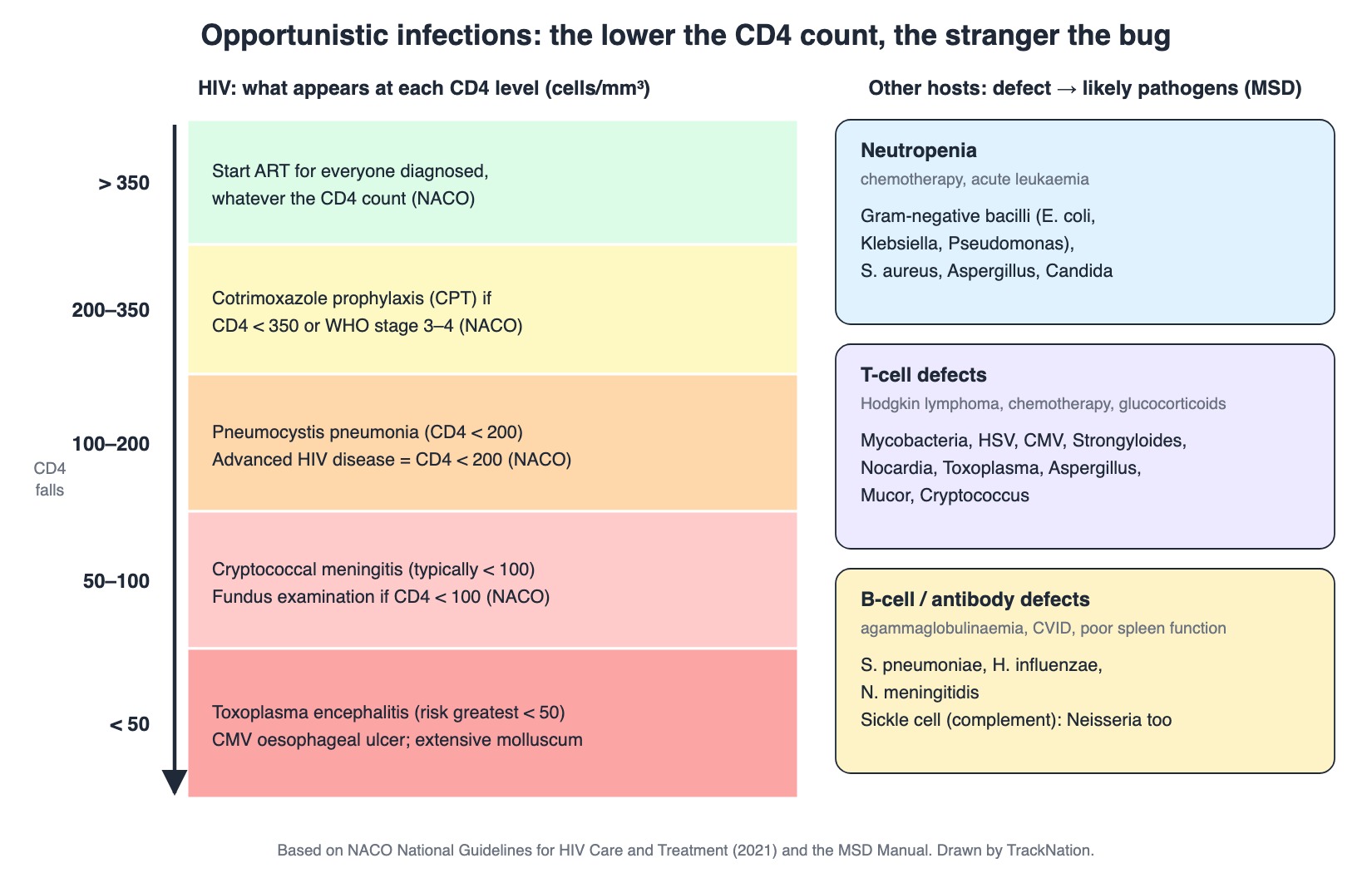
Opportunistic infections by CD4 count, NACO actions, and pathogens by immune defect. Drawn by TrackNation.
NACO 2021: start ART for everyone diagnosed regardless of CD4; give cotrimoxazole prophylaxis (CPT) for CD4 <350 or WHO stage 3–4; advanced HIV disease = CD4 <200 or stage 3–4 (or child under 5); fundus examination if CD4 <100.
CD4 ladder (MSD, NACO): Pneumocystis pneumonia below 200 (first-line co-trimoxazole); cryptococcal disease typically below 100; toxoplasma encephalitis (ring-enhancing lesions) risk greatest below 50, rare above 200; CMV oesophageal ulcer and extensive molluscum below 50. CMV retinitis occurs in HIV and transplant patients.
Defect → bug (MSD): neutropenia → gram-negative bacilli, S. aureus, Aspergillus, Candida; chronic granulomatous disease → S. aureus; T-cell defects (Hodgkin lymphoma, chemotherapy, steroids) → mycobacteria, HSV, CMV, Strongyloides, opportunistic fungi, Nocardia, Toxoplasma; B-cell defects → (S. pneumoniae, H. influenzae, N. meningitidis); sickle cell (alternative complement) → Neisseria too.
Infections That Cause Cancer (MSD, WHO)
HPV: virtually all cervical cancer; types 16 and 18 cause about 70%; also penile, vaginal, anal and oropharyngeal cancer.
EBV: nasopharyngeal carcinoma, Burkitt lymphoma, Hodgkin lymphoma and post-transplant lymphomas. HHV-8: Kaposi sarcoma, primary effusion lymphoma, multicentric Castleman disease. HTLV-1: certain leukaemias and lymphomas. HBV and HCV: hepatocellular carcinoma.
HIV raises the risk of Kaposi sarcoma, non-Hodgkin lymphoma and cervical carcinoma. Non-viral: H. pylori → gastric adenocarcinoma and low-grade gastric lymphoma; Schistosoma haematobium → bladder squamous cell carcinoma; Clonorchis (undercooked freshwater fish) → cholangiocarcinoma.
Emerging and Re-emerging Diseases; Programmes
Emerging (OpenStax): new to humans or increasing over the previous 20 years — e.g. HIV (1981), Ebola (1976), Nipah (1998), Zika, mpox. Re-emerging: rising again after a period of decline — e.g. drug-resistant TB, bacterial pneumonia and malaria.
Drivers include changing conditions, prevention programmes that stop working, drug resistance and global travel — an outbreak anywhere can spread quickly everywhere; close contact with animals in farming and as pets drives zoonoses.
India's programmes are taught with their organisms: NACO HIV testing and ART (article 16 and above), NTEP (11), malaria, kala-azar and filariasis under NCVBDC (20, 21), dengue, JE and rabies (18), leprosy (11) and the immunisation schedule (UIP).
Traps the Examiner Sets
Q fever has no vector and no rash — it is caught by inhaling aerosols.
The natural host of Nipah is the fruit bat; pigs and date-palm sap are routes.
Monkeys are not the reservoir of mpox.
NACO starts ART regardless of CD4; CPT is for CD4 below 350 or stage 3–4.
Schistosoma haematobium is linked with squamous cell carcinoma of the bladder.
Memory Hooks & Shortcuts
Shortcuts to lock in this article's numbers and lists. Each one only re-packages facts proven above.
🧠 'Cattle Abort, Goats Melt, Swine Suis' — B. abortus, B. melitensis, B. suis — Brucella
🧠 'Flea for the bubo, droplet for the lung' — plague — plague
🧠 'Q = Quiet': no vector, no rash, just inhaled dust — Q fever
🧠 '350 Cotrimoxazole, 200 Pneumocystis & advanced, 100 Crypto, 50 Toxo & CMV' — the CD4 ladder — OI
🧠 'Bats Drink Palm' — Nipah: fruit Bats, Date-palm sap — Nipah
Rapid-Revision Cards
Zoonosis
Vertebrate animal → human; >200 types.
Brucella
abortus cattle, melitensis sheep/goats, suis pigs.
Brucellosis
Raw milk; blood culture; doxy + second drug.
Plague
Rat flea; bubonic commonest; pneumonic contagious.
Y. pestis
Bipolar 'safety pin'; streptomycin/gentamicin.
Leptospirosis
Animal urine in water; conjunctival suffusion.
Weil syndrome
Jaundice + azotaemia.
Scrub typhus
Mites; eschar; doxycycline.
Q fever
Ruminants; aerosols; no vector, no rash.
Hantavirus
Inhaled rodent excreta; HFRS, HPS.
Nipah
Fruit bats; date-palm sap; CFR 40–75%; no vaccine.
Mpox
Orthopoxvirus; not monkeys; PCR.
Zika
Aedes, sexual; microcephaly.
NACO ART
All diagnosed, any CD4.
NACO CPT
CD4 <350 or stage 3–4.
Advanced HIV
CD4 <200 / stage 3–4 / child <5.
CD4 ladder
PCP <200; crypto <100; toxo <50.
Neutropenia
GNB, S. aureus, Aspergillus, Candida.
HPV
16, 18 → ~70% cervical cancer.
EBV / HHV-8
NPC, Burkitt / Kaposi, PEL, Castleman.
Emerging vs re-emerging
New or rising in 20 y / rising after decline.
Sources
Facts in this article were checked against these documents.
Zoonoses; Nipah virus; Human papillomavirus and cancer (fact sheets) — World Health Organization, accessed 2026 (link)
National Guidelines for HIV Care and Treatment — National AIDS Control Organisation, MoHFW, 2021
MSD Manual Professional: Brucellosis; Plague; Leptospirosis; Scrub Typhus; Q Fever; Hantavirus; Mpox; Zika; Echinococcosis; Anthrax — Merck & Co., 2026 (link)
MSD Manual Professional: Pneumonia in Immunocompromised Patients; Pneumocystis; Cryptococcosis; Toxoplasmosis; CMV; Overview of Viruses; HPV; Infectious Mononucleosis; H. pylori; Schistosomiasis; Clonorchiasis — Merck & Co., 2026 (link)
Microbiology (sections 16.4, 25.4) — Parker N, Schneegurt M, Thi Tu A-H, Lister P, Forster BM (OpenStax), 2016 (link)
Test Yourself: Practice Questions
Thirty questions in NEET PG style, many of them clinical scenarios.
Practice Questions (NEET PG pattern)
Original questions written in the style of the exam: +4 for a correct answer, −1 for a wrong one. Every answer was checked against the sources listed above. NEET PG papers are not published by NBEMS, so these are not past-paper questions.
Q1. WHO defines a zoonosis as an infection naturally transmissible from
(a) soil to humans
(b) vertebrate animals to humans
(c) insects to plants
(d) humans to animals only
Show answer
Answer: (b) — Over 200 types.
Q2. Brucella melitensis is acquired mainly from
(a) cattle
(b) sheep and goats
(c) pigs
(d) dogs
Show answer
Answer: (b) — B. abortus cattle, B. suis pigs.
Q3. A veterinarian has relapsing fever, sweats and back pain after drinking raw milk. The best diagnostic test is
(a) skin biopsy
(b) blood culture
(c) stool culture
(d) Widal test
Show answer
Answer: (b) — Brucellosis.
Q4. Optimal treatment of brucellosis is
(a) penicillin alone
(b) vancomycin
(c) doxycycline plus an aminoglycoside, rifampicin or a fluoroquinolone
(d) metronidazole
Show answer
Answer: (c) — Two drugs.
Q5. Plague is transmitted from rodents to humans by
(a) the bite of an infected rat flea
(b) contaminated water
(c) ticks
(d) mosquitoes
Show answer
Answer: (a) — MSD.
Q6. The commonest form of plague is
(a) meningeal
(b) septicaemic
(c) pneumonic
(d) bubonic
Show answer
Answer: (d) — MSD.
Q7. The form of plague that spreads person to person by droplets is
(a) primary pneumonic plague
(b) pestis minor
(c) septicaemic plague
(d) bubonic plague
Show answer
Answer: (a) — Highly contagious.
Q8. Yersinia pestis shows a 'safety-pin' appearance due to
(a) metachromatic granules
(b) bipolar staining
(c) spores
(d) capsule swelling
Show answer
Answer: (b) — Giemsa.
Q9. A farmer who works in water contaminated by animal urine has fever and conjunctival suffusion on day 3. The likely agent is
(a) Coxiella
(b) Orientia
(c) Leptospira
(d) Brucella
Show answer
Answer: (c) — Water contaminated by animal urine.
Q10. Weil syndrome is
(a) icteric leptospirosis with jaundice and azotaemia
(b) rash of scrub typhus
(c) Q fever endocarditis
(d) pneumonic plague
Show answer
Answer: (a) — MSD.
Q11. An eschar at a chigger-bite site with fever and rash suggests
(a) brucellosis
(b) plague
(c) scrub typhus
(d) Q fever
Show answer
Answer: (c) — Orientia; doxycycline.
Q12. In Q fever,
(a) there is no vector and usually no rash
(b) rodents are the reservoir
(c) ticks are essential
(d) a rash is typical
Show answer
Answer: (a) — Ruminants; aerosols.
Q13. Q fever is usually caught by
(a) eating pork
(b) inhaling infectious aerosols
(c) mosquito bite
(d) dog bite
Show answer
Answer: (b) — Also raw milk.
Q14. Hantavirus reaches humans mainly by
(a) mosquitoes
(b) tick bites
(c) pork
(d) inhaling aerosols of rodent excreta
Show answer
Answer: (d) — HFRS and HPS.
Q15. The natural host of Nipah virus is the
(a) pig
(b) rat
(c) monkey
(d) fruit bat
Show answer
Answer: (d) — Pteropodidae.
Q16. Nipah can be caught by drinking
(a) unpasteurised milk
(b) undercooked fish
(c) raw date-palm sap contaminated by bats
(d) well water
Show answer
Answer: (c) — WHO.
Q17. The case fatality of Nipah virus infection is estimated at
(a) 10–15%
(b) 40–75%
(c) over 95%
(d) 1–2%
Show answer
Answer: (b) — No vaccine or treatment.
Q18. Regarding mpox, which is true?
(a) Monkeys are the reservoir
(b) It is diagnosed by culture only
(c) It is a herpesvirus
(d) It is an orthopoxvirus and monkeys are not its reservoir
Show answer
Answer: (d) — PCR diagnosis.
Q19. Zika virus infection in pregnancy can cause
(a) cataract only
(b) neural tube defect
(c) hydrops from parvovirus
(d) microcephaly
Show answer
Answer: (d) — Aedes; sexual spread too.
Q20. Under NACO 2021, ART is started
(a) only if CD4 below 200
(b) for everyone diagnosed, regardless of CD4 count
(c) only in stage 4
(d) only if CD4 below 350
Show answer
Answer: (b) — Test and treat.
Q21. NACO gives cotrimoxazole preventive therapy to adults with CD4 below
(a) 100 only
(b) 50 only
(c) 350 or WHO stage 3–4
(d) 500
Show answer
Answer: (c) — NACO 2021.
Q22. NACO defines advanced HIV disease as CD4 below
(a) 350
(b) 200 or WHO stage 3–4
(c) 500
(d) 50
Show answer
Answer: (b) — Or any child under 5.
Q23. Pneumocystis pneumonia risk rises sharply when the CD4 count falls below
(a) 1000
(b) 200
(c) 50
(d) 500
Show answer
Answer: (b) — First-line co-trimoxazole.
Q24. Cryptococcosis in HIV is typically seen at CD4 counts below
(a) 350
(b) 500
(c) 100
(d) 1000
Show answer
Answer: (c) — MSD.
Q25. A man with HIV and CD4 of 40 has seizures and ring-enhancing brain lesions. The likely cause is
(a) pyogenic abscess
(b) neurocysticercosis
(c) glioma
(d) Toxoplasma encephalitis
Show answer
Answer: (d) — Rare above 200.
Q26. Neutropenia after cancer chemotherapy predisposes especially to
(a) Pneumocystis only
(b) encapsulated bacteria only
(c) Toxoplasma
(d) gram-negative bacilli, S. aureus, Aspergillus and Candida
Show answer
Answer: (d) — MSD table.
Q27. Chronic granulomatous disease (defective intracellular killing) predisposes to
(a) Staphylococcus aureus
(b) Pneumocystis
(c) Giardia
(d) Neisseria
Show answer
Answer: (a) — MSD.
Q28. About 70% of cervical cancers are caused by HPV types
(a) 1 and 2
(b) 16 and 18
(c) 31 and 33
(d) 6 and 11
Show answer
Answer: (b) — Virtually all cervical cancer is HPV-related.
Q29. Kaposi sarcoma, primary effusion lymphoma and multicentric Castleman disease are caused by
(a) EBV
(b) HPV
(c) HTLV-1
(d) HHV-8
Show answer
Answer: (d) — MSD.
Q30. A re-emerging infectious disease is one that
(a) increases again after a period of decline
(b) is new to humans
(c) affects only animals
(d) has never caused outbreaks
Show answer
Answer: (a) — E.g. drug-resistant TB, malaria.
Active Recall
From memory: list zoonoses by animal source with their routes, the key features of brucellosis, plague, leptospirosis, scrub typhus, Q fever and Nipah, NACO's ART, CPT and advanced-disease thresholds, the CD4 ladder of opportunistic infections, pathogens by immune defect, oncogenic infections, and the difference between emerging and re-emerging diseases.