Geriatric Medicine and the Physician in the Community for NEET PG Medicine: Frailty, Falls, Beers Criteria, NPHCE, NP-NCD
Start Here
🎯 Exam priority: Medium. Expect: body composition changes with age, why creatinine misleads, ADL vs IADL, frailty definition, falls as leading injury death, the Get-Up-and-Go test, Beers Criteria, benzodiazepine harms, prescribing cascade, start-low dosing, immobility complications, elder abuse types, NPHCE components, NP-NCD screening age and PM-JAY 70+.
CBME mapping: GM 25.1–25.22 (geriatrics) and GM 29 (physician in the community). Programme details are in Community Medicine; drug handling in Pharmacology; dementia and delirium in article 24.
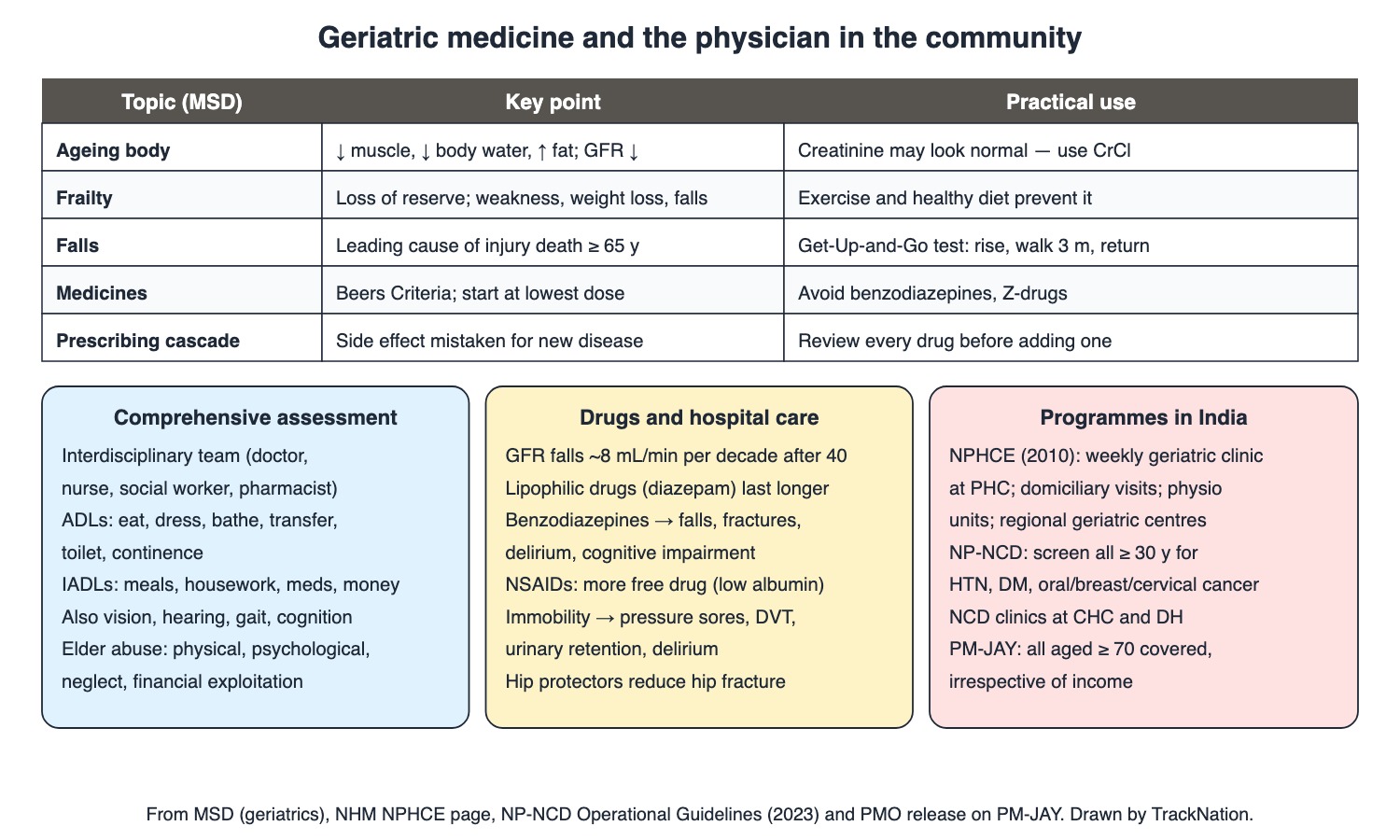
Ageing, frailty, falls, medicines and programmes in India. Drawn by TrackNation.
Ageing, Assessment and Frailty
Ageing: less lean and muscle mass, less creatinine production, less total body water, more fat; presbyopia; dehydration-prone. GFR falls ~8 mL/min/1.73 m² per decade after 40 while serum creatinine can stay normal — estimate creatinine clearance (e.g. Cockcroft–Gault).
Comprehensive geriatric assessment by an interdisciplinary team (geriatrician, nurse, social worker, pharmacist). ADLs: eating, dressing, bathing, transferring, toileting, continence. IADLs: meals, housework, medications, errands, finances, telephone. Also vision, hearing, continence, gait and balance, cognition and mood.
Frailty: loss of physiological reserve → disability after minor stress; weakness, slowness, weight loss, sarcopenia, falls, immobility, incontinence. Exercise and a healthy diet prevent or reduce it.
Falls: the leading cause of injury-related death at ≥ 65 years. Causes include orthostatic and postprandial hypotension, delirium, dementia, stroke, arthritis, drugs. Get-Up-and-Go test: rise from an armchair, walk 3 m, turn, return and sit. Prevent with leg-strength and balance exercise, fall education; hip protectors reduce hip fracture.
Elder abuse: physical or psychological mistreatment, neglect, financial exploitation.
Medicines and Hospital Care
More body fat prolongs lipophilic drugs (e.g. diazepam); lower albumin means more free drug (e.g. NSAIDs); reduced renal clearance.
Beers Criteria (AGS) list potentially inappropriate medicines for adults ≥ 65. Benzodiazepines and Z-drugs raise the risk of cognitive impairment, delirium, falls and fractures; paroxetine is sedating and anticholinergic.
Prescribing cascade: a side effect is read as a new disease and treated with another drug. Start medicines at the lowest dose; a drug is inappropriate when harm outweighs benefit.
Immobilised or demented inpatients are prone to pressure sores, DVT, urinary retention and delirium.
Programme | What a physician should know |
NPHCE (2010) | Preventive/promotive care via domiciliary visits; weekly geriatric clinic at PHC; wards at CHC/DH; physiotherapy units; Regional Geriatric Centres with PG courses |
NP-NCD | NCD clinics at CHC and DH (opportunistic screening); population-based screening (from 2016) of everyone ≥ 30 y for hypertension, diabetes and oral, breast, cervical cancer; CBAC checklist |
AB PM-JAY | Health cover for all citizens aged ≥ 70 years irrespective of income |
Legal | Maintenance & Welfare of Parents & Senior Citizens Act 2007 (basis for NPHCE) |
Traps the Examiner Sets
Normal creatinine in an elderly person does not mean normal GFR.
Using the telephone or managing money is an IADL, not an ADL.
New symptom after a new drug → think prescribing cascade.
NP-NCD screening starts at 30 years; PM-JAY covers all aged 70+.
Memory Hooks & Shortcuts
Shortcuts to lock in this article's numbers and lists. Each one only re-packages facts proven above.
🧠 ADL = 'DEATH': Dressing, Eating, Ambulating/transfer, Toileting, Hygiene — ADLs
🧠 IADL = 'SHAFT': Shopping/errands, Housework, Accounts, Food (meals), Telephone — plus medications — IADLs
🧠 Get-Up-and-Go: 'Up, 3 metres, turn, back, down' — falls test
🧠 Prescribing cascade: 'pill for a pill' — cascade
🧠 India's elderly: 'NPHCE 2010, NP-NCD 30+, PM-JAY 70+' — programmes
Rapid-Revision Cards
Ageing body
↓ muscle, water; ↑ fat; creatinine falsely normal.
GFR decline
~8 mL/min/1.73 m² per decade after 40.
Diazepam in elderly
Longer (fat ↑ Vd).
ADLs
Eat, dress, bathe, transfer, toilet, continence.
IADLs
Meals, housework, meds, errands, money, phone.
CGA team
Geriatrician, nurse, social worker, pharmacist.
Frailty
Loss of reserve; prevent with exercise, diet.
Falls
Leading injury death ≥ 65.
Get-Up-and-Go
Rise, walk 3 m, turn, return, sit.
Fall causes
Postural hypotension, delirium, dementia, stroke, drugs.
Hip protectors
Reduce hip fracture.
Beers Criteria
Inappropriate drugs ≥ 65 y.
Benzodiazepines/Z-drugs
Falls, fractures, delirium.
NSAIDs elderly
Low albumin → more free drug.
Prescribing cascade
Side effect treated as new disease.
Dosing
Start lowest, go slow.
Immobility
Pressure sores, DVT, retention, delirium.
Elder abuse
Physical, psychological, neglect, financial.
NPHCE
2010; weekly PHC clinic; RGCs; physio units.
NP-NCD
Screen ≥ 30 y; NCD clinics at CHC/DH.
PM-JAY 70+
All ≥ 70, any income.
Sources
Facts in this article were checked against these documents.
MSD Manual Professional: Physical Changes With Aging; Comprehensive Geriatric Assessment; Prevention of Frailty; Falls in Older Adults; Pharmacokinetics in Older Adults; Drug Categories of Concern; Medication-Related Problems; Prevention of Iatrogenic Complications; Elder Abuse — Merck & Co. (MSD Manuals), reviewed 2025–26 (link)
National Programme for Health Care of the Elderly (NPHCE) — National Health Mission, MoHFW, page accessed 2026 (link)
NP-NCD Operational Guidelines — Ministry of Health and Family Welfare, 2023 (link)
Cabinet approves health coverage to all senior citizens aged 70 and above under AB PM-JAY — Prime Minister's Office, 2024 (link)
Competency Based Undergraduate Curriculum, General Medicine (GM 25, GM 29) — National Medical Commission, 2024
Test Yourself: Practice Questions
Thirty questions in NEET PG style, most of them clinical vignettes.
Practice Questions (NEET PG pattern)
Original questions written in the style of the exam: +4 for a correct answer, −1 for a wrong one. Every answer was checked against the sources listed above. NEET PG papers are not published by NBEMS, so these are not past-paper questions.
Q1. An 80-year-old has a serum creatinine of 1.0 mg/dL. The correct interpretation is
(a) GFR may still be reduced because muscle mass and creatinine production fall with age
(b) GFR is increased
(c) creatinine is irrelevant
(d) renal function is certainly normal
Show answer
Answer: (a) — Estimate creatinine clearance.
Q2. After age 40, GFR declines on average by about
(a) 8 mL/min/1.73 m² per decade
(b) 30 mL/min per decade
(c) 1 mL/min per decade
(d) nothing
Show answer
Answer: (a) — Variable between individuals.
Q3. With ageing, body composition changes include
(a) no change
(b) more muscle and water
(c) less lean mass and total body water, more fat
(d) less fat
Show answer
Answer: (c) — Explains drug-level changes and dehydration risk.
Q4. Diazepam lasts longer in older adults mainly because
(a) absorption falls
(b) albumin rises
(c) increased body fat enlarges its volume of distribution
(d) it is renally cleared faster
Show answer
Answer: (c) — Highly lipophilic.
Q5. Which is an instrumental activity of daily living (IADL)?
(a) eating
(b) bathing
(c) toileting
(d) managing finances
Show answer
Answer: (d) — IADLs enable independent living.
Q6. Basic activities of daily living (ADLs) include
(a) managing money
(b) eating, dressing, bathing, transferring, toileting and continence
(c) using the phone
(d) shopping and cooking
Show answer
Answer: (b) — IADLs are higher-level tasks.
Q7. Comprehensive geriatric assessment is most successful when performed by
(a) a single specialist
(b) a surgeon alone
(c) family members
(d) an interdisciplinary team (geriatrician, nurse, social worker, pharmacist)
Show answer
Answer: (d) — Usually outpatient.
Q8. Frailty is best defined as
(a) loss of physiological reserve making a person vulnerable to disability after minor stress
(b) dementia
(c) any chronic disease
(d) old age itself
Show answer
Answer: (a) — Weakness, slowness, weight loss, falls.
Q9. The measure recommended to prevent or reduce frailty is
(a) routine hormone therapy
(b) exercise and a healthy diet
(c) benzodiazepines
(d) bed rest
Show answer
Answer: (b) — Regular aerobic activity also helps longevity.
Q10. In people aged 65 and over, the leading cause of injury-related death is
(a) falls
(b) burns
(c) road traffic accidents
(d) drowning
Show answer
Answer: (a) — Assess fall risk routinely.
Q11. The Get-Up-and-Go test involves
(a) climbing stairs
(b) walking 100 m
(c) standing on one leg for 1 minute
(d) rising from an armchair, walking 3 m, turning, walking back and sitting
Show answer
Answer: (d) — Detects weakness, imbalance, unsteady gait.
Q12. An older man falls each time he gets up quickly from bed. A likely contributor to look for is
(a) orthostatic (postural) hypotension
(b) myopia
(c) hypertension
(d) hyperthyroidism
Show answer
Answer: (a) — Also postprandial hypotension, drugs.
Q13. A device that reduces hip fracture risk during falls is
(a) knee braces
(b) cervical collars
(c) padded hip protectors over the greater trochanter
(d) walking sticks only
Show answer
Answer: (c) — Plus exercise and education.
Q14. Exercises that help prevent falls in older adults are those that improve
(a) breath-holding
(b) flexibility of fingers
(c) leg strength and balance
(d) grip only
Show answer
Answer: (c) — With fall-prevention education.
Q15. The tool most commonly used to identify potentially inappropriate medicines in adults ≥ 65 is
(a) the AGS Beers Criteria
(b) the CHA2DS2-VASc score
(c) the CURB-65 score
(d) the Glasgow score
Show answer
Answer: (a) — Not for hospice/end-of-life care.
Q16. An 82-year-old taking a benzodiazepine for sleep is at increased risk of
(a) weight loss only
(b) better memory
(c) falls, fractures, delirium and cognitive impairment
(d) fewer falls
Show answer
Answer: (c) — Z-drugs carry similar risks.
Q17. Z-drug hypnotics such as zolpidem in older adults
(a) prevent delirium
(b) improve balance
(c) carry risks similar to benzodiazepines
(d) are completely safe
Show answer
Answer: (c) — Listed with benzodiazepines.
Q18. NSAID adverse effects may be greater in the elderly partly because
(a) fat decreases
(b) low plasma protein leaves more free active drug
(c) they are cleared faster
(d) absorption is blocked
Show answer
Answer: (b) — Also wider distribution (lipid-soluble).
Q19. An elderly woman develops a new symptom after starting a drug; it is taken as a new disease and another drug is added. This sequence is
(a) normal ageing
(b) a prescribing cascade
(c) heart failure
(d) drug allergy
Show answer
Answer: (b) — Side effect mistaken for a new disease.
Q20. When starting a new medicine in an older adult, the dose should be
(a) the usual adult maximum
(b) double the adult dose
(c) the lowest dose, titrated slowly
(d) irrelevant
Show answer
Answer: (c) — Responses vary widely.
Q21. A medication is considered inappropriate in an older adult when
(a) its potential for harm exceeds its potential benefit
(b) it is new
(c) it is expensive
(d) it is generic
Show answer
Answer: (a) — Review regularly.
Q22. An immobilised elderly patient after hip surgery is at high risk of
(a) hypertension only
(b) polycythaemia
(c) pressure sores, DVT, urinary retention and delirium
(d) hyperthyroidism
Show answer
Answer: (c) — Iatrogenic complications.
Q23. Elder abuse includes all EXCEPT
(a) financial exploitation
(b) routine prescription of indicated medicines
(c) neglect
(d) psychological mistreatment
Show answer
Answer: (b) — And physical abuse.
Q24. The National Programme for Health Care of the Elderly (NPHCE) was launched in
(a) 2005
(b) 2020
(c) 1990
(d) 2010
Show answer
Answer: (d) — Based on the National Policy on Older Persons and the 2007 Act.
Q25. Under NPHCE, regular monitoring of older people is organised through
(a) a weekly geriatric clinic at PHCs and domiciliary visits by health workers
(b) private clinics
(c) only tertiary hospitals
(d) annual camps only
Show answer
Answer: (a) — Wards at CHC/DH; Regional Geriatric Centres.
Q26. NPHCE provides medical rehabilitation through
(a) only home visits
(b) private gyms
(c) physiotherapy units at CHC, district hospital and Regional Geriatric Centres
(d) none
Show answer
Answer: (c) — Therapeutic exercise and ADL training.
Q27. The legal basis cited for NPHCE includes
(a) the MTP Act
(b) the Mental Healthcare Act 2017
(c) the PCPNDT Act
(d) the Maintenance & Welfare of Parents & Senior Citizens Act 2007
Show answer
Answer: (d) — And the National Policy on Older Persons.
Q28. Under NP-NCD, population-based screening for hypertension, diabetes and three common cancers covers
(a) everyone aged 30 years and above
(b) only women
(c) only symptomatic people
(d) only those over 60
Show answer
Answer: (a) — Launched in 2016.
Q29. Under NP-NCD, opportunistic screening at district hospitals and CHCs happens through
(a) NCD clinics
(b) IDSP units
(c) ICTCs
(d) DOTS centres
Show answer
Answer: (a) — Population screening extends it to the community.
Q30. Under AB PM-JAY, health coverage is extended to
(a) only women over 70
(b) only BPL families over 60
(c) only government pensioners
(d) all senior citizens aged 70 and above, irrespective of income
Show answer
Answer: (d) — Approved by the Cabinet in 2024.
Active Recall
From memory: describe body changes with ageing and their effect on creatinine and drugs, list ADLs and IADLs, define frailty, explain falls and the Get-Up-and-Go test, the Beers Criteria, benzodiazepine harms and the prescribing cascade, immobility complications and elder abuse, and the elderly-related features of NPHCE, NP-NCD and PM-JAY.