Oncology Essentials for NEET PG Medicine: Paraneoplastic Syndromes, Oncologic Emergencies, Tumour Lysis, Tumour Markers, Lung Cancer
Start Here
🎯 Exam priority: Medium. Expect: paraneoplastic syndrome–tumour pairs (ACTH and SCLC, PTHrP and squamous cancers, erythropoietin and renal cancer, Lambert–Eaton), cord compression, TLS laboratory criteria and treatment, neutropenia threshold and G-CSF, ondansetron, tumour markers and their misuse in screening, lung cancer subtypes and Pancoast/SVC features, LDCT screening, carcinoid syndrome, NP-NCD screening age.
CBME mapping: GM 13.1–13.19. Neoplasia biology and tumour pathology are in Pathology; anticancer drugs in Pharmacology; surgical oncology in Surgery; leukaemia/lymphoma in Pathology and article 20.
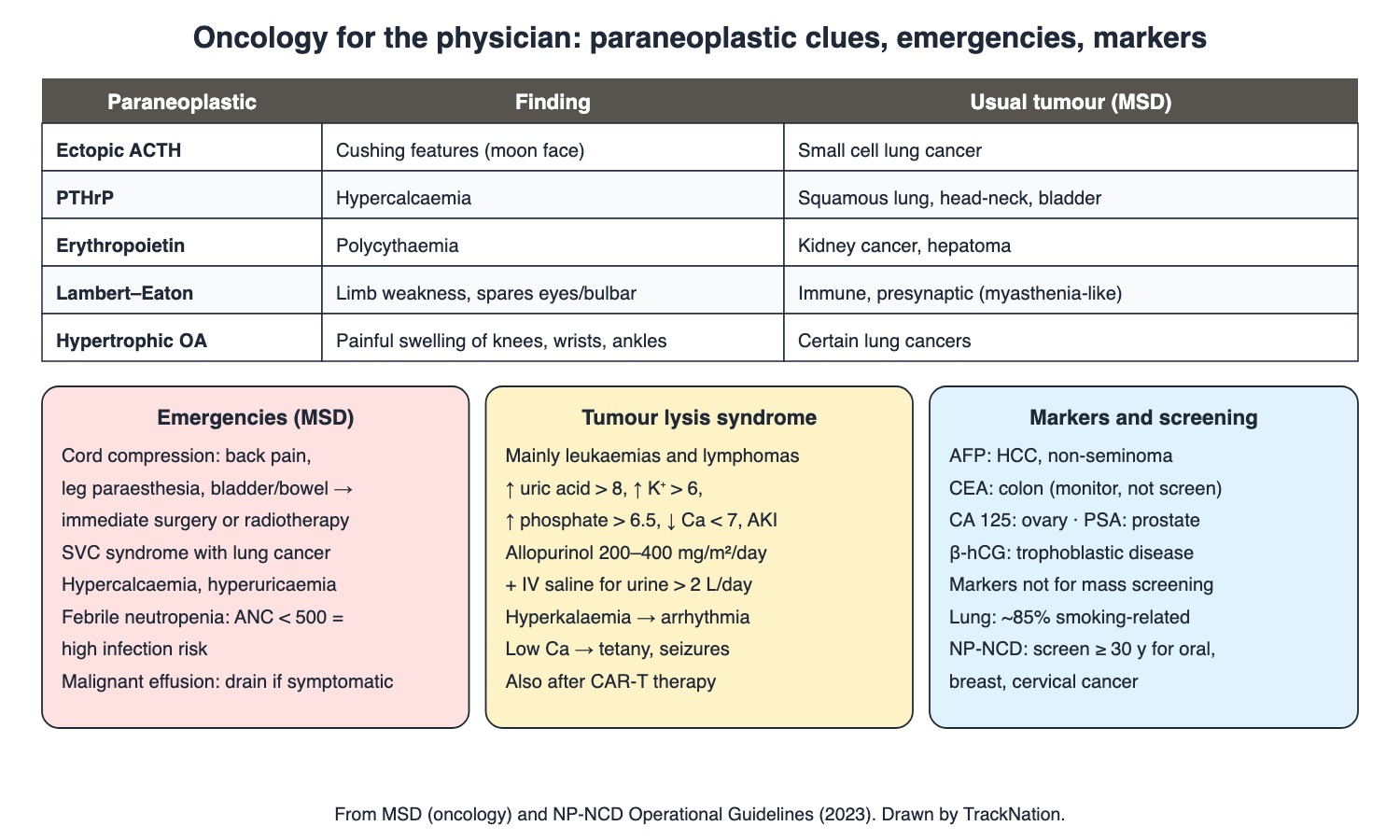
Paraneoplastic syndromes, emergencies, tumour lysis and markers. Drawn by TrackNation.
Paraneoplastic Syndromes
Symptoms at sites distant from the tumour or its metastases — from secreted substances or cross-reacting antibodies.
Endocrine: ectopic ACTH (Cushing features) — mostly small cell lung cancer; PTHrP (hypercalcaemia) — squamous lung, head-and-neck, bladder cancers; vasopressin (hyponatraemia) — lung cancers; erythropoietin (polycythaemia) — kidney cancer, hepatoma; IGF (hypoglycaemia).
Neurological: peripheral neuropathy (commonest), cerebellar syndromes, Lambert–Eaton (immune, myasthenia-like, limb weakness sparing eye and bulbar muscles).
Skin and joints: acanthosis nigricans (axillae, neck); hypertrophic osteoarthropathy with certain lung cancers.
Carcinoid syndrome: flushing, abdominal cramps, diarrhoea, later right-sided valve disease; urinary 5-HIAA; GI tumours cause it only after hepatic metastases; somatostatin analogues.
Emergencies, Tumour Lysis and Chemotherapy Toxicity
Spinal cord compression: back pain, leg paraesthesias, bladder and bowel dysfunction — immediate surgery or radiotherapy. Most cancer deaths come from metastases. Drain symptomatic malignant effusions.
Tumour lysis syndrome (mainly leukaemias and lymphomas, also after CAR-T): AKI, Ca < 7, uric acid > 8, phosphate > 6.5, K⁺ > 6. Symptoms: lethargy, vomiting, seizures; arrhythmias from hyperkalaemia, tetany from hypocalcaemia. Treat with allopurinol 200–400 mg/m²/day (max 600 mg) and IV saline for urine > 2 L/day.
Neutropenia: ANC < 500/µL markedly increases infection risk; G-CSF shortens neutropenia; selected low-risk febrile neutropenia can be treated as outpatients. Antiemetics: ondansetron/granisetron. Mucositis is common.
Marker (MSD) | Main use |
AFP | Hepatocellular carcinoma, non-seminomatous germ cell tumours |
CEA | Colon cancer — follow-up of patients who had a raised level; not for screening |
CA 125 | Diagnosing and monitoring ovarian cancer (raised by peritoneal inflammation too) |
PSA | Prostate cancer (monitor recurrence) |
β-hCG | Gestational trophoblastic neoplasia |
Rule | Markers lack the sensitivity/specificity for early diagnosis or mass screening |
Lung Cancer and Screening
Lung cancer: ~85% linked to smoking; adenocarcinoma is the commonest subtype, especially in never-smokers; diagnosis needs tissue (histology and molecular testing, e.g. EGFR). Presentations: cough, weight loss, haemoptysis, SVC syndrome, Pancoast tumour (shoulder/arm pain), hoarseness, brain metastases. Small cell lung cancer responds initially but relapses quickly.
Annual low-dose CT screening of high-risk adults cut lung cancer deaths by 20% vs chest X-ray (NLST).
India (NP-NCD): population-based screening of everyone ≥ 30 years for hypertension, diabetes and oral, breast and cervical cancers. Cervical screening options include Pap and HPV testing.
Traps the Examiner Sets
Tumour markers are for diagnosis support and monitoring, not mass screening.
Squamous lung cancer → hypercalcaemia (PTHrP); small cell → ACTH, SIADH.
Cord compression is an emergency — treat before paralysis.
TLS: high K, phosphate, urate; LOW calcium.
Carcinoid syndrome from gut tumours implies liver metastases.
Memory Hooks & Shortcuts
Shortcuts to lock in this article's numbers and lists. Each one only re-packages facts proven above.
🧠 Small cell = 'Small hormones' (ACTH, ADH); Squamous = 'Stones' (calcium/PTHrP) — lung paraneoplastic
🧠 TLS 'K-P-U up, Ca down' — tumour lysis
🧠 Markers 'follow, don't fish' — monitor, not screen — tumour markers
🧠 Carcinoid needs the liver bypassed (metastases) — carcinoid
🧠 Cord compression: 'back pain in cancer = MRI today' — cord compression
Rapid-Revision Cards
Paraneoplastic
Distant effects of tumour, not metastasis.
Ectopic ACTH
Small cell lung cancer.
PTHrP
Squamous lung, head-neck, bladder → hypercalcaemia.
Ectopic EPO
Kidney cancer, hepatoma → polycythaemia.
SIADH (tumour)
Lung cancers.
Lambert–Eaton
Limb weakness, spares eyes/bulbar; presynaptic.
Commonest neuro PNS
Peripheral neuropathy.
Hypertrophic OA
Lung cancer; painful joints.
Cord compression
Back pain, leg symptoms, sphincters → surgery/RT now.
TLS criteria
Ca < 7, urate > 8, PO4 > 6.5, K > 6, AKI.
TLS Rx
Allopurinol + IV saline (urine > 2 L/d).
Neutropenia risk
ANC < 500.
G-CSF
Shortens neutropenia.
Chemo antiemetic
Ondansetron/granisetron.
AFP
HCC, non-seminoma.
CEA
Colon — monitor, not screen.
CA 125
Ovary.
β-hCG
Trophoblastic disease.
Lung cancer & smoking
~85%.
Commonest lung cancer
Adenocarcinoma (never-smokers too).
Pancoast
Shoulder/arm pain.
LDCT screening
20% fewer deaths.
Carcinoid
Flushing, diarrhoea; 5-HIAA; liver mets; octreotide.
NP-NCD screening
≥ 30 y: oral, breast, cervix, HTN, DM.
Sources
Facts in this article were checked against these documents.
MSD Manual Professional: Paraneoplastic Syndromes; Sequelae of Cancer; Management of Adverse Effects of Cancer Therapy; Tumor Immunodiagnosis; Lung Carcinoma; GI Neuroendocrine Tumors and Carcinoid Syndrome; Cancer Screening — Merck & Co. (MSD Manuals), reviewed 2024–26 (link)
National Programme for Prevention and Control of Non-Communicable Diseases — Operational Guidelines — Ministry of Health and Family Welfare, 2023 (link)
Competency Based Undergraduate Curriculum, General Medicine (GM 13) — National Medical Commission, 2024
Test Yourself: Practice Questions
Thirty questions in NEET PG style, most of them clinical vignettes.
Practice Questions (NEET PG pattern)
Original questions written in the style of the exam: +4 for a correct answer, −1 for a wrong one. Every answer was checked against the sources listed above. NEET PG papers are not published by NBEMS, so these are not past-paper questions.
Q1. A paraneoplastic syndrome is defined as
(a) chemotherapy toxicity
(b) symptoms at sites distant from the tumour or its metastases
(c) metastatic spread
(d) direct tumour invasion
Show answer
Answer: (b) — Due to secreted substances or antibodies.
Q2. A smoker with a lung mass develops Cushing features. The likely tumour is
(a) carcinoid of appendix
(b) squamous cell carcinoma
(c) adenocarcinoma of lung
(d) small cell lung cancer (ectopic ACTH)
Show answer
Answer: (d) — ACTH-like molecules.
Q3. Hypercalcaemia from PTH-related peptide is typical of
(a) basal cell carcinoma
(b) small cell lung cancer only
(c) squamous cell lung, head-and-neck and bladder cancers
(d) seminoma
Show answer
Answer: (c) — Humoral hypercalcaemia of malignancy.
Q4. Paraneoplastic polycythaemia from ectopic erythropoietin is associated especially with
(a) breast cancer
(b) prostate cancer
(c) kidney cancer and hepatoma
(d) melanoma
Show answer
Answer: (c) — Renal cell carcinoma.
Q5. A patient with lung cancer has limb weakness that spares the eyes and bulbar muscles; the syndrome is immune-mediated and presynaptic. It is
(a) Lambert–Eaton syndrome
(b) myasthenia gravis
(c) polymyositis
(d) GBS
Show answer
Answer: (a) — Myasthenia-like.
Q6. The most common neurological paraneoplastic syndrome is
(a) cerebellar degeneration
(b) limbic encephalitis
(c) peripheral neuropathy
(d) opsoclonus
Show answer
Answer: (c) — Cerebellar syndromes also occur.
Q7. Painful swelling of knees, wrists and ankles in a patient with certain lung cancers suggests
(a) septic arthritis
(b) hypertrophic osteoarthropathy
(c) gout
(d) rheumatoid arthritis
Show answer
Answer: (b) — A paraneoplastic joint syndrome.
Q8. Hyponatraemia in lung cancer can result from tumour production of
(a) renin
(b) vasopressin (ADH)
(c) insulin
(d) aldosterone
Show answer
Answer: (b) — Small cell and non-small cell lung cancers.
Q9. A patient with known prostate cancer develops new back pain, leg paraesthesia and urinary retention. Management is
(a) analgesics and review in a month
(b) bed rest only
(c) physiotherapy
(d) immediate surgery or radiotherapy for spinal cord compression
Show answer
Answer: (d) — Treat before permanent paralysis.
Q10. Most cancer deaths are due to
(a) chemotherapy
(b) metastases rather than the primary tumour
(c) the primary tumour only
(d) surgery
Show answer
Answer: (b) — Also inanition and organ failure.
Q11. After the first chemotherapy cycle for lymphoma, a patient develops oliguria and seizures with high potassium, phosphate and uric acid and low calcium. The diagnosis is
(a) tumour lysis syndrome
(b) hypercalcaemia of malignancy
(c) septic shock
(d) SIADH
Show answer
Answer: (a) — Mainly leukaemias and lymphomas.
Q12. Diagnostic laboratory criteria of tumour lysis syndrome include
(a) low potassium
(b) calcium < 7, uric acid > 8, phosphate > 6.5, potassium > 6 and AKI
(c) high calcium and low phosphate
(d) high sodium
Show answer
Answer: (b) — Calcium is LOW.
Q13. Treatment of tumour lysis syndrome per MSD includes
(a) allopurinol 200–400 mg/m²/day with IV saline for urine output > 2 L/day
(b) fluid restriction
(c) thiazides
(d) calcium infusion first
Show answer
Answer: (a) — Close lab monitoring.
Q14. Infection risk rises markedly in chemotherapy-induced neutropenia when the granulocyte count falls below
(a) 2000/µL
(b) 500/µL
(c) 5000/µL
(d) 1500/µL
Show answer
Answer: (b) — G-CSF shortens neutropenia.
Q15. A drug used to shorten the duration of chemotherapy-induced neutropenia is
(a) erythropoietin
(b) G-CSF
(c) vitamin B12
(d) interferon
Show answer
Answer: (b) — Or GM-CSF.
Q16. Antiemetics with virtually no toxicity apart from headache, used for chemotherapy nausea, are
(a) haloperidol
(b) metoclopramide high dose
(c) ondansetron and granisetron
(d) promethazine
Show answer
Answer: (c) — 5-HT3 antagonists.
Q17. A raised CEA is best used to
(a) monitor colon cancer after treatment, not to screen
(b) diagnose hepatitis
(c) diagnose lung cancer
(d) screen the population for colon cancer
Show answer
Answer: (a) — Markers lack specificity for screening.
Q18. Alpha-fetoprotein is raised in
(a) hepatocellular carcinoma and non-seminomatous germ cell tumours
(b) colon cancer
(c) seminoma only
(d) prostate cancer
Show answer
Answer: (a) — A fetal liver protein.
Q19. The tumour marker used to diagnose and monitor ovarian cancer is
(a) AFP
(b) CA 19-9
(c) PSA
(d) CA 125
Show answer
Answer: (d) — Also raised by peritoneal inflammation.
Q20. The main marker for gestational trophoblastic neoplasia is
(a) CA 125
(b) CEA
(c) LDH
(d) β-hCG
Show answer
Answer: (d) — Includes hydatidiform mole.
Q21. About what proportion of lung cancers are related to cigarette smoking?
(a) 10%
(b) 85%
(c) 99%
(d) 40%
Show answer
Answer: (b) — Leading cancer death worldwide.
Q22. The commonest histological subtype of lung cancer, especially in never-smokers, is
(a) small cell carcinoma
(b) large cell carcinoma
(c) adenocarcinoma
(d) squamous cell carcinoma
Show answer
Answer: (c) — Test for EGFR and other drivers.
Q23. An apical lung tumour causing shoulder and arm pain is
(a) carcinoid
(b) Pancoast tumour
(c) mesothelioma
(d) hamartoma
Show answer
Answer: (b) — Other presentations: SVC syndrome, hoarseness.
Q24. Small cell lung cancer is characteristically
(a) always curable by surgery
(b) resistant to chemotherapy
(c) initially responsive to treatment but relapses quickly
(d) slow-growing
Show answer
Answer: (c) — Chemotherapy ± immunotherapy ± radiotherapy.
Q25. Annual low-dose CT screening of high-risk adults reduced lung cancer deaths compared with chest X-ray by about
(a) 20%
(b) 2%
(c) 80%
(d) 50%
Show answer
Answer: (a) — National Lung Screening Trial.
Q26. Diagnosis of lung cancer requires
(a) sputum culture
(b) tumour markers
(c) pathological confirmation by tissue sampling
(d) CT appearance alone
Show answer
Answer: (c) — Histology and molecular analysis.
Q27. A patient has episodic flushing, abdominal cramps and diarrhoea with a right-sided heart murmur. The investigation of choice is
(a) serum CEA
(b) VMA
(c) urinary 5-hydroxyindoleacetic acid (5-HIAA)
(d) serum calcitonin
Show answer
Answer: (c) — Carcinoid syndrome.
Q28. A small intestinal neuroendocrine tumour usually causes carcinoid syndrome only when
(a) it is smaller than 1 cm
(b) hepatic metastases are present
(c) the patient is young
(d) it is in the appendix
Show answer
Answer: (b) — The liver inactivates serotonin.
Q29. Symptoms of carcinoid syndrome are controlled with
(a) insulin
(b) propranolol only
(c) allopurinol
(d) somatostatin analogues (octreotide, lanreotide)
Show answer
Answer: (d) — Debulking may help.
Q30. Under India's NP-NCD, population-based screening for oral, breast and cervical cancer covers people aged
(a) 60 years and above
(b) 18 years and above
(c) 50 years and above
(d) 30 years and above
Show answer
Answer: (d) — Along with hypertension and diabetes.
Active Recall
From memory: match paraneoplastic syndromes to their tumours, describe spinal cord compression and tumour lysis criteria and treatment, the neutropenia threshold and G-CSF, uses and limits of tumour markers, lung cancer subtypes, presentations and LDCT screening, carcinoid syndrome and NP-NCD cancer screening.