Globalisation and Indian Society for UPSC: Liberalisation, TNCs, the Knowledge Economy, Glocalisation, Consumer Culture and Youth
What Globalisation Is
🎯 Exam priority: High-yield (Mains). Globalisation is the most-asked society theme: six questions between 2019 and 2026 (local versus global identity, cryptocurrency, new technology, consumer culture, fast food, youth). The NCERT chapter's concepts, especially glocalisation and cultural consumption, answer most of them.
What globalisation is
Globalisation is the stretching of social and economic relationships throughout the world. Economists see capital flows, political scientists the changing role of governments; sociologists ask how it changes everyday life, from jobs and malls to how young people spend leisure time.
Driver | What the NCERT text says |
Liberalisation (1991) | Policy decisions to open India to the world market, breaking with the earlier protection of Indian business, which had assumed a former colony would lose in a free market; loans from international institutions came with 'structural adjustment', usually cuts in health, education and social security spending, and a bigger say for the WTO |
Transnational corporations | Firms that produce or market in more than one country; some Indian firms are now transnational too |
The electronic economy | Money moved across the world 'with the click of a mouse', with great risks |
Weightless and knowledge economy | Products based on information (software, media, internet services); workers engaged in design, marketing and services rather than physical production |
Culture: Homogenisation or Glocalisation?
The cultural effects are where the exam questions sit.
Culture: homogenisation or glocalisation?
Homogenisation: one view holds that all cultures will become alike, dominated by the West.
Glocalisation: the other sees the global mixing with the local, often as a deliberate business strategy. Star, MTV, Channel V and Cartoon Network broadcast in Indian languages; McDonald's sells only vegetarian and chicken products in India and goes vegetarian during Navaratri; music gave us Bhangra pop, Indi pop and fusion.
Culture of consumption: until the 1970s manufacturing drove the growth of cities; now cultural consumption (art, food, fashion, music, tourism) does, visible in malls, multiplexes and amusement parks.
Corporate culture: management techniques (company events, rituals, traditions) that build loyalty and productivity, spreading with multinational firms and IT.
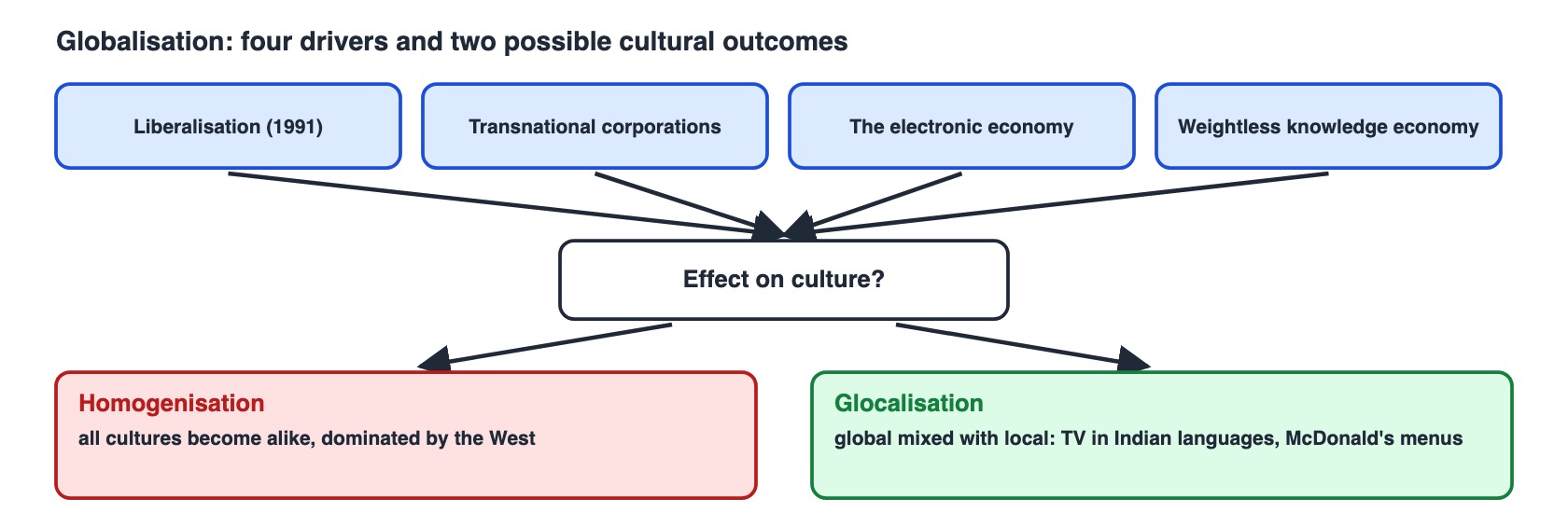
Drivers of globalisation and its two possible cultural outcomes.
Work in a global economy
A new international division of labour: routine manufacturing moves to Third World cities. Nike's shoes were made in Japan, then South Korea, then Thailand and Indonesia, and since the 1990s in India, moving wherever labour is cheaper. Mass production in one place (Fordism) has given way to flexible production at dispersed locations (post-Fordism), which leaves workers insecure. The NCERT text's example: of a $20,000 "American" General Motors car, only $7,600 went to Americans; 48% went to South Korea for labour and assembly, 28% to Japan for engines and electronics and 12% to Germany for design.
Uneven gains: for urban middle-class youth the IT revolution opened careers in software, call centres and business process outsourcing. For others it took livelihoods: Bihar's women silk spinners lost out to Chinese and Korean yarn, Gujarat's women gum collectors to cheaper gum from Sudan, women fish sorters, dryers and vendors to large fishing vessels in Indian waters, and rag pickers to imported waste paper.
Politics beyond the state: intergovernmental bodies such as the WTO set more of the rules, while international NGOs (Greenpeace, the Red Cross, Amnesty International, Doctors Without Borders) act across borders. Finance is globalised too, with markets trading round the clock.
An open tradition: the NCERT text reminds us that Indian culture has long been open to outside influence and wary of the kupamanduka, the frog in the well.
Who loses
Traditional producers: weavers in Sircilla (Karimnagar) and Dubakka (Medak) took their lives, unable to invest in technology or compete with power looms and changing tastes; mill workers lost jobs.
Traditional performers: the NCERT text quotes the dombari (acrobat) community, whose living was taken by television and the circus.
Indigenous knowledge: attempts by multinational companies to patent the use of tulsi, haldi (turmeric), rudraksha and basmati rice showed the need to protect traditional knowledge.
Food, Youth and How to Answer
Health and youth are the newest angles.
Globalisation, food and the young
Fast food (2025): the Economic Survey 2025-26 names unhealthy diets, sedentary lives and more ultra-processed foods as drivers of obesity; India is one of the fastest-growing markets for them. NFHS-5 (2019-21) found 24% of women and 23% of men overweight or obese, and excess weight among children under five rose from 2.1% (2015-16) to 3.4%.
Digital addiction: the Survey also flags digital addiction among young people as a public-health concern (article 12).
Writing the globalisation answers
Are we losing local identity for global identity? (2019) Not simply: glocalisation shows identities being remixed (vegetarian menus, Indian-language channels, fusion music). Some local forms do die (weavers, dombari performers), so the answer is "transformed, and unevenly".
Only an aggressive consumer culture? (2025) Consumption now shapes cities, but globalisation also brought jobs in the knowledge economy, new ideas of rights and individual choice, and global solidarity movements.
Fast food despite health concerns (2025): urban work and time pressure, women's paid work, aspiration and status, aggressive marketing and glocalised menus, set against rising obesity and NCDs.
Cryptocurrency and society (2021): the electronic economy taken further: money that moves instantly and outside the state, offering access and speed but also fraud, speculation and the risks the NCERT text already warned about.
Globalisation and new technology in a world of scarce resources (2022): technology spreads production and consumption globally while pressing on finite resources; India's answer lies in leapfrogging (digital public goods, clean energy) and in protecting its traditional knowledge.
Globalisation and youth (2026): young people are both its biggest winners (IT and service careers, global exposure) and among its most exposed (insecure flexible work, consumer pressure, digital addiction). Take the four spheres the question names: social (individualism, new relationships, migration), political (global causes, online mobilisation), economic (knowledge jobs, gig work, insecurity) and cultural (glocal tastes, consumer identity, digital life).
Further Reading
PIB press releases, ministry websites and annual reports, the Gazette of India, MEA and UN documents and the official sources named in each note — the primary sources behind every fact above.
Test Yourself: Practice Questions & PYQs
12 practice questions, then the six GS Paper 1 questions on globalisation.
Practice Questions
Q1. In the NCERT text, globalisation is defined as
(a) Westernisation
(b) the end of the nation-state
(c) free trade only
(d) the stretching of social and economic relationships throughout the world
Show answer
Answer: (d) — Different disciplines stress different dimensions.
Q2. India's liberalisation policies date from
(a) 1977
(b) 1984
(c) 1991
(d) 2000
Show answer
Answer: (c) — They opened the Indian economy to the world market.
Q3. 'Structural adjustment' conditions attached to international loans usually mean
(a) higher import duties
(b) more public sector jobs
(c) land reform
(d) cuts in social-sector spending
Show answer
Answer: (d) — Health, education and social security spending.
Q4. An economy whose products are based on information, such as software and media, is called a
(a) barter economy
(b) command economy
(c) weightless economy
(d) subsistence economy
Show answer
Answer: (c) — In a knowledge economy most workers design, market and service rather than produce physically.
Q5. The mixing of the global with the local is called
(a) sanskritisation
(b) homogenisation
(c) glocalisation
(d) hybridity of capital
Show answer
Answer: (c) — Often a deliberate strategy of foreign firms.
Q6. Which of these is cited in the NCERT text as an example of glocalisation?
(a) The Bhakti movement
(b) McDonald's going vegetarian during Navaratri
(c) Linguistic States
(d) The Green Revolution
Show answer
Answer: (b) — Foreign TV channels using Indian languages is another.
Q7. According to the NCERT text, what now shapes the growth of cities more than manufacturing did until the 1970s?
(a) Cultural consumption
(b) Railways
(c) Agriculture
(d) Government offices
Show answer
Answer: (a) — Art, food, fashion, music and tourism: malls and multiplexes.
Q8. The weavers' suicides in Sircilla and Dubakka are cited as an example of
(a) displacement by dams
(b) fishermen losing to trawlers
(c) farmers hit by drought
(d) traditional producers unable to compete with power looms and changing tastes
Show answer
Answer: (d) — They had no means to invest in technology.
Q9. Attempts to patent the use of tulsi, haldi, rudraksha and basmati rice highlight the need to protect
(a) GI tags for textiles only
(b) software
(c) film copyrights
(d) indigenous knowledge systems
Show answer
Answer: (d) — Traditional knowledge in medicine and agriculture.
Q10. According to NFHS-5, the share of Indian women who are overweight or obese is about
(a) 6.4%
(b) 40%
(c) 24%
(d) 12%
Show answer
Answer: (c) — 6.4% of women aged 15-49 are obese; 23% of men are overweight or obese.
Q11. Corporate culture, in the NCERT text, refers to
(a) trade unions
(b) corporate social responsibility
(c) the culture of company towns
(d) management techniques that build an organisational culture to raise productivity and loyalty
Show answer
Answer: (d) — Company events, rituals and traditions.
Q12. The 'electronic economy' raises which risk, according to the NCERT text?
(a) it abolishes banks
(b) funds can move internationally instantly, with great risks
(c) it reduces trade
(d) it ends taxation
Show answer
Answer: (b) — A useful hook for the 2021 question on cryptocurrency.
Mains Practice Questions
Use these to frame full-length answers. You don't have to answer one exactly — they show the angles UPSC tests, so let them guide which points you cover.
Evaluate the impact of globalisation on Indian youth in social, political, economic and cultural spheres.
Are we losing our local identity for a global identity? Use the idea of glocalisation.
Does globalisation result only in an aggressive consumer culture?
UPSC Mains — Previous Years’ Questions on this topic (last 10 years)
These are the actual GS Mains questions UPSC has asked on this theme — real proof of how, and when, it is tested. Try to write a full answer to each.
2019 (GS-I): Are we losing our local identity for the global identity? Discuss.
2021 (GS-I): What is Cryptocurrency? How does it affect global society? Has it been affecting Indian society also?
2022 (GS-I): Elucidate the relationship between globalization and new technology in a world of scarce resources, with special reference to India.
2025 (GS-I): Do you think that globalization results in only an aggressive consumer culture? Justify your answer.
2025 (GS-I): How do you account for the growing fast food industries given that there are increased health concerns in modern society? Illustrate your answer with the Indian experience.
2026 (GS-I): Evaluate the impact of globalization on Indian youths with reference to social, political, economic and cultural spheres.