Media, Digital Technology and Social Movements for UPSC: Mass Media History, Digital India in Numbers, Types of Movements and Children's Screens
Mass Media and Digital India
🎯 Exam priority: Important (Mains). Technology entered the society questions in 2023 (mobile phones and the socialisation of children) and 2026 (does digital technology promote social empowerment?). The NCERT chapters on mass media and social movements supply the concepts; the Economic Survey 2025-26 supplies the numbers.
Mass media in India: a short history
Phase | What changed |
Modern printing began with Gutenberg (1440); newspapers reached mass audiences only from the mid-19th century | |
Colonial India | The nationalist press (Kesari, Mathrubhumi, Amrita Bazar Patrika) faced censorship, for instance during the Ilbert Bill agitation (1883); its influence far exceeded its circulation as news spread by word of mouth |
Development broadcasting | All India Radio ran a sustained campaign for Green Revolution crops; the Satellite Instructional Television Experiment (August 1975-July 1976) reached villages in six States; Doordarshan stations in Delhi, Mumbai, Srinagar and Amritsar by 1975 |
The gravest test | The Emergency (1975) and censorship of the media; democracy was restored in 1977 |
Liberalisation | Private FM radio from 2002, private TV; newspaper circulation grew rather than shrank, especially in Indian languages |
A social institution: mass media needs formal organisation, capital and management, and its content shifts with who controls it: the state dominated the development era, the market dominates now. The Indian-language press shows how social change drives media: as literate people migrated to cities, average daily newspaper circulation rose from 39.1 million (2006) to 62.8 million (2016), with Hindi, Telugu and Kannada growing fastest.
The NCERT text also flags the digital divide: different sections of society can use media with very different ease. Even before smartphones, migrant workers stayed in touch with their villages by phone.
Digital India by the numbers
Internet subscriptions rose from about 25 crore to 101.8 crore (September 2025); data fell from about Rs 300 per GB (2014) to Rs 8.3 (2025), and monthly use per subscriber rose from 62 MB to about 25 GB.
Over 80 crore smartphone users and 15 billion UPI transactions a month have powered the gig economy: from 77 lakh workers in 2020-21 to 120 lakh in 2024-25.
In rural India, 89.1% of youth aged 14-16 had a smartphone at home (ASER 2024); over half used it for education and about 75% for social media.
Social Movements
Media and technology also change how people organise for change.
Social movements
What counts: sustained collective action over time, usually directed at the state, with some organisation (leadership, structure, shared aims). Spontaneous, disorganised protest is not a social movement. Movements meet opposition and counter-movements (for example against extending reservations), and change comes slowly.
Types: redemptive (changing members' own consciousness, as the Ezhavas of Kerala under Narayana Guru); reformist (gradual change in institutions, as the linguistic States movement and the Right to Information campaign); revolutionary (radical change, often by seizing state power, as the Bolshevik revolution and the Naxalite movement). Most movements mix all three.
Old and new: old movements worked through parties and unions around class and power; new social movements turn on identity, culture, environment and women's rights, cut across class and are often international, while old and new join in alliances such as the World Social Forum.
India's movements at a glance: ecological: Chipko, where Himalayan villagers, many of them women, hugged oak and rhododendron trees to stop contractors, pitting "the economy of subsistence" against "the economy of profit"; workers': the first trade union in Madras (April 1918, B.P. Wadia), the AITUC (1920) and the Congress-backed INTUC (May 1947); peasants': the indigo revolt (1859-62), Kisan Sabhas (Bihar 1929, all-India 1936), Tebhaga (1946-47, sharecroppers demanding two-thirds of the crop) and Telangana (1946-51), and non-party "new farmers' movements" in Punjab and Tamil Nadu from the 1970s; Dalit: a struggle for dignity, "a struggle to be touched"; the word Dalit was given its new meaning in Marathi by Ambedkar's neo-Buddhist followers in the early 1970s.
Why the 1970s surge: Rajni Kothari linked it to dissatisfaction with parliamentary democracy captured by elites; people left out turned to non-party movements to press the state from outside.
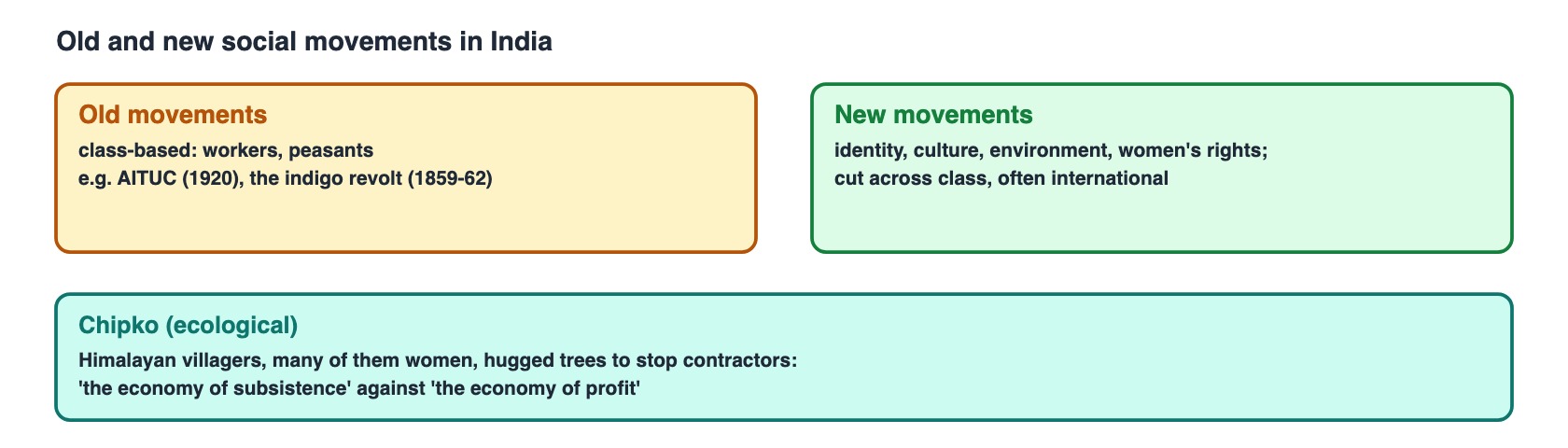
Old and new social movements, with Chipko as the example.
Technology, Empowerment and Children
The two technology questions ask you to weigh both sides.
Does digital technology promote social empowerment? (2026)
Yes, in important ways: cheap data and phones put information, payments, government services and markets within reach of groups once excluded; gig work offers income and flexibility (article 6); movements can organise and document injustice faster; rural youth use phones to learn.
But unevenly: the digital divide follows income, gender, region and age; gig work lacks security; misinformation and online abuse can disempower; and the Economic Survey warns of digital addiction among young people.
Online protest and social movements: by the NCERT definition, a burst of online outrage is not yet a movement; it becomes one only with sustained, organised collective action. The Right to Information campaign grew from an agitation in rural Rajasthan; digital tools can speed such work, but they do not replace organisation, leadership and shared aims.
The answer: technology empowers when it comes with skills, rights and public safeguards (digital literacy, data protection, social security for gig workers), so empowerment is a social outcome, not a feature of the device.
Mobile phones and the socialisation of children (2023)
The concern: socialisation (learning language, values and relationships) happens through close, responsive contact with parents and family; screens can replace that contact, with risks to attention, emotional bonds and mental health.
The response: the CBSE has issued guidelines on safe internet use in schools and school buses; the National Commission for Protection of Child Rights has issued screen-time and online-safety guidelines; Tele-MANAS (October 2022) runs a free 24/7 mental-health helpline, 14416.
Balance: phones also connect migrant parents with children and open learning, so the issue is how they are used: limits, shared use and time for play and conversation.
Further Reading
PIB press releases, ministry websites and annual reports, the Gazette of India, MEA and UN documents and the official sources named in each note — the primary sources behind every fact above.
Test Yourself: Practice Questions & PYQs
12 practice questions, then the two GS Paper 1 questions on technology and society.
Practice Questions
Q1. Modern printing with movable type was developed by Johann Gutenberg in
(a) 1540
(b) 1640
(c) 1440
(d) 1340
Show answer
Answer: (c) — Newspapers reached mass audiences only in the mid-19th century.
Q2. The Satellite Instructional Television Experiment (SITE) ran in
(a) 1975-76
(b) 1982-83
(c) 1965-66
(d) 1991-92
Show answer
Answer: (a) — It reached rural community viewers in six States.
Q3. Private FM radio stations began in India in
(a) 1991
(b) 2008
(c) 2002
(d) 1995
Show answer
Answer: (c) — They boosted entertainment programming on radio.
Q4. According to the NCERT text, the gravest challenge to Indian media was
(a) the Ilbert Bill
(b) liberalisation in 1991
(c) the arrival of the internet
(d) the Emergency of 1975 and press censorship
Show answer
Answer: (d) — Democracy was restored in 1977.
Q5. India's internet subscriptions by September 2025 were about
(a) 60 crore
(b) 25 crore
(c) 101.8 crore
(d) 140 crore
Show answer
Answer: (c) — Up from about 25 crore; data now costs about Rs 8.3 per GB.
Q6. ASER 2024 found what share of rural youth aged 14-16 had smartphone access at home?
(a) 89.1%
(b) 65%
(c) 50.2%
(d) 35%
Show answer
Answer: (a) — About 75% used phones for social media.
Q7. Gig and platform workers grew between 2020-21 and 2024-25 from
(a) 120 lakh to 200 lakh
(b) 1 crore to 3 crore
(c) 20 lakh to 50 lakh
(d) 77 lakh to 120 lakh
Show answer
Answer: (d) — Driven by over 80 crore smartphone users and 15 billion UPI transactions a month.
Q8. A social movement, unlike a spontaneous protest, requires
(a) government approval
(b) a political party
(c) sustained, organised collective action over time
(d) violence
Show answer
Answer: (c) — Usually directed at the state, with leadership and shared aims.
Q9. The Right to Information campaign is cited by NCERT as an example of a
(a) redemptive movement
(b) reformist movement
(c) counter-movement
(d) revolutionary movement
Show answer
Answer: (b) — Reformist movements change institutions step by step.
Q10. Narayana Guru's work among the Ezhavas of Kerala is an example of a
(a) revolutionary movement
(b) reformist movement
(c) new social movement
(d) redemptive movement
Show answer
Answer: (d) — It aimed to change members' own consciousness and practices.
Q11. Consider the following statements:
1. Old social movements worked mainly through political parties and trade unions.
2. New social movements centre on identity, culture and the environment and cut across classes.
3. Old and new movements never work together.
Which of the statements given above are correct?
(a) 1 and 2 only
(b) 2 and 3 only
(c) 1 and 3 only
(d) 1, 2 and 3
Show answer
Answer: (a) — 1 and 2 are correct. They combine in alliances such as the World Social Forum.
Q12. The free 24/7 mental-health helpline Tele-MANAS, launched in October 2022, can be reached at
(a) 112
(b) 14416
(c) 1930
(d) 181
Show answer
Answer: (b) — The Economic Survey cites it among responses to digital addiction and mental-health needs.
Mains Practice Questions
Use these to frame full-length answers. You don't have to answer one exactly — they show the angles UPSC tests, so let them guide which points you cover.
Do you think digital technology promotes social empowerment? Explain with examples.
Child cuddling is being replaced by mobile phones. Discuss the impact on the socialisation of children.
How have social movements changed from 'old' to 'new' in India?
UPSC Mains — Previous Years’ Questions on this topic (last 10 years)
These are the actual GS Mains questions UPSC has asked on this theme — real proof of how, and when, it is tested. Try to write a full answer to each.
2023 (GS-I): Child cuddling is now being replaced by mobile phones. Discuss its impact on the socialization of children.
2026 (GS-I): Do you think digital technology promotes social empowerment? Explain with examples.