GS4 Case Studies for UPSC: A Six-Step Method, All 36 Cases of 2021-2026 Classified, a Worked Example and Scoring Habits
The Paper and a Six-Step Method
🎯 Exam priority: High-yield (Mains GS4). Section B is six case studies of 20 marks each, 120 of the paper's 250 marks, answered in about 250 words each. The syllabus says questions "may utilise the case study approach" to test attitude, integrity and problem-solving. This article gives a repeatable method and maps all 36 cases set from 2021 to 2026.
The paper's structure
Section A | Section B | |
Questions | Six questions, mostly with parts (a), (b) | Six case studies |
Marks | About 130 (10 marks per part) | 120 (20 marks each) |
Word limit | 150 words per part | 250 words per case |
Tests | Concepts, thinkers, quotations | Applying values to a real dilemma |
All twelve questions are compulsory. Time is the real constraint: about 10-12 minutes per case, so the method has to be quick.
A six-step method
Read the sub-questions first, then the case. Answer what is asked (often: ethical issues; options with merits and demerits; your course of action; long-term measures).
Stakeholders: list everyone affected, especially the weakest (victims, the poor, future generations), not just the officer and his boss.
Ethical issues: name the values in conflict in one line each: "integrity vs loyalty to superior", "rule of law vs compassion", "public safety vs deadline".
Options: give two to four realistic options with pros and cons. Avoid straw men; include the tempting wrong option and show why it fails.
Course of action: choose and justify with law (rules, the Constitution), values (integrity, impartiality, empathy) and a thinker or framework where it fits (Kant's dignity, Rawls's least advantaged, Gandhi's trusteeship). Be specific: who you call, what you record, in what order.
Systemic fix: one or two measures so the problem does not recur (transparency, SOPs, grievance channels, training).
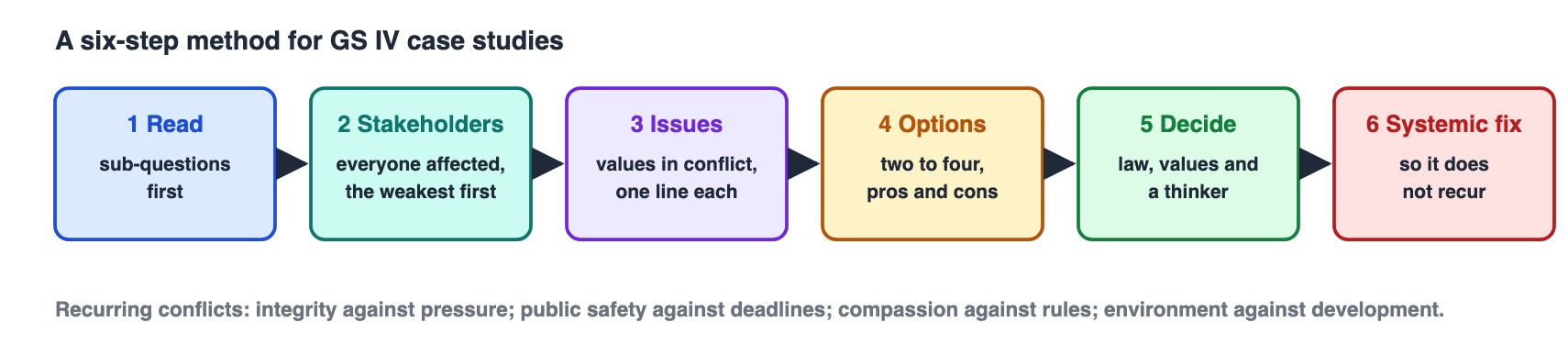
The six steps for every case study.
All 36 Cases, 2021-2026
All 36 cases, 2021-2026
Recurring themes: integrity against pressure (from mafias, politicians, superiors or one's own career), public safety against deadlines, compassion against rules, environment against livelihoods or development, security against rights, and, increasingly, technology and medical consent.
Year | Setting (opening of the case) | Core theme |
2021 | Young officer posted to a tribal district notorious for illegal sand mining | Integrity vs mafia and political pressure |
2021 | Vice-principal; flying squad catches students cheating, helped by a senior lecturer close to management | Integrity vs career interest |
2021 | Project manager of an elevated corridor due before elections; inspection finds a crack | Public safety vs deadline and political pressure |
2021 | COVID-19 strategy and the response to the outbreak | Public health, rights and administrative ethics |
2021 | Food company exporting a product, then launching it in India | Corporate ethics and consumer safety |
2021 | Officer Pawan with a difficult, insensitive senior | Workplace conduct and dignity |
2022 | VP (Marketing) under pressure to win a government order in falling sales | Business ethics vs targets |
2022 | Officer in a border State's Home Department; mother with cancer, children in school; confidential intelligence report | Duty vs personal interest and pressure |
2022 | New SP in a district where banned Aravalli stone mining continues with official connivance | Rule of law vs corrupt nexus |
2022 | New employee in a shoe company's inspection section, with dependent family | Honesty vs job security |
2022 | Joint Commissioner facing a drivers' strike over compensation for a driver who died on duty | Compassion vs rules and precedent |
2022 | Pollution control officer; small industries with clearances employ migrant workers | Environment vs livelihoods |
2023 | Bank executive; colleague's father's surgery paid from a dormant account | Empathy vs integrity; reporting wrongdoing |
2023 | District Magistrate at a landslide near Uttarkashi; urgent request for medical help | Triage, fairness and compassion in disaster |
2023 | Joint Secretary asked late on a Saturday for an urgent note while caring for young children | Work-life balance and gender |
2023 | Honest MD of a State transport corporation; powerful chairman and irregularities | Integrity vs political power |
2023 | New ADG, CPWD; retiring chief architect and a new architect's objections to his project | Professional ethics, merit and team conflict |
2023 | Senior official called to school: son found wandering, withdrawn | Personal life vs public duty |
2024 | CEO and majority owner of a large tech company facing environmental concerns | Corporate responsibility vs growth |
2024 | DGP facing terrorist recruitment of unemployed youth | Security, rights and root causes |
2024 | SP (Special Operations) in a district where Naxalism persists | Security operations and human rights |
2024 | Hospital manager running equipment procurement | Procurement integrity |
2024 | District Collector in a severe water shortage, curbing groundwater over-exploitation | Scarce resources and fairness |
2024 | Scientist under pressure to expedite a drug trial during an epidemic | Research ethics vs urgency |
2025 | Deputy Commissioner after a cloudburst destroys roads and homes | Disaster response and priorities |
2025 | Housing for the homeless proposed on ecologically sensitive forest land | Basic needs vs environment |
2025 | Secretary, PWD, trusted by the minister | Integrity in infrastructure |
2025 | Administrative officer in an oil PSU expecting promotion based on ACRs | Career interest vs honesty |
2025 | MGNREGA implementation | Welfare delivery and accountability |
2025 | Divisional Commissioner of a border district as civil war rages next door | Humanitarian duty vs security |
2026 | Surgeon finds a possible tumour during a consented diagnostic laparoscopy | Consent and autonomy |
2026 | SP using AI predictive policing with crowd biometrics | Security vs privacy and bias |
2026 | District Collector finds land-use change applications approved selectively | Fairness and corruption in discretion |
2026 | District Collector running the PDS in a remote hilly district | Last-mile delivery |
2026 | Border district with two communities in violent conflict | Impartiality and peace-building |
2026 | Head of weapon sales choosing between two buyer countries | Ethics in arms exports |
A Worked Example and Scoring Habits
A worked example: the bank colleague (2023)
Facts: a close colleague, widowed and from a lower-middle-class family, needed about Rs 10 lakh for her uninsured father's heart surgery. Weeks later she confides that the bank manager released the money from someone's dormant account, in confidence, and she is repaying it.
Stakeholders: the colleague and her father; the dormant account's owner; the bank and its depositors; the manager; you.
Ethical issues: misuse of a depositor's money and abuse of authority by the manager; empathy and friendship vs duty to report; the colleague's good faith but complicity; the precedent for public trust in a nationalised bank.
Options: (a) keep the secret since she is repaying: kind, but it condones fraud and leaves the depositor's money at risk; (b) report her and the manager at once: lawful, but ignores her circumstances; (c) encourage her to disclose voluntarily, report the manager's act through the vigilance channel, and support her case for leniency and a regular staff loan to replace the irregular funds.
Course of action: (c), because it restores the depositor's money and the bank's integrity while treating the colleague with compassion and respect.
Systemic fix: monitoring of dormant accounts; an employee welfare fund for medical emergencies; awareness of health insurance.
Habits that lift case-study marks
Act within the law, then go beyond it with compassion. Never choose an illegal option, however kind; look for the lawful route that is also humane.
Put pressure on record. Ask for oral orders in writing (the conduct rules say a superior's direction should ordinarily be in writing); keep a file note; escalate to the right authority.
Do not resign or go to the media as a first step. Use institutional channels first; resignation abandons the people you serve.
Protect the vulnerable and the honest. Victims, whistle-blowers and honest juniors come first.
Be specific and time-bound. "Within the hour I would…" beats "I would ensure justice".
Use the playlist's tools: the values of article 04, the dilemma method of article 08, bioethics principles (article 06) for medical cases, just war and security balancing (article 10) for security cases.
Further Reading
PIB press releases, ministry websites and annual reports, the Gazette of India, MEA and UN documents and the official sources named in each note — the primary sources behind every fact above.
Test Yourself: Practice Questions & PYQs
12 practice questions, then the case-study questions.
Practice Questions
Q1. How many marks does Section B (case studies) of GS4 carry?
(a) 100
(b) 120
(c) 130
(d) 250
Show answer
Answer: (b) — Six case studies of 20 marks each; Section A carries about 130.
Q2. The word limit for each GS4 case study answer is
(a) 200 words
(b) 250 words
(c) 300 words
(d) 150 words
Show answer
Answer: (b) — Section A parts carry 150 words each.
Q3. What should you do first in a case study?
(a) Count the words
(b) Read the sub-questions
(c) List thinkers
(d) Write the conclusion
Show answer
Answer: (b) — Answer exactly what is asked.
Q4. When a superior gives an oral order you doubt, the conduct rules suggest
(a) seeking it in writing
(b) refusing without explanation
(c) obeying silently
(d) going to the media
Show answer
Answer: (a) — A superior's direction should ordinarily be in writing.
Q5. Consider the following statements:
1. Options in a case answer should include realistic choices with pros and cons.
2. The chosen action should be justified by law and values.
3. Resignation is the best first step under pressure.
Which of the statements given above are correct?
(a) 1 and 2 only
(b) 2 and 3 only
(c) 1 and 3 only
(d) 1, 2 and 3
Show answer
Answer: (a) — 1 and 2 are correct. Use institutional channels before resignation.
Q6. In the 2021 elevated-corridor case, the central conflict was
(a) public safety vs a politically timed deadline
(b) career vs family
(c) privacy vs security
(d) tribal rights vs mining
Show answer
Answer: (a) — An inspection found a crack before an inauguration planned ahead of elections.
Q7. The 2026 case of an SP using AI predictive policing with crowd biometrics mainly tests
(a) security vs privacy and bias
(b) corporate CSR
(c) medical consent
(d) arms exports
Show answer
Answer: (a) — Link to the AI-ethics discussion in article 08.
Q8. Which is the best course in the 2023 bank-colleague case?
(a) Repay the money yourself secretly
(b) Report only the colleague
(c) Encourage disclosure, report the manager, support leniency and a lawful loan
(d) Keep the secret
Show answer
Answer: (c) — It combines integrity with compassion.
Q9. The 2025 case of housing for the homeless on ecologically sensitive forest land mainly involves
(a) arms exports
(b) corporate procurement
(c) exam cheating
(d) basic needs vs environmental protection
Show answer
Answer: (d) — Look for alternative sites and minimal-impact designs.
Q10. The GS4 syllabus says case studies are used to test candidates'
(a) memory of dates
(b) attitude and approach to integrity, probity and problem-solving
(c) knowledge of optional subjects
(d) typing speed
Show answer
Answer: (b) — Questions may use the case study approach to determine these aspects.
Q11. A systemic fix in a case answer means
(a) a measure that prevents the problem recurring
(b) ignoring the root cause
(c) transferring yourself
(d) punishing everyone involved
Show answer
Answer: (a) — Examples: SOPs, transparency, grievance channels, training.
Q12. How many questions are there in the GS4 paper, all compulsory?
(a) Twenty
(b) Twelve
(c) Ten
(d) Eight
Show answer
Answer: (b) — Six in Section A and six case studies in Section B.
Mains Practice Questions
Use these to frame full-length answers. You don't have to answer one exactly — they show the angles UPSC tests, so let them guide which points you cover.
Apply the six-step method to the 2021 elevated-corridor case.
How should an officer respond when a superior orally directs a decision that seems unlawful?
Pick any 2026 case and identify its stakeholders, ethical issues and options.
UPSC Mains — Previous Years’ Questions on this topic (last 10 years)
These are the actual GS Mains questions UPSC has asked on this theme — real proof of how, and when, it is tested. Try to write a full answer to each.
2021-2026: six case studies every year (36 in all), each 20 marks and 250 words; settings and themes are tabulated in this article.
2023 (GS-IV): You are working as an executive in a nationalised bank ... (the worked example above). (a) What are the ethical issues involved? (b) Evaluate the behaviour of the bank manager from an ethical point of view. (c) How would you react to the situation?