Corruption and Anti-Corruption Laws for UPSC GS4: Causes, the PC Act 2018 Amendment, Lokpal and Lokayuktas Act, Whistle Blowers Act and Institutions
Corruption: Meaning, Causes and Values
🎯 Exam priority: High-yield (Mains GS4). "Challenges of corruption" closes the probity syllabus. Asked in 2023 (corruption as the failure of core values; how to uplift them) and 2022 (policy measures to protect whistle-blowers), and present in many case studies. Know the laws precisely: they give your answers authority.
What corruption is
Corruption is the misuse of public office or entrusted power for private gain. The 2nd ARC calls it an important manifestation of the failure of ethics and distinguishes grand corruption (persons in high places, big contracts, policy capture) from retail corruption touching the everyday life of common people (bribes for certificates, licences, ration cards). It warns that corruption is so entrenched that most people see it as inevitable, a cynicism that threatens democracy itself.
Causes
Type of cause | Examples |
Structural (ARC) | Monopoly and discretion; over-regulation and an economy of scarcity; over-centralisation; asymmetry of power between officials and citizens |
Institutional | Slow investigation and trials, low conviction, weak protection for honest officers and whistle-blowers |
Political | Costly elections, patronage, criminalisation of politics |
Social and moral | Tolerance of 'speed money', loyalty to kin over public duty, materialism, decline of core values |
Corruption as the failure of core values (2023)
Corruption shows that honesty, fairness and respect for others' rights have given way to greed and the idea that rules are for others. Measures to uplift core values: value education and examples in family and school (article 02); role models in public life; social sanction against corrupt wealth; rewards for honesty and quick punishment for corruption (the ARC: values need institutions); transparency that makes corruption harder (RTI, e-governance, DBT); and citizen vigilance through social audit. Gandhi's "wealth without work" and "commerce without morality" name exactly what has to change.
The PC Act, the 2018 Amendment and the Lokpal
The Prevention of Corruption Act, 1988 and its 2018 amendment
The PC Act of 1947 made criminal misconduct an offence; the 1988 Act expanded it, defined public servants and offences in detail and consolidated earlier provisions. The 2018 amendment rewrote its core:
Change | Provision |
'Undue advantage' | Any gratification other than legal remuneration; not limited to money |
Taking a bribe | Obtaining, accepting or attempting to obtain an undue advantage is itself an offence, even if the public duty is not performed improperly; 3 to 7 years' imprisonment and fine |
Giving a bribe | Now a separate offence (up to 7 years); exemption if a person is compelled to pay and reports it to the authorities within 7 days |
Commercial organisations | Liable to a fine if an associate bribes to win business, unless they had adequate procedures to prevent it |
Section 17A | No police enquiry or investigation into an offence relatable to a public servant's recommendation or decision in official duties without the previous approval of the government (or authority) that employs or employed him |
Speedy trial | Trial to be concluded within two years, extendable with recorded reasons |
Ethical debate on section 17A: it protects honest officers from harassment for bona fide decisions (the fear that freezes decision-making), but critics fear it can shield the corrupt by making approval a gatekeeper.
Lokpal and Lokayuktas Act, 2013
An Act for a Lokpal for the Union and Lokayuktas for the States to inquire into corruption allegations against public functionaries (dated 1 January 2014).
Composition: a Chairperson and up to eight Members, half of them Judicial Members; at least half of the Members from SC, ST, OBC, minorities and women.
Selection committee: the Prime Minister (chair), the Speaker of the Lok Sabha, the Leader of Opposition in the Lok Sabha, the Chief Justice of India or a Supreme Court judge he nominates, and an eminent jurist nominated by the President on the others' recommendation.
The 2nd ARC had recommended an ombudsman (a "Rashtriya Lokayukta") and strong Lokayuktas, while warning that no institution succeeds without independence and capacity.
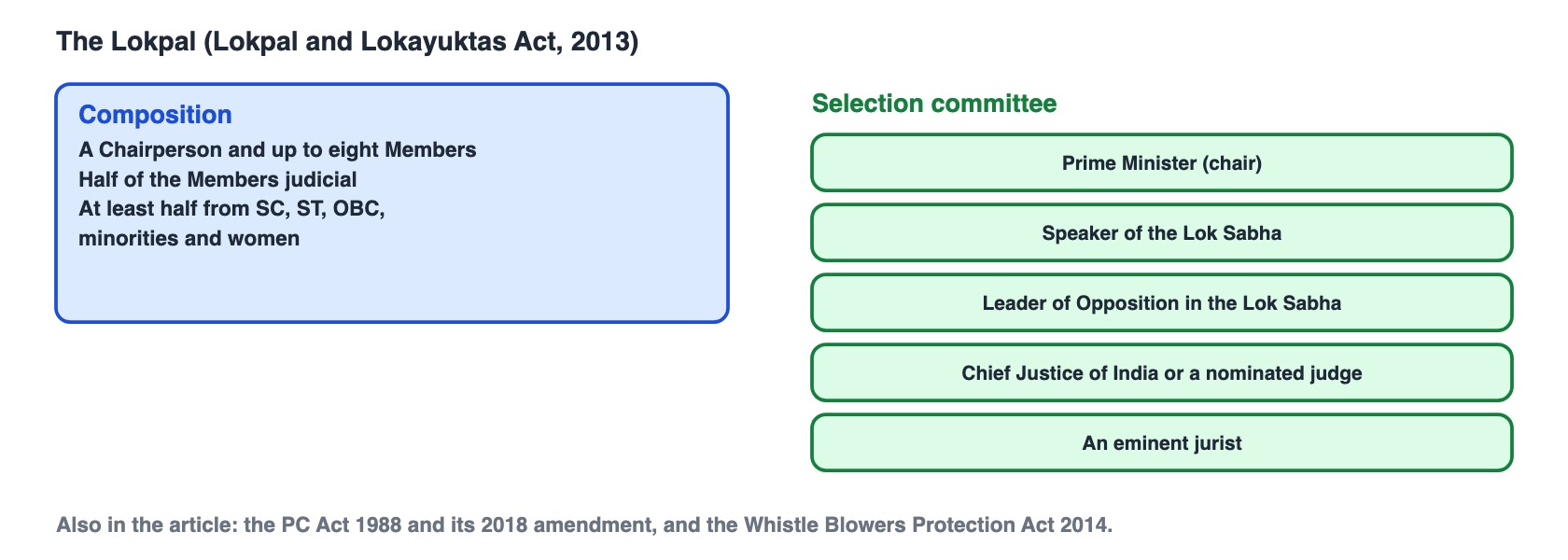
Who sits on the Lokpal, and who selects them.
Whistle-blowers, Institutions and Case Studies
Protecting whistle-blowers (2022)
The 2022 question noted that a whistle-blower who reports corruption risks grave danger, physical harm and victimisation by vested interests, and asked for policy measures.
The Whistle Blowers Protection Act, 2014: disclosures of corruption, wilful misuse of power or criminal offences by public servants go to a competent authority (for a Union minister, the Prime Minister; for most central employees, the Central Vigilance Commission). The competent authority shall not reveal the identity of the complainant. To deter abuse, a mala fide disclosure known to be false is punishable with up to two years and a fine up to Rs 30,000.
Policy measures: bring the Act fully into force with clear rules; strict identity protection and secure (including anonymous) digital channels; protection from transfer, demotion and harassment, with the burden on the employer to justify adverse action; physical protection where threatened; time-bound inquiry into disclosures; rewards for disclosures that lead to recovery; coverage of private-sector whistle-blowers; and a culture that treats them as guardians, not traitors.
Institutions and systemic remedies
Institution or tool | Role |
Central Vigilance Commission | Apex vigilance body; competent authority for many whistle-blower complaints |
CBI and State anti-corruption bureaus | Investigation and prosecution |
Lokpal and Lokayuktas | Ombudsmen for complaints against public functionaries |
CAG and audit | Detects irregular spending |
RTI, social audit, e-governance, DBT | Transparency that prevents corruption |
Integrity pacts, e-procurement | Clean public contracting (article 09) |
In a case study
When you meet corruption in a case: do not participate; record the facts; report through proper channels (superior, vigilance, CVC); protect the honest junior or whistle-blower; and fix the system that allowed it (discretion, delay, opacity). The ARC's balance holds: values to refuse, institutions to punish, systems to prevent.
Further Reading
PIB press releases, ministry websites and annual reports, the Gazette of India, MEA and UN documents and the official sources named in each note — the primary sources behind every fact above.
Test Yourself: Practice Questions & PYQs
12 practice questions, then the GS4 questions on corruption.
Practice Questions
Q1. The 2nd ARC distinguishes grand corruption from
(a) retail corruption touching common people's everyday life
(b) foreign corruption
(c) legal corruption
(d) private corruption only
Show answer
Answer: (a) — Grand corruption involves persons in high places.
Q2. Under the PC Act as amended in 2018, a public servant who takes an undue advantage faces imprisonment of
(a) up to 10 years only
(b) 1 to 3 years
(c) 6 months to 2 years
(d) 3 to 7 years
Show answer
Answer: (d) — Obtaining or accepting it is itself an offence.
Q3. Under the 2018 amendment, a person compelled to give a bribe escapes liability if he reports it within
(a) 30 days
(b) 7 days
(c) 90 days
(d) 24 hours
Show answer
Answer: (b) — He must report to the law enforcement authority or investigating agency.
Q4. Section 17A of the PC Act requires prior approval before police
(a) arrest any citizen
(b) enquire into offences relatable to a public servant's official decisions
(c) seize property
(d) file a chargesheet against a company
Show answer
Answer: (b) — It protects bona fide decisions but critics fear it can shield the corrupt.
Q5. The amended PC Act asks special judges to conclude trials within
(a) six months
(b) one year
(c) two years
(d) five years
Show answer
Answer: (c) — Extensions require recorded reasons.
Q6. The Lokpal consists of a Chairperson and up to how many Members?
(a) Five
(b) Ten
(c) Eight
(d) Twelve
Show answer
Answer: (c) — Half of them must be Judicial Members.
Q7. Consider the following statements:
1. At least half of Lokpal Members must be from SC, ST, OBC, minorities and women.
2. The Leader of Opposition in the Lok Sabha sits on the selection committee.
3. The Lokpal's selection committee is chaired by the President.
Which of the statements given above are correct?
(a) 1 and 2 only
(b) 2 and 3 only
(c) 1 and 3 only
(d) 1, 2 and 3
Show answer
Answer: (a) — 1 and 2 are correct. The Prime Minister chairs the selection committee.
Q8. Which of these is NOT on the Lokpal selection committee?
(a) The Chief Election Commissioner
(b) An eminent jurist
(c) The Chief Justice of India or his nominee
(d) The Speaker of the Lok Sabha
Show answer
Answer: (a) — The Prime Minister chairs it.
Q9. Under the Whistle Blowers Protection Act, 2014, the competent authority for a complaint against a Union minister is
(a) the Lokpal
(b) the CVC
(c) the President
(d) the Prime Minister
Show answer
Answer: (d) — For most central employees it is the Central Vigilance Commission.
Q10. A knowingly false, mala fide disclosure under the Whistle Blowers Act is punishable with up to
(a) life imprisonment
(b) seven years
(c) two years and a fine up to Rs 30,000
(d) a warning only
Show answer
Answer: (c) — This deters frivolous complaints.
Q11. 'Undue advantage' under the amended PC Act means
(a) only cash payments
(b) any salary
(c) any gratification other than legal remuneration
(d) only gifts above Rs 5,000
Show answer
Answer: (c) — Gratification is not limited to money.
Q12. The PC Act of 1947 was expanded and replaced in
(a) 1964
(b) 2005
(c) 1988
(d) 2013
Show answer
Answer: (c) — The 2018 amendment then rewrote its core offences.
Mains Practice Questions
Use these to frame full-length answers. You don't have to answer one exactly — they show the angles UPSC tests, so let them guide which points you cover.
Corruption is the manifestation of the failure of core values in society. What measures can uplift core values?
What policy measures would strengthen protection for whistle-blowers?
Evaluate the 2018 amendments to the Prevention of Corruption Act.
UPSC Mains — Previous Years’ Questions on this topic (last 10 years)
These are the actual GS Mains questions UPSC has asked on this theme — real proof of how, and when, it is tested. Try to write a full answer to each.
2022 (GS-IV): Whistle-blower, who reports corruption and illegal activities, wrongdoing and misconduct to the concerned authorities, runs the risk of being exposed to grave danger, physical harm and victimization by the vested interests, accused persons and his team. What policy measures would you suggest to strengthen [the protection of whistle-blowers]?
2022 (short note, 30 words): Conflict of interest.
2023 (GS-IV): "Corruption is the manifestation of the failure of core values in the society." In your opinion, what measures can be adopted to uplift the core values in the society?