Hair and Nail Disorders for NEET PG Dermatology: Alopecia Areata, Telogen Effluvium, Pattern Hair Loss, Scarring Alopecia, Hirsutism, Nail Signs
Start Here
🎯 Exam priority: Moderate. Expect: up to 100 hairs a day is normal, scarring vs non-scarring signs, exclamation-mark hairs, alopecia totalis vs universalis, ICMR alopecia areata treatment by extent, telogen effluvium 3–4 months after a trigger, pull test, male and female pattern loss with minoxidil and finasteride, trichotillomania, scarring alopecias, hirsutism vs hypertrichosis, and the nail signs of systemic disease.
CBME: no separate dermatology code; hair and nail signs recur across DR 3 (psoriasis), DR 7 (fungal), DR 9 (leprosy) and Medicine.
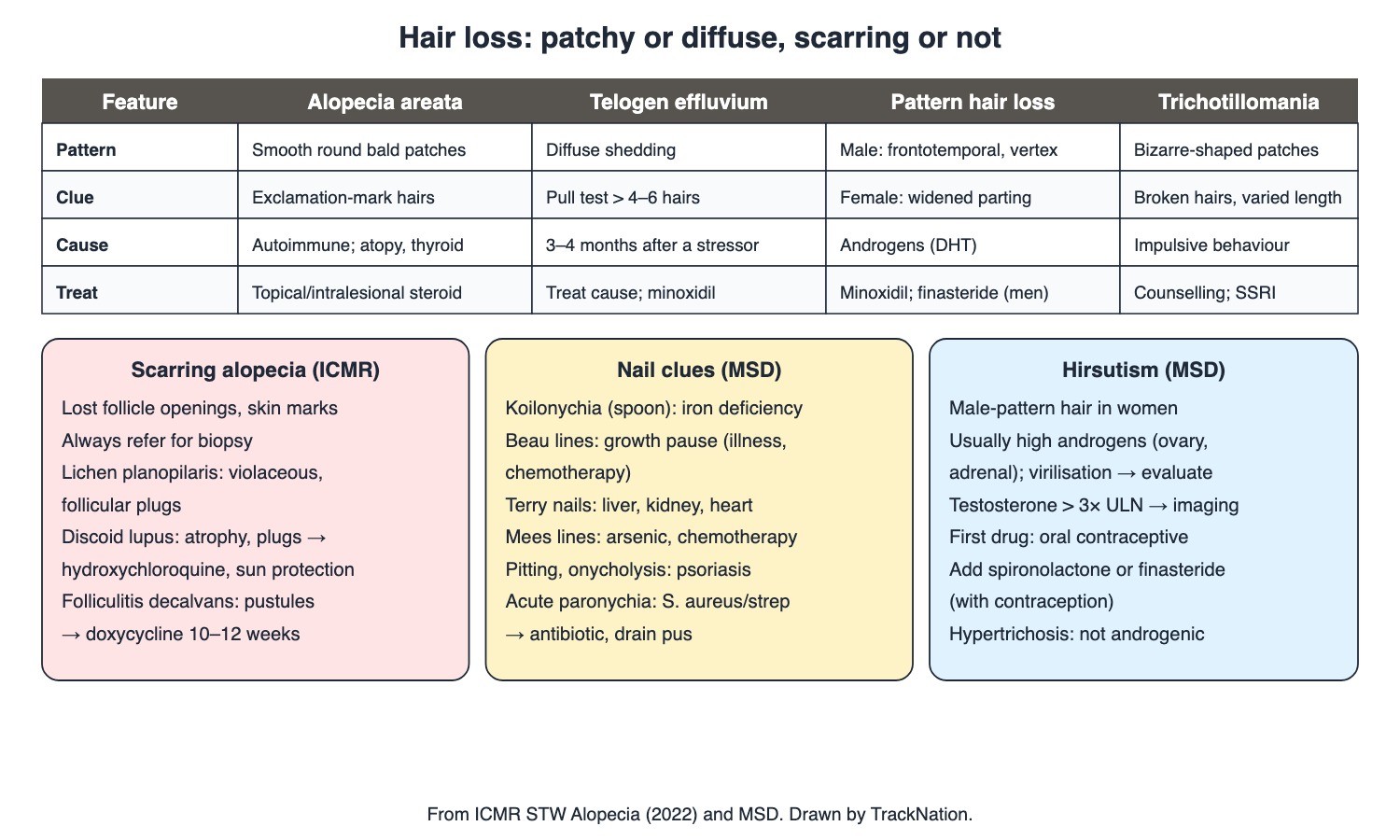
Alopecia areata, telogen effluvium, pattern hair loss and trichotillomania compared; scarring alopecia; nail clues; hirsutism. Drawn by TrackNation.
Approach to Hair Loss and Alopecia Areata
Losing up to 100 hairs a day can be normal. Ask about duration, patchy vs diffuse, other hair-bearing areas, illness, drugs, menstrual problems and hair procedures. On the scalp, scarring alopecia shows loss of skin markings and of follicle openings, with pigment change; non-scarring areas are smooth with small intact black follicles. All scarring alopecia goes to a dermatologist for biopsy.
Alopecia areata: autoimmune; smooth, asymptomatic, round bald patches with exclamation-mark hairs at the edge; may progress to the whole scalp (totalis) or all body hair (universalis). Look for atopy, nail pitting, vitiligo and thyroid disease.
ICMR treatment: under 50% of scalp — topical betamethasone 0.05% lotion, intralesional triamcinolone every 2–4 weeks (5 mg/mL scalp, 2.5 mg/mL beard or eyebrows), topical minoxidil 5%; over 50%, face or body hair, or the occipital margin — refer for oral steroid minipulse, methotrexate or cyclosporine. JAK inhibitors (baricitinib, ritlecitinib, deuruxolitinib) are used for severe disease.
Diffuse and Patterned Hair Loss
Telogen effluvium: diffuse shedding (> 100 hairs a day) 3–4 months after a stressor — pregnancy, febrile illness, surgery, drugs, psychological stress; positive pull test (> 4–6 hairs per pull). Check haemogram, ferritin and TSH if indicated; treat the cause and reassure — it is temporary; minoxidil may speed recovery. Anagen effluvium: loss 2–4 weeks after chemotherapy or radiotherapy.
Androgenetic alopecia (the commonest cause of hair loss): hereditary and androgen-dependent (dihydrotestosterone). Men — frontotemporal recession and vertex thinning, sparing the occiput: topical minoxidil 5% twice daily ± oral finasteride 1 mg/day (5-alpha-reductase inhibitor; teratogenic, not in pregnancy); hair transplant if needed. Women — widening of the parting, usually after menopause; in premenopausal women look for hyperandrogenism (PCOS, virilising tumours); minoxidil 5% once daily, antiandrogens.
Trichotillomania: children or young adults with bizarre-shaped patches and broken hairs of different lengths; look for other impulsive behaviour; counselling and psychiatry referral (SSRIs or clomipramine may help). Tinea capitis (Derm 08) needs oral antifungals; avoid comb sharing.
Scarring Alopecia, Hirsutism and Nails
Scarring alopecias: lichen planopilaris (violaceous plaques, follicular plugs; look for LP elsewhere) — steroid minipulse ± immunosuppressants; discoid lupus (red to depigmented atrophic plaques with plugs; exclude SLE) — photoprotection, topical steroids, hydroxychloroquine 5 mg/kg/day after eye check; folliculitis decalvans (pustules) — doxycycline or clindamycin for 10–12 weeks.
Hirsutism: thick dark hair in a male pattern in women, usually from high androgens (ovary or adrenal); virilisation (loss of periods, deep voice, clitoromegaly, muscle bulk) needs evaluation, and testosterone above 3 times the upper limit needs imaging for a tumour. First drug: oral contraceptive; add spironolactone or finasteride only with contraception (they can feminise a male fetus); eflornithine cream, hair removal. Hypertrichosis is non-androgenic.
Nail sign (MSD) | Appearance | Think of |
Koilonychia | Spoon-shaped, concave nail | Iron deficiency (Plummer–Vinson) |
Beau lines | Horizontal grooves; regrow normally | Pause in growth: illness, infection, chemotherapy |
Terry nails | Nail almost all white, no lunula, narrow distal band | Liver failure, kidney failure, heart failure, diabetes |
Mees lines | White transverse lines | Arsenic, thallium, chemotherapy |
Pitting, onycholysis | Pits; nail lifts from bed | Psoriasis (onycholysis also in thyrotoxicosis) |
Yellow nail syndrome | Thick, over-curved yellow nails | Rare syndrome |
Acute paronychia | Painful red swollen nail fold, pus | S. aureus or streptococci → antibiotic, drain |
Traps the Examiner Sets
Exclamation-mark hairs = alopecia areata; broken hairs of varying length in odd shapes = trichotillomania.
Diffuse shedding 3 months after a fever or delivery = telogen effluvium.
Scarring alopecia always needs a biopsy.
Spoon nails = iron deficiency; white nail with no lunula = Terry nails (liver, kidney, heart).
Memory Hooks & Shortcuts
Shortcuts to lock in this article's numbers and lists. Each one only re-packages facts proven above.
🧠 'Exclamation! Areata' — broken hairs at the edge of a smooth patch — alopecia areata
🧠 Telogen effluvium '3-month echo' of a fever, delivery or surgery — telogen effluvium
🧠 'Totalis = Top (scalp); Universalis = Universe (all hair)' — AA extent
🧠 Nails: 'Spoon = Iron, Beau = Break in growth, Terry = Tired organs, Mees = Metal' — nail signs
🧠 Hirsutism drugs: 'Pill first, then antiandrogen — always with contraception' — hirsutism
Rapid-Revision Cards
Normal shedding
Up to 100 hairs/day.
Scarring sign
Lost follicle openings → biopsy.
Alopecia areata
Smooth patch; exclamation-mark hairs.
Totalis / universalis
Whole scalp / all body hair.
AA associations
Atopy, nail pitting, vitiligo, thyroid.
AA < 50%
Topical, intralesional steroid; minoxidil.
AA severe
Minipulse, MTX, CsA; JAK inhibitors.
Telogen effluvium
3–4 months after stressor; pull test +.
Anagen effluvium
2–4 weeks after chemo.
Commonest hair loss
Androgenetic (DHT).
Male pattern Rx
Minoxidil 5% BD ± finasteride 1 mg.
Finasteride
5-alpha-reductase; not in pregnancy.
Female pattern
Wide parting; check hyperandrogenism.
Trichotillomania
Bizarre patches, varied broken hairs.
Discoid lupus
Hydroxychloroquine after eye check.
Hirsutism
Male-pattern hair in women; OCP first.
Testosterone > 3×
Image for tumour.
Koilonychia
Iron deficiency.
Beau lines
Growth pause.
Terry nails
Liver, kidney, heart failure.
Mees lines
Arsenic, chemotherapy.
Sources
Facts in this article were checked against these documents.
Test Yourself: Practice Questions
Thirty questions in NEET PG style, most of them clinical vignettes.
Practice Questions (NEET PG pattern)
Original questions written in the style of the exam: +4 for a correct answer, −1 for a wrong one. Every answer was checked against the sources listed above. NEET PG papers are not published by NBEMS, so these are not past-paper questions.
Q1. A worried patient counts about 80 hairs lost a day with no thinning. ICMR advice is that
(a) a biopsy is needed
(b) up to 100 hairs a day may be normal
(c) this is alopecia areata
(d) this is telogen effluvium
Show answer
Answer: (b) — Reassure.
Q2. Loss of follicle openings and skin markings on a bald patch indicates
(a) telogen effluvium
(b) alopecia areata
(c) androgenetic alopecia
(d) scarring alopecia
Show answer
Answer: (d) — Refer for biopsy.
Q3. A child has a smooth round bald patch with short broken hairs at its edge. The diagnosis is
(a) telogen effluvium
(b) tinea capitis
(c) trichotillomania
(d) alopecia areata
Show answer
Answer: (d) — Exclamation-mark hairs.
Q4. Loss of all scalp and body hair in alopecia areata is called
(a) telogen effluvium
(b) alopecia universalis
(c) ophiasis
(d) alopecia totalis
Show answer
Answer: (b) — Totalis = whole scalp only.
Q5. In a patient with alopecia areata, ICMR advises examining the
(a) eyes for cataract
(b) nails for pitting and asking about atopy
(c) tongue
(d) joints
Show answer
Answer: (b) — Associations.
Q6. Alopecia areata may coexist with
(a) vitiligo and thyroiditis
(b) psoriasis only
(c) acne
(d) rosacea
Show answer
Answer: (a) — Autoimmune.
Q7. Alopecia areata involving less than 50% of the scalp is treated (ICMR) with
(a) hair transplant
(b) oral antifungals
(c) oral finasteride
(d) topical betamethasone and intralesional triamcinolone every 2–4 weeks
Show answer
Answer: (d) — Minoxidil may be added.
Q8. Alopecia areata involving more than half the scalp or the eyebrows and body hair should be
(a) treated with finasteride
(b) treated with shampoo
(c) ignored
(d) referred for systemic treatment such as steroid minipulse, methotrexate or cyclosporine
Show answer
Answer: (d) — Tertiary care.
Q9. A drug class now used for severe alopecia areata is
(a) retinoids
(b) 5-alpha-reductase inhibitors
(c) JAK inhibitors (e.g. baricitinib)
(d) antifungals
Show answer
Answer: (c) — Also ritlecitinib, deuruxolitinib.
Q10. A woman notices diffuse hair shedding about 3 months after delivery. The likely diagnosis is
(a) telogen effluvium
(b) alopecia areata
(c) androgenetic alopecia
(d) anagen effluvium
Show answer
Answer: (a) — 3–4 months after a stressor.
Q11. A positive hair pull test (more than 4–6 hairs per pull) suggests
(a) trichotillomania
(b) normal hair
(c) scarring alopecia
(d) telogen effluvium
Show answer
Answer: (d) — Also other active shedding.
Q12. Hair loss 2–4 weeks after starting chemotherapy is
(a) alopecia areata
(b) telogen effluvium
(c) anagen effluvium
(d) trichotillomania
Show answer
Answer: (c) — Growing-phase hairs.
Q13. The most common cause of hair loss overall is
(a) androgenetic alopecia
(b) telogen effluvium
(c) alopecia areata
(d) tinea capitis
Show answer
Answer: (a) — Male and female pattern.
Q14. The hormone chiefly responsible for male-pattern baldness is
(a) dihydrotestosterone
(b) oestrogen
(c) thyroxine
(d) cortisol
Show answer
Answer: (a) — Androgen-dependent, hereditary.
Q15. A man has frontotemporal recession and vertex thinning with a preserved occipital fringe. ICMR first-line treatment is
(a) oral steroids
(b) intralesional steroid
(c) oral antifungals
(d) topical minoxidil 5% twice daily, optionally with finasteride 1 mg/day
Show answer
Answer: (d) — Transplant if required.
Q16. Finasteride acts by inhibiting
(a) aromatase
(b) tyrosinase
(c) androgen receptor directly
(d) 5-alpha-reductase
Show answer
Answer: (d) — Blocks testosterone → DHT.
Q17. Finasteride must not be used in pregnant women because it
(a) causes hypertension
(b) causes hair loss
(c) is ineffective
(d) is teratogenic
Show answer
Answer: (d) — Animal teratogenicity.
Q18. A premenopausal woman with widening of the hair parting also has acne and irregular periods. ICMR advises
(a) oral antifungals
(b) a hormonal work-up to rule out PCOS or a virilising tumour
(c) reassurance only
(d) intralesional steroids
Show answer
Answer: (b) — Signs of hyperandrogenism.
Q19. A teenager has a bald patch of odd shape with broken hairs of different lengths and other impulsive behaviour. The likely diagnosis is
(a) alopecia areata
(b) tinea capitis
(c) telogen effluvium
(d) trichotillomania
Show answer
Answer: (d) — Look for impulsive behaviour; counselling.
Q20. Drugs that may help trichotillomania include
(a) antifungals
(b) finasteride
(c) steroids
(d) SSRIs or clomipramine
Show answer
Answer: (d) — With behaviour therapy.
Q21. Discoid lupus causing scarring alopecia is treated with photoprotection, topical steroids and
(a) finasteride
(b) griseofulvin
(c) hydroxychloroquine after a baseline eye examination
(d) minoxidil only
Show answer
Answer: (c) — Exclude SLE.
Q22. Folliculitis decalvans is treated with
(a) long-term doxycycline or clindamycin for 10–12 weeks
(b) no treatment
(c) minoxidil
(d) antifungals
Show answer
Answer: (a) — Pustular scarring alopecia.
Q23. Hirsutism is defined as
(a) thick dark hair in a male pattern in women
(b) excess fine hair anywhere
(c) hair loss in women
(d) white hair in youth
Show answer
Answer: (a) — Hypertrichosis is non-androgenic.
Q24. A woman with hirsutism has a total testosterone more than three times the upper limit. The next step is
(a) imaging to exclude an ovarian or adrenal tumour
(b) reassurance
(c) laser hair removal only
(d) start minoxidil
Show answer
Answer: (a) — Rapid virilisation also prompts imaging.
Q25. The usual first drug for hirsutism from ovarian androgen excess is
(a) spironolactone alone without contraception
(b) a combined oral contraceptive
(c) steroids
(d) finasteride alone
Show answer
Answer: (b) — Antiandrogens need contraception.
Q26. Spoon-shaped (concave) nails point to
(a) liver failure
(b) iron deficiency
(c) psoriasis
(d) arsenic poisoning
Show answer
Answer: (b) — Koilonychia; Plummer–Vinson.
Q27. Horizontal grooves appearing across all nails after a severe illness are
(a) pitting
(b) Mees lines
(c) Beau lines
(d) Terry nails
Show answer
Answer: (c) — Growth pause; regrow normally.
Q28. Nails that are almost entirely opaque white with no visible lunula and a narrow distal band suggest
(a) Terry nails — liver, kidney or heart failure
(b) koilonychia
(c) Beau lines
(d) psoriasis
Show answer
Answer: (a) — Also diabetes, ageing.
Q29. White transverse lines across the nails after acute arsenic poisoning are
(a) splinter haemorrhages
(b) Mees lines
(c) Beau lines
(d) Muehrcke lines
Show answer
Answer: (b) — Also chemotherapy, thallium.
Q30. Acute painful swelling of the nail fold with pus is usually caused by
(a) Staphylococcus aureus or streptococci — antibiotic and drainage
(b) dermatophytes
(c) Candida — antifungal only
(d) HPV
Show answer
Answer: (a) — Chronic paronychia is often candidal.
Active Recall
From memory: separate scarring from non-scarring alopecia, describe alopecia areata and its ICMR treatment, telogen and anagen effluvium, male and female pattern hair loss with treatment, trichotillomania, hirsutism, and the nail signs of systemic disease.