Vitiligo and Pigmentary Disorders for NEET PG Dermatology: Types, Activity, ICMR Treatment, Leprosy vs Vitiligo, Melasma, Albinism
Start Here
🎯 Exam priority: Moderate-High. Expect: depigmented vs hypopigmented, vitiligo types and segmental features, the activity rule (> 5 new lesions in a month), limited vs extensive (5%), thyroid association, Wood light, ICMR treatment by site (tacrolimus on the face, no clobetasol), minipulse for rapid spread, surgery for stable disease, vitiligo vs leprosy, melasma triple cream and pregnancy, albinism.
CBME mapping: DR 2.1. Melanin synthesis is also in Biochemistry; albinism genetics in Pathology.
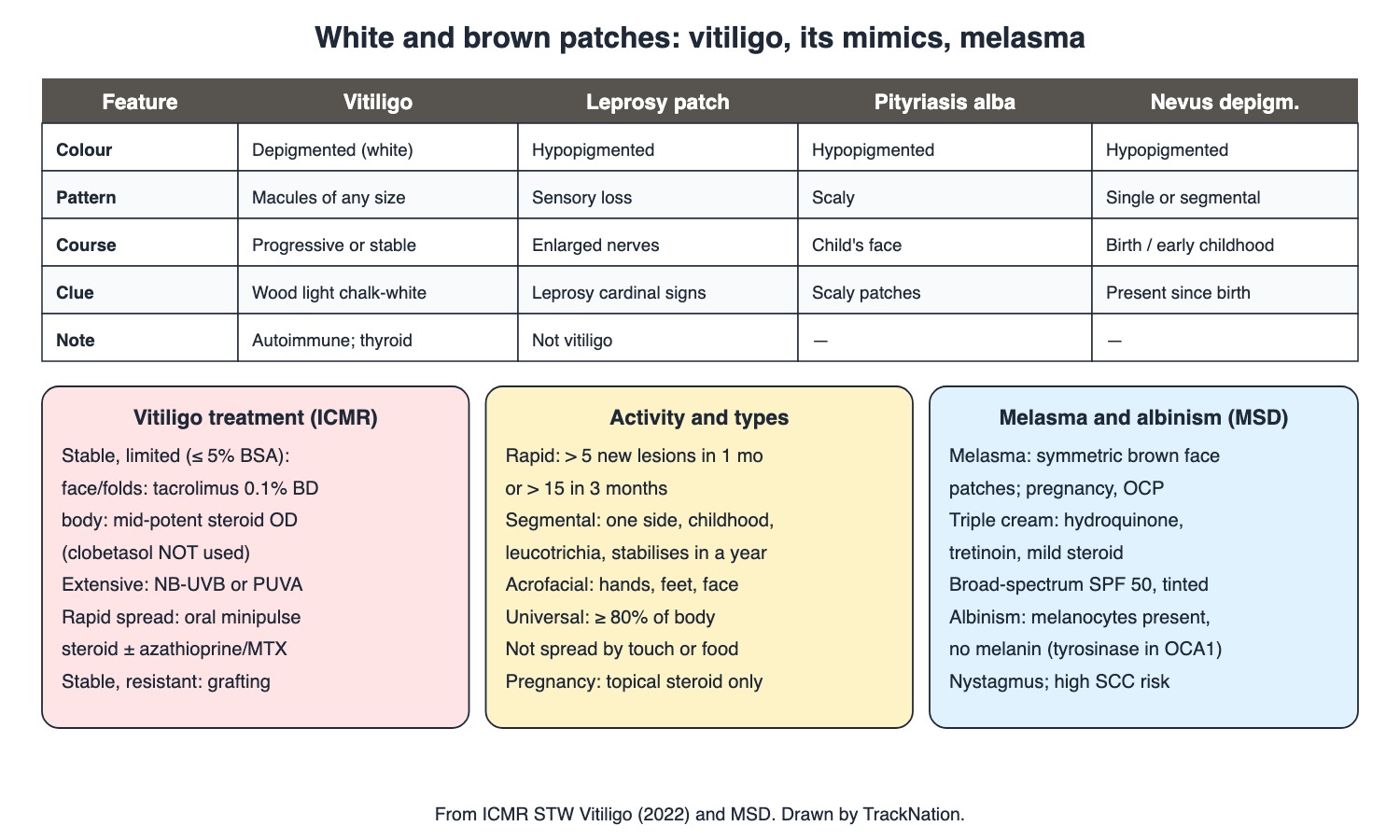
Vitiligo and its mimics compared; ICMR vitiligo treatment and activity; melasma and albinism. Drawn by TrackNation.
Vitiligo
Acquired loss of melanocytes producing depigmented (white) macules; prevalence 1–2%; multifactorial, mainly autoimmune. Up to 30% have other autoimmune antibodies or endocrinopathies — strongest link with Graves disease and Hashimoto thyroiditis (check thyroid function and anti-TPO as indicated). Wood light shows chalk-white depigmentation. Diagnosis is clinical.
Types: non-segmental — generalised (vitiligo vulgaris), acrofacial (distal limbs and face, less responsive), focal, mucosal, universal (≥ 80% of body); segmental — one side with a midline cut-off, childhood onset, white hairs (leucotrichia), stabilises within a year, often needs surgery. Koebner phenomenon marks activity.
Activity: rapidly progressive — > 5 new lesions in 1 month or > 15 in 3 months; slowly progressive — fewer; stable — no new lesions or spread. Extent: limited ≤ 5% or extensive > 5% of body surface.
Counsel: not leprosy, does not spread by touch, not caused by milk, curd, lemon or fish; it is treatable. In pregnancy use only topical steroids. Camouflage for poorly responsive patches. Monitor growth, weight, BP and sugar on oral steroids and blood counts and liver tests on azathioprine or methotrexate.
Situation (ICMR) | Treatment |
Stable, face, flexures, genitals | Tacrolimus 0.1% ointment twice daily |
Stable, other sites | Mid-potent steroid cream once daily (betamethasone valerate, mometasone, fluticasone, fluocinolone) — clobetasol NOT used; refer if no response by 3 months |
Extensive (> 5%) stable or slowly progressive | Narrowband UVB or oral PUVA / PUVAsol |
Slowly progressive | Phototherapy; levamisole |
Rapidly progressive | Oral steroid minipulse and/or azathioprine or methotrexate |
Stable limited or segmental, unresponsive | Surgery: minipunch grafting, suction blister epidermal grafting, non-cultured epidermal cell suspension |
Universal | Sun protection; depigmentation with monobenzyl ether of hydroquinone 20% if the patient wishes |
White Patches That Are Not Vitiligo
Leprosy: hypopigmented (not depigmented) macules with sensory loss and enlarged peripheral nerves.
Pityriasis alba: hypopigmented scaly patches, usually on a child's face.
Nevus depigmentosus: a single hypopigmented macule or segmental lesion present since birth or early childhood.
Pityriasis versicolor (Derm 08) and albinism (below) are other causes of light skin.
Melasma, Other Hyperpigmentation and Albinism
Melasma: symmetric dark-brown facial patches with irregular borders — mainly in pregnancy ("mask of pregnancy") and with oral contraceptives; commoner and longer-lasting in dark skin. Only epidermal pigment (accentuated by Wood light) responds. First line: triple cream — hydroquinone 2–4%, tretinoin, low-potency steroid — with broad-spectrum SPF 50 tinted sunscreen. Long continuous hydroquinone risks exogenous ochronosis. In pregnancy use azelaic acid or glycolic peels; hydroquinone, tretinoin and tranexamic acid are not safe. Oral tranexamic acid helps moderate–severe melasma.
Other hyperpigmentation: post-inflammatory (commonest focal cause), acanthosis nigricans (velvety plaques on neck and axillae), and diffuse pigmentation from Addison disease, haemochromatosis or primary biliary cholangitis.
Oculocutaneous albinism: usually autosomal recessive; normal melanocyte numbers but absent or reduced melanin (OCA1: tyrosinase gene). Nystagmus, strabismus, poor vision; very high risk of sunburn and skin cancer (especially SCC) — strict sun protection. Hermansky–Pudlak syndrome adds platelet defects.
Traps the Examiner Sets
Depigmented = vitiligo; hypopigmented with sensory loss = leprosy.
Vitiligo has absent melanocytes; albinism has melanocytes but no melanin.
ICMR: no clobetasol for vitiligo; tacrolimus for the face and folds.
No hydroquinone or tretinoin for melasma in pregnancy.
Memory Hooks & Shortcuts
Shortcuts to lock in this article's numbers and lists. Each one only re-packages facts proven above.
🧠 'De-pigmented = De-stroyed melanocytes (vitiligo); Hypo = Hansen's' — white patches
🧠 Activity rule '5 in 1, 15 in 3' — rapidly progressive
🧠 'Tacrolimus for the Thin skin, no Clobetasol for vitiligo' — ICMR topical
🧠 Melasma triple: 'Hydro, Tret, Tiny steroid' + sunscreen — melasma
🧠 Albinism: 'factory present, no paint' (melanocytes without melanin) — albinism
Rapid-Revision Cards
Vitiligo
Depigmented; melanocytes lost; 1–2%.
Association
Graves, Hashimoto.
Wood light
Chalk-white.
Segmental
One side, child, leucotrichia, stable < 1 y.
Universal
≥ 80% BSA.
Rapid activity
> 5 new/month or > 15/3 months.
Limited
≤ 5% BSA.
Face/folds
Tacrolimus 0.1%.
Body
Mid-potent steroid; no clobetasol.
Extensive
NB-UVB or PUVA.
Rapid spread
Minipulse ± azathioprine/MTX.
Stable, resistant
Grafting.
Universal option
Monobenzyl ether of hydroquinone.
Pregnancy
Topical steroid only.
Leprosy patch
Hypopigmented, numb, thick nerve.
Pityriasis alba
Scaly, child's face.
Nevus depigmentosus
Since birth, single.
Melasma
Pregnancy, OCP; triple cream.
Melasma pregnancy
Azelaic acid, glycolic peel.
Albinism
Melanocytes present, no melanin; SCC.
OCA1
Tyrosinase.
Sources
Facts in this article were checked against these documents.
Standard Treatment Workflow: Vitiligo — Indian Council of Medical Research, DHR, 2022 (link)
MSD Manual Professional: Vitiligo; Hyperpigmentation; Albinism — Merck & Co. (MSD Manuals), reviewed 2024–26 (link)
Competency Based Undergraduate Curriculum, Dermatology (DR 2) — National Medical Commission, 2024
Test Yourself: Practice Questions
Thirty questions in NEET PG style, most of them clinical vignettes.
Practice Questions (NEET PG pattern)
Original questions written in the style of the exam: +4 for a correct answer, −1 for a wrong one. Every answer was checked against the sources listed above. NEET PG papers are not published by NBEMS, so these are not past-paper questions.
Q1. Vitiligo is best described as
(a) hypopigmented anaesthetic patches
(b) inherited absence of melanin with normal melanocytes
(c) acquired depigmented macules from loss of melanocytes
(d) post-inflammatory hypopigmentation
Show answer
Answer: (c) — Prevalence 1–2%.
Q2. The autoimmune disease most strongly associated with vitiligo is
(a) coeliac disease
(b) psoriasis
(c) rheumatoid arthritis
(d) autoimmune thyroid disease (Graves, Hashimoto)
Show answer
Answer: (d) — Also Addison, diabetes, pernicious anaemia.
Q3. Under a Wood lamp, vitiligo appears
(a) blue-green
(b) golden yellow
(c) chalk-white
(d) coral red
Show answer
Answer: (c) — 365 nm.
Q4. A child has a white patch on one side of the face with a sharp midline cut-off and white hairs within it. The type is
(a) universal vitiligo
(b) generalised vitiligo
(c) segmental vitiligo
(d) acrofacial vitiligo
Show answer
Answer: (c) — Childhood onset; stabilises in a year.
Q5. Segmental vitiligo typically
(a) spreads all over the body
(b) starts after 60 years
(c) responds best to clobetasol
(d) stabilises within a year and often needs surgery
Show answer
Answer: (d) — Variable medical response.
Q6. Vitiligo affecting at least 80% of the body surface is called
(a) generalised vitiligo
(b) universal vitiligo
(c) acrofacial
(d) segmental
Show answer
Answer: (b) — Consider depigmentation of the rest.
Q7. A patient developed 7 new vitiligo lesions in the last month. ICMR calls this
(a) rapidly progressive vitiligo
(b) slowly progressive
(c) segmental vitiligo
(d) stable vitiligo
Show answer
Answer: (a) — > 5 in 1 month or > 15 in 3 months.
Q8. ICMR defines limited vitiligo as involvement of
(a) 10% or less
(b) 1% or less
(c) a single lesion only
(d) 5% or less of body surface
Show answer
Answer: (d) — Extensive > 5%.
Q9. Stable vitiligo on the eyelids and genitals is treated (ICMR) with
(a) oral steroid minipulse
(b) tacrolimus 0.1% ointment twice daily
(c) clobetasol
(d) PUVA
Show answer
Answer: (b) — Thin skin.
Q10. Which topical steroid does ICMR say should NOT be used for vitiligo?
(a) betamethasone valerate
(b) clobetasol propionate
(c) fluticasone
(d) mometasone
Show answer
Answer: (b) — Use mid-potent steroids.
Q11. Extensive stable vitiligo is best treated with
(a) excision
(b) oral antibiotics
(c) topical clobetasol all over
(d) narrowband UVB or PUVA
Show answer
Answer: (d) — NB-UVB often treatment of choice.
Q12. Rapidly progressive vitiligo is treated with
(a) surgery
(b) depigmentation
(c) oral corticosteroid minipulse and/or azathioprine or methotrexate
(d) camouflage only
Show answer
Answer: (c) — To halt spread.
Q13. Surgical options such as minipunch or suction blister grafting are used for
(a) stable limited or segmental vitiligo unresponsive to medicines
(b) rapidly progressive vitiligo
(c) all new patients
(d) universal vitiligo
Show answer
Answer: (a) — Stability is essential.
Q14. A patient with universal vitiligo wants an even skin tone. An option is
(a) depigmenting the remaining skin with monobenzyl ether of hydroquinone 20%
(b) grafting all areas
(c) PUVA for life
(d) no option exists
Show answer
Answer: (a) — Plus sun protection.
Q15. In a pregnant woman with vitiligo, ICMR prefers
(a) only topical corticosteroids
(b) PUVA
(c) oral minipulse
(d) methotrexate
Show answer
Answer: (a) — Avoid systemic treatment.
Q16. A family believes vitiligo was caused by eating fish with milk. The correct counselling is that vitiligo
(a) is caused by food combinations
(b) is not caused by such foods and does not spread by touch
(c) is a form of leprosy
(d) is contagious
Show answer
Answer: (b) — Predominantly autoimmune.
Q17. A hypopigmented (not depigmented) patch with loss of sensation and a thickened nerve nearby suggests
(a) nevus depigmentosus
(b) vitiligo
(c) pityriasis alba
(d) leprosy
Show answer
Answer: (d) — Key differential.
Q18. A child has hypopigmented scaly patches on the face. The likely diagnosis is
(a) albinism
(b) leprosy
(c) vitiligo
(d) pityriasis alba
Show answer
Answer: (d) — Common in children.
Q19. A single hypopigmented patch present since birth suggests
(a) leprosy
(b) nevus depigmentosus
(c) pityriasis versicolor
(d) vitiligo
Show answer
Answer: (b) — Present since birth or early childhood.
Q20. Non-responders to topical treatment in primary care should be referred after
(a) 3 months
(b) never
(c) 2 years
(d) 1 week
Show answer
Answer: (a) — ICMR.
Q21. A topical JAK inhibitor available for vitiligo is
(a) upadacitinib
(b) ruxolitinib
(c) tofacitinib
(d) baricitinib
Show answer
Answer: (b) — JAK 1 and 2.
Q22. A pregnant woman develops symmetric brown patches on the cheeks and forehead. The diagnosis is
(a) vitiligo
(b) acanthosis nigricans
(c) lentigines
(d) melasma
Show answer
Answer: (d) — Mask of pregnancy.
Q23. First-line treatment of melasma (outside pregnancy) is
(a) oral steroids
(b) PUVA
(c) clobetasol alone
(d) triple cream: hydroquinone, tretinoin and a low-potency steroid, with sunscreen
Show answer
Answer: (d) — Only epidermal pigment responds.
Q24. Which melasma treatment is NOT safe in pregnancy?
(a) azelaic acid
(b) hydroquinone
(c) glycolic acid peel
(d) sunscreen
Show answer
Answer: (b) — Also tretinoin and tranexamic acid.
Q25. Long-term continuous hydroquinone use can cause
(a) skin cancer
(b) exogenous ochronosis (permanent hyperpigmentation)
(c) vitiligo
(d) hair loss
Show answer
Answer: (b) — Use 2% for maintenance.
Q26. Which type of melasma pigment responds to treatment?
(a) neither
(b) dermal
(c) both equally
(d) epidermal (accentuated by Wood light)
Show answer
Answer: (d) — Per MSD.
Q27. Velvety dark plaques on the back of the neck and axillae are
(a) acanthosis nigricans
(b) post-inflammatory pigmentation
(c) tinea versicolor
(d) melasma
Show answer
Answer: (a) — Focal hyperpigmentation.
Q28. In oculocutaneous albinism, melanocytes are
(a) normal in number but produce little or no melanin
(b) malignant
(c) increased
(d) absent
Show answer
Answer: (a) — Contrast vitiligo.
Q29. OCA type 1 results from a defect in
(a) homogentisate oxidase
(b) phenylalanine hydroxylase
(c) tyrosinase
(d) DOPA decarboxylase
Show answer
Answer: (c) — TYR gene.
Q30. The skin cancer for which people with albinism are at especially high risk is
(a) Kaposi sarcoma
(b) dermatofibrosarcoma
(c) squamous cell carcinoma
(d) Merkel cell carcinoma
Show answer
Answer: (c) — Strict sun protection.
Active Recall
From memory: define vitiligo and its types, give the activity and extent rules, the ICMR treatment by site and activity, how to tell vitiligo from leprosy and other white patches, then melasma treatment with pregnancy rules and the features of albinism.