Human Reproduction — Part B (NEET Biology Class 12): Menstrual Cycle, Pregnancy & Parturition
The Menstrual Cycle — Four Phases
🎯 NEET priority: High-yield. Part B of Human Reproduction — the menstrual cycle, fertilisation, pregnancy and parturition. Menstrual cycle phase/hormone questions appear in almost every NEET paper.
The menstrual cycle is the reproductive cycle of female primates (monkeys, apes, humans). The first menstruation is menarche; cycles repeat roughly every 28–29 days until menopause (~50 years).
The four phases — quick reference
Phase | Duration (of 28-day cycle) | Key event | Dominant hormone activity |
Menstrual | Days 1–5 (3–5 days) | Endometrium sheds — occurs only if NOT fertilised | LH, FSH, estrogen, progesterone all low |
Follicular | Days 6–13 | Follicle grows to Graafian; endometrium regenerates | LH, FSH rise gradually; estrogen rises |
Ovulatory | ~Day 14 | LH surge ruptures Graafian follicle — ovulation | LH and FSH both peak (LH surge) |
Luteal | Days 15–28 | Corpus luteum forms; maintains endometrium | Progesterone high (from corpus luteum) |
Now the detail behind each phase, in order:
Menstrual phase (3–5 days): the endometrial lining breaks down and is shed — occurs only if the released ovum was NOT fertilised.
Follicular phase: primary follicles grow into a Graafian follicle; endometrium regenerates. LH and FSH rise gradually, stimulating follicle development and estrogen secretion.
Ovulatory phase: LH and FSH both peak around day 14 — the sharp LH surge triggers rupture of the Graafian follicle and ovulation.
Luteal phase: the ruptured follicle transforms into the corpus luteum, which secretes large amounts of progesterone — essential to maintain the endometrium for implantation. Without fertilisation, the corpus luteum degenerates → endometrium disintegrates → next menstruation. During pregnancy, the entire cycle stops — no menstruation.
Fertilisation, Cleavage & Implantation
Fertilisation
Fertilisation needs sperm and ovum to reach the ampullasimultaneously — this is why not every coitus leads to pregnancy. On contact with the zona pellucida, the sperm's acrosome enzymes help it enter; this contact also triggers membrane changes that block entry of any other sperm — ensuring only ONE sperm fertilises the ovum.
Sperm entry triggers the secondary oocyte to complete its second meiotic division — again unequal, giving a second polar body and a haploid ovum (ootid). The haploid sperm and ovum nuclei fuse into a diploid zygote.
Sex determination: every ovum carries an X chromosome; sperm carry either X or Y (50:50). XX → female, XY → male. The father's sperm determines the baby's sex — not the mother.
Cleavage & implantation
As the zygote moves through the isthmus toward the uterus, mitotic cleavage produces 2 → 4 → 8 → 16 blastomeres. The 8–16 cell stage is a morula, which develops into a blastocyst — an outer trophoblast layer and an inner inner cell mass (becomes the embryo).
The trophoblast attaches to the endometrium; uterine cells grow rapidly over the blastocyst, embedding it — this is implantation, and it marks the start of pregnancy.
Pregnancy & Embryonic Development
Pregnancy & embryonic development
After implantation, chorionic villi from the trophoblast interdigitate with uterine tissue to form the placenta — connected to the embryo by the umbilical cord. Placenta functions: exchange O₂/CO₂ and nutrients/waste, AND acts as an endocrine gland.
Placental/pregnancy hormones: hCG (human chorionic gonadotropin), hPL (human placental lactogen) and (from the ovary, late pregnancy) relaxin — these three are produced ONLY during pregnancy. Levels of estrogens, progestogens, cortisol, prolactin and thyroxine also rise sharply to support fetal growth.
The inner cell mass differentiates into 3 germ layers: ectoderm, mesoderm, endoderm — origin of all adult tissues; it also contains stem cells.
Milestones: month 1 — heart forms; month 2 (end) — limbs and digits appear; 12 weeks (end of 1st trimester) — most major organ systems formed, limbs and external genitalia well developed; month 5 — first fetal movements, head hair appears; 24 weeks (end of 2nd trimester) — body covered in fine hair, eyelids separate; 9 months — fully developed, ready for delivery.
Parturition, Lactation & Why This Matters for NEET
Parturition & lactation
The average gestation period is 9 months. Signals from the fully developed foetus and placenta trigger mild uterine contractions — the foetal ejection reflex — which releases oxytocin from the maternal pituitary. Oxytocin causes stronger contractions, which stimulate MORE oxytocin — a self-reinforcing positive feedback loop that ends in parturition (childbirth), followed by expulsion of the placenta.
Lactation begins near the end of pregnancy. The first milk, colostrum, is rich in antibodies essential for the newborn's early immunity.
Embryonic development milestones — the timeline NEET asks
Stage / time | What has developed |
1 month | The embryo's HEART is formed — the first sign of a growing foetus, detectable as a heart sound through a stethoscope |
End of 2 months | The foetus develops LIMBS and DIGITS |
End of 12 weeks (1st trimester) | MOST MAJOR ORGAN SYSTEMS are formed; limbs and external genital organs are well developed |
5 months | First MOVEMENTS of the foetus, and appearance of HAIR on the head |
End of 24 weeks (2nd trimester) | Body covered with FINE HAIR; eyelids SEPARATE; eyelashes formed |
9 months | Foetus is fully developed and READY FOR DELIVERY |
Stage of cleavage | Description |
Zygote | Single diploid cell formed by fusion of sperm and ovum nuclei, in the AMPULLA |
Blastomeres (2, 4, 8, 16) | Mitotic cleavage products, formed as the zygote moves through the ISTHMUS toward the uterus |
Morula | The embryo at the 8–16 blastomere stage — a solid ball |
Blastocyst | Morula transforms as it enters the uterus: outer TROPHOBLAST layer + INNER CELL MASS attached to it |
Implantation | Trophoblast attaches to the endometrium; uterine cells divide and cover the blastocyst, embedding it — this MARKS PREGNANCY |
Why this matters for NEET
High-value one-liners: LH surge ⇒ ovulation around day 14; corpus luteum ⇒ progesterone ⇒ maintains endometrium; menstruation = endometrium shedding when NOT fertilised; hCG/hPL/relaxin are pregnancy-EXCLUSIVE hormones; oxytocin-contraction loop is positive feedback, one of NEET's favourite physiology examples of this concept.
Trap: the corpus luteum forms from the ruptured Graafian follicle in the luteal phase, not the follicular phase. The zona-pellucida block against extra sperm happens at first sperm contact — polyspermy prevention, not a post-fertilisation event. A morula (8–16 cells, solid) is NOT the same as a blastocyst (has a trophoblast + inner cell mass + cavity) — don't use them interchangeably.
Test Yourself: MCQs, PYQs & Active Recall
Answer these, then close the article and do an Active Recall. Reveal each answer only after you commit to one.
Practice Questions
Q1. The menstrual phase, during which the endometrial lining is shed, lasts about:
(a) 3–5 days
(b) 10 days
(c) 1 day
(d) 14 days
Show answer
Answer: (a) — The menstrual phase, marked by menstrual flow, typically lasts 3–5 days.
Q2. The LH surge that triggers ovulation occurs around day:
(a) 7
(b) 14
(c) 28
(d) 21
Show answer
Answer: (b) — Both LH and FSH peak around day 14 of a typical 28-day cycle; the LH surge ruptures the Graafian follicle.
Q3. The corpus luteum is formed during the:
(a) Menstrual phase
(b) Follicular phase
(c) Luteal phase
(d) Ovulatory phase
Show answer
Answer: (c) — In the luteal phase, the ruptured Graafian follicle transforms into the corpus luteum, which secretes progesterone.
Q4. Menstruation does NOT occur when:
(a) Fertilisation and pregnancy occur
(b) LH levels are low
(c) FSH levels are low
(d) The ovum is not fertilised
Show answer
Answer: (a) — During pregnancy, all events of the menstrual cycle stop, so menstruation does not occur.
Q5. The mechanism that prevents more than one sperm from fertilising an ovum is triggered at the:
(a) Zona pellucida, on first sperm contact
(b) Second meiotic division only
(c) Uterus, after implantation
(d) Fallopian tube isthmus
Show answer
Answer: (a) — Contact of the first sperm with the zona pellucida triggers membrane changes that block entry of additional sperm.
Q6. The second meiotic division of the oocyte, which is unequal, is completed:
(a) During menstruation
(b) In the fetal ovary
(c) Only after being triggered by sperm entry
(d) Before ovulation
Show answer
Answer: (c) — Sperm entry triggers completion of the secondary oocyte's second meiotic division, giving a second polar body and the ovum.
Q7. The sex of a human baby is determined by:
(a) Hormonal levels during pregnancy
(b) The mother, since she provides the X chromosome
(c) The father, depending on whether the sperm carries X or Y
(d) Both parents equally at conception
Show answer
Answer: (c) — All ova carry X; sperm carry X or Y — so the father's sperm determines whether the zygote is XX (female) or XY (male).
Q8. The solid ball of 8 to 16 blastomeres formed by cleavage is called the:
(a) Zygote
(b) Trophoblast
(c) Blastocyst
(d) Morula
Show answer
Answer: (d) — Continued cleavage of the zygote produces the morula (8–16 blastomeres), which later becomes the blastocyst.
Q9. In the blastocyst, the layer that attaches to the endometrium and later forms the placenta is the:
(a) Inner cell mass
(b) Corpus luteum
(c) Trophoblast
(d) Zona pellucida
Show answer
Answer: (c) — The outer trophoblast layer attaches to the endometrium and gives rise to the placenta; the inner cell mass becomes the embryo.
Q10. Which of these hormones is produced ONLY during pregnancy?
(a) Progesterone
(b) Human chorionic gonadotropin (hCG)
(c) FSH
(d) Estrogen
Show answer
Answer: (b) — hCG, along with hPL and relaxin, are produced exclusively during pregnancy; estrogen/progesterone/FSH are also present outside pregnancy.
Q11. By the end of the first trimester (12 weeks) of human pregnancy:
(a) The baby is ready for delivery
(b) Most major organ systems are formed
(c) The heart has just started forming
(d) Implantation has not yet occurred
Show answer
Answer: (b) — By 12 weeks (end of first trimester), most major organ systems, including limbs and external genitalia, are well developed.
Q12. The self-reinforcing hormonal loop between uterine contractions and oxytocin release during childbirth is an example of:
(a) Feedforward inhibition only
(b) Positive feedback
(c) Negative feedback
(d) No feedback
Show answer
Answer: (b) — Stronger contractions stimulate more oxytocin release, which causes even stronger contractions — a positive feedback loop.
Q13. The sharp mid-cycle surge marked A, which triggers the rupture of the Graafian follicle and release of the ovum, is of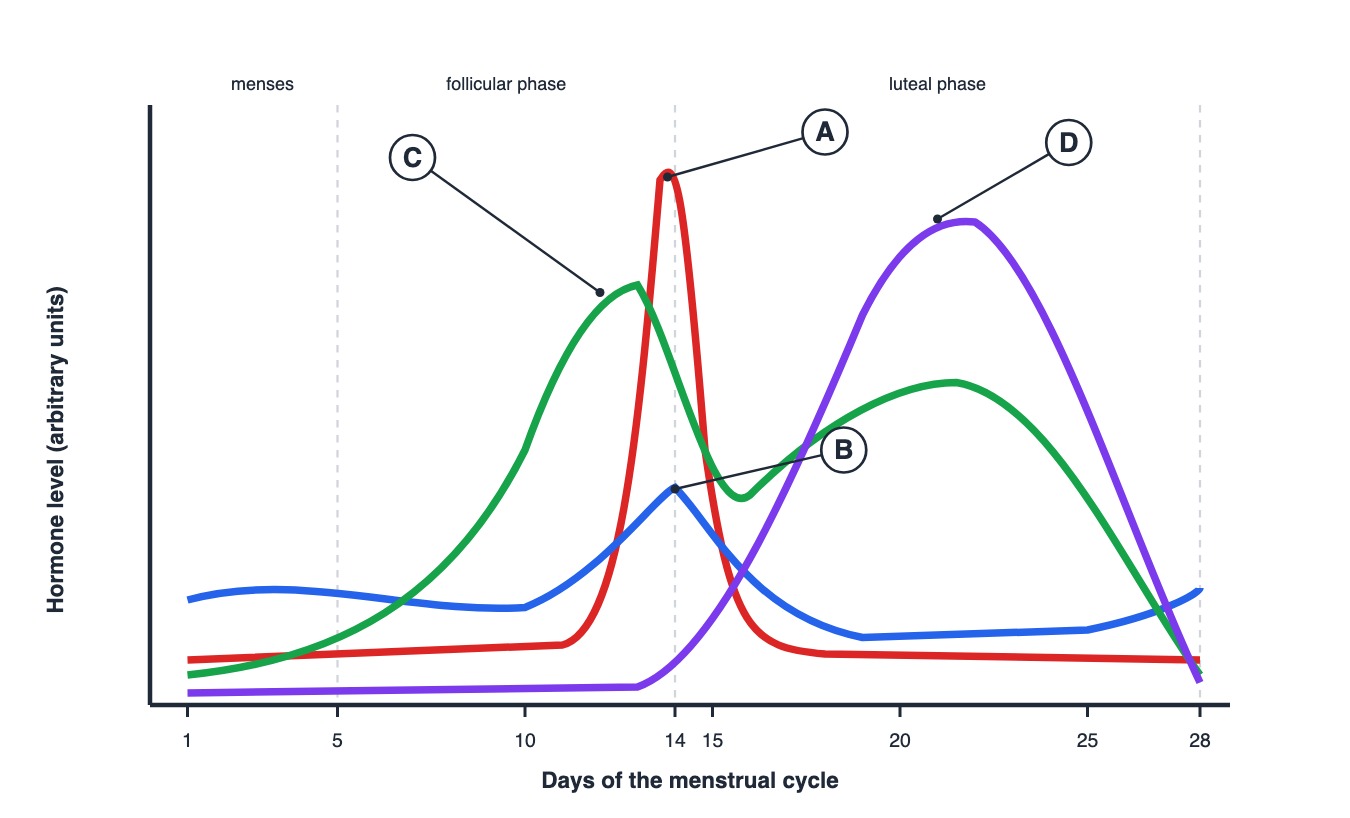
(a) LH
(b) progesterone
(c) oestrogen
(d) FSH
Show answer
Answer: (a) — The LH surge (around day 14) induces rupture of the Graafian follicle, causing ovulation. It follows the rising oestrogen, which exerts positive feedback on the pituitary.
Q14. The hormone marked D, secreted by the corpus luteum and essential for maintaining the endometrium for implantation, is
(a) progesterone
(b) oestrogen
(c) LH
(d) FSH
Show answer
Answer: (a) — Progesterone rises after ovulation, peaks in the luteal phase (about day 21) and falls if fertilisation does not occur, causing menstruation.
Q15. The hormone marked C, secreted by the growing follicles and peaking just before ovulation, is
(a) progesterone
(b) inhibin
(c) oestrogen
(d) relaxin
Show answer
Answer: (c) — Oestrogen from the growing follicle peaks around day 12-13; the high level triggers the LH surge (positive feedback). It has a second smaller peak in the luteal phase, from the corpus luteum.
NEET Previous Year Questions (PYQs)
Real NEET previous-year questions on this chapter, with explanations in our own words.
Q16. The corpus luteum secretes large amounts of which hormone essential for maintaining the endometrium? (NEET PYQ)
(a) Estrogen
(b) FSH
(c) Oxytocin
(d) Progesterone
Show answer
Answer: (d) — The corpus luteum secretes progesterone, which maintains the endometrium needed for implantation.
Q17. Which of the following is NOT a hormone produced exclusively during pregnancy? (NEET PYQ)
(a) Relaxin
(b) hPL
(c) hCG
(d) Progesterone
Show answer
Answer: (d) — Progesterone is present outside pregnancy too (e.g. luteal phase); hCG, hPL and relaxin are pregnancy-exclusive.
Q18. The average duration of human gestation (pregnancy) is: (NEET PYQ)
(a) 9 months
(b) 6 months
(c) 3 months
(d) 12 months
Show answer
Answer: (a) — Human gestation lasts about 9 months.
Q19. The structure that provides the vascular connection between foetus and uterus is the: (NEET PYQ)
(a) Chorionic villi alone
(b) Umbilical cord
(c) Zona pellucida
(d) Amniotic sac
Show answer
Answer: (b) — The umbilical cord, containing the fetal blood vessels, connects the foetus to the placenta.
Q20. Colostrum, secreted during the initial days of lactation, is especially rich in: (NEET PYQ)
(a) Minerals only
(b) Antibodies
(c) Fats only
(d) Vitamins only
Show answer
Answer: (b) — Colostrum contains antibodies essential for building the newborn's early immunity.
Q21. Ovulation occurs during which phase of the menstrual cycle? (NEET PYQ)
(a) Menstrual phase
(b) Luteal phase
(c) Follicular phase
(d) Ovulatory phase (around day 14)
Show answer
Answer: (d) — Ovulation is triggered by the LH surge at the ovulatory phase, roughly day 14 of a 28-day cycle.
Active Recall Prompt
Write everything you can recall about Human Reproduction (Part B), naming each part first: the menstrual cycle (menarche, the four phases in order, LH surge, corpus luteum, menopause); fertilisation (zona pellucida block, completion of meiosis II, sex determination); cleavage and implantation (morula, blastocyst, trophoblast, inner cell mass); pregnancy (placenta, pregnancy-exclusive hormones, germ layers, trimester milestones); and parturition and lactation (foetal ejection reflex, oxytocin positive feedback, colostrum). Begin each fact with its topic and end it with a full stop.