Indian Politics since 1989 for UPSC GS1: End of the Congress System, Mandal and OBC Reservation, Reforms, Ayodhya and the Era of Coalitions
Five Developments Around 1989
🎯 Exam priority: Foundational (Mains GS1). The last NCERT chapter brings the story to the present. NCERT identifies five developments around 1989-1991 that reshaped Indian politics; they are useful context for GS1 society (caste, communalism), GS2 (coalitions, federalism) and GS3 (reforms).
Five developments around 1989
Development
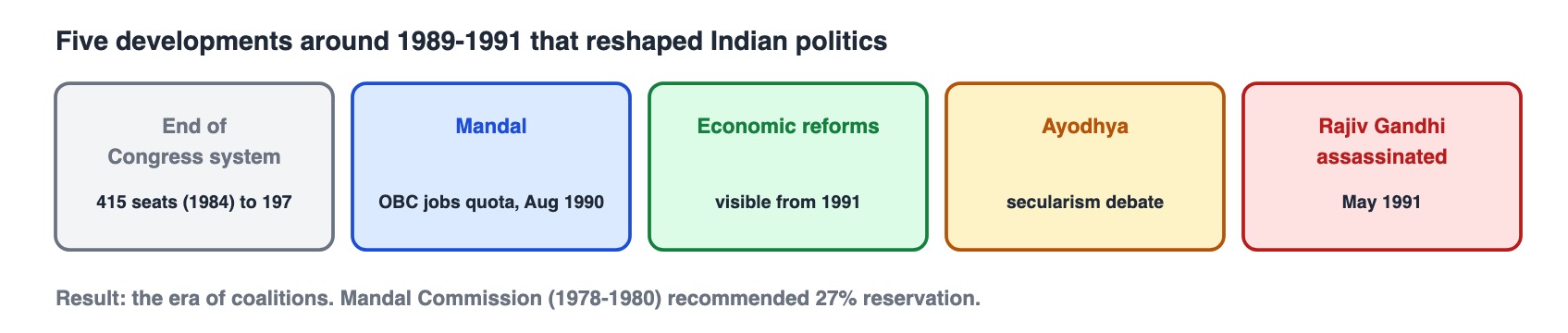
Five developments around 1989-1991 that ended the Congress system. | What happened |
1. End of the Congress system | The Congress fell from 415 Lok Sabha seats (1984) to 197 (1989); it returned in 1991 but lost its central place in the party system |
2. The Mandal issue | The National Front government's 1990 decision to implement the Mandal Commission's OBC reservation in central jobs |
3. Economic reforms | The structural adjustment programme or new economic reforms, begun under Rajiv Gandhi and visible from 1991 |
4. Ayodhya | The Ram Janmabhoomi dispute began to shape politics and the debate on secularism, until the Supreme Court's Constitution Bench decision of 9 November 2019 and the construction of the temple |
5. Rajiv Gandhi's assassination | May 1991, by a Sri Lankan Tamil linked to the LTTE, during the campaign in Tamil Nadu; P.V. Narasimha Rao became Prime Minister |
Mandal, the BJP and New Parties
Mandal and the politics of backward classes
The Second Backward Classes Commission, appointed in 1978 and chaired by B.P. Mandal, reported in 1980: "backward classes" should mean backward castes, which were poorly represented in education and public services; it recommended 27% reservation in educational institutions and government jobs, along with land reform and other measures.
In August 1990 the National Front government implemented OBC reservation in central government jobs, sparking anti-Mandal protests. In the Indira Sawhney case (November 1992) the Supreme Court upheld the decision; OBC reservation now has the support of all major parties.
New parties: the Janata Dal with OBC support; the Bahujan Samaj Party under Kanshi Ram, which broke through in Uttar Pradesh in 1989 and 1991 as a party of Dalit voters.
Communalism, secularism and the BJP
Supporters of the former Jana Sangh formed the BJP in 1980; after 1986 it stressed nationalism and Hindutva, popularised by V.D. Savarkar as the basis of Indian nationhood. The Ram Janmabhoomi movement transformed the national debate on secularism and democracy.
The Era of Coalitions and After
The era of coalitions (1989-2014)
No single party won a Lok Sabha majority from 1989 until 2014. Governments were coalitions or minority governments needing regional parties: the National Front (1989), the United Front (1996-97), the BJP-led coalition (1998), the NDA (1999, under Atal Bihari Vajpayee, the first to complete a full term), and the UPA (2004 and 2009).
In 2014 and 2019 the BJP won a clear majority on its own.
What changed
Before 1989 | After 1989 |
One dominant party | Multi-party competition and coalitions |
National parties dominant | Regional parties crucial to government formation |
State-led economy | Market-oriented reforms with broad agreement across parties |
Elite-led politics | Rise of OBC and Dalit parties and leaders |
Linking to the playlist
Read this alongside the story of consolidation (articles 01-04): the Congress system that integrated India gave way to a federal, competitive, socially broader democracy, which is itself a sign of the consolidation that began in 1947.
Further Reading
PIB press releases, ministry websites and annual reports, the Gazette of India, MEA and UN documents and the official sources named in each note — the primary sources behind every fact above.
Test Yourself: Practice Questions & PYQs
12 practice questions on politics since 1989.
Practice Questions
Q1. In the 1989 Lok Sabha election, the Congress's seats fell from 415 (in 1984) to
(a) 282
(b) 244
(c) 140
(d) 197
Show answer
Answer: (d) — NCERT says 1989 marked the end of the Congress system.
Q2. The Mandal Commission was officially called the
(a) First Backward Classes Commission
(b) Second Backward Classes Commission
(c) Kalelkar Commission
(d) National Commission for Backward Classes
Show answer
Answer: (b) — It was appointed in 1978.
Q3. The Mandal Commission recommended reservation for OBCs of
(a) 22.5%
(b) 27%
(c) 15%
(d) 50%
Show answer
Answer: (b) — In educational institutions and government jobs.
Q4. OBC reservation in central government jobs was implemented in August 1990 by the
(a) United Front government
(b) NDA government
(c) National Front government
(d) Congress government
Show answer
Answer: (c) — It sparked anti-Mandal protests.
Q5. The Supreme Court upheld OBC reservation in November 1992 in the
(a) Indira Sawhney case
(b) Minerva Mills case
(c) Kesavananda Bharati case
(d) Shah Bano case
Show answer
Answer: (a) — OBC reservation now has all-party support.
Q6. According to NCERT, the new economic reforms were started by
(a) Indira Gandhi in 1971
(b) Morarji Desai in 1977
(c) Rajiv Gandhi, becoming very visible in 1991
(d) Vajpayee in 1999
Show answer
Answer: (c) — Also called the structural adjustment programme.
Q7. Rajiv Gandhi was assassinated in
(a) October 1984
(b) May 1991
(c) June 1996
(d) December 1989
Show answer
Answer: (b) — By a Sri Lankan Tamil linked to the LTTE.
Q8. The Supreme Court Constitution Bench decision on Ayodhya was announced on
(a) 15 August 2020
(b) 26 January 2019
(c) 9 November 2019
(d) 6 December 1992
Show answer
Answer: (c) — It was followed by construction of the Ram temple.
Q9. Consider the following statements:
1. No party won a Lok Sabha majority on its own from 1989 to 2014.
2. The BJP won a clear majority on its own in 2014 and 2019.
3. The UPA governed from 1998 to 2004.
Which of the statements given above are correct?
(a) 1 and 2 only
(b) 2 and 3 only
(c) 1 and 3 only
(d) 1, 2 and 3
Show answer
Answer: (a) — 1 and 2 are correct. The NDA governed in 1998-2004; the UPA in 2004-2014.
Q10. The BJP was formed in
(a) 1980
(b) 1977
(c) 1989
(d) 1951
Show answer
Answer: (a) — By supporters of the former Jana Sangh.
Q11. The Bahujan Samaj Party emerged under the leadership of
(a) B.R. Ambedkar
(b) Jagjivan Ram
(c) Kanshi Ram
(d) Mayawati alone
Show answer
Answer: (c) — It broke through in Uttar Pradesh in 1989 and 1991.
Q12. Which government, led by Atal Bihari Vajpayee, completed a full term?
(a) The NDA government formed in 1999
(b) The 1998 government
(c) The 1996 government
(d) The National Front
Show answer
Answer: (a) — The 1998 government had fallen in 1999.
Mains Practice Questions
Use these to frame full-length answers. You don't have to answer one exactly — they show the angles UPSC tests, so let them guide which points you cover.
Why is 1989 seen as a turning point in Indian politics?
How did the Mandal issue change Indian politics?
What are the implications of the era of coalitions for Indian democracy?
UPSC Mains — Previous Years’ Questions on this topic (last 10 years)
These are the actual GS Mains questions UPSC has asked on this theme — real proof of how, and when, it is tested. Try to write a full answer to each.
No GS1 question of 2019 or 2021-2026 asked directly about post-1989 politics; the developments here support GS1 society (caste, communalism) and GS2 (coalitions, federalism) answers.