Regional Aspirations for UPSC GS1: Kashmir and Article 370, the Dravidian Movement, Punjab, Mizoram, Nagaland, the Assam Accord, Goa and Sikkim
India's Approach, Kashmir and the Dravidian Movement
🎯 Exam priority: Important (Mains GS1). "Reorganisation within the country" did not end in 1956 (article 02). From the 1960s to the 1980s regional movements in Tamil Nadu, Punjab, Kashmir, Assam and the North-East tested India's democratic approach to diversity. Questions on regionalism and national integration draw on this chapter.
India's approach
Unlike states that saw diversity as a threat, India adopted a democratic approach to diversity: regional parties and demands are allowed, and regional problems receive attention in policy-making, while separatism is resisted.
Jammu and Kashmir
Kashmiriyat: the popular movement led by Sheikh Abdullah's National Conference, a secular organisation close to the Congress, wanted to end the Maharaja's rule but opposed joining Pakistan. J&K held a special status under Article 370.
Insurgency: Centre-State tensions and a 1987 election widely believed to have been rigged fed a crisis; by 1989 a militant movement for a separate Kashmiri nation, backed morally, materially and militarily by Pakistan, gripped the state, and President's Rule followed for years.
2019: on 5 August 2019 Article 370 was abolished and, by the J&K Reorganisation Act, the state became two Union Territories, Jammu & Kashmir and Ladakh.
The Dravidian movement
Its slogan, "The north thrives even as the south decays", expressed resentment of northern dominance. Led first by E.V. Ramasami (Periyar), its legacy passed to the DMK, which entered politics with a three-pronged agitation in 1953-54, opposed Hindi as the sole official language (the anti-Hindi agitation of 1965), and won power in 1967. Dravidian parties have dominated Tamil Nadu since, without becoming separatist.
Punjab and the North-East
Punjab
Year | Event |
1966 | Punjabi-speaking Punjab created; the Akali Dal, formed in 1920 as the Sikhs' political wing, had led the movement |
1973 | Anandpur Sahib Resolution: regional autonomy and a redefined Centre-State relationship |
1980s | Militancy; militants turned the Golden Temple into an armed fortress |
June 1984 | Operation Blue Star: army action in the Golden Temple flushed out militants but hurt Sikh sentiments |
31 October 1984 | Indira Gandhi assassinated by her Sikh bodyguards; anti-Sikh violence in Delhi and the north |
July 1985 | Rajiv Gandhi-Longowal (Punjab) Accord with the Akali Dal president; normalcy returned slowly over the next decade |
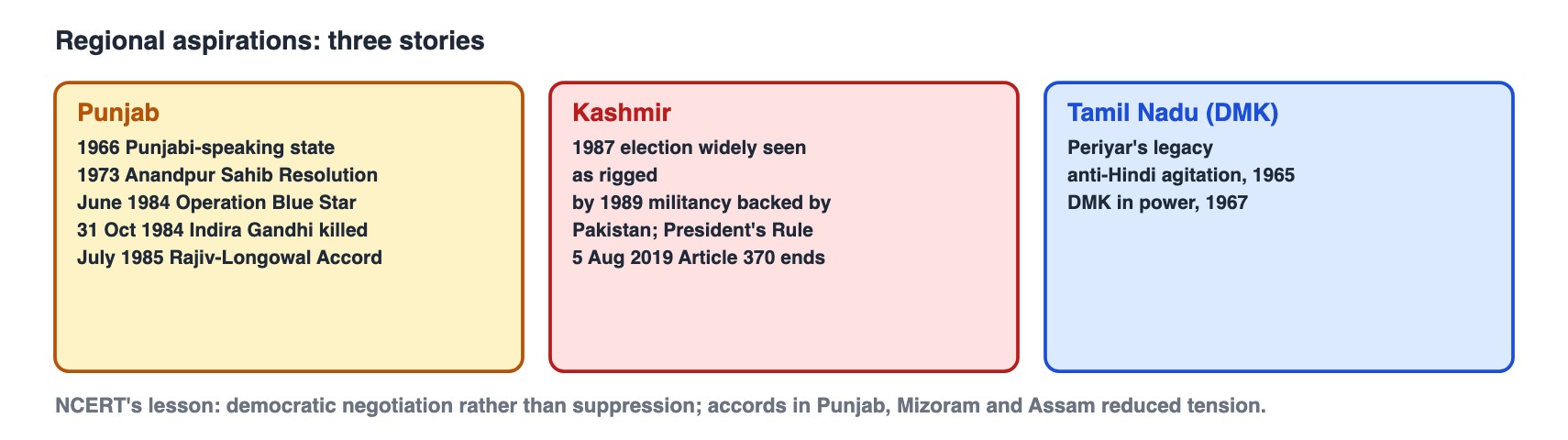
Punjab, Kashmir and Tamil Nadu: three stories of regional aspiration.
The North-East
The region has 4% of India's population but about twice that share of its area, joined to the rest of the country by a corridor of about 22 km. Three kinds of demand arose:
Autonomy: new states carved out of Assam by 1972; communities such as the Bodos, Karbis and Dimasas sought separate states.
Secession: in Mizoram the Mizo National Front fought for independence until the 1986 accord between Rajiv Gandhi and Laldenga gave full statehood with special powers; Laldenga became Chief Minister. In Nagaland, a section led by A.Z. Phizo declared independence in 1951; the conflict has had no comparable settlement.
Against "outsiders": the Assam Movement (1979-1985), led by the All Assam Students' Union, demanded detection and deportation of foreigners who entered after 1951; it ended with the 1985 Assam Accord with the Rajiv Gandhi government.
Goa, Sikkim and the Lessons
Goa and Sikkim
Goa: Portugal refused to leave Goa, Diu and Daman after 1947; the army liberated them in December 1961 in barely two days. A special opinion poll in January 1967 let Goans decide to stay separate from Maharashtra; Goa remained a Union Territory and became a state in 1987.
Sikkim: a protectorate whose monarch (the Chogyal) failed to meet the democratic aspirations of its largely Nepali population; its assembly asked for full integration in April 1975, confirmed by a referendum, and Sikkim became the 22nd state.
Lessons (NCERT)
Regional aspirations are a normal part of democratic politics, as in Scotland or among Spain's Basques; nation-building is ongoing.
The best response is democratic negotiation rather than suppression: the accords in Punjab, Mizoram and Assam reduced tension.
Power sharing matters: regional groups need real shares of power, not only formal autonomy.
Regional imbalance in economic development feeds a sense of discrimination, so backward regions need priority.
India has thus accepted regionalism as part of democratic politics, while not allowing it to become separatism.
Further Reading
PIB press releases, ministry websites and annual reports, the Gazette of India, MEA and UN documents and the official sources named in each note — the primary sources behind every fact above.
Test Yourself: Practice Questions & PYQs
12 practice questions on regional aspirations.
Practice Questions
Q1. The Kashmiri regional identity associated with the National Conference is called
(a) Sufiyat
(b) Jamhooriyat
(c) Kashmiriyat
(d) Dogra raj
Show answer
Answer: (c) — Sheikh Abdullah's movement opposed both the Maharaja and joining Pakistan.
Q2. Article 370 was abolished and J&K reorganised into two Union Territories on
(a) 26 January 2020
(b) 5 August 2019
(c) 31 October 2019
(d) 15 August 2018
Show answer
Answer: (b) — The UTs are Jammu & Kashmir and Ladakh.
Q3. The DMK first came to power in Tamil Nadu in
(a) 1957
(b) 1952
(c) 1967
(d) 1977
Show answer
Answer: (c) — After the anti-Hindi agitation of 1965.
Q4. The Anandpur Sahib Resolution (1973) mainly demanded
(a) regional autonomy and redefined Centre-State relations
(b) Hindi as official language
(c) abolition of the Akali Dal
(d) a separate country
Show answer
Answer: (a) — It also spoke of the aspirations of the Sikh community.
Q5. Operation Blue Star took place in
(a) June 1984
(b) October 1984
(c) July 1985
(d) June 1975
Show answer
Answer: (a) — Army action in the Golden Temple.
Q6. The Punjab Accord of July 1985 was signed by Rajiv Gandhi and
(a) Prakash Singh Badal
(b) Tara Singh
(c) Harchand Singh Longowal
(d) Jarnail Singh Bhindranwale
Show answer
Answer: (c) — Longowal was then Akali Dal president.
Q7. The 1986 accord that ended insurgency in Mizoram was signed with
(a) A.Z. Phizo
(b) Laldenga
(c) Lalthanhawla
(d) Zoramthanga
Show answer
Answer: (b) — Mizoram got full statehood with special powers.
Q8. The Assam Movement (1979-1985) was led by
(a) the Bodo Liberation Tigers
(b) the Mizo National Front
(c) the Naga National Council
(d) the All Assam Students' Union
Show answer
Answer: (d) — It ended with the 1985 Assam Accord.
Q9. Consider the following statements:
1. The North-East has about 4% of India's population.
2. A corridor of about 22 km links it to the rest of India.
3. Nagaland's conflict was settled by the 1986 accord.
Which of the statements given above are correct?
(a) 1 and 2 only
(b) 2 and 3 only
(c) 1 and 3 only
(d) 1, 2 and 3
Show answer
Answer: (a) — 1 and 2 are correct. The 1986 accord was for Mizoram.
Q10. Goa, Diu and Daman were liberated from Portuguese rule in
(a) 1975
(b) January 1967
(c) December 1961
(d) August 1947
Show answer
Answer: (c) — An opinion poll in 1967 kept Goa separate from Maharashtra.
Q11. Sikkim became the 22nd state of India in
(a) 1947
(b) 1975
(c) 1962
(d) 1987
Show answer
Answer: (b) — After its assembly sought full integration in April 1975.
Q12. NCERT's main lesson for responding to regional aspirations is
(a) abolishing regional parties
(b) democratic negotiation rather than suppression
(c) military action first
(d) centralising all powers
Show answer
Answer: (b) — Power sharing is the third lesson.
Mains Practice Questions
Use these to frame full-length answers. You don't have to answer one exactly — they show the angles UPSC tests, so let them guide which points you cover.
Regional aspirations are part of democratic politics. Discuss with examples.
Compare the outcomes in Mizoram and Nagaland.
What lessons do the accords of the 1980s offer for national integration?
UPSC Mains — Previous Years’ Questions on this topic (last 10 years)
These are the actual GS Mains questions UPSC has asked on this theme — real proof of how, and when, it is tested. Try to write a full answer to each.
No GS1 question of 2019 or 2021-2026 asked directly about these regional movements; regionalism and national integration recur in GS1 society and GS2 federalism questions.