Mental Healthcare Act 2017 for NEET PG: Capacity, Advance Directive, Nominated Representative, Admissions, Rights, NMHP, DMHP and Tele-MANAS
Start Here
🎯 Exam priority: High. Expect: what counts as mental illness under the Act, capacity, advance directive and nominated representative, the right to free essential drugs, admission types with their limits (30 days, 72 hours, 90/120/180 days), prohibited procedures, section 115, police within 24 hours, NMHP 1982 and DMHP's Bellary model, and Tele-MANAS 14416.
This closes the Psychiatry playlist. Emergency-specific rules were in article 14; ECT rules in article 15.
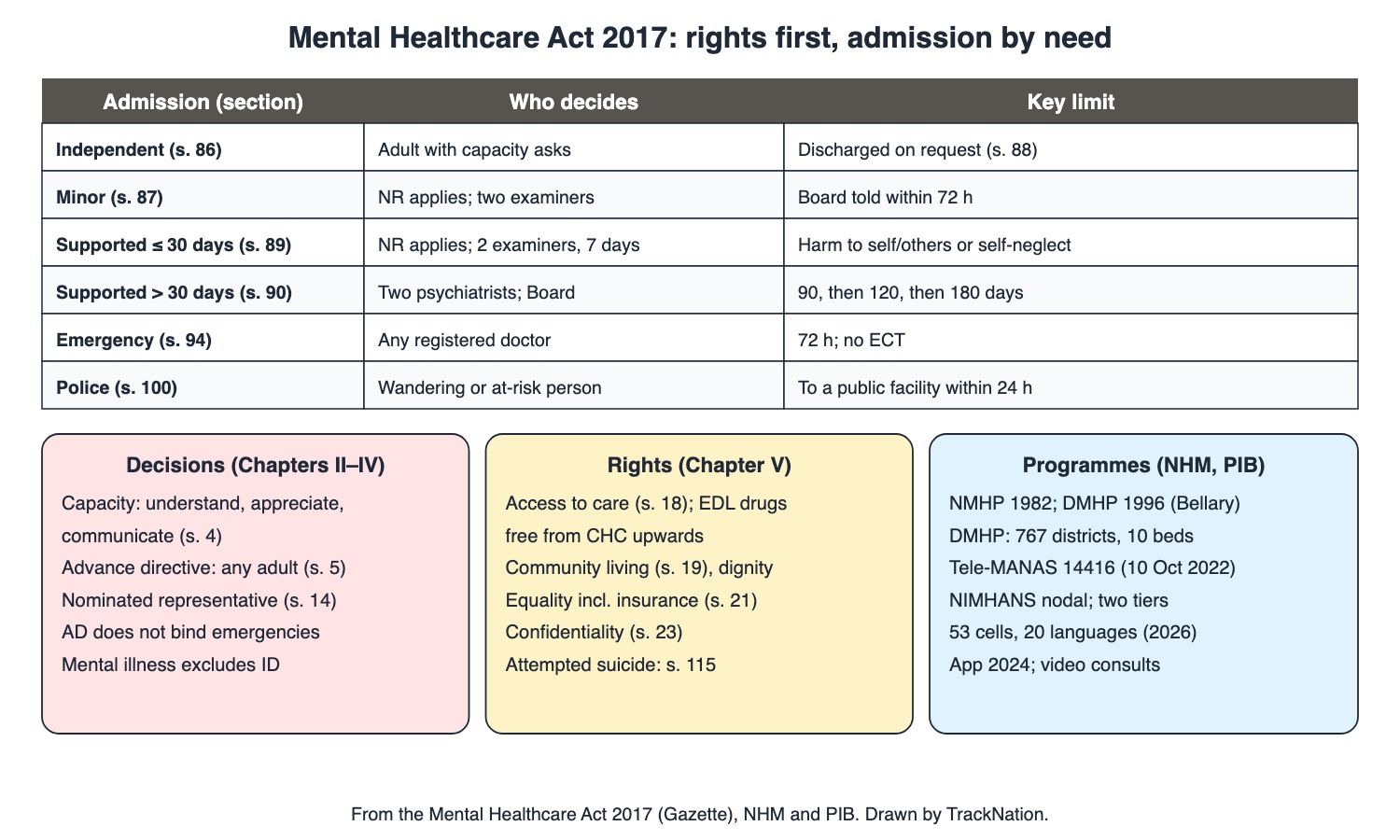
Mental Healthcare Act 2017: admission types and limits, decision-making, rights, and the national programmes. Drawn by TrackNation.
Mental Illness, Capacity and Decisions
Mental illness = a substantial disorder of thinking, mood, perception, orientation or memory that grossly impairs judgment, behaviour, reality testing or ability to meet ordinary demands — includes alcohol and drug conditions but excludes intellectual disability ("mental retardation"). Determined by nationally or internationally accepted standards, including the latest WHO ICD. A minor is under 18.
Capacity (s. 4): everyone, including a person with mental illness, is deemed to have capacity if able to understand relevant information, appreciate foreseeable consequences, or communicate the decision (speech, gesture, any means).
Advance directive (s. 5): any adult may write how they wish (and do not wish) to be treated and whom to appoint as nominated representative, regardless of past illness; it does not apply to emergency treatment. Nominated representative (s. 14): appointed in writing on plain paper with signature or thumb impression; must not be a minor.
Rights of Persons with Mental Illness (Chapter V)
Right to access mental healthcare (s. 18) from government services — affordable, good quality, without discrimination; includes half-way homes, sheltered accommodation, community rehabilitation, child and old-age services; mental health integrated at all levels of care; long-term institutional care only as a last resort. Essential Drug List medicines free to all persons with mental illness at government facilities from CHCs upward.
Community living (s. 19) — not kept in hospital merely for lack of family or home; dignity (s. 20) — protection from cruel, inhuman or degrading treatment; equality (s. 21) — same emergency care, ambulances and living conditions as physical illness; insurers must cover mental illness on the same basis as physical illness; confidentiality (s. 23).
Bodies: Central Mental Health Authority (s. 33), State Authorities, and district Mental Health Review Boards (s. 73) that review admissions and restraint.
Admission, Emergencies and Prohibitions
Independent admission (s. 86): an adult with capacity asks to be admitted; discharged on request (s. 88). Minor (s. 87): nominated representative applies; two examiners (two psychiatrists, or psychiatrist + mental health professional or doctor); Board informed within 72 hours.
Supported admission up to 30 days (s. 89): nominated representative applies; a psychiatrist and a mental health professional or doctor examine within 7 days; recent self-harm threat, violence, or inability to care for self; least restrictive option; unable to decide independently. Beyond 30 days (s. 90): two psychiatrists; Board decides within 21 days; up to 90 days, then 120, then 180 days each time.
Emergency treatment (s. 94): any registered doctor, 72 hours, no ECT. Prohibited (s. 95): ECT without anaesthesia and muscle relaxants, ECT for minors (unless guardian consent and Board permission), sterilisation as treatment, chaining. No seclusion; restraint only as authorised (s. 97).
Police (s. 100): take a wandering or at-risk person with suspected mental illness into protection and to the nearest public health establishment within 24 hours; a magistrate (s. 102) may order assessment at a public mental health establishment. Section 115: attempted suicide presumed due to severe stress; no punishment.
National Mental Health Programmes
About 6–7% of the population has a mental disorder, and over 90% remain untreated (NHM). NMHP launched in 1982 to make minimum mental healthcare available to all, apply mental health knowledge in general care, and promote community participation.
DMHP 1996, on the Bellary model: early detection and treatment, short training of general doctors with a limited drug list, health-worker training, awareness, record keeping. Now sanctioned in 767 districts with OPD, counselling, outreach and a 10-bed district inpatient unit; mental health added to Ayushman Arogya Mandir primary-care packages (PIB 2026).
Tele-MANAS (National Tele Mental Health Programme): launched 10 October 2022 (World Mental Health Day) as the digital arm of DMHP; toll-free 14416, 24×7. Two tiers — state cells with counsellors and specialists, then DMHP or medical-college specialists in person or by e-Sanjeevani. NIMHANS nodal; IIIT-Bangalore technology. By March 2026: 53 cells in 36 States/UTs, 20 languages; app launched 10 October 2024; video consultations added.
Traps the Examiner Sets
Intellectual disability is not "mental illness" under the Act.
Supported admission: 30 days first; then 90 → 120 → 180.
Advance directives do not bind emergency treatment.
Tele-MANAS number is 14416.
Memory Hooks & Shortcuts
Shortcuts to lock in this article's numbers and lists. Each one only re-packages facts proven above.
🧠 Capacity 'U-A-C': Understand, Appreciate, Communicate — capacity
🧠 Supported admission '30 → 90 → 120 → 180' — durations
🧠 Time limits '24-72': police 24 h; minor report and emergency 72 h — hours
🧠 NMHP '82, DMHP '96 — Bellary — programmes
🧠 Tele-MANAS '1-44-16' on World Mental Health Day 2022 — helpline
Rapid-Revision Cards
Mental illness (MHCA)
Excludes intellectual disability.
Diagnosis standard
Latest WHO ICD.
Minor
Under 18.
Capacity
Understand, appreciate, communicate.
Advance directive
Any adult; not in emergencies.
Nominated rep
Written; not a minor.
Free drugs
EDL from CHC upward.
Community living
s. 19.
Insurance
Parity with physical illness.
Confidentiality
s. 23.
Review Boards
By State Authority (s. 73).
Independent admission
Discharge on request.
Minor admission
Board in 72 h.
Supported ≤ 30 d
s. 89.
Supported > 30 d
90 → 120 → 180 days.
Emergency
72 h; no ECT.
Police
Public facility in 24 h.
Attempted suicide
Severe stress (s. 115).
NMHP / DMHP
1982 / 1996 Bellary.
DMHP beds
10 per district.
Tele-MANAS
14416; NIMHANS nodal.
Sources
Facts in this article were checked against these documents.
The Mental Healthcare Act, 2017 (Act 10 of 2017) — Gazette of India, Ministry of Law and Justice, 2017 (link)
National Mental Health Programme (NMHP) — National Health Mission, MoHFW, page updated 2026 (link)
Tele-MANAS initiative launched on World Mental Health Day (PRID 1866498); Steps Taken to Strengthen and Integrate Mental Healthcare Services (PRID 2245967) — Press Information Bureau, Government of India, 2022; 2026 (link)
Test Yourself: Practice Questions
Thirty questions in NEET PG style, many of them case-based.
Practice Questions (NEET PG pattern)
Original questions written in the style of the exam: +4 for a correct answer, −1 for a wrong one. Every answer was checked against the sources listed above. NEET PG papers are not published by NBEMS, so these are not past-paper questions.
Q1. Under the Mental Healthcare Act 2017, which condition is excluded from the definition of mental illness?
(a) schizophrenia
(b) intellectual disability (mental retardation)
(c) severe depression
(d) alcohol use disorder
Show answer
Answer: (b) — Alcohol and drug conditions are included.
Q2. MHCA directs that mental illness be determined according to accepted standards including
(a) family history
(b) only DSM
(c) the latest WHO International Classification of Diseases
(d) court opinion
Show answer
Answer: (c) — Section 3.
Q3. A patient with schizophrenia understands the proposed treatment, appreciates its consequences and states her choice. Under s. 4 she
(a) has capacity to make the decision
(b) lacks capacity because of the diagnosis
(c) needs her NR to decide
(d) needs a court order
Show answer
Answer: (a) — Diagnosis ≠ incapacity.
Q4. Under MHCA, a decision can be communicated by
(a) a lawyer only
(b) speech only
(c) writing only
(d) speech, expression, gesture or any other means
Show answer
Answer: (d) — Capacity criterion.
Q5. Who may make an advance directive under MHCA 2017?
(a) only psychiatrists
(b) only minors with parents
(c) only those never ill
(d) any adult, irrespective of past mental illness
Show answer
Answer: (d) — Section 5.
Q6. A patient's advance directive refuses all injections, but he is violent and a doctor must give emergency treatment. The directive
(a) does not apply to emergency treatment
(b) must be followed
(c) needs a magistrate
(d) invalidates all treatment
Show answer
Answer: (a) — Section 9.
Q7. A nominated representative under MHCA must
(a) be appointed in writing and not be a minor
(b) be a blood relative
(c) be approved by court
(d) be a doctor
Show answer
Answer: (a) — Plain paper; signature or thumb impression.
Q8. Under MHCA section 18, medicines on the Essential Drug List must be free to persons with mental illness at government facilities from
(a) district hospitals only
(b) private hospitals
(c) medical colleges only
(d) Community Health Centres upwards
Show answer
Answer: (d) — At all times.
Q9. A patient has recovered but stays in a mental hospital because his family refuses to take him back. MHCA says he
(a) should not remain merely because he has no family accepting him
(b) should be sent to jail
(c) loses his rights
(d) must stay indefinitely
Show answer
Answer: (a) — Right to community living (s. 19).
Q10. An insurer refuses to cover hospitalisation for bipolar disorder. Under MHCA
(a) insurers may exclude it
(b) insurers must cover mental illness on the same basis as physical illness
(c) only government insurance applies
(d) coverage is optional
Show answer
Answer: (b) — Section 21.
Q11. MHCA guarantees persons with mental illness ambulance services
(a) only for emergencies with court order
(b) not at all
(c) of the same quality as for physical illness
(d) only by police vehicles
Show answer
Answer: (c) — Equality, s. 21.
Q12. Mental Health Review Boards are constituted by the
(a) Medical Council
(b) District Collector alone
(c) State Mental Health Authority
(d) Supreme Court
Show answer
Answer: (c) — Section 73.
Q13. An adult with depression asks to be admitted and later asks to leave. As an independent patient he must be
(a) kept 72 hours
(b) discharged immediately on request (subject to s. 88(3))
(c) kept 30 days
(d) kept until the Board decides
Show answer
Answer: (b) — Independent admission.
Q14. When a minor is admitted to a mental health establishment, the Board must be informed within
(a) 7 days
(b) 72 hours
(c) 24 hours
(d) 30 days
Show answer
Answer: (b) — Section 87(9).
Q15. Admission of a minor needs examination by
(a) a magistrate
(b) the parents only
(c) two psychiatrists, or a psychiatrist plus a mental health professional or doctor
(d) one nurse
Show answer
Answer: (c) — NR applies.
Q16. A man with mania who lacks capacity is threatening his family. His nominated representative applies for admission. The applicable route is
(a) independent admission
(b) supported admission (s. 89), up to 30 days
(c) police custody
(d) emergency treatment for 30 days
Show answer
Answer: (b) — High support needs.
Q17. A criterion for supported admission under s. 89 is that the person has recently shown
(a) poor school marks
(b) insomnia only
(c) mild anxiety
(d) inability to care for himself placing him at risk
Show answer
Answer: (d) — Or harm to self/others.
Q18. Continuing supported admission beyond 30 days requires
(a) a magistrate only
(b) two psychiatrists and Board permission
(c) only the family's consent
(d) one nurse
Show answer
Answer: (b) — Section 90.
Q19. Supported admission beyond 30 days is limited first to
(a) 1 year
(b) unlimited
(c) 90 days, then 120 days, then 180 days each time
(d) 30 days only
Show answer
Answer: (c) — Section 90(8–9).
Q20. Which of these is prohibited under MHCA section 95?
(a) ECT under anaesthesia for adults
(b) lithium
(c) sterilisation as a treatment for mental illness
(d) CBT
Show answer
Answer: (c) — Also chaining, unmodified ECT.
Q21. Police find a confused man wandering on the highway who seems unable to care for himself. Under MHCA they must take him to a public health establishment within
(a) 24 hours
(b) 7 days
(c) 30 days
(d) 72 hours
Show answer
Answer: (a) — Section 100.
Q22. A person with apparent mental illness is brought before a magistrate. Under s. 102 the magistrate may
(a) fine him
(b) order ECT
(c) send him to prison
(d) order him conveyed to a public mental health establishment for assessment
Show answer
Answer: (d) — Assessment and treatment.
Q23. An emergency physician gives sedation to a violent patient with psychosis under MHCA s. 94. This is valid for up to
(a) 30 days
(b) 7 days always
(c) 72 hours or until assessment, whichever is earlier
(d) 1 hour
Show answer
Answer: (c) — No ECT.
Q24. Under MHCA, a person who attempts suicide is
(a) fined
(b) always prosecuted
(c) presumed to have severe stress
(d) denied treatment
Show answer
Answer: (c) — Section 115.
Q25. The National Mental Health Programme was launched in
(a) 1996
(b) 2022
(c) 1982
(d) 2017
Show answer
Answer: (c) — DMHP 1996.
Q26. The District Mental Health Programme was modelled on the
(a) Bhore model
(b) Bellary model
(c) Kerala model
(d) Alma-Ata model
Show answer
Answer: (b) — Launched 1996.
Q27. Under DMHP, each district is provided with an inpatient facility of
(a) 10 beds
(b) 50 beds
(c) 2 beds
(d) 100 beds
Show answer
Answer: (a) — PIB 2026.
Q28. The national toll-free Tele-MANAS number is
(a) 14416
(b) 104
(c) 112
(d) 1098
Show answer
Answer: (a) — 24×7.
Q29. Tele-MANAS was launched on
(a) 15 August 2017
(b) 10 October 2022 (World Mental Health Day)
(c) 7 April 2023
(d) 1 January 2020
Show answer
Answer: (b) — Digital arm of DMHP.
Q30. The nodal centre for Tele-MANAS is
(a) CIP, Ranchi
(b) AIIMS, New Delhi
(c) NIMHANS, Bengaluru
(d) PGIMER, Chandigarh
Show answer
Answer: (c) — IIIT-B for technology.
Active Recall
From memory: define mental illness and capacity under the Mental Healthcare Act 2017, explain advance directives and nominated representatives, list the main rights, give each admission type with its time limits, state the prohibitions and police duties, and outline NMHP, DMHP and Tele-MANAS.