Personality, Eating and Sleep Disorders for NEET PG: Clusters, Borderline and Antisocial PD, Anorexia, Bulimia, Insomnia and Narcolepsy
Start Here
🎯 Exam priority: Medium–High. Expect: cluster A/B/C members, borderline features (splitting, emptiness, self-harm) and DBT, antisocial criteria (conduct disorder before 15, age 18), anorexia vs bulimia (weight, signs, lanugo, parotids, hypokalaemia), refeeding syndrome, bulimia CBT and fluoxetine, sleep hygiene, and narcolepsy tetrad with hypocretin.
CBME: these topics lie outside the 13 PS topics but are standard NEET PG ground. The Mental Healthcare Act is article 17.
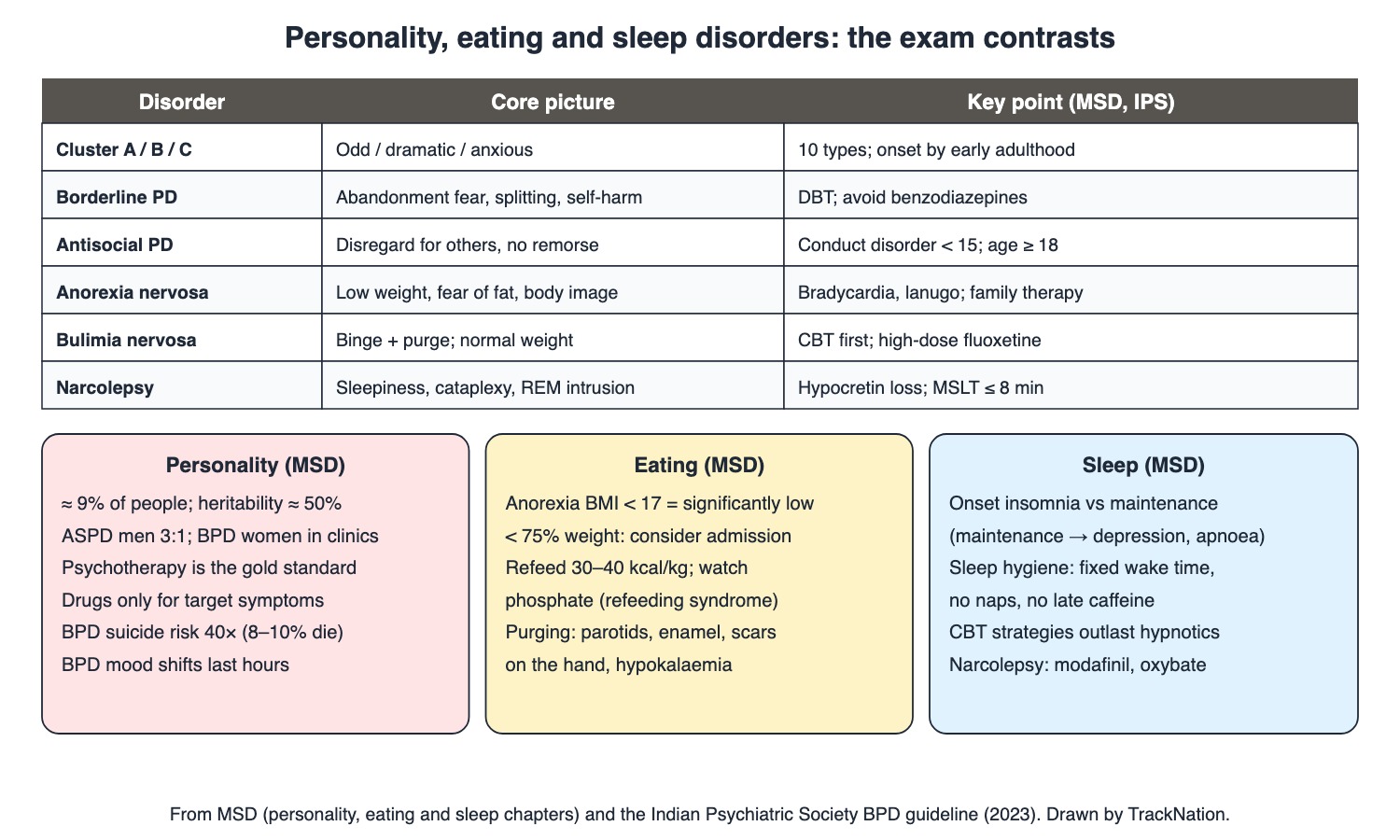
Personality, eating and sleep disorders: clusters, borderline and antisocial PD, anorexia, bulimia, narcolepsy; key points. Drawn by TrackNation.
Personality Disorders (MSD)
Pervasive, enduring, inflexible patterns of thinking, feeling and relating that cause distress or impairment; onset traced to adolescence or early adulthood. About 9% of people; heritability about 50%. Under 18 the pattern must last ≥ 1 year; antisocial PD is never diagnosed before 18. Patients usually present with depression or anxiety, and lack insight.
Cluster A — odd: paranoid (mistrust), schizoid (disinterest in others), schizotypal (eccentric ideas). Cluster B — dramatic: antisocial, borderline, histrionic (attention seeking), narcissistic (grandiosity, no empathy). Cluster C — anxious: avoidant (rejection sensitivity), dependent (submissive), obsessive-compulsive (perfectionism, rigidity).
Antisocial and borderline traits lessen with age; obsessive-compulsive and schizotypal persist. Psychotherapy is the gold standard; drugs only for target symptoms or comorbidity.
Borderline and Antisocial PD
Borderline: frantic efforts to avoid abandonment; idealisation then devaluation (splitting); unstable self-image; chronic emptiness; intense anger; impulsivity; repeated self-harm and suicidal gestures; mood shifts lasting hours; stress-linked paranoia or dissociation. Needs ≥ 5 of 9 criteria. Childhood abuse or loss is common. Suicide risk 40× (8–10% die). Commonly misdiagnosed as bipolar disorder — but bipolar moods are sustained, borderline moods react to interpersonal stress.
Borderline treatment: psychotherapy — dialectical behaviour therapy, STEPPS, mentalisation-based, transference-focused, schema therapy. Drugs: lamotrigine or topiramate, atypical antipsychotics for transient psychosis or anger; avoid benzodiazepines and polypharmacy (IPS).
Antisocial: disregard for others' rights shown by ≥ 3 — law-breaking, deceit, impulsivity, aggression, recklessness, irresponsibility, lack of remorse; conduct disorder before 15; age ≥ 18. Men 3:1; most have substance use. Borderline patients manipulate to be nurtured, antisocial ones for gain. No treatment proven for long-term change; contingency management may help a little.
Anorexia and Bulimia Nervosa (MSD)
Anorexia nervosa: restriction → significantly low weight (adult BMI < 17 significantly low), intense fear of weight gain, distorted body image. Restricting or binge-purge type. Mostly girls and young women (1.5% of women). Appetite persists (misnomer); food preoccupation, excessive exercise; amenorrhoea.
Signs: bradycardia, orthostatic hypotension, hypothermia, lanugo, oedema; low sex hormones, low T3/T4, high cortisol; hypokalaemia, alkalosis, anaemia, osteoporosis, long QT and sudden death. Infections are not increased. Depression or schizophrenia can cause weight loss but without body-image distortion.
Treatment: consider admission below ~75% of recommended weight or with unstable vitals; start feeding at 30–40 kcal/kg/day and watch for refeeding syndrome (hypophosphataemia); then psychotherapy for a year after weight restoration; Maudsley family-based treatment for adolescents; olanzapine may help weight gain.
Bulimia nervosa: binges with loss of control plus compensatory purging, fasting or exercise, ≥ once a week for 3 months; normal or high weight; more guilt and insight than anorexia. Signs: parotid swelling, dental erosion, scars on the back of the hand, hypokalaemia; ipecac → cardiomyopathy. Treatment: CBT is the treatment of choice; fluoxetine at a dose higher than for depression.
Insomnia and Narcolepsy (MSD)
Sleep-onset insomnia → delayed sleep phase, psychophysiological insomnia, restless legs; sleep-maintenance insomnia / early waking → depression, sleep apnoea, ageing. Psychophysiological insomnia: anxious about not sleeping; sleeps better away from home.
Sleep hygiene: fixed wake-up time, no naps, no late caffeine or stimulation; cognitive-behavioural strategies (time-in-bed restriction, relaxation, stimulus control, cognitive therapy) work longer than hypnotics; hypnotics short term only.
Narcolepsy: excessive daytime sleepiness, cataplexy (emotion-triggered weakness, consciousness kept, reflexes lost), sleep paralysis, hypnagogic hallucinations — REM intrusion. Type 1 = hypocretin (orexin) deficiency with cataplexy (lateral hypothalamus; HLA-linked autoimmunity suspected). Diagnosis: polysomnography + MSLT — mean sleep latency ≤ 8 min, ≥ 2 sleep-onset REM periods. Treatment: scheduled naps < 30 min; type 1 oxybate or pitolisant (+ modafinil); type 2 modafinil first (lowers OCP efficacy). Kleine-Levin: episodic hypersomnia with hyperphagia.
Traps the Examiner Sets
Antisocial PD needs age ≥ 18 and conduct disorder before 15.
Anorexia = low weight; bulimia = normal weight.
Refeeding syndrome = low phosphate.
Cataplexy keeps consciousness.
Memory Hooks & Shortcuts
Shortcuts to lock in this article's numbers and lists. Each one only re-packages facts proven above.
🧠 Clusters 'Weird, Wild, Worried' — A, B, C — clusters
🧠 Borderline 'I hate you — don't leave me' — borderline
🧠 Antisocial '15 to start, 18 to name' — antisocial
🧠 'Anorexia = thin and denying; bulimia = normal and guilty' — eating
🧠 Narcolepsy tetrad 'Sleepy, Slumped, Stuck, Seeing' — EDS, cataplexy, paralysis, hallucinations — narcolepsy
Rapid-Revision Cards
Cluster A
Odd: paranoid, schizoid, schizotypal.
Cluster B
Dramatic: antisocial, borderline, histrionic, narcissistic.
Cluster C
Anxious: avoidant, dependent, OCPD.
PD under 18
≥ 1 year; antisocial never.
PD treatment
Psychotherapy.
Borderline core
Abandonment, splitting, emptiness.
Borderline mood
Shifts in hours.
Borderline suicide
40× risk.
Borderline therapy
DBT.
Borderline drugs
Avoid benzodiazepines.
Antisocial
Conduct disorder < 15; age ≥ 18.
Antisocial comorbidity
Substance use.
Anorexia
Low weight + body-image distortion.
Anorexia BMI
< 17 significantly low.
Anorexia signs
Bradycardia, lanugo, hypothermia.
Refeeding
Low phosphate.
Adolescent anorexia
Maudsley family therapy.
Bulimia
Normal weight; parotids, hypokalaemia.
Bulimia Rx
CBT; high-dose fluoxetine.
Sleep hygiene
Fixed wake time; no naps.
Narcolepsy
Hypocretin; MSLT ≤ 8 min.
Sources
Facts in this article were checked against these documents.
MSD Manual Professional: Overview of Personality Disorders; Borderline and Antisocial Personality Disorder; Anorexia Nervosa; Bulimia Nervosa; Insomnia and EDS; Narcolepsy — Merck & Co. (MSD Manuals), 2024–26 (link)
Clinical Practice Guidelines for Assessment and Management of Patients with Borderline Personality Disorder — Indian Journal of Psychiatry (Indian Psychiatric Society; CC BY-NC-SA), 2023 (link)
Test Yourself: Practice Questions
Thirty questions in NEET PG style, most of them clinical vignettes.
Practice Questions (NEET PG pattern)
Original questions written in the style of the exam: +4 for a correct answer, −1 for a wrong one. Every answer was checked against the sources listed above. NEET PG papers are not published by NBEMS, so these are not past-paper questions.
Q1. A man is suspicious of everyone, believes colleagues are against him, without psychosis, since early adulthood. His cluster is
(a) none
(b) Cluster A
(c) Cluster B
(d) Cluster C
Show answer
Answer: (b) — Paranoid PD — odd/eccentric.
Q2. A man has no interest in relationships, prefers solitary activities and shows no oddness of belief. The likely personality disorder is
(a) schizotypal
(b) avoidant
(c) borderline
(d) schizoid
Show answer
Answer: (d) — Disinterest, not fear.
Q3. A woman longs for friendships but avoids people because she fears rejection. This is
(a) avoidant personality disorder
(b) paranoid personality disorder
(c) dependent personality disorder
(d) schizoid personality disorder
Show answer
Answer: (a) — Cluster C.
Q4. Perfectionism, rigidity and obstinacy describe which personality disorder?
(a) dependent
(b) histrionic
(c) obsessive-compulsive
(d) narcissistic
Show answer
Answer: (c) — Cluster C; tends to persist.
Q5. A personality disorder other than antisocial can be diagnosed under 18 only if the pattern has lasted at least
(a) it can never be diagnosed under 18
(b) 1 year
(c) 5 years
(d) 1 month
Show answer
Answer: (b) — Antisocial: never under 18.
Q6. The gold-standard treatment for personality disorders is
(a) antipsychotics
(b) benzodiazepines
(c) psychotherapy
(d) ECT
Show answer
Answer: (c) — Drugs for target symptoms.
Q7. A woman idealises a new friend and then, when the friend is late, calls her worthless; she cuts her wrists after rejections and feels empty. The diagnosis is
(a) bipolar disorder
(b) antisocial PD
(c) histrionic PD
(d) borderline personality disorder
Show answer
Answer: (d) — Splitting, emptiness, self-harm.
Q8. The defence of seeing people as all good or all bad, typical of borderline PD, is
(a) projection
(b) repression
(c) splitting
(d) sublimation
Show answer
Answer: (c) — Idealisation → devaluation.
Q9. Borderline PD is most often misdiagnosed as bipolar disorder. A feature favouring borderline PD is
(a) sustained mood change for weeks
(b) increased energy and reduced sleep need
(c) mood shifts lasting hours, triggered by interpersonal stress
(d) family history of mania
Show answer
Answer: (c) — Reactive, brief.
Q10. Compared with the general population, suicide risk in borderline PD is about
(a) 100 times
(b) 40 times
(c) same
(d) 2 times
Show answer
Answer: (b) — 8–10% die by suicide.
Q11. A psychotherapy designed around emotion regulation with on-call coaching for borderline PD is
(a) aversion therapy
(b) flooding
(c) psychoanalysis
(d) dialectical behaviour therapy
Show answer
Answer: (d) — Also mentalisation, STEPPS.
Q12. A resident plans to give alprazolam for chronic distress in borderline PD. Guidelines advise
(a) benzodiazepines plus stimulants
(b) avoiding benzodiazepines and polypharmacy
(c) high-dose benzodiazepines
(d) routine clonazepam
Show answer
Answer: (b) — Addiction, disinhibition, overdose.
Q13. An adult man repeatedly cheats, lies, fights and shows no remorse; he had conduct disorder in early adolescence. The diagnosis is
(a) borderline PD
(b) antisocial personality disorder
(c) conduct disorder
(d) narcissistic PD
Show answer
Answer: (b) — Conduct disorder before 15, age ≥ 18.
Q14. Antisocial personality disorder can be diagnosed only from the age of
(a) 18
(b) 15
(c) 12
(d) 21
Show answer
Answer: (a) — Before that, conduct disorder.
Q15. A common comorbidity in antisocial PD is
(a) substance use disorder
(b) anorexia nervosa
(c) autism
(d) OCD
Show answer
Answer: (a) — Most patients.
Q16. Both borderline and antisocial patients may manipulate others. The difference is that borderline patients manipulate
(a) for money
(b) only under psychosis
(c) to be nurtured, antisocial ones for money or power
(d) never
Show answer
Answer: (c) — Motive.
Q17. An underweight teenage girl exercises excessively, fears getting fat and believes her thighs are too big. Weight loss with body-image distortion indicates
(a) bulimia nervosa
(b) anorexia nervosa
(c) hyperthyroidism
(d) depression
Show answer
Answer: (b) — Distorted body image.
Q18. In an adult with anorexia, a BMI considered significantly low is
(a) below 20 only
(b) below 25
(c) below 22
(d) below 17
Show answer
Answer: (d) — 17–18.5 depends on starting point.
Q19. A finding typical of anorexia nervosa on examination is
(a) fever with lymphadenopathy
(b) bradycardia with lanugo hair
(c) tachycardia with goitre
(d) hypertension
Show answer
Answer: (b) — Also hypothermia, hypotension.
Q20. Which statement about anorexia nervosa is correct?
(a) patients lose appetite early
(b) appetite usually persists until severe cachexia
(c) cortisol is low
(d) infections are greatly increased
Show answer
Answer: (b) — Name is a misnomer.
Q21. A severely underweight patient with anorexia becomes weak and confused soon after feeding is started. Check urgently for
(a) hypophosphataemia (refeeding syndrome)
(b) hypercalcaemia
(c) hyperkalaemia
(d) hypernatraemia
Show answer
Answer: (a) — Start 30–40 kcal/kg/day.
Q22. Hospitalisation for anorexia should be considered when weight falls below about
(a) 95%
(b) 50% only
(c) 90%
(d) 75% of recommended weight
Show answer
Answer: (d) — Or unstable vitals.
Q23. For an adolescent with anorexia nervosa, the family approach with evidence is
(a) no family involvement
(b) Maudsley family-based treatment
(c) parentectomy
(d) family blame therapy
Show answer
Answer: (b) — Parents refeed at home.
Q24. A normal-weight young woman binges in secret and then vomits, several times a week for 4 months; she has swollen parotids and scars on her hand. The diagnosis is
(a) Kleine-Levin syndrome
(b) binge-eating disorder
(c) anorexia nervosa
(d) bulimia nervosa
Show answer
Answer: (d) — Normal weight + purging.
Q25. The electrolyte abnormality to look for in bulimia nervosa is
(a) hypernatraemia
(b) hypokalaemia
(c) hyperkalaemia
(d) hypercalcaemia
Show answer
Answer: (b) — From purging.
Q26. The treatment of choice for bulimia nervosa is
(a) ECT
(b) olanzapine
(c) CBT, with fluoxetine at a higher-than-depression dose if needed
(d) bupropion
Show answer
Answer: (c) — 16–20 sessions.
Q27. A patient wakes at 3 a.m. and cannot return to sleep. Sleep-maintenance insomnia should prompt you to look for
(a) major depression or sleep apnoea
(b) delayed sleep phase
(c) childhood phobia
(d) restless legs only
Show answer
Answer: (a) — Onset insomnia has other causes.
Q28. Core sleep-hygiene advice for chronic insomnia is to
(a) nap to catch up
(b) take a hypnotic indefinitely
(c) sleep late at weekends
(d) keep a fixed wake-up time and avoid daytime naps
Show answer
Answer: (d) — Restrict time in bed.
Q29. A young man falls asleep in lectures and collapses when he laughs, staying fully aware. The deficient neuropeptide is
(a) hypocretin (orexin)
(b) serotonin
(c) melatonin
(d) dopamine
Show answer
Answer: (a) — Type 1 narcolepsy.
Q30. On the multiple sleep latency test, narcolepsy shows
(a) absent REM
(b) only delta sleep
(c) mean sleep latency ≤ 8 minutes with sleep-onset REM periods
(d) latency over 20 minutes
Show answer
Answer: (c) — ≥ 2 of 5 naps.
Active Recall
From memory: list the three personality clusters with members, describe borderline and antisocial personality disorder and their treatment, contrast anorexia and bulimia nervosa with complications and management, and outline insomnia care and narcolepsy.