Penis, Testis and Scrotum for NEET PG Surgery: Torsion, Epididymo-orchitis, Testicular Tumours, Undescended Testis, Hydrocele, Varicocele and Penile Emergencies
Start Here
🎯 Exam priority: High. Expect: torsion vs appendage torsion vs epididymo-orchitis, blue-dot sign, absent cremasteric reflex, explore within 6 hours without waiting for tests, outward detorsion, contralateral fixation, testicular tumour markers and inguinal orchidectomy, undescended testis timing and cancer risk, transillumination, varicocele on the left, filarial scrotum (DEC + doxycycline), phimosis vs paraphimosis, penile cancer and ischaemic priapism.
CBME mapping: SU30. Indian anchors: ICMR STWs on acute scrotum in children (2022) and scrotal swelling (Jan 2026). This completes the Surgery playlist.
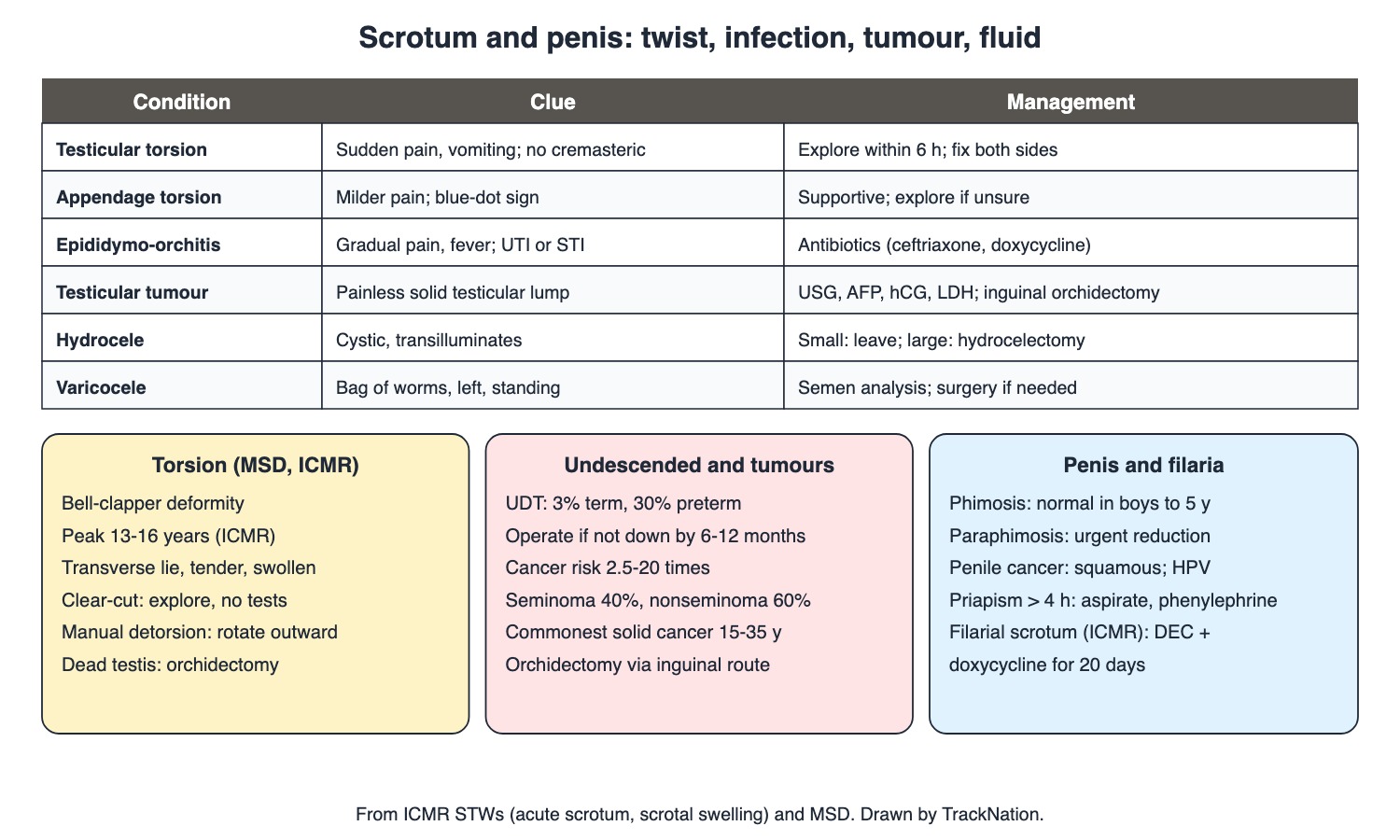
Scrotal and penile conditions at a glance. Drawn by TrackNation.
Acute Scrotum (ICMR, MSD)
Testicular torsion is the condition to rule out first. Intravaginal torsion peaks at 13–16 years; the bell-clapper deformity predisposes. Sudden severe pain in testis, groin or lower abdomen with nausea and vomiting; tender, swollen testis with a transverse lie, absent cremasteric reflex; pain worsens on elevating the testis (ICMR). Fever or urinary symptoms do not exclude it.
Clear-cut cases: no investigations — immediate exploration; colour Doppler only if equivocal. Salvage falls from 80–100% at 6–8 h to near zero at 12 h — operate within 6 hours (ICMR; golden window 4–8 h). Manual detorsion: rotate outward. Fix both testes; remove a dead testis.
Torsion of the appendage (peak ~11 years): milder pain, testis less tender, blue-dot sign at the upper pole; supportive care; explore if it cannot be told from torsion.
Epididymo-orchitis: gradual pain, fever, urinary symptoms. Children: often E. coli with urinary anomalies. Men <35: gonococcus, chlamydia (ceftriaxone + doxycycline); >35: coliforms after catheters or urological procedures. Mumps orchitis only after puberty. In India, chronic epididymo-orchitis is mostly filarial (ICMR) — think TB if there is a history.
Scrotal Swellings and Tumours (ICMR, MSD)
ICMR approach: can you get above the swelling? (no → inguinoscrotal, e.g. hernia); scrotal wall vs intrascrotal; testis vs epididymis vs cord; cystic vs solid; painful vs painless.
Hydrocele: cystic, transilluminates; small — no treatment; moderate/large — hydrocelectomy. Spermatocele/epididymal cyst: cystic, upper pole, transilluminates. Varicocele: up to 20% of men; "bag of worms", usually left, felt standing; semen analysis 2–3 times; surgery if testicular size discrepancy, abnormal semen or persistent pain.
Filarial scrotum (ICMR): epididymo-orchitis, funiculitis, hydrocele, elephantiasis → DEC 100 mg TDS + doxycycline 100 mg BD for 20 days, scrotal support. Fournier gangrene is a scrotal-wall emergency.
Testicular tumour: commonest solid cancer in men 15–35; painless solid testicular lump (most testicular masses are malignant; most extratesticular are not). Ultrasound + AFP, β-hCG, LDH; radical orchidectomy via the inguinal route, cord clamped first; then CT staging. Germ cell: seminoma 40%, non-seminoma 60% (teratoma, embryonal, yolk sac, choriocarcinoma). Encourage monthly self-examination.
Undescended testis: 3% of term, 30% of preterm boys; most that will descend do so early; distinguish retractile testes; orchiopexy if not down by 6–12 months. Cancer risk 2.5–20×, reduced if orchiopexy is done before 10 years.
Penile Conditions (MSD)
Phimosis (cannot retract foreskin): normal in boys, usually resolves by 5; treat only for balanitis, UTI, obstruction (steroid cream, stretching, circumcision). Paraphimosis (retracted foreskin trapped): emergency — reduce urgently.
Penile cancer: squamous; uncircumcised men with poor hygiene; HPV 16/18, balanitis, HIV, tobacco; premalignant erythroplasia of Queyrat. Biopsy; excision.
Priapism: painful erection without desire; children — sickle cell; adults — erectile drugs. Ischaemic (low-flow) beyond 4 h → fibrosis and ED: aspirate the corpora and inject phenylephrine.
Traps the Examiner Sets
Suspected torsion: operate — don't wait for Doppler in a clear case.
Testicular tumour: inguinal approach, cord clamped first.
Fix the other testis too.
Paraphimosis is an emergency; childhood phimosis usually isn't.
Memory Hooks & Shortcuts
Shortcuts to lock in this article's numbers and lists. Each one only re-packages facts proven above.
🧠 Torsion: 'Time is testis' — six hours to save it — torsion
🧠 Detorsion: 'Open the book' — rotate outward — detorsion
🧠 'Blue dot = small appendage, not the whole testis' — appendage
🧠 Tumour: 'Go in through the groin, clamp the cord first' — orchidectomy
🧠 Varicocele: 'Bag of worms on the Left, felt when Standing' — varicocele
Rapid-Revision Cards
Torsion age
Peak 13–16 years.
Torsion signs
Transverse lie; no cremasteric.
Torsion timing
Explore within 6 h.
Salvage
Near zero at 12 h.
Detorsion
Rotate outward.
Other side
Fix it too.
Blue-dot sign
Appendage torsion.
Epididymitis <35
Gonococcus, chlamydia.
Epididymitis >35
Coliforms.
Mumps orchitis
After puberty.
Filarial scrotum
DEC + doxycycline 20 d.
Hydrocele
Transilluminates.
Varicocele
Bag of worms; left.
Testis tumour
Painless solid lump; 15–35.
Markers
AFP, β-hCG, LDH.
Orchidectomy
Inguinal route.
Seminoma
40%.
UDT
3% term, 30% preterm.
Orchiopexy
By 6–12 months.
Paraphimosis
Emergency.
Ischaemic priapism
Aspirate + phenylephrine.
Sources
Facts in this article were checked against these documents.
Standard Treatment Workflows: Acute Scrotum in Children (2022); Scrotal Swelling (Jan 2026) — ICMR / Department of Health Research, 2022–26
MSD Manual Professional: Testicular Torsion; Testicular Cancer; Cryptorchidism; Painless Scrotal Mass; Epididymitis; Phimosis and Paraphimosis; Penile Cancer; Priapism — Merck & Co. (MSD Manuals), 2025–26 (link)
Competency Based Undergraduate Curriculum, Vol III: General Surgery (SU30) — National Medical Commission, 2024
Test Yourself: Practice Questions
Thirty questions in NEET PG style, most of them clinical vignettes.
Practice Questions (NEET PG pattern)
Original questions written in the style of the exam: +4 for a correct answer, −1 for a wrong one. Every answer was checked against the sources listed above. NEET PG papers are not published by NBEMS, so these are not past-paper questions.
Q1. A 14-year-old boy wakes with sudden severe left testicular pain and vomiting; the testis lies transversely and the cremasteric reflex is absent. Next step:
(a) antibiotics
(b) analgesics and rest
(c) Doppler and review next day
(d) immediate scrotal exploration
Show answer
Answer: (d) — Torsion: within 6 h.
Q2. Per ICMR, to save a torted testis surgery should be done within
(a) six hours
(b) 3 days
(c) 24 hours
(d) 1 week
Show answer
Answer: (a) — Golden window 4–8 h.
Q3. Testicular salvage after torsion falls to near zero by about
(a) 12 hours
(b) 1 hour
(c) 1 week
(d) 3 days
Show answer
Answer: (a) — 80–100% at 6–8 h.
Q4. The anatomical anomaly predisposing to intravaginal torsion is the
(a) bell-clapper deformity
(b) hydrocele
(c) patent processus vaginalis
(d) varicocele
Show answer
Answer: (a) — Often bilateral.
Q5. During manual detorsion, the testis is rotated
(a) inward (medially)
(b) it is never attempted
(c) upward
(d) outward (laterally)
Show answer
Answer: (d) — Testes usually twist inward.
Q6. At surgery for torsion, the contralateral testis should be
(a) biopsied
(b) left alone
(c) fixed (orchiopexy) as well
(d) removed
Show answer
Answer: (c) — Prevents torsion on that side.
Q7. An 11-year-old has milder scrotal pain with a tender bluish spot at the upper pole of a non-tender testis. Diagnosis:
(a) testicular torsion
(b) torsion of the testicular appendage
(c) epididymitis
(d) hydrocele
Show answer
Answer: (b) — Blue-dot sign.
Q8. Which finding does NOT exclude testicular torsion?
(a) sudden onset
(b) absent cremasteric reflex
(c) fever or urinary frequency
(d) transverse lie
Show answer
Answer: (c) — MSD.
Q9. A 24-year-old sexually active man has gradual scrotal pain and fever with urethral discharge. Likely organisms:
(a) mumps virus
(b) N. gonorrhoeae or C. trachomatis
(c) Mycobacterium tuberculosis
(d) E. coli only
Show answer
Answer: (b) — Coliforms in older men.
Q10. Epididymitis in a 65-year-old with an indwelling catheter is usually due to
(a) chlamydia
(b) mumps
(c) gram-negative coliforms
(d) gonococcus
Show answer
Answer: (c) — Urological instrumentation.
Q11. Mumps orchitis affects
(a) only the epididymis
(b) all ages equally
(c) only post-pubertal testes
(d) only infants
Show answer
Answer: (c) — ICMR.
Q12. In India, ICMR says chronic epididymo-orchitis without a UTI or TB history is mostly
(a) viral
(b) gonococcal
(c) malignant
(d) filarial — treat with DEC and doxycycline for 20 days
Show answer
Answer: (d) — DEC 100 mg TDS.
Q13. On examining a scrotal swelling, the first clinical question in the ICMR approach is
(a) is the patient febrile?
(b) what is the PSA?
(c) is it painful?
(d) can you get above the swelling?
Show answer
Answer: (d) — If not: inguinoscrotal.
Q14. A cystic, transilluminating swelling surrounding the testis is a
(a) haematocele
(b) hydrocele
(c) varicocele
(d) testicular tumour
Show answer
Answer: (b) — Small: no treatment.
Q15. A soft 'bag of worms' above the testis on standing, mostly on the left, is a
(a) hydrocele
(b) spermatocele
(c) varicocele
(d) hernia
Show answer
Answer: (c) — Up to 20% of men.
Q16. A man with a varicocele should, per ICMR, first be counselled for
(a) semen analysis 2–3 times
(b) CT abdomen
(c) PSA
(d) immediate orchidectomy
Show answer
Answer: (a) — Surgery if atrophy, abnormal semen, pain.
Q17. A cystic, transilluminating lump at the upper pole of the testis next to the epididymis is a
(a) spermatocele
(b) inguinal hernia
(c) seminoma
(d) varicocele
Show answer
Answer: (a) — Benign.
Q18. A 25-year-old notices a painless, solid lump in his testis that does not transilluminate. Most likely
(a) hydrocele
(b) testicular tumour
(c) epididymal cyst
(d) varicocele
Show answer
Answer: (b) — Most testicular masses are malignant.
Q19. Serum markers measured for a suspected testicular tumour include
(a) PSA and CA-125
(b) AFP, β-hCG and LDH
(c) calcitonin
(d) CEA and CA 19-9
Show answer
Answer: (b) — Before orchidectomy.
Q20. The correct operation for a suspected testicular tumour is
(a) trans-scrotal orchidectomy
(b) scrotal biopsy
(c) radical orchidectomy via the inguinal route
(d) observation
Show answer
Answer: (c) — Cord clamped first.
Q21. The proportion of germ cell testicular tumours that are seminomas is about
(a) 75%
(b) 90%
(c) 10%
(d) 40%
Show answer
Answer: (d) — Non-seminomas 60%.
Q22. A tumour type classed as non-seminomatous is
(a) classic seminoma
(b) yolk sac (endodermal sinus) tumour
(c) lymphoma
(d) Leydig cell tumour
Show answer
Answer: (b) — Also teratoma, embryonal, choriocarcinoma.
Q23. Undescended testis occurs in about what proportion of preterm boys?
(a) 70%
(b) 0.3%
(c) 30%
(d) 3%
Show answer
Answer: (c) — 3% of term.
Q24. An undescended testis that has not come down should be brought down surgically by
(a) 6–12 months of age
(b) 5 years
(c) 18 years
(d) puberty
Show answer
Answer: (a) — Orchiopexy.
Q25. The raised cancer risk in an undescended testis is reduced if orchiopexy is done before age
(a) 30 years
(b) 20 years
(c) 10 years
(d) it never falls
Show answer
Answer: (c) — Risk 2.5–20×.
Q26. A testis that sits in the scrotum but easily slips into the canal with the cremasteric reflex is
(a) ectopic
(b) undescended
(c) retractile
(d) atrophic
Show answer
Answer: (c) — No surgery.
Q27. A 3-year-old cannot retract his foreskin but has no infection or obstruction. Management:
(a) reassure; it usually resolves by 5
(b) antibiotics
(c) dorsal slit now
(d) urgent circumcision
Show answer
Answer: (a) — Physiological.
Q28. A man's retracted foreskin cannot be pulled forward and the glans is swelling. This is
(a) balanitis
(b) priapism
(c) paraphimosis — a medical emergency
(d) phimosis
Show answer
Answer: (c) — Reduce urgently.
Q29. Penile cancer is most often
(a) sarcoma
(b) squamous cell carcinoma in uncircumcised men
(c) melanoma
(d) adenocarcinoma
Show answer
Answer: (b) — HPV 16/18.
Q30. A boy with sickle cell disease has a painful erection lasting 6 hours. Initial treatment:
(a) aspiration of the corpora with intracavernous phenylephrine
(b) wait 24 hours
(c) circumcision
(d) oral sildenafil
Show answer
Answer: (a) — Ischaemic priapism.
Active Recall
From memory: distinguish testicular torsion, appendage torsion and epididymo-orchitis and outline their management, describe the approach to scrotal swellings including hydrocele, varicocele and filarial disease, outline testicular tumours and undescended testis, and summarise phimosis, paraphimosis, penile cancer and priapism.