Bladder, Prostate and Urethra for NEET PG Surgery: Acute Retention, BPH, Prostate and Bladder Cancer, Urethral Stricture and Lower Urinary Tract Trauma
Start Here
🎯 Exam priority: High. Expect: ICMR acute retention steps (no tests first, 12–14 Fr catheter, SPC if it fails, alpha-blocker then TWOC), drugs and conditions that cause retention, BPH symptoms, flow/PVR cut-offs, drugs and TURP indications/complications, prostate cancer PSA, mpMRI, Gleason and ADT, bladder cancer risks, TURBT and BCG, stricture causes and RUG, posterior vs anterior urethral injury, blood at meatus and bladder rupture types.
CBME mapping: SU29.7–29.11. Indian anchor: ICMR STW on acute urinary retention in men (Nov 2025).
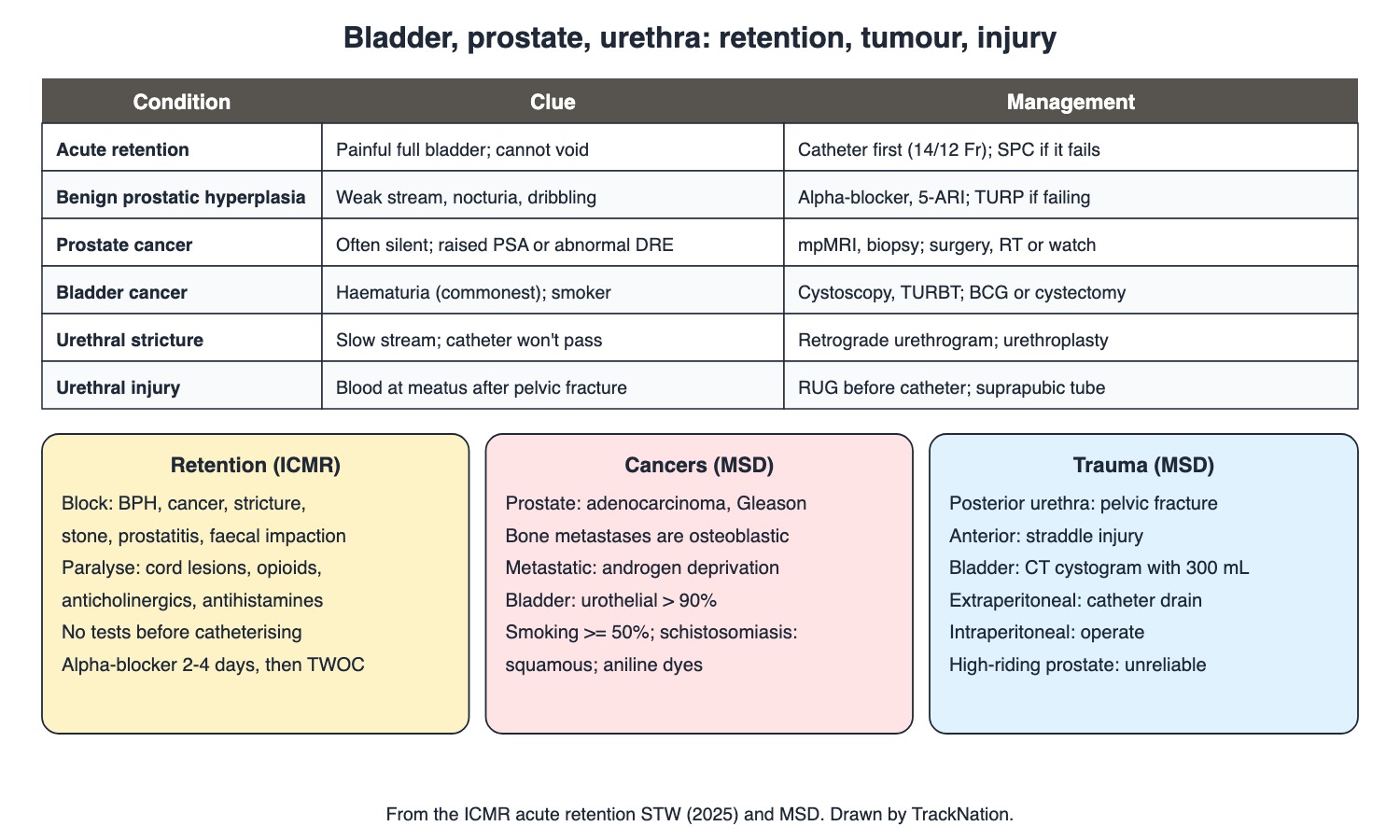
Bladder, prostate and urethra at a glance. Drawn by TrackNation.
Acute Urinary Retention (ICMR)
Sudden, painful inability to void with a tender, dull, palpable bladder. History: prior LUTS, fever, weight loss, leg weakness, drugs; examine for phimosis, meatal stenosis, stone, discharge; DRE (size, consistency, faecal impaction) and neuro exam (anal tone, perianal sensation, bulbocavernosus reflex).
Causes that block: BPH, prostate cancer, stricture, urethral/vesical stone, prostatitis, faecal impaction. Causes that paralyse the detrusor: cord compression, myelitis, stroke, head injury; opioids, anticholinergics, antihistamines. Precipitants: anaesthesia/surgery, over-distension (long journey), cold, alcohol, diuretics.
No investigation before catheterising. Gentle aseptic urethral catheterisation with a 12–14 Fr Foley, lots of lubricant; record the volume; keep it ≥1 day. If it fails → suprapubic cystostomy (if trained) or refer.
Spontaneous AUR from BPH: alpha-blocker for 2–4 days then trial without catheter; failure → surgery. Watch for UTI, AKI, post-obstructive diuresis with electrolyte loss, decompression haematuria, urethral injury. Atraumatic catheterisation prevents lifelong stricture.
BPH and Prostate Cancer (MSD)
BPH: benign overgrowth of the periurethral gland → weak stream, hesitancy, frequency, nocturia, terminal dribbling, overflow, retention. Score symptoms with IPSS; urinalysis, PSA (raised PSA → evaluate for cancer); flow <15 mL/s = obstruction, PVR >100 mL = retention.
Drugs: alpha-blockers (tamsulosin, alfuzosin, silodosin…), 5-alpha-reductase inhibitors (finasteride, dutasteride), combination; tadalafil if ED; saw palmetto no better than placebo. Surgery if drugs fail or complications: recurrent UTI, stones, bladder dysfunction, upper-tract dilatation (and refractory retention). TURP is the standard; commonest after-effect retrograde ejaculation.
Prostate cancer: adenocarcinoma; commonest non-skin cancer in men >50 (US); slow, usually silent until late (haematuria, outflow symptoms, osteoblastic bone metastases to pelvis, ribs, spine). PSA >10 → 67% PPV. mpMRI then biopsy; Gleason ≤6 well, 7 moderate, 8–10 poor. Screening needs shared decisions.
Localised: active surveillance, radical prostatectomy (incontinence, stricture, ED) or radiotherapy. Metastatic: androgen deprivation (LHRH agonists/antagonists ≈ orchiectomy) ± abiraterone/enzalutamide or docetaxel. More men die with it than of it.
Bladder Cancer, Stricture and Trauma (MSD)
Bladder cancer: urothelial >90%; haematuria commonest, also irritative symptoms. Risks: smoking (≥50%), cyclophosphamide, aniline dyes/aromatic amines, chronic irritation (catheters, stones, schistosomiasis → squamous cell). Cystoscopy and biopsy. Non-muscle-invasive: TURBT + intravesical chemo; high grade → intravesical BCG. Muscle-invasive: radical cystectomy or chemoradiation. Recurs in >40%.
Urethral stricture: scarring of the anterior urethra; trauma (straddle, catheter/endoscope) commonest, gonorrhoea, lichen sclerosus. Slow stream, recurrent UTI, difficult catheterisation. Retrograde urethrogram or cystoscopy. Dilation or internal urethrotomy; self-catheterisation; urethroplasty for recurrent localised strictures.
Urethral injury: posterior with pelvic fracture; anterior with straddle or perineal blow. Blood at the meatus is the key sign; high-riding prostate is unreliable. Retrograde urethrogram before any catheter. Contusion → catheter 5–7 days; partial disruption → suprapubic cystostomy; delayed repair.
Bladder injury: with pelvic fracture and gross haematuria; retrograde (CT) cystography with ≥300 mL. Most are extraperitoneal → catheter drainage; intraperitoneal (urinary ascites) and penetrating → surgery, as is bladder-neck injury.
Traps the Examiner Sets
Blood at the meatus: urethrogram first, never a blind catheter.
Retention: catheterise first, investigate later.
Prostate metastases are osteoblastic.
Intraperitoneal bladder rupture needs surgery; extraperitoneal usually doesn't.
Memory Hooks & Shortcuts
Shortcuts to lock in this article's numbers and lists. Each one only re-packages facts proven above.
🧠 Retention causes: 'Block or Paralyse' — prostate/stricture/stone vs cord/drugs — retention
🧠 'Tube first, tests later' in acute retention — management
🧠 'Blood at the tip? Picture before the pipe' (urethrogram before catheter) — urethral injury
🧠 Bladder rupture: 'Intra goes to theatre, Extra gets a catheter' — bladder injury
🧠 'Prostate builds bone' — osteoblastic metastases — prostate cancer
Rapid-Revision Cards
AUR first step
Catheter; no tests.
Catheter size
12–14 Fr Foley.
Catheter fails
Suprapubic cystostomy.
Retention drugs
Opioids, anticholinergics.
After AUR (BPH)
Alpha-blocker 2–4 d → TWOC.
Post-obstructive
Diuresis; electrolytes.
BPH
Periurethral overgrowth.
Flow / PVR
<15 mL/s; >100 mL.
BPH drugs
Alpha-blocker; finasteride.
BPH surgery
Recurrent UTI, stones, hydronephrosis.
TURP effect
Retrograde ejaculation.
Prostate mets
Osteoblastic.
PSA >10
PPV 67%.
Pre-biopsy
mpMRI.
Gleason 8–10
Poorly differentiated.
Bladder cancer risk
Smoking ≥50%.
Schistosomiasis
Squamous bladder cancer.
NMIBC
TURBT; BCG.
Stricture cause
Trauma; RUG.
Blood at meatus
RUG before catheter.
Bladder rupture
Extra: catheter; intra: surgery.
Sources
Facts in this article were checked against these documents.
Standard Treatment Workflow: Acute Urinary Retention in Men — ICMR / Department of Health Research, Nov 2025
MSD Manual Professional: Benign Prostatic Hyperplasia; Prostate Cancer; Bladder Cancer; Urethral Stricture; Urethral Trauma; Bladder Trauma — Merck & Co. (MSD Manuals), 2025–26 (link)
Competency Based Undergraduate Curriculum, Vol III: General Surgery (SU29) — National Medical Commission, 2024
Test Yourself: Practice Questions
Thirty questions in NEET PG style, most of them clinical vignettes.
Practice Questions (NEET PG pattern)
Original questions written in the style of the exam: +4 for a correct answer, −1 for a wrong one. Every answer was checked against the sources listed above. NEET PG papers are not published by NBEMS, so these are not past-paper questions.
Q1. A 70-year-old man has a sudden painful inability to pass urine and a tender, dull suprapubic swelling. Per ICMR, the first step is
(a) cystoscopy
(b) IV furosemide
(c) ultrasound KUB first
(d) gentle urethral catheterisation without waiting for tests
Show answer
Answer: (d) — Tests can wait.
Q2. The catheter size ICMR recommends for acute retention is
(a) 22–24 Fr three-way
(b) 12–14 Fr Foley
(c) 8 Fr feeding tube
(d) 30 Fr
Show answer
Answer: (b) — Adequate lubrication.
Q3. Urethral catheterisation fails in acute retention. The next step (if trained) is
(a) suprapubic cystostomy
(b) forceful repeated catheter attempts
(c) diuretics
(d) observe till morning
Show answer
Answer: (a) — Else refer.
Q4. A drug class that can cause acute retention by paralysing the detrusor is
(a) alpha-blockers
(b) anticholinergics
(c) 5-alpha-reductase inhibitors
(d) PPIs
Show answer
Answer: (b) — Also opioids, antihistamines.
Q5. After catheterisation for spontaneous retention due to BPH, ICMR advises
(a) antibiotics only
(b) an alpha-blocker for 2–4 days then trial without catheter
(c) immediate TURP
(d) lifelong catheter
Show answer
Answer: (b) — Surgery if TWOC fails.
Q6. After relief of chronic retention, a patient passes large volumes of urine with falling sodium and potassium. This is
(a) acute tubular necrosis only
(b) post-obstructive diuresis
(c) SIADH
(d) diabetes insipidus always
Show answer
Answer: (b) — Watch electrolytes.
Q7. In a man with acute retention, the neurological examination should include
(a) fundoscopy only
(b) gag reflex
(c) anal tone, perianal sensation and bulbocavernosus reflex
(d) plantar only
Show answer
Answer: (c) — Cord compression.
Q8. BPH arises from overgrowth of the
(a) periurethral prostate gland
(b) seminal vesicles
(c) bladder neck muscle
(d) peripheral zone only
Show answer
Answer: (a) — Outflow obstruction.
Q9. On uroflowmetry, obstruction is suggested by a maximum flow below
(a) 15 mL/s
(b) 5 L/min
(c) 100 mL/s
(d) 40 mL/s
Show answer
Answer: (a) — PVR >100 mL = retention.
Q10. A 5-alpha-reductase inhibitor used in BPH is
(a) finasteride
(b) tamsulosin
(c) oxybutynin
(d) sildenafil
Show answer
Answer: (a) — Also dutasteride.
Q11. An indication for surgery in BPH is
(a) nocturia once
(b) recurrent UTI, bladder stones or upper-tract dilatation
(c) mild symptoms responding to drugs
(d) PSA of 2
Show answer
Answer: (b) — Or drug failure.
Q12. The commonest sequel of TURP is
(a) retrograde ejaculation
(b) urethral cancer
(c) impotence in all
(d) permanent incontinence
Show answer
Answer: (a) — Continence usually kept.
Q13. Herbal saw palmetto for BPH
(a) is first-line
(b) replaces TURP
(c) cures BPH
(d) is no better than placebo
Show answer
Answer: (d) — MSD.
Q14. Bone metastases from prostate cancer are typically
(a) absent
(b) purely soft tissue
(c) osteoblastic
(d) osteolytic
Show answer
Answer: (c) — Pelvis, ribs, spine.
Q15. An asymptomatic man has PSA 12 ng/mL. The positive predictive value for cancer is about
(a) 5%
(b) 67%
(c) 25%
(d) 100%
Show answer
Answer: (b) — 25% for PSA 4–10.
Q16. The current first imaging before prostate biopsy is
(a) multiparametric MRI
(b) CT KUB
(c) IVP
(d) bone scan
Show answer
Answer: (a) — Then needle biopsy.
Q17. A Gleason score of 8–10 indicates
(a) inflammation
(b) poorly differentiated tumour
(c) well differentiated
(d) benign hyperplasia
Show answer
Answer: (b) — ≤6 well, 7 moderate.
Q18. For metastatic prostate cancer, the backbone of treatment is
(a) TURP
(b) androgen deprivation therapy
(c) radical prostatectomy
(d) BCG
Show answer
Answer: (b) — LHRH agonists ≈ orchiectomy.
Q19. The most common risk factor for bladder cancer is
(a) bladder stones
(b) smoking
(c) schistosomiasis
(d) cyclophosphamide
Show answer
Answer: (b) — ≥50% of cases.
Q20. Bladder cancer in a patient with chronic schistosomiasis is most likely
(a) sarcoma
(b) urothelial carcinoma
(c) adenocarcinoma
(d) squamous cell carcinoma
Show answer
Answer: (d) — Chronic irritation.
Q21. A dye-industry worker who smokes has haematuria. The definitive test is
(a) plain X-ray
(b) PSA
(c) urine culture
(d) cystoscopy and biopsy
Show answer
Answer: (d) — Aniline dyes.
Q22. High-grade non-muscle-invasive bladder cancer after complete TURBT is treated with
(a) observation only
(b) radical prostatectomy
(c) intravesical BCG
(d) oral tamoxifen
Show answer
Answer: (c) — Or cystectomy.
Q23. Muscle-invasive bladder cancer is treated by
(a) TURBT alone
(b) BCG alone
(c) radical cystectomy or chemoradiation
(d) observation
Show answer
Answer: (c) — MSD.
Q24. The most common cause of urethral stricture is
(a) cancer
(b) trauma (straddle injury or instrumentation)
(c) lichen sclerosus
(d) gonorrhoea
Show answer
Answer: (b) — Anterior urethra.
Q25. A man with a slow stream cannot be catheterised. Stricture is confirmed by
(a) PSA
(b) retrograde urethrogram or cystoscopy
(c) IVP
(d) renal scan
Show answer
Answer: (b) — Then urethrotomy or urethroplasty.
Q26. A recurrent, localised urethral stricture that keeps failing dilation is best treated by
(a) TURP
(b) open urethroplasty
(c) cystectomy
(d) repeated dilation forever
Show answer
Answer: (b) — MSD.
Q27. After a pelvic fracture, a man has blood at the urethral meatus and cannot void. Next step:
(a) retrograde urethrogram before any catheter
(b) IVP
(c) cystoscopy
(d) urethral catheter at once
Show answer
Answer: (a) — Posterior urethral injury.
Q28. A man falls astride a beam and has perineal bruising and blood at the meatus. The injured segment is most likely the
(a) anterior (bulbar) urethra
(b) bladder neck
(c) posterior (membranous) urethra
(d) ureter
Show answer
Answer: (a) — Straddle injury.
Q29. A partial urethral disruption is best managed initially by
(a) immediate urethroplasty in all
(b) urethral catheter by force
(c) observation
(d) suprapubic cystostomy
Show answer
Answer: (d) — Delayed repair.
Q30. CT cystography after blunt trauma shows an intraperitoneal bladder rupture. Management:
(a) catheter drainage alone
(b) suprapubic aspiration
(c) surgical exploration and repair
(d) observation
Show answer
Answer: (c) — Extraperitoneal: catheter.
Active Recall
From memory: outline the ICMR approach to acute urinary retention and its causes, describe BPH evaluation and treatment, summarise prostate and bladder cancer, and describe urethral stricture, urethral injuries and bladder rupture management.