Skin, CNS and Eye for NEET PG Pathology: Basal Cell Carcinoma, Squamous Cell Carcinoma, Melanoma, Meningitis CSF, Brain Tumours, Retinoblastoma
Start Here
🎯 Exam priority: High. Expect: CSF patterns of bacterial, viral and TB meningitis, organisms by age, Waterhouse-Friderichsen syndrome, the commonest skin cancer, BCC vs SCC, melanoma types and depth, astrocytoma grades, 1p/19q, meningioma in women, medulloblastoma site, and retinoblastoma genetics.
CBME mapping: PA 33.1–33.4, 34.1–34.3, 35.1. This closes the Pathology playlist; CSF examination basics are in article 16.
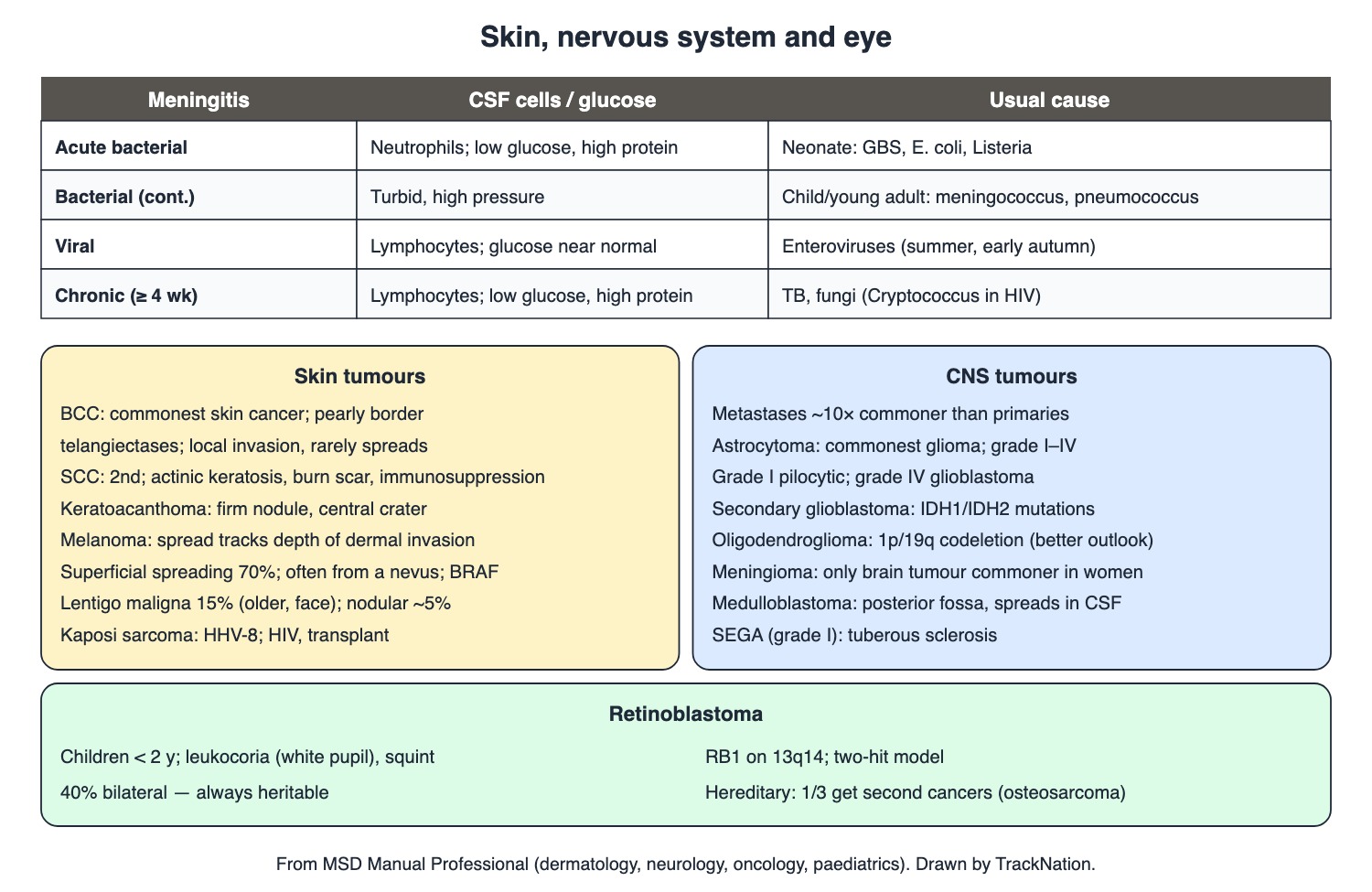
Meningitis CSF, skin tumours, brain tumours and retinoblastoma. Drawn by TrackNation.
Skin Tumours
Basal cell carcinoma: the commonest skin cancer, in fair, sun-exposed skin (very rare in dark skin). A shiny papule that grows a pearly border with telangiectases and a central dell or ulcer. It invades locally but rarely metastasises.
Squamous cell carcinoma: the second commonest; sun-exposed skin; may arise in an actinic keratosis, oral leukoplakia or a burn scar; commoner with chronic immunosuppression; metastasises in advanced stages. Keratoacanthoma: a firm round nodule with a central crater.
Melanoma arises from melanocytes (skin, mucosa, eye, CNS); metastasis tracks the depth of dermal invasion. Superficial spreading (70%) — young adults, intermittent sun, often from a precursor nevus, BRAF V600; lentigo maligna melanoma (15%) — older adults, face; nodular (~5%). Warning signs: asymmetry, irregular border, mottled colour. Risks: many or atypical moles, giant congenital nevus > 20 cm, dysplastic nevus syndrome, CDKN2A (p16) mutations, immunosuppression.
Kaposi sarcoma: endothelial tumour driven by HHV-8; far commoner with HIV or transplant immunosuppression.
Meningitis
Bacterial: neonates — group B streptococci, E. coli, Listeria; older infants, children and young adults — N. meningitidis and S. pneumoniae. Hib, once the commonest, is now rare in the US and Western Europe. Meningococcal sepsis can cause bilateral adrenal haemorrhagic infarction — Waterhouse-Friderichsen syndrome.
Viral: enteroviruses (summer, early autumn); lymphocytes with near-normal glucose. Chronic (≥ 4 weeks): TB, fungi (Cryptococcus in HIV), others — lymphocyte-predominant, low glucose, high protein.
Meningitis | Cells | Glucose | Protein | Usual cause |
Acute bacterial | Neutrophils; turbid, high pressure | Low | High | Neonate: GBS, E. coli, Listeria; later: meningococcus, pneumococcus |
Viral | Lymphocytes | Near normal | Slightly high | Enteroviruses |
Chronic (≥ 4 weeks) | Mixed, lymphocyte-predominant | Low | High | TB, fungi (Cryptococcus in HIV) |
CNS Tumours and Retinoblastoma
Brain metastases are about 10 times commoner than primary tumours.
Astrocytomas are the commonest gliomas: grade I pilocytic (and SEGA in tuberous sclerosis), II low-grade, III anaplastic, IV glioblastoma. Secondary glioblastomas carry IDH1/IDH2 mutations. Oligodendroglioma: 1p/19q codeletion — diagnostic, with longer survival and better treatment response.
Meningioma: among the commonest intracranial tumours; the only brain tumour commoner in women; median age 67. Medulloblastoma: a primitive neuroectodermal tumour presenting as a posterior fossa mass with hydrocephalus; spreads through CSF.
Retinoblastoma: children under 2; leukocoria (white pupil) and squint. Both alleles of RB1 (13q14) are lost — in hereditary cases one is germline and the second somatic (two-hit model). 40% bilateral, and bilateral disease is always heritable. A third of hereditary patients develop second cancers (sarcomas, osteosarcoma) within 50 years.
Traps the Examiner Sets
BCC rarely metastasises; SCC can; melanoma spread depends on depth.
Low CSF glucose + neutrophils = bacterial; low glucose + lymphocytes = TB/fungal; normal glucose + lymphocytes = viral.
Neonatal meningitis: GBS, E. coli, Listeria — not meningococcus.
Bilateral retinoblastoma = always hereditary; watch for osteosarcoma later.
Memory Hooks & Shortcuts
Shortcuts to lock in this article's numbers and lists. Each one only re-packages facts proven above.
🧠 BCC Barely spreads; SCC Sometimes spreads; melanoma by depth — skin cancer spread
🧠 Newborn meningitis = 'GEL' (GBS, E. coli, Listeria) — neonatal meningitis
🧠 Low sugar + polys = bugs; low sugar + lymphs = TB/fungus; normal sugar + lymphs = virus — CSF
🧠 1p/19q = 'Oh, good' (oligodendroglioma, better outlook) — oligodendroglioma
🧠 Meningioma likes Madam (women) — meningioma
🧠 RB: two hits on 13; both eyes = born with it — retinoblastoma
Rapid-Revision Cards
Commonest skin cancer
Basal cell carcinoma.
BCC look
Pearly border, telangiectases, central dell.
BCC spread
Local invasion; rarely metastasises.
SCC origins
Actinic keratosis, leukoplakia, burn scar.
SCC risk
Chronic immunosuppression.
Keratoacanthoma
Firm nodule, central crater.
Melanoma prognosis
Depth of dermal invasion.
Superficial spreading
70%; young; nevus; BRAF.
Lentigo maligna melanoma
15%; older; face.
Nodular melanoma
~5%.
Melanoma gene (familial)
CDKN2A (p16).
Kaposi
HHV-8; HIV, transplant.
Neonatal meningitis
GBS, E. coli, Listeria.
Child/young adult meningitis
Meningococcus, pneumococcus.
Waterhouse-Friderichsen
Meningococcal sepsis; adrenal haemorrhage.
Bacterial CSF
Neutrophils, low glucose, high protein.
Viral CSF
Lymphocytes, near-normal glucose.
Chronic meningitis CSF
Lymphocytes, low glucose; TB, fungi.
Brain metastases
~10× primaries.
Glioma grades
I pilocytic/SEGA; IV glioblastoma.
Oligodendroglioma
1p/19q codeletion; better outlook.
Meningioma
Only brain tumour commoner in women.
Medulloblastoma
Posterior fossa; CSF spread.
Retinoblastoma
< 2 y; leukocoria; RB1 13q14; two hits.
Bilateral RB
Always heritable; osteosarcoma later.
Sources
Facts in this article were checked against these documents.
MSD Manual Professional: Basal Cell Carcinoma; Squamous Cell Carcinoma; Keratoacanthoma; Melanoma; Kaposi Sarcoma — Merck & Co. (MSD Manuals), reviewed 2025–26 (link)
MSD Manual Professional: Acute Bacterial Meningitis; Viral Meningitis; Subacute and Chronic Meningitis — Merck & Co. (MSD Manuals), reviewed 2025–26 (link)
MSD Manual Professional: Overview of CNS Tumors; Gliomas; Meningiomas; Medulloblastomas; Retinoblastoma — Merck & Co. (MSD Manuals), reviewed 2025–26 (link)
Competency Based Undergraduate Curriculum, Pathology (PA 33–35) — National Medical Commission, 2024
Test Yourself: Practice Questions
Thirty questions in NEET PG style, most of them clinical vignettes.
Practice Questions (NEET PG pattern)
Original questions written in the style of the exam: +4 for a correct answer, −1 for a wrong one. Every answer was checked against the sources listed above. NEET PG papers are not published by NBEMS, so these are not past-paper questions.
Q1. The commonest skin cancer is
(a) basal cell carcinoma
(b) melanoma
(c) Merkel cell carcinoma
(d) squamous cell carcinoma
Show answer
Answer: (a) — Mostly in fair, sun-exposed skin.
Q2. A fair-skinned person with long sun exposure has a slowly enlarging papule with a shiny pearly border, surface telangiectases and a central dell. The lesion
(a) is basal cell carcinoma, which invades locally but rarely metastasises
(b) is a benign keratoacanthoma
(c) is melanoma with early spread
(d) is squamous carcinoma always metastatic
Show answer
Answer: (a) — Local invasion can still damage vital structures.
Q3. A skin cancer develops in an old burn scar. The likely type is
(a) melanoma
(b) Kaposi sarcoma
(c) basal cell carcinoma
(d) squamous cell carcinoma
Show answer
Answer: (d) — SCC may also arise in actinic keratosis or leukoplakia.
Q4. A patient on chronic immunosuppression is at particular risk of
(a) seborrhoeic keratosis
(b) basal cell carcinoma only
(c) cutaneous squamous cell carcinoma
(d) dermatofibroma
Show answer
Answer: (c) — Chronic immunosuppression raises SCC risk.
Q5. A firm round skin nodule with sharply sloping borders and a central crater is
(a) melanoma
(b) molluscum
(c) keratoacanthoma
(d) basal cell carcinoma
Show answer
Answer: (c) — It arises on sun-exposed skin of older adults.
Q6. The single most important predictor of metastasis in cutaneous melanoma is
(a) colour
(b) patient sex
(c) depth of dermal invasion
(d) diameter alone
Show answer
Answer: (c) — Pathologists report the maximal thickness.
Q7. The commonest type of melanoma, often on a young woman's leg and often arising from a pre-existing nevus, is
(a) lentigo maligna melanoma
(b) nodular melanoma
(c) acral lentiginous melanoma
(d) superficial spreading melanoma (70%)
Show answer
Answer: (d) — Commonly BRAF V600 mutated.
Q8. An elderly man has a melanoma arising in a freckle-like tan-brown macule on his chronically sun-exposed face. The type is
(a) seborrhoeic keratosis
(b) superficial spreading melanoma
(c) basal cell carcinoma
(d) lentigo maligna melanoma
Show answer
Answer: (d) — 15% of melanomas; arises from lentigo maligna (Hutchinson freckle).
Q9. A familial melanoma syndrome is linked to germline mutation of the tumour suppressor
(a) RB1 only
(b) APC
(c) CDKN2A (p16)
(d) VHL
Show answer
Answer: (c) — Also BAP1 and CHEK2.
Q10. Which skin lesion is a recognised melanoma risk factor?
(a) a giant congenital melanocytic nevus over 20 cm
(b) a cherry angioma
(c) a skin tag
(d) a seborrhoeic keratosis
Show answer
Answer: (a) — Also many or atypical moles and dysplastic nevus syndrome.
Q11. Multicentric vascular skin tumours in a patient with advanced HIV arise from endothelial cells driven by
(a) human herpesvirus 8
(b) HPV 16
(c) CMV
(d) EBV
Show answer
Answer: (a) — Kaposi sarcoma; also after transplantation.
Q12. A 2-week-old has bacterial meningitis with neutrophils in the CSF. The likely organisms include
(a) group B streptococci, E. coli and Listeria
(b) enteroviruses
(c) meningococcus and pneumococcus
(d) Cryptococcus
Show answer
Answer: (a) — Meningococcus and pneumococcus dominate later.
Q13. In children and young adults, the commonest causes of bacterial meningitis are
(a) Neisseria meningitidis and Streptococcus pneumoniae
(b) Listeria and E. coli
(c) Staphylococcus aureus
(d) Hib only
Show answer
Answer: (a) — Hib is now rare where vaccinated.
Q14. A teenager with meningococcal sepsis develops coagulopathy and bilateral adrenal haemorrhagic infarction. This is
(a) Addison disease from TB
(b) Waterhouse-Friderichsen syndrome
(c) Sheehan syndrome
(d) Cushing syndrome
Show answer
Answer: (b) — Coagulopathy accompanies it.
Q15. CSF that is turbid, under high pressure, with many neutrophils, high protein and a low CSF:blood glucose ratio suggests
(a) viral meningitis
(b) acute bacterial meningitis
(c) multiple sclerosis
(d) normal CSF
Show answer
Answer: (b) — Bacteria consume glucose.
Q16. In summer, a young adult has meningitis; CSF shows lymphocytes, near-normal glucose and slightly raised protein. The likely cause is
(a) enteroviruses
(b) Cryptococcus
(c) Mycobacterium tuberculosis
(d) Neisseria meningitidis
Show answer
Answer: (a) — Still treat as bacterial until excluded.
Q17. A patient has meningitis for 5 weeks; CSF shows lymphocyte-predominant cells, low glucose and high protein. The likely group is
(a) acute bacterial meningitis
(b) viral meningitis
(c) subarachnoid haemorrhage
(d) chronic meningitis — TB or fungal
Show answer
Answer: (d) — Chronic meningitis lasts at least 4 weeks.
Q18. An HIV patient with low CD4 count develops chronic meningitis. The commonest fungal cause in this setting is
(a) Aspergillus
(b) Candida albicans
(c) Cryptococcus neoformans
(d) Histoplasma
Show answer
Answer: (c) — Most common among immunocompromised patients.
Q19. Compared with primary brain tumours, brain metastases are
(a) seen only in children
(b) rarer
(c) about 10 times more common
(d) equally common
Show answer
Answer: (c) — Always consider a primary elsewhere.
Q20. The commonest type of glioma is
(a) astrocytoma
(b) ependymoma
(c) medulloblastoma
(d) oligodendroglioma
Show answer
Answer: (a) — Graded I–IV.
Q21. A WHO grade IV astrocytic tumour is
(a) glioblastoma
(b) subependymal giant cell astrocytoma
(c) anaplastic astrocytoma
(d) pilocytic astrocytoma
Show answer
Answer: (a) — Anaplastic astrocytoma is grade III.
Q22. A frontal-lobe glioma shows codeletion of 1p and 19q. This points to
(a) glioblastoma
(b) meningioma
(c) medulloblastoma
(d) oligodendroglioma with a better prognosis
Show answer
Answer: (d) — Diagnostic of oligodendroglial tumours; predicts longer survival.
Q23. Secondary glioblastomas typically carry mutations in
(a) VHL
(b) RB1
(c) BRAF V600E
(d) IDH1 or IDH2
Show answer
Answer: (d) — They arise from lower-grade astrocytomas.
Q24. A child with tuberous sclerosis has a grade I astrocytic tumour near the ventricles. It is
(a) oligodendroglioma
(b) ependymoma
(c) subependymal giant cell astrocytoma
(d) glioblastoma
Show answer
Answer: (c) — Grade I with pilocytic astrocytoma.
Q25. The only brain tumour more common in women is
(a) medulloblastoma
(b) primary CNS lymphoma
(c) glioblastoma
(d) meningioma
Show answer
Answer: (d) — Median age about 67.
Q26. A patient presents with a posterior fossa mass and obstructive hydrocephalus; the tumour can spread through CSF. The likely tumour is
(a) glioblastoma
(b) meningioma
(c) craniopharyngioma
(d) medulloblastoma
Show answer
Answer: (d) — A primitive neuroectodermal tumour; staged with lumbar puncture and craniospinal imaging.
Q27. An 18-month-old's photo shows a white pupillary reflex in one eye, and the child has a squint. The likely diagnosis and gene are
(a) congenital cataract — no gene
(b) retinoblastoma — RB1 on 13q14
(c) neuroblastoma — MYCN
(d) retinopathy of prematurity
Show answer
Answer: (b) — Leukocoria is the classic sign.
Q28. In hereditary retinoblastoma, tumour develops when
(a) one allele is mutated only
(b) a germline RB1 mutation is followed by a somatic mutation of the other allele
(c) both alleles are normal
(d) RB1 is amplified
Show answer
Answer: (b) — The two-hit model.
Q29. A child has retinoblastoma in both eyes. This disease is
(a) caused by HPV
(b) never heritable
(c) always heritable
(d) usually acquired from radiation
Show answer
Answer: (c) — About 40% of patients have bilateral disease.
Q30. A survivor of hereditary retinoblastoma is at increased risk of which later cancer?
(a) osteosarcoma
(b) papillary thyroid carcinoma
(c) Hodgkin lymphoma
(d) seminoma
Show answer
Answer: (a) — About a third develop second cancers within 50 years.
Active Recall
From memory: contrast basal and squamous cell carcinoma; give melanoma types, risk factors and the main prognostic factor; name Kaposi sarcoma's cause; give meningitis organisms by age and the CSF pattern of bacterial, viral and chronic meningitis; describe glioma grades, oligodendroglioma genetics, meningioma and medulloblastoma; and explain retinoblastoma genetics and presentation.