Development and Milestones for NEET PG Paediatrics: Motor, Language and Social Milestones by Age, Delay, Autism, ADHD and Intellectual Disability
Start Here
🎯 Exam priority: Very high. Expect: the age of a milestone (sits without support, walks, tower of cubes, copies a circle/cross/triangle, words and sentences), which domain a milestone belongs to, what to test first in speech delay, and the features, screening and treatment of autism, ADHD and intellectual disability.
CBME mapping: PE1, PE3, PE4. Fact-checked against the MSD Manual and MoHFW's RBSK 2.0 guidelines (2026). Ages are medians — the sequence is fairly fixed, the timing varies.
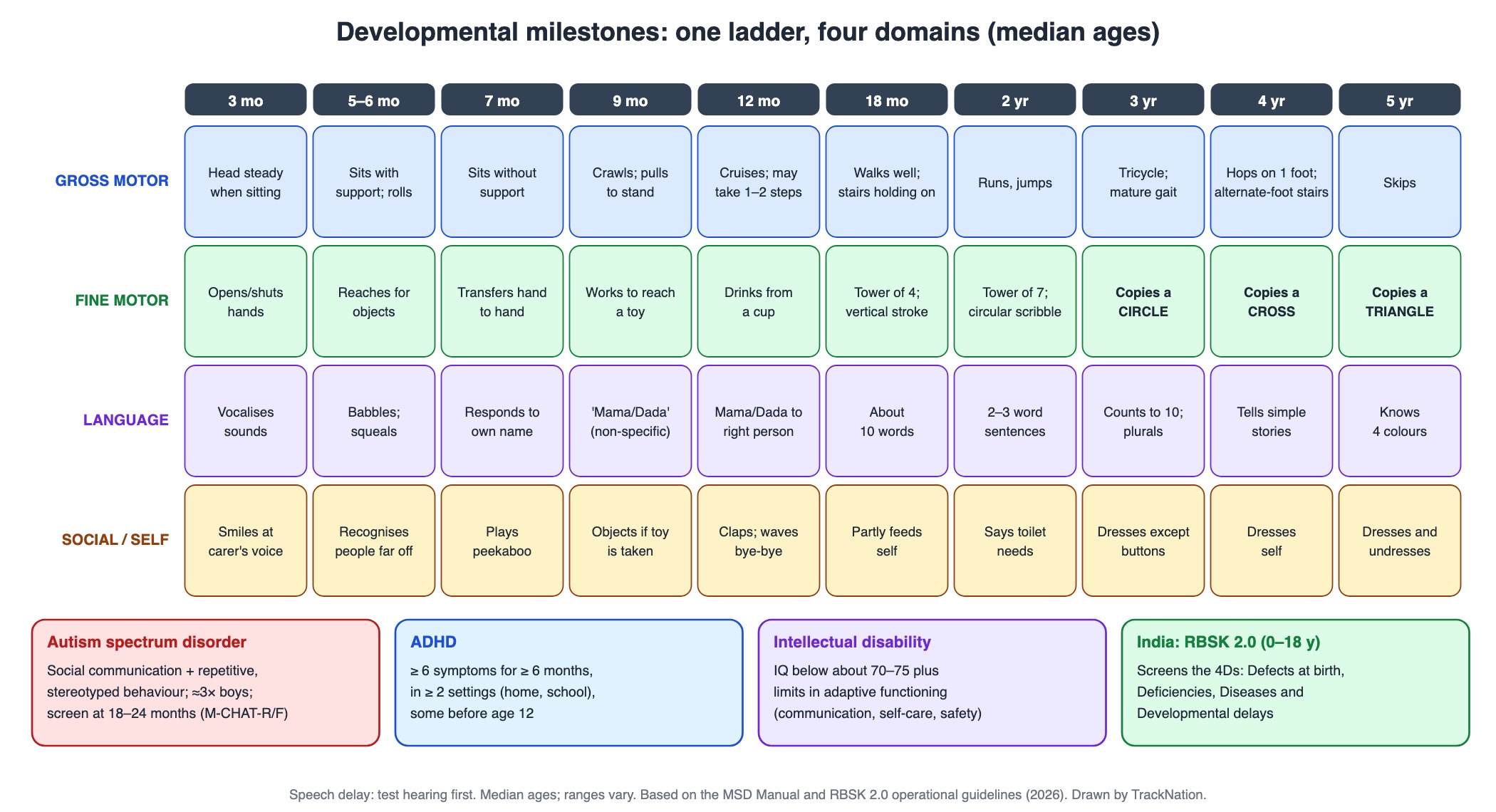
Milestones from 3 months to 5 years in four domains, plus autism, ADHD, intellectual disability and RBSK. Drawn by TrackNation.
Motor Milestones (MSD)
Domains: gross motor, fine motor, language, cognition, social and emotional — a child can be late in one and early in another (walks late, talks early).
4 weeks: lifts head when prone. 6 weeks: social smile; head lags on pull-to-sit. 3 months: head steady when sitting, raises head 45° prone, opens and shuts hands.
5–6 months: sits with support, rolls over, reaches. 7 months: sits without support, transfers objects hand to hand. 9 months: crawls, pulls to stand.
12 months: cruises, may take 1–2 steps (walking typically begins at 12 months). 18 months: walks well, stairs holding on, tower of 4 cubes, vertical stroke. 2 years: runs, jumps, tower of 7, circular scribble.
3 years: tricycle, hand preference, copies a circle. 4 years: hops on one foot, alternate feet on stairs, copies a cross. 5 years: skips, copies a triangle, draws a person in 6 parts. 6 years: heel-to-toe walk, writes name. Extra stimulation cannot significantly speed up motor development.
Language and Social Milestones (MSD)
Understanding comes before speaking. Cooing → babbling (5–6 months) → responds to name (7 months) → "Mama/Dada" non-specifically (9 months) → to the right person by 12 months → about 10 words at 18 months → 2–3-word sentences at 2 years → conversation, counts to 10, plurals and 3 colours at 3 years → simple stories at 4 → 4 colours at 5.
Speech delay: test hearing first. Most children with speech delay have normal intelligence; delays in both understanding and speaking more often mean other developmental problems.
Social and self-care: smiles at a carer's voice (3 months), peekaboo (7 months), objects when a toy is taken (9 months), waves bye-bye and drinks from a cup (12 months), tells toilet needs (2 years), dresses except buttons (3 years), dresses and undresses (5 years). Screening tools such as the Denver II show the range of typical ages.
Autism, ADHD and Intellectual Disability (MSD); RBSK
Autism spectrum disorder: impaired social interaction and communication plus repetitive, stereotyped behaviour, often with intellectual disability; about 1 in 100 worldwide, 3 times more in boys; genetic component. Screen at 18–24 months (M-CHAT-R/F). Treatment: applied behaviour analysis, speech and language therapy, sometimes medication.
ADHD: inattention, hyperactivity, impulsivity — 3 types (inattentive, hyperactive-impulsive, combined); about twice as common in boys. Needs ≥6 symptoms for ≥6 months, in ≥2 settings, some before age 12. Treatment: stimulant or other medication, behaviour therapy and school support.
Intellectual disability: IQ below about 70–75 plus limits in adaptive functioning; IQ bands (mild 52–70/75, moderate 36–51, severe 20–35, profound <20) alone are inadequate — support needed matters. Causes include Down syndrome and fragile X.
India — RBSK 2.0 (2026): screens children 0–18 years for the 4Ds — Defects at birth, Deficiencies, Diseases and Developmental delays — through Mobile Health Teams at Anganwadi centres and schools.
Traps the Examiner Sets
Circle at 3, cross at 4, triangle at 5 — the order of shapes is a favourite.
Sitting without support is 7 months; sitting with support is 5–6 months.
In a child with speech delay, check hearing before anything else.
ADHD needs symptoms in at least two settings, not just at school.
Intellectual disability is not defined by IQ alone — adaptive functioning counts.
Memory Hooks & Shortcuts
Shortcuts to lock in this article's numbers and lists. Each one only re-packages facts proven above.
🧠 'Circle at 3, Cross at 4, Triangle at 5' — one more side each year — shapes
🧠 Towers: '4 at one-and-a-half, 7 at two' — cubes
🧠 'Seven months, Sits Solo' — sits without support — sitting
🧠 Words: '10 at 18, sentences at 2' — language
🧠 ADHD '6-2-12': 6 months, 2 settings, before 12 — ADHD
Rapid-Revision Cards
6 weeks
Social smile; head lag.
3 months
Head steady sitting; 45° prone; opens hands.
5–6 months
Sits with support; rolls; reaches.
7 months
Sits without support; transfers; name.
9 months
Crawls; pulls to stand; Mama/Dada (any).
12 months
Cruises; Mama/Dada specific; cup; bye-bye.
18 months
Walks well; tower of 4; ~10 words.
2 years
Runs, jumps; tower of 7; 2–3-word sentences.
3 years
Tricycle; CIRCLE; counts to 10.
4 years
Hops; alternate stairs; CROSS.
5 years
Skips; TRIANGLE; person in 6 parts.
6 years
Heel-to-toe; writes name.
Speech delay
Test hearing first.
Autism
Social communication + repetitive; 3× boys.
Autism screen
18–24 mo; M-CHAT-R/F.
Autism treatment
Applied behaviour analysis.
ADHD criteria
≥6 mo, ≥2 settings, before 12.
ADHD types
Inattentive, hyperactive, combined.
Intellectual disability
IQ <70–75 + adaptive limits.
X-linked ID
Fragile X, Rett.
RBSK 4Ds
Defects, Deficiencies, Diseases, Delays.
Sources
Facts in this article were checked against these documents.
MSD Manual Professional: Childhood Development; Autism Spectrum Disorder; Attention-Deficit/Hyperactivity Disorder; Intellectual Disability — Merck & Co., 2025–2026 (link)
Rashtriya Bal Swasthya Karyakram 2.0: Operational Guidelines — Child Health Division, Ministry of Health & Family Welfare, 2026
Test Yourself: Practice Questions
Thirty questions in NEET PG style, many of them clinic scenarios.
Practice Questions (NEET PG pattern)
Original questions written in the style of the exam: +4 for a correct answer, −1 for a wrong one. Every answer was checked against the sources listed above. NEET PG papers are not published by NBEMS, so these are not past-paper questions.
Q1. A baby who sits without support and transfers objects from hand to hand is most likely aged
(a) 3 months
(b) 18 months
(c) 7 months
(d) 12 months
Show answer
Answer: (c) — Sits with support at 5–6 months.
Q2. A child copies a circle but not a cross. The likely age is
(a) 6 years
(b) 3 years
(c) 18 months
(d) 5 years
Show answer
Answer: (b) — Cross at 4, triangle at 5.
Q3. Copying a triangle is expected at
(a) 5 years
(b) 2 years
(c) 4 years
(d) 3 years
Show answer
Answer: (a) — MSD median.
Q4. A child who hops on one foot and copies a cross is about
(a) 6 years
(b) 3 years
(c) 4 years
(d) 2 years
Show answer
Answer: (c) — MSD.
Q5. A tower of 4 cubes is typically made at
(a) 12 months
(b) 18 months
(c) 2–2½ years
(d) 3 years
Show answer
Answer: (b) — Tower of 7 at 2–2½ years.
Q6. Children typically begin to walk at about
(a) 12 months
(b) 2 years
(c) 18 months
(d) 9 months
Show answer
Answer: (a) — Stairs holding on 18 months, run 2 years.
Q7. A 9-month-old is expected to
(a) climb stairs holding on
(b) crawl and pull to stand
(c) walk well
(d) ride a tricycle
Show answer
Answer: (b) — MSD.
Q8. Head lag on pull-to-sit is normal at
(a) 6 months
(b) 12 months
(c) 9 months
(d) 6 weeks
Show answer
Answer: (d) — Head steady on sitting at 3 months.
Q9. A baby raises the head 45° when prone and holds it steady when sitting. The age is about
(a) 1 month
(b) 7 months
(c) 3 months
(d) 9 months
Show answer
Answer: (c) — MSD.
Q10. A child says 'Mama' and 'Dada' to the right person by
(a) 2 years
(b) 6 months
(c) 12 months
(d) 18 months
Show answer
Answer: (c) — Non-specific at 9 months.
Q11. Two- to three-word phrases are expected by
(a) 2 years
(b) 3 years
(c) 18 months
(d) 12 months
Show answer
Answer: (a) — About 10 words at 18 months.
Q12. A child speaks about 10 words. The likely age is
(a) 9 months
(b) 3 years
(c) 12 months
(d) 18 months
Show answer
Answer: (d) — MSD table.
Q13. A 2-year-old has very few words. The first investigation is
(a) a hearing assessment
(b) MRI brain
(c) EEG
(d) karyotype
Show answer
Answer: (a) — MSD.
Q14. Most children with isolated speech delay have
(a) intellectual disability
(b) normal intelligence
(c) autism
(d) deafness
Show answer
Answer: (b) — MSD.
Q15. Which statement about motor development is true?
(a) It precedes head control
(b) It is identical in all children
(c) Extra stimulation doubles its speed
(d) It cannot be significantly speeded up by extra stimulation
Show answer
Answer: (d) — MSD.
Q16. A child rides a tricycle, counts to 10 and uses plurals. The age is about
(a) 5 years
(b) 2 years
(c) 18 months
(d) 3 years
Show answer
Answer: (d) — MSD.
Q17. Skipping is expected at
(a) 5 years
(b) 3 years
(c) 4 years
(d) 2 years
Show answer
Answer: (a) — Hops at 4.
Q18. Walking heel-to-toe in a straight line and writing their name is expected at
(a) 2 years
(b) 6 years
(c) 4 years
(d) 3 years
Show answer
Answer: (b) — MSD.
Q19. Autism spectrum disorder is characterised by
(a) motor delay only
(b) impaired social communication with repetitive, stereotyped behaviour
(c) hyperactivity only
(d) isolated speech delay with normal play
Show answer
Answer: (b) — Often with intellectual disability.
Q20. Autism is about how many times more common in boys?
(a) 3
(b) 10
(c) 1 (equal)
(d) 20
Show answer
Answer: (a) — ≈1/100 worldwide.
Q21. Universal autism screening is recommended by some bodies at
(a) 6 months
(b) 18–24 months
(c) birth
(d) 5 years
Show answer
Answer: (b) — M-CHAT-R/F.
Q22. The screening tool for autism in toddlers is
(a) M-CHAT-R/F
(b) Denver II
(c) APGAR
(d) Glasgow Coma Scale
Show answer
Answer: (a) — MSD.
Q23. A core treatment for autism spectrum disorder is
(a) stimulant medication alone
(b) applied behaviour analysis
(c) antibiotics
(d) surgery
Show answer
Answer: (b) — Plus speech therapy.
Q24. For a diagnosis of ADHD, symptoms must be present in at least
(a) 4 settings
(b) 1 setting
(c) 2 settings
(d) the classroom only
Show answer
Answer: (c) — ≥ 6 months; some before 12.
Q25. Some ADHD symptoms must be present before age
(a) 3
(b) 6
(c) 12
(d) 18
Show answer
Answer: (c) — MSD.
Q26. ADHD symptoms must persist for at least
(a) 2 weeks
(b) 2 years
(c) 6 months
(d) 1 month
Show answer
Answer: (c) — MSD.
Q27. The three types of ADHD are
(a) mild, moderate and severe
(b) motor, vocal and mixed
(c) early, late and adult
(d) inattentive, hyperactive-impulsive and combined
Show answer
Answer: (d) — MSD.
Q28. Intellectual disability requires an IQ below about 70–75 together with
(a) seizures
(b) limits in adaptive functioning
(c) an abnormal MRI
(d) autism
Show answer
Answer: (b) — IQ alone is inadequate.
Q29. An X-linked cause of intellectual disability is
(a) fragile X syndrome
(b) Down syndrome
(c) neurofibromatosis
(d) phenylketonuria
Show answer
Answer: (a) — Also Rett.
Q30. Under RBSK 2.0, children aged 0–18 are screened for the 4Ds, which are
(a) defects at birth, deficiencies, diseases and developmental delays
(b) diet, dental, dermatology, disability
(c) deafness, dyslexia, depression, drugs
(d) diarrhoea, dengue, diphtheria, dehydration
Show answer
Answer: (a) — MoHFW 2026.
Active Recall
From memory: list the key motor, fine motor, language and social milestones from 6 weeks to 6 years, what to test first in speech delay, and the features, screening and treatment of autism, ADHD and intellectual disability, plus the RBSK 4Ds.