Caste for UPSC: Varna and Jati, Colonial Census, Untouchability and Article 17, Dominant Caste, and Why Caste Is Both Fluid and Static
Caste in the Past: Varna and Jati
🎯 Exam priority: High-yield (Mains). Caste was asked in 2022, 2023, 2024 (twice) and 2026. The questions are about change: is caste fluid or static, is it disappearing in cities, why does affirmative action fall short. The NCERT chapter answers all of them; learn its argument.
Caste in the past: varna and jati
"Caste" comes from the Portuguese casta ("pure breed"). Indian languages use two words: varna ("colour"), the four-fold all-India division (brahmana, kshatriya, vaishya, shudra), which left out the "outcastes" and others; and jati, the regional and local groups, hundreds or thousands of them, which is what most people mean by caste.
The varna scheme is about 3,000 years old, but it was not one unchanging system. In the late Vedic period (about 900-500 BC) the divisions were few, not rigid and not fixed by birth; movement was common. Caste hardened into a birth-based institution later.
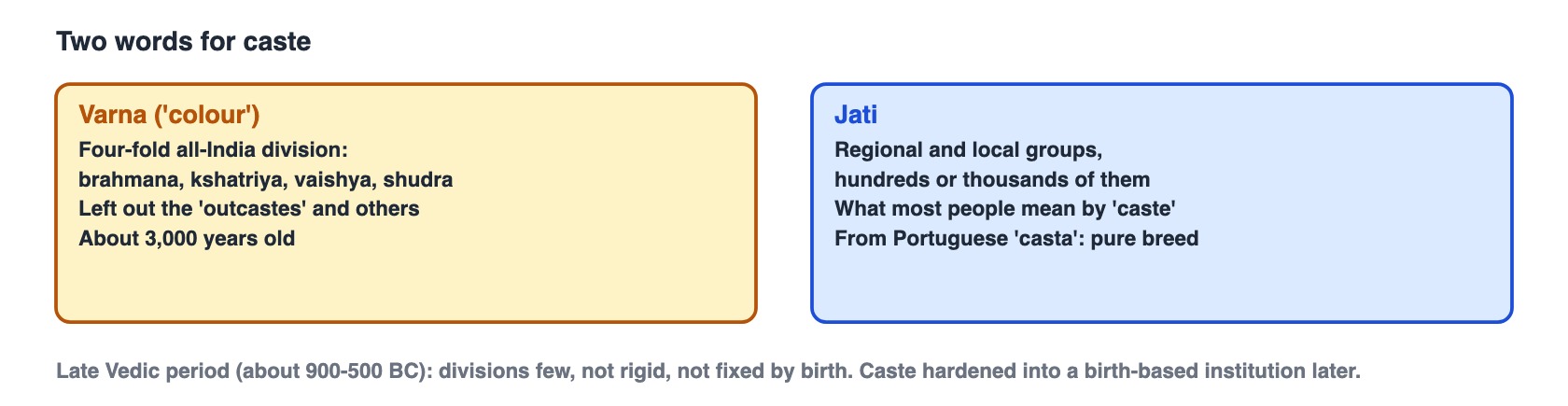
Varna and jati: the two words behind 'caste'.
Defining feature (as the scriptures prescribed it) | Meaning |
Birth | You are born into your parents' caste and cannot choose or leave it |
Endogamy | Marriage only within the group |
Food rules | What may be eaten, and with whom food may be shared |
Hierarchy | Every caste has a rank, ordered by ritual purity and pollution |
Segmental organisation | Castes split into sub-castes, and sub-castes into further divisions |
Hereditary occupation | Each caste tied to an occupation, closed to others |
Underneath sit two principles: difference and separation (rules that keep castes apart in marriage, food and work) and wholism and hierarchy (no caste exists alone; each has a fixed rank in a ladder ordered by purity and pollution). Ritual status tracked material power, and the system worked as a division of labour that in principle allowed no mobility.
Colonialism, Reform and the Constitution
Much of caste as we know it was reshaped in the colonial period, and then again after 1947.
Colonialism, reform and the Constitution
Counting caste changed it. The census became a ten-yearly exercise from 1881. The 1901 Census under Herbert Risley tried to record each caste's rank; hundreds of caste associations petitioned for a higher place. Identities that had been fluid became fixed once recorded.
Schedules: the Government of India Act, 1935 gave legal recognition to lists ("schedules") of castes and tribes, which is where the terms Scheduled Castes and Scheduled Tribes come from.
Reformers from below and above: Jotirao Phule (Satyashodhak Samaj, 1873) and Savitribai Phule; Ayyankali and Sri Narayana Guru ("One Caste, One Religion, One God for all men") in Kerala; Periyar in Tamil Nadu; Babasaheb Ambedkar. Gandhi and Ambedkar both campaigned against untouchability from the 1920s.
Untouchability has three equally important dimensions: exclusion (from water sources, worship and festivals), humiliation-subordination and exploitation.
Measure | What it does |
Article 17 | Abolishes untouchability and forbids its practice in any form; enforcing a disability arising from it is an offence |
Reservations | Seats in legislatures, government jobs and educational institutions for SCs and STs in proportion to their population share; the OBC share is decided differently |
SC/ST (Prevention of Atrocities) Act, 1989 | Stronger punishment for violence and humiliation against Dalits and adivasis |
OBCs | Kaka Kalelkar Commission report (1953) sidelined; B.P. Mandal Commission report implemented in 1990; surveys put OBCs at about 41% of the population |
EWS (103rd Amendment, 2019) | Articles 15(6) and 16(6): up to 10% reservation for economically weaker sections outside the SC, ST and OBC categories |
Census 2027 | To be held in two phases with an enumeration of castes; reference date 1 March 2027 |
The NCERT text draws the lesson: laws had to be passed again and again because the law alone cannot end a social practice.
Caste Today: Fluid and Static
This is the core of every recent question.
Caste today: fluid and static
The state's contradiction: it wrote the abolition of caste into the Constitution but was unwilling to push the land reforms that would have removed caste's economic base, and assumed that acting "caste-blind" (except for SC/ST reservations) would make caste fade.
Where it weakened: modern industry created jobs with no caste rules; crowded city life made segregation hard; educated Indians dropped extreme practices.
Where it held: factory recruitment in the Mumbai textile and Kolkata jute mills ran through caste and kin networks; prejudice survived in cities; and endogamy stayed largely untouched. Inter-caste marriages have grown, but the boundaries between castes of similar status are the ones that loosen, while wider borders stay "heavily patrolled" (the point of the 2024 question).
Politics: caste became central to electoral politics, with explicitly caste-based parties since the 1980s. M.N. Srinivas's dominant caste, intermediate castes that gained land through post-1947 reforms and had numbers in a democracy, explains rural power: the Yadavs (Bihar, UP), Vokkaligas (Karnataka), Reddys and Khammas (Andhra Pradesh), Marathas (Maharashtra), Jats (Punjab, Haryana, western UP) and Patidars (Gujarat).
Invisible for some, all too visible for others: for the urban upper-caste middle class, caste seems to have vanished because it has done its job: it gave them the education and early public-sector jobs that now carry them on merit. For SCs, STs and OBCs, caste is all too visible: with no inherited capital and continuing discrimination, it is one of the few collective assets they have, and reservations are their lifeline.
Group | Below poverty line, rural (2011-12, %) | Urban (%) |
Scheduled Tribes | 45.3 | 24.1 |
Scheduled Castes | 31.5 | 21.7 |
OBCs | 22.7 | 15.4 |
Forward castes | 15.5 | 8.1 |
All groups | 25.4 | 13.7 |
Writing the caste answers
Is caste disappearing in urban India? (2026) In public life and work it has weakened; in marriage, networks, housing and politics it persists; and its "disappearance" is itself a sign of upper-caste advantage. A balanced "no, it is changing form" is the strong answer.
Fluid and static (2023): fluid in occupation, ritual and mobility (Sanskritisation, new jobs); static in endogamy and hierarchy of status; counting and politics have both hardened and reshaped identities.
Affirmative action falls short (2024): benefits concentrated in better-off sub-groups, unfilled posts, private-sector growth outside reservation, and discrimination that law cannot reach; use the poverty gap above as evidence.
Sect versus caste, region and religion (2022): sects cut across castes and draw on faith and a teacher, but in practice they often recruit along caste and regional lines; identities overlap rather than replace each other.
Further Reading
PIB press releases, ministry websites and annual reports, the Gazette of India, MEA and UN documents and the official sources named in each note — the primary sources behind every fact above.
Test Yourself: Practice Questions & PYQs
12 practice questions, then the five GS Paper 1 questions on caste.
Practice Questions
Q1. The English word 'caste' comes from the
(a) Latin 'castus'
(b) Persian 'qaum'
(c) Sanskrit 'jati'
(d) Portuguese 'casta'
Show answer
Answer: (d) — Casta means 'pure breed'.
Q2. According to the NCERT text, in the late Vedic period (about 900-500 BC) the varna divisions were
(a) replaced by jatis
(b) rigid and hereditary
(c) few, not rigid and not determined by birth
(d) fixed by occupation
Show answer
Answer: (c) — Caste hardened into a birth-based institution in the post-Vedic period.
Q3. The division of a caste into sub-castes, and of sub-castes into further divisions, is called
(a) segmental organisation
(b) hierarchy
(c) endogamy
(d) sanskritisation
Show answer
Answer: (a) — Endogamy is marriage within the group.
Q4. Which census tried to record the social rank of every caste, prompting hundreds of petitions for higher status?
(a) 1881
(b) 1901, under Herbert Risley
(c) 1931
(d) 1951
Show answer
Answer: (b) — Scholars argue that counting caste made fluid identities rigid.
Q5. The terms 'Scheduled Castes' and 'Scheduled Tribes' come from lists given legal recognition by
(a) the Government of India Act, 1935
(b) the Census of 1881
(c) the Constitution of 1950
(d) the Morley-Minto Reforms
Show answer
Answer: (a) — The lists, or 'schedules', identified castes and tribes for special treatment.
Q6. Who founded the Satyashodhak Samaj in 1873?
(a) Periyar
(b) Ayyankali
(c) Sri Narayana Guru
(d) Jotirao Phule
Show answer
Answer: (d) — Narayana Guru preached 'One Caste, One Religion, One God for all men'.
Q7. Consider the following statements:
1. The three dimensions of untouchability are exclusion, humiliation-subordination and exploitation.
2. Article 17 abolishes untouchability.
3. The SC/ST (Prevention of Atrocities) Act was passed in 1955.
Which of the statements given above are correct?
(a) 1 and 2 only
(b) 2 and 3 only
(c) 1 and 3 only
(d) 1, 2 and 3
Show answer
Answer: (a) — 1 and 2 are correct. The Prevention of Atrocities Act is of 1989.
Q8. The First Backward Classes Commission (1953) was headed by
(a) B.R. Ambedkar
(b) Kaka Kalelkar
(c) B.P. Mandal
(d) V.P. Singh
Show answer
Answer: (b) — The Mandal Commission's report was implemented in 1990.
Q9. The concept of the 'dominant caste' was contributed by
(a) G.S. Ghurye
(b) Louis Dumont
(c) Herbert Risley
(d) M.N. Srinivas
Show answer
Answer: (d) — Intermediate castes that gained land after independence and had numbers in electoral democracy.
Q10. Which of the following is NOT listed in the NCERT text as an example of a dominant caste?
(a) Vokkaligas of Karnataka
(b) Jats of Haryana
(c) Brahmins of Tamil Nadu
(d) Patidars of Gujarat
Show answer
Answer: (c) — Dominant castes are intermediate landowning castes, not the ritually highest.
Q11. The 103rd Amendment (2019) allows reservation for economically weaker sections of up to
(a) 10% of posts in each category
(b) 27%
(c) 15%
(d) 50%
Show answer
Answer: (a) — Articles 15(6) and 16(6), for those outside the SC, ST and OBC categories.
Q12. According to the MHA, Census 2027 will
(a) be held in one phase in 2026
(b) count only Scheduled Castes and Tribes
(c) include an enumeration of castes, with reference date 1 March 2027
(d) exclude caste entirely
Show answer
Answer: (c) — It will be held in two phases.
Mains Practice Questions
Use these to frame full-length answers. You don't have to answer one exactly — they show the angles UPSC tests, so let them guide which points you cover.
Is caste disappearing in urban India? Illustrate with examples.
Why is caste identity both fluid and static?
Why does caste seem invisible to some groups and all too visible to others?
UPSC Mains — Previous Years’ Questions on this topic (last 10 years)
These are the actual GS Mains questions UPSC has asked on this theme — real proof of how, and when, it is tested. Try to write a full answer to each.
2022 (GS-I): Analyse the salience of 'sect' in Indian society vis-a-vis caste, region and religion.
2023 (GS-I): Why is caste identity in India both fluid and static?
2024 (GS-I): Intercaste marriages between castes which have socio-economic parity have increased, to some extent, but this is less true of interreligious marriages. Discuss.
2024 (GS-I): Despite comprehensive policies for equity and social justice, underprivileged sections are not yet getting the full benefits of affirmative action envisaged by the Constitution. Comment.
2026 (GS-I): Is caste disappearing in urban India? Illustrate your answer with examples.