Women in Indian Society for UPSC: Reformers, Women's Organisations, the Women's Movement, Labour Force Participation and the 2023 Reservation
Gender Is Social: How the Women's Question Arose
🎯 Exam priority: High-yield (Mains). Women's issues were asked in 2019, 2021, 2023 and 2024 (twice): continued challenges, the gig economy, suicide among young women, equality versus equity versus empowerment, and the migration of young women. Learn the history of the women's question, then the latest numbers.
Gender is social, not natural
Inequality between men and women is often treated as natural, but the NCERT text shows it is social. Nothing in biology explains why so few women hold public power or why they inherit less. The strongest evidence comes from societies that differed: matrilineal communities such as the Nairs of Kerala (historically) and the Khasis of Meghalaya (still today), and the many African societies where women have long been successful farmers and traders.
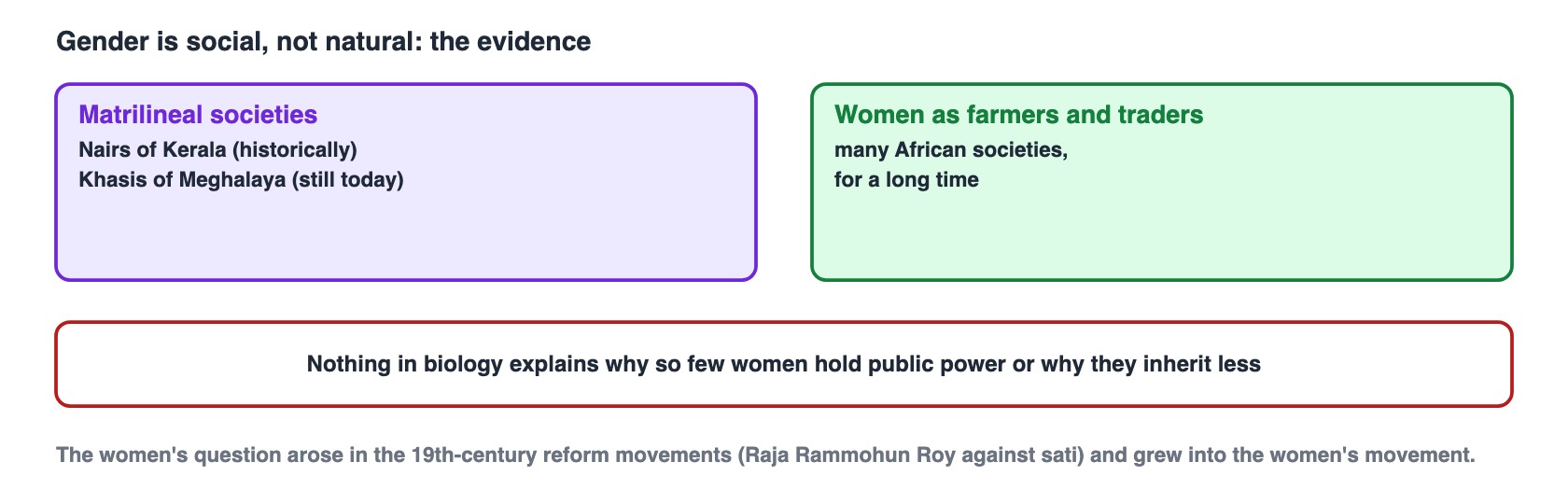
Why gender inequality is social, not natural.
How the women's question arose
Reformer or writer | Contribution |
Raja Rammohun Roy (Bengal) | Campaign against sati, a decade before founding the Brahmo Samaj (1828); drew on both natural-rights ideas and the shastras |
M.G. Ranade (Bombay Presidency) | Widow remarriage; wrote on the shastric sanction for remarrying widows |
Jotirao Phule | Attacked caste and gender oppression together; helped women and 'untouchables' first |
Sir Syed Ahmed Khan; Dayanand Saraswati | Education for girls, Sir Syed within the home; curricula that look stereotyped now but opened the door |
Tarabai Shinde, Stree Purush Tulana (1882) | A Maharashtrian housewife's protest against the double standards of male-dominated society |
Begum Rokeya Sakhawat Hossain, Sultana's Dream (1905) | A 'Ladyland' where men keep purdah; probably the earliest science fiction written in India |
The point of the last two: women's equality was not only a male reformers' project, nor an alien import.
Women's Organisations and the Women's Movement
From the early 20th century women organised themselves.
Women's organisations and the women's movement
Early organisations: the Women's India Association (1917), the National Council for Women in India (1925) and the All India Women's Conference (1926). The AIWC began by keeping "welfare" apart from "politics" and soon tied women's freedom to national freedom.
Women in mass struggles: they took part in the Tebhaga movement in Bengal, the Telangana armed struggle against the Nizam and the Warli tribal revolt in Maharashtra, not just in middle-class campaigns.
A constitutional promise: the Karachi Session of the Congress (1931) declared equality before the law irrespective of sex, and the right of women to vote, to represent and to hold public office.
The second phase (mid-1970s): after a post-1947 lull, the movement revived with new issues: violence against women, dowry, sexual harassment, land rights, employment, women's representation in the media and the gendered effects of unequal development. Law became a major site of reform in the 1980s, when many laws affecting women were found unchanged since the 19th century.
Not one experience: the concerns of a Dalit woman differ from an upper-caste woman's, a peasant woman's from an educated middle-class woman's. And dominant gender norms constrain men too (the pressure to be strong and successful), which is why a gender-just society frees both.
From reform to rights: the 19th-century reformers attacked "backward" customs (sati, child marriage, the treatment of widows); the 1970s movement turned to "modern" questions of representation, work and violence. Representation came in two steps: one-third of seats in panchayats and municipalities, and in 2023 the same share in Parliament and the Assemblies.
New challenges: the fall in the child sex ratio (article 2) shows bias against the girl child.
Women Today and How to Answer
Here is where women stand on the latest official data.
Women today: work, representation and safety
Area | Latest position |
Work | Female labour force participation rose from 23.3% (2017-18) to 41.7% (2023-24) while female unemployment fell from 5.6% to 3.2% (PLFS) |
Enterprise | Female-headed proprietary establishments rose from 24.2% (2021-22) to 26.2% (2023-24) |
Barriers | Limited mobility, housing and inflexible work clashing with care duties; women with advanced degrees are only 2.9% of employed women; women are 43% of STEM enrolment; the Time Use Survey 2024 shows a heavy unpaid care load |
Law | The Labour Codes let women work in all establishments, including night shifts, with safety measures |
Local government | Since the 73rd and 74th Amendments, not less than one-third of directly elected seats in every panchayat and municipality (including SC/ST seats) are reserved for women (Articles 243D and 243T): the first large-scale entry of women into elected office |
Representation | 106th Amendment (2023), Article 330A: one-third of directly elected Lok Sabha seats (including SC/ST seats) and Assembly seats reserved for women, taking effect after delimitation based on the first census after the Amendment, for 15 years (Article 334A) |
Safety and support | Mission Shakti: 865 One Stop Centres operational, 12.67 lakh women helped; helpline 181 linked to ERSS-112; PMMVY maternity benefit to 4.26 crore women (Rs 20,060 crore); Beti Bachao Beti Padhao completed 10 years in 2025 |
Writing the women's answers
Equality, equity and empowerment (2024): equality is the same rights and opportunities for all; equity is fairness, giving different support so that outcomes can be equal (maternity benefit, reserved seats, crèches); empowerment is women's own capacity to make choices and act on them. Gender concerns belong in programme design because "neutral" programmes inherit unequal starting points (care work, mobility, safety).
Continued challenges "against time and space" (2019): time, through the unpaid care burden; space, through limits on mobility, safety in public places and at work, and access to housing.
The gig economy (2021): flexible hours and home-based work fit around care duties and raise participation, but the work is insecure, lacks social security and can lock women into low-skill tasks; the Labour Codes and social security for gig workers are the policy answer.
Suicide among young women (2023): treat it as Durkheim did, as a social fact with social causes: pressure around marriage and dowry, domestic violence, the gap between rising education and restricted choices, and isolation after migration. Prevention lies in support systems, not only in individual counselling.
Young women migrating to cities (2024): more personal freedom, income and choice in marriage and lifestyle, alongside renegotiated ties with family, safety worries and loneliness; family relations change rather than break.
Further Reading
PIB press releases, ministry websites and annual reports, the Gazette of India, MEA and UN documents and the official sources named in each note — the primary sources behind every fact above.
Test Yourself: Practice Questions & PYQs
12 practice questions, then the five GS Paper 1 questions on women.
Practice Questions
Q1. Which community does the NCERT text cite as still matrilineal?
(a) Khasis of Meghalaya
(b) Todas of the Nilgiris
(c) Nairs of Kerala
(d) Bhils of Rajasthan
Show answer
Answer: (a) — The Nairs used to be matrilineal; the Khasis still are.
Q2. Raja Rammohun Roy's campaign against sati began about a decade before he founded the
(a) Prarthana Samaj in 1867
(b) Arya Samaj in 1875
(c) Satyashodhak Samaj in 1873
(d) Brahmo Samaj in 1828
Show answer
Answer: (d) — Sati was the first women's issue to get wide public attention.
Q3. 'Stree Purush Tulana' (1882), a protest against double standards in a male-dominated society, was written by
(a) Begum Rokeya
(b) Savitribai Phule
(c) Pandita Ramabai
(d) Tarabai Shinde
Show answer
Answer: (d) — Begum Rokeya Sakhawat Hossain wrote 'Sultana's Dream' (1905).
Q4. 'Sultana's Dream' (1905) is notable as
(a) a treatise on Hindu law
(b) a Congress resolution
(c) the first Indian novel in English
(d) probably the earliest science fiction written in India
Show answer
Answer: (d) — It imagines a 'Ladyland' where men are kept in purdah.
Q5. Arrange these women's organisations by year of founding: 1. All India Women's Conference 2. Women's India Association 3. National Council for Women in India
(a) 3, 2, 1
(b) 1, 2, 3
(c) 2, 1, 3
(d) 2, 3, 1
Show answer
Answer: (d) — WIA 1917, NCWI 1925, AIWC 1926.
Q6. The Congress declaration on Fundamental Rights that committed it to women's equality was issued at the
(a) Lucknow Session, 1916
(b) Haripura Session, 1938
(c) Karachi Session, 1931
(d) Lahore Session, 1929
Show answer
Answer: (c) — It included women's right to vote, to represent and to hold public office.
Q7. The 'second phase' of the Indian women's movement, focused on issues such as violence against women and dowry, began in the
(a) 1950s
(b) 1990s
(c) 1920s
(d) mid-1970s
Show answer
Answer: (d) — Law became a major site of reform in the 1980s.
Q8. Female labour force participation (PLFS) rose between 2017-18 and 2023-24 from
(a) 18% to 25%
(b) 35% to 45%
(c) 41.7% to 52%
(d) 23.3% to 41.7%
Show answer
Answer: (d) — Female unemployment fell from 5.6% to 3.2% over the same years.
Q9. Consider the following statements:
1. Article 330A reserves one-third of directly elected Lok Sabha seats for women.
2. The reservation takes effect after delimitation based on the first census after the 106th Amendment.
3. The reservation is permanent.
Which of the statements given above are correct?
(a) 1 and 2 only
(b) 2 and 3 only
(c) 1 and 3 only
(d) 1, 2 and 3
Show answer
Answer: (a) — 1 and 2 are correct. Article 334A limits it to 15 years from its commencement.
Q10. Women's Helpline 181 has been integrated with
(a) 1098
(b) 1930
(c) ERSS-112
(d) 14567
Show answer
Answer: (c) — 865 One Stop Centres were operational under Mission Shakti in 2025.
Q11. Explaining variations in suicide rates by social causes is associated with
(a) Emile Durkheim
(b) M.N. Srinivas
(c) Karl Marx
(d) Max Weber
Show answer
Answer: (a) — The NCERT text uses his study to show that a rate is a social fact.
Q12. Giving different support to different groups so that outcomes can be equal is best described as
(a) empowerment
(b) gender equity
(c) gender neutrality
(d) gender equality
Show answer
Answer: (b) — Equality is the same rights for all; empowerment is women's own capacity to choose and act.
Mains Practice Questions
Use these to frame full-length answers. You don't have to answer one exactly — they show the angles UPSC tests, so let them guide which points you cover.
Distinguish between gender equality, gender equity and women's empowerment, and show why programmes need a gender lens.
Examine the role of the gig economy in women's empowerment.
Why is suicide among young women increasing in Indian society? Answer as a sociologist.
UPSC Mains — Previous Years’ Questions on this topic (last 10 years)
These are the actual GS Mains questions UPSC has asked on this theme — real proof of how, and when, it is tested. Try to write a full answer to each.
2019 (GS-I): What are the continued challenges for women in India against time and space?
2021 (GS-I): Examine the role of 'Gig Economy' in the process of empowerment of women in India.
2023 (GS-I): Explain why suicide among young women is increasing in Indian society.
2024 (GS-I): Distinguish between gender equality, gender equity and women's empowerment. Why is it important to take gender concerns into account in programme design and implementation?
2024 (GS-I): Globalization has increased urban migration by skilled, young, unmarried women from various classes. How has this trend impacted upon their personal freedom and relationship with family?