Tribal Communities for UPSC: Who Is a Tribe, the Caste-Tribe Debate, Displacement and Development, and Adivasi Identity
Who Is a Tribe?
🎯 Exam priority: Important (Mains). Tribes were asked in 2021, 2022 and 2025: knowledge systems, whether diverse tribes form one category, and development as displacement and rehabilitation. The welfare schemes (PM-JANMAN, Dharti Aaba, Forest Rights Act) are in the Government Schemes playlist; this article gives the sociology.
Who is a tribe?
"Tribe" is a modern term for some of the oldest communities of the subcontinent. They were long defined by what they were not: no religion with a written text, no state of the usual kind, no sharp class divisions. Positive classifications use two kinds of trait:
Trait | What the NCERT text records |
Region (permanent) | About 85% live in 'middle India', from Gujarat and Rajasthan to West Bengal and Odisha; over 11% in the North-East, where tribes are over 60% (up to 95%) of the population in Arunachal Pradesh, Meghalaya, Mizoram and Nagaland |
Language (permanent) | Four families: Indo-Aryan and Dravidian (shared with others), Austric and Tibeto-Burman (spoken mainly by tribes) |
Size | From the Gonds, Bhils, Santhals, Oraons, Minas, Bodos and Mundas (each over a million) to Andamanese groups of under a hundred |
Livelihood (acquired) | Fishers, hunters and gatherers, shifting cultivators, peasants, plantation and industrial workers |
Incorporation (acquired) | Degree of assimilation into Hindu society, the classification most used in politics |
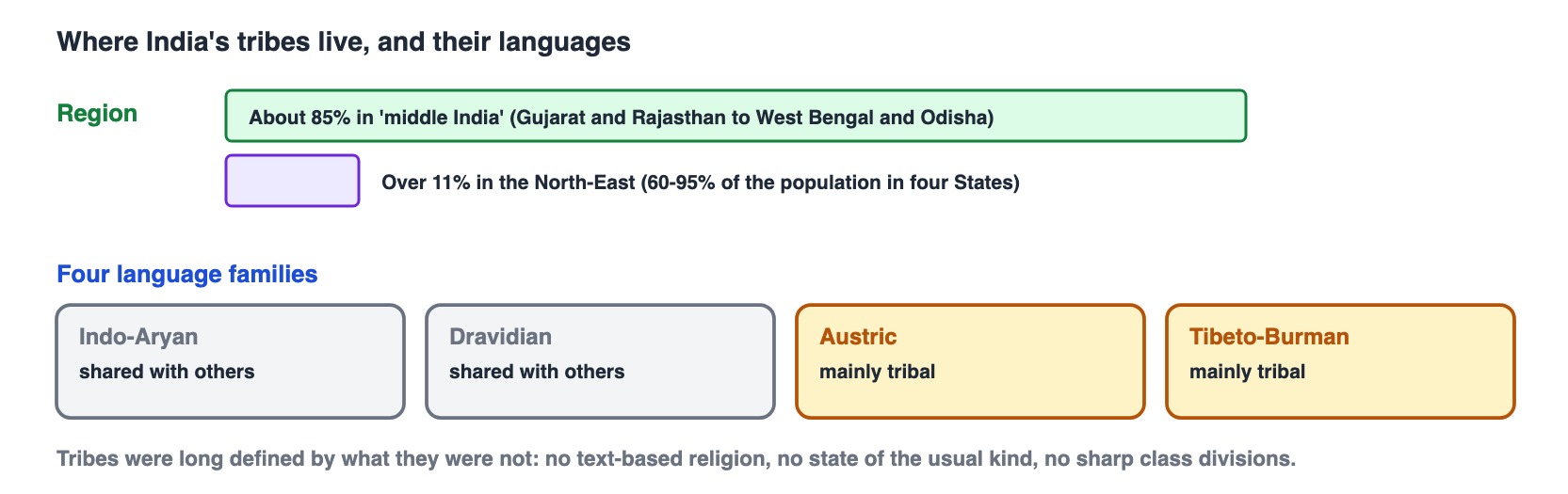
Where tribes live and the four language families.
Numbers: Census 2011 counted about 104 million tribal people, 8.6% of the population; the Government's 2025 count is over 10.45 crore. There are 75 Particularly Vulnerable Tribal Groups in 18 States and 1 Union Territory.
Tribe: The Career of a Concept
Sociologists have argued for decades about what makes a tribe a tribe.
Tribe: the career of a concept
Continuum or difference? In the 1960s some saw tribes as one end of a continuum with caste-peasant society, simply less stratified and with community ownership of resources. Others said tribes were wholly different because they had no notion of purity and pollution.
By the 1970s every major definition was shown to be faulty: size, isolation, religion and livelihood all failed as tests. Santhals, Gonds and Bhils are huge and spread out; Mundas and Hos took to settled farming long ago; some castes turned to hunting.
Absorption: Indian history is often read as tribes being absorbed into caste society through Sanskritisation, conquest or acculturation. Early anthropologists stressed the cultural side; later writers, the exploitation.
Not "pristine": some scholars see tribes as "secondary" phenomena, formed through contact with states. Adivasis were not always subordinate: there were Gond kingdoms such as Garha Mandla and Chanda, and tribes traded forest produce, salt and elephants.
When should tribes be one category? (the 2022 question)
Tribes are diverse in language, region, livelihood and degree of integration, and the most vulnerable (the PVTGs) differ sharply from the emerging tribal middle class. They make sense as a single category where they share a common relationship with the state and the market: constitutional status and reservations, protection of land and forests, and shared experience of displacement. Elsewhere, policy must be group-specific, which is exactly why PVTGs have their own mission.
Development, Displacement and Identity
The central question of tribal sociology today is development: whose development, and at whose cost?
National development versus tribal development
A disproportionate price: dams, factories and mines were built in mineral-rich, forested tribal areas. The Sardar Sarovar dam on the Narmada and the Polavaram dam on the Godavari displaced hundreds of thousands of adivasis; land acquisition became easier after liberalisation in the 1990s.
Loss of forests and commons: forests were exploited from British times on, and private property in land disadvantaged community ownership.
In-migration: non-tribal inflows diluted tribal shares in Jharkhand's industrial belt; in Tripura the tribal share was halved within a single decade, turning them into a minority.
'Adivasi', meaning "original inhabitants", was coined in the 1930s in resistance to colonial intrusion, outside settlers and moneylenders. Like "Dalit", it signals political awareness. Movements won statehood for Jharkhand and Chhattisgarh, possible because adivasis, unlike Dalits, live in contiguous areas.
Identity today grows from interaction with the mainstream, not from some primordial essence. An educated tribal middle class is emerging, and movements turn on two issues that can diverge: control of land and forests, and ethnic-cultural identity.
Rights that answer these problems
Instrument | What it gives |
Forest Rights Act, 2006, Section 3(1) | Individual and community rights, including rights to protect and manage community forest resources, habitat rights for PVTGs, and access to biodiversity and the community right to intellectual property and traditional knowledge; 23.88 lakh individual and 1.21 lakh community titles distributed |
RFCTLARR Act, 2013 | The Right to Fair Compensation and Transparency in Land Acquisition, Rehabilitation and Resettlement Act governs compensation and resettlement when land is taken |
Statehood and special laws | Jharkhand and Chhattisgarh; Fifth and Sixth Schedule protections (Polity playlist) |
The state's response today
Money across ministries: under the Development Action Plan for Scheduled Tribes, 42 ministries and departments earmark funds, which rose about fivefold from Rs 24,598 crore (2013-14) to Rs 1.23 lakh crore (2024-25).
The most vulnerable first: PM-JANMAN (Rs 24,104 crore) aims to saturate PVTG habitations with housing, roads, water, health and education, recognising that the PVTGs need group-specific policy.
Villages: the Dharti Aaba Janjatiya Gram Utkarsh Abhiyan, launched on 2 October 2024 from Hazaribagh, Jharkhand (Rs 79,156 crore), covers about 63,843 tribal-majority villages and aspirational districts.
Knowledge and culture: 29 Tribal Research Institutes document tribal heritage, languages and traditional knowledge.
The unresolved part: the NCERT text notes that several North-Eastern States lived for decades under special laws that limit civil liberties, a reminder that integration has come with security as well as welfare.
Writing the tribal answers
Tribal knowledge systems (2021): oral, community-owned and tied to ecology (forests, medicinal plants, seeds, water), in contrast to codified, individual, market-oriented knowledge. The FRA's recognition of community intellectual property and traditional knowledge is the legal hook.
Displacement and rehabilitation (2025): agree that development has centred on these two axes, using the Narmada and Polavaram examples and the disproportionate-price argument, then show the alternative: consent, community forest rights, a share in project benefits, and education that builds the tribal middle class without erasing identity.
Further Reading
PIB press releases, ministry websites and annual reports, the Gazette of India, MEA and UN documents and the official sources named in each note — the primary sources behind every fact above.
Test Yourself: Practice Questions & PYQs
12 practice questions, then the three GS Paper 1 questions on tribes.
Practice Questions
Q1. According to the NCERT text, about what share of India's tribal population lives in 'middle India'?
(a) About 50%
(b) About 85%
(c) About 3%
(d) About 11%
Show answer
Answer: (b) — Over 11% live in the North-East and a little over 3% elsewhere.
Q2. Which two language families are spoken primarily by tribal communities?
(a) Indo-Aryan and Dravidian
(b) Dravidian and Austric
(c) Austric and Tibeto-Burman
(d) Indo-Aryan and Tibeto-Burman
Show answer
Answer: (c) — Tribes are only about 1% of Indo-Aryan and 3% of Dravidian speakers.
Q3. Census 2011 put India's tribal population at about
(a) 8.6% of the population
(b) 16.6%
(c) 12.4%
(d) 5.2%
Show answer
Answer: (a) — About 104 million people.
Q4. How many Particularly Vulnerable Tribal Groups (PVTGs) are there?
(a) 104
(b) 75
(c) 62
(d) 90
Show answer
Answer: (b) — In 18 States and 1 Union Territory.
Q5. Scholars who argued that tribes were wholly different from castes stressed that tribes
(a) were all nomadic
(b) had no notion of purity and pollution
(c) were always small
(d) had no agriculture
Show answer
Answer: (b) — By the 1970s this and other definitions were shown to be faulty.
Q6. Which of these was a Gond kingdom in Central India?
(a) Hoysala
(b) Kakatiya
(c) Garha Mandla
(d) Vijayanagara
Show answer
Answer: (c) — Chanda was another.
Q7. The term 'Adivasi', meaning 'original inhabitants', was coined in the
(a) 1880s
(b) 1970s
(c) 1930s
(d) 1950s
Show answer
Answer: (c) — In the struggle against colonial intrusion, outside settlers and moneylenders.
Q8. Which two States were created after long adivasi movements?
(a) Goa and Sikkim
(b) Telangana and Uttarakhand
(c) Mizoram and Nagaland
(d) Jharkhand and Chhattisgarh
Show answer
Answer: (d) — Adivasis live in contiguous areas and could demand States of their own.
Q9. In which State, according to the NCERT text, did the tribal share of the population halve within a single decade?
(a) Tripura
(b) Mizoram
(c) Odisha
(d) Jharkhand
Show answer
Answer: (a) — In-migration of non-tribals turned them into a minority.
Q10. Consider the following statements:
1. Section 3(1) of the Forest Rights Act recognises the community right to intellectual property and traditional knowledge.
2. It recognises habitat rights for primitive tribal groups.
3. It allows the sale of tribal forest land to private buyers.
Which of the statements given above are correct?
(a) 1 and 2 only
(b) 2 and 3 only
(c) 1 and 3 only
(d) 1, 2 and 3
Show answer
Answer: (a) — 1 and 2 are correct. Forest rights are heritable but not alienable or transferable.
Q11. The Sardar Sarovar and Polavaram dams are cited in the NCERT text as examples of
(a) tribal self-governance
(b) community forest management
(c) displacement of adivasis by development projects
(d) Sanskritisation
Show answer
Answer: (c) — They displaced hundreds of thousands of adivasis.
Q12. Which Act governs compensation, rehabilitation and resettlement when land is acquired?
(a) Forest Conservation Act, 1980
(b) PESA Act, 1996
(c) RFCTLARR Act, 2013
(d) Land Acquisition Act, 1894 (still in force)
Show answer
Answer: (c) — The Right to Fair Compensation and Transparency in Land Acquisition, Rehabilitation and Resettlement Act, 2013.
Mains Practice Questions
Use these to frame full-length answers. You don't have to answer one exactly — they show the angles UPSC tests, so let them guide which points you cover.
Does tribal development in India centre around displacement and rehabilitation? Give your opinion.
Given their diversity, when should tribal communities be considered a single category?
What makes tribal knowledge systems distinct, and how can the law protect them?
UPSC Mains — Previous Years’ Questions on this topic (last 10 years)
These are the actual GS Mains questions UPSC has asked on this theme — real proof of how, and when, it is tested. Try to write a full answer to each.
2021 (GS-I): Examine the uniqueness of tribal knowledge system when compared with mainstream knowledge and cultural systems.
2022 (GS-I): Given the diversities among tribal communities in India, in which specific contexts should they be considered as a single category?
2025 (GS-I): Does tribal development in India centre around two axes, those of displacement and of rehabilitation? Give your opinion.