Menopause for NEET PG OBG: Definition, Stages, Hot Flushes, Genitourinary Syndrome, Hormone Therapy Rules and Non-hormonal Options
Start Here
🎯 Exam priority: Moderate–high. Expect: 12-month definition, average and premature/early ages, FSH role, hot flush facts, GSM and its local treatment, why a progestogen is added, the age/time window for starting hormone therapy, its risks, and non-hormonal alternatives.
CBME mapping: OG32.
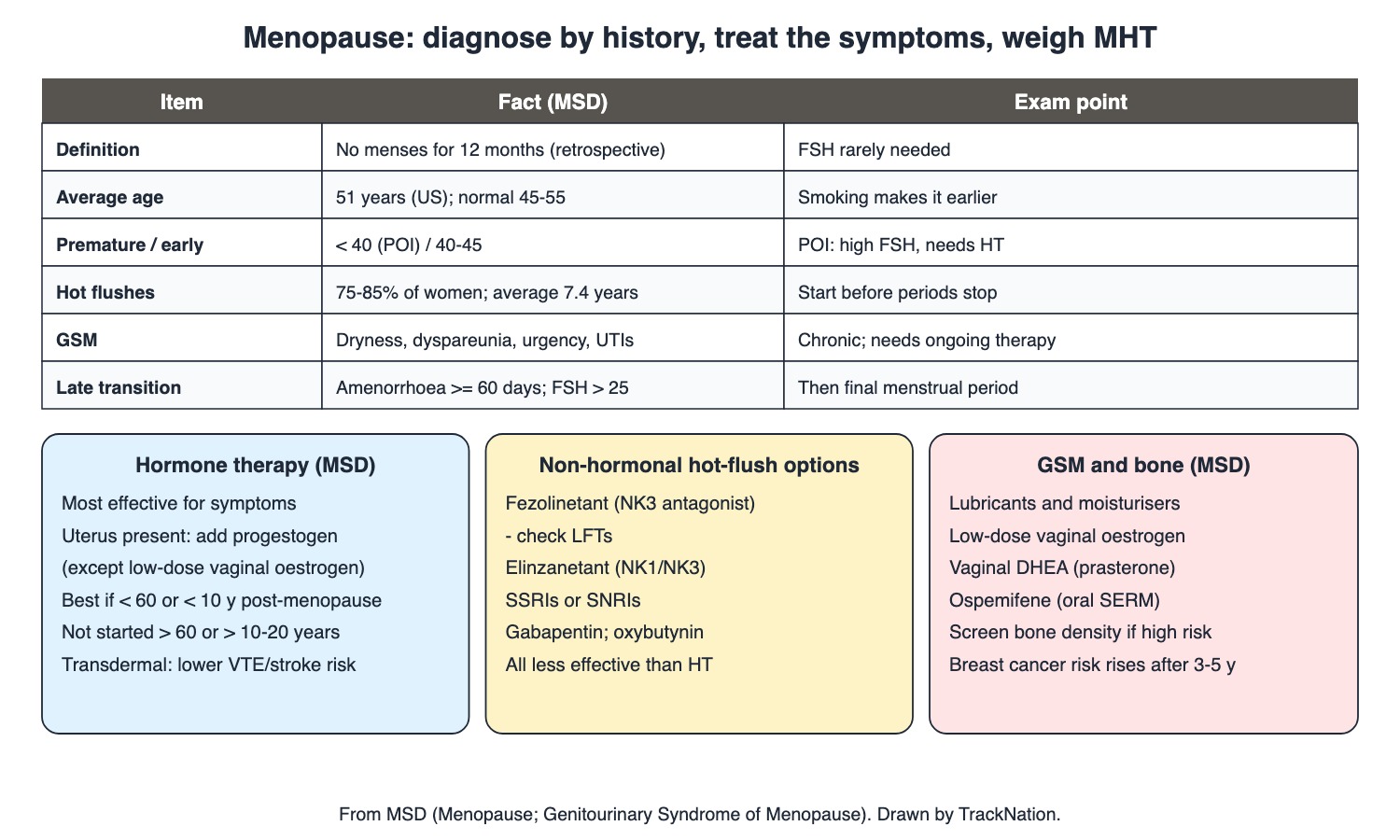
Menopause definitions, symptoms, hormone therapy and alternatives. Drawn by TrackNation.
Definitions and Stages (MSD)
Menopause is diagnosed retrospectively after 12 months without menses; average age 51 (US), normal range 45–55. Smoking, high altitude and undernutrition bring it earlier.
Premature <40 (= primary ovarian insufficiency, treated with oestrogen-progestogen); early 40–45.
Perimenopause: years before and 1 year after the last period — the most symptomatic phase. The menopausal transition lasts about 4–8 years; late transition = gaps of ≥60 days, FSH >25 IU/L. FSH is rarely needed (e.g. after hysterectomy or at a young age).
Rule out pregnancy, other causes of amenorrhoea and uterine cancer in abnormal bleeding.
Symptoms (MSD)
Hot flushes/night sweats in 75–85%, usually starting before periods stop, lasting on average 7.4 years (sometimes >10).
Genitourinary syndrome of menopause (GSM): falling oestrogen → dryness, burning, dyspareunia, urgency, dysuria, recurrent UTIs. It is chronic; treatment must continue.
Others: sleep disturbance, mood change; long-term bone loss — screen bone density in women at high fracture risk.
Treatment (MSD)
Hormone therapy (HT) is the most effective treatment for symptoms. With a uterus, oestrogen must be combined with a progestogen (prevents endometrial neoplasia) — except very low-dose vaginal oestrogen; conjugated oestrogens + bazedoxifene need no progestogen.
Timing: benefits most likely exceed harms in healthy women <60 years or <10 years after menopause; starting >60 or >10–20 years after is generally not recommended (more coronary disease).
Risks: breast cancer rises after 3–5 years of combined therapy (oestrogen alone: slightly lower at 7 years in WHI); VTE and stroke lower with low-dose transdermal oestrogen. HT reduces bone loss and fractures.
Non-hormonal (all less effective than HT): fezolinetant (neurokinin-3 antagonist; check LFTs), elinzanetant (NK1/NK3), SSRIs/SNRIs, gabapentin, oxybutynin. Raloxifene for bone protection in women at high breast-cancer risk.
GSM: lubricants and moisturisers; first-line drugs — low-dose vaginal oestrogen, vaginal DHEA (prasterone) or ospemifene (oral SERM; VTE risk).
Traps the Examiner Sets
Menopause is a clinical, retrospective diagnosis — not an FSH diagnosis.
Oestrogen alone is only for women without a uterus (vaginal low dose excepted).
Starting HT after 60 or long after menopause is not advised.
Premature menopause is before 40; early is 40–45.
Memory Hooks & Shortcuts
Shortcuts to lock in this article's numbers and lists. Each one only re-packages facts proven above.
🧠 '12 months, 51 years, 40 premature, 45 early' — definitions
🧠 'Uterus = add Progestogen' (vaginal low-dose oestrogen excepted) — HT
🧠 HT window '60 or 10': under 60 or within 10 years — timing
🧠 'Patch protects' — transdermal oestrogen means less clotting and stroke — route
🧠 Fezolinetant: 'NK3 blocks the hot flush, check the liver' — non-hormonal
Rapid-Revision Cards
Definition
12 months no menses.
Average age
51 (normal 45–55).
Premature
<40.
Early
40–45.
Earlier with
Smoking, altitude, undernutrition.
FSH test
Rarely needed.
Late transition
≥60-day gaps; FSH >25.
Hot flushes
75–85%; ~7.4 y.
GSM
Dryness, dyspareunia, urgency.
Best for symptoms
Hormone therapy.
Uterus present
Add progestogen.
Exception
Low-dose vaginal oestrogen.
CE + bazedoxifene
No progestogen needed.
HT window
<60 or <10 y.
Don't start
>60 or >10–20 y.
Breast risk
After 3–5 y combined.
Safer route
Transdermal (VTE, stroke).
Fezolinetant
NK3 antagonist; LFTs.
GSM drugs
Vaginal E, DHEA, ospemifene.
Bone + breast risk
Raloxifene.
POI
E + P therapy.
Sources
Facts in this article were checked against these documents.
MSD Manual Professional: Menopause; Genitourinary Syndrome of Menopause; Primary Ovarian Insufficiency — Merck & Co. (MSD Manuals), 2025–26 (link)
Competency Based Undergraduate Curriculum, Vol III: Obstetrics & Gynaecology (OG32) — National Medical Commission, 2024
Test Yourself: Practice Questions
Thirty questions in NEET PG style, most of them clinical vignettes.
Practice Questions (NEET PG pattern)
Original questions written in the style of the exam: +4 for a correct answer, −1 for a wrong one. Every answer was checked against the sources listed above. NEET PG papers are not published by NBEMS, so these are not past-paper questions.
Q1. Menopause is diagnosed when there has been no menstruation for
(a) 6 months
(b) 12 months
(c) 3 months
(d) 24 months
Show answer
Answer: (b) — Retrospective.
Q2. The average age of natural menopause (MSD, US data) is
(a) 40 years
(b) 51 years
(c) 55 years
(d) 45 years
Show answer
Answer: (b) — Normal 45–55.
Q3. A factor that makes menopause occur earlier is
(a) oral contraceptive use
(b) multiparity
(c) smoking
(d) obesity
Show answer
Answer: (c) — Also altitude, undernutrition.
Q4. Menopause at 38 years is termed
(a) normal
(b) early
(c) premature (primary ovarian insufficiency)
(d) late
Show answer
Answer: (c) — <40.
Q5. Menopause at 43 years is termed
(a) normal
(b) early
(c) late
(d) premature
Show answer
Answer: (b) — 40–45.
Q6. A 50-year-old with 12 months of amenorrhoea and hot flushes asks for an FSH test. MSD says FSH is
(a) needed monthly
(b) rarely necessary — diagnosis is clinical
(c) mandatory
(d) the only way to diagnose
Show answer
Answer: (b) — Except after hysterectomy/young.
Q7. Hot flushes affect about
(a) 75–85% of women
(b) 100%
(c) 5%
(d) 25%
Show answer
Answer: (a) — Average 7.4 years.
Q8. Vasomotor symptoms last on average
(a) 6 months
(b) 7.4 years
(c) 1 month
(d) 20 years always
Show answer
Answer: (b) — Can exceed 10 years.
Q9. Hot flushes usually begin
(a) only 5 years after menopause
(b) before periods stop
(c) never in perimenopause
(d) only after surgery
Show answer
Answer: (b) — MSD.
Q10. The late menopausal transition is marked by
(a) regular cycles
(b) amenorrhoea of ≥60 days and FSH >25 IU/L
(c) low FSH
(d) heavy regular periods
Show answer
Answer: (b) — STRAW-type staging.
Q11. The most effective treatment for menopausal vasomotor symptoms is
(a) SSRIs
(b) black cohosh
(c) hormone therapy
(d) gabapentin
Show answer
Answer: (c) — MSD.
Q12. A 52-year-old with an intact uterus starts systemic oestrogen. She must also take
(a) a progestogen
(b) testosterone
(c) nothing else
(d) thyroxine
Show answer
Answer: (a) — Prevents endometrial neoplasia.
Q13. Which oestrogen can be used without a progestogen in a woman with a uterus?
(a) oral conjugated oestrogen 0.625 mg alone
(b) transdermal oestradiol patch alone
(c) very low-dose vaginal oestrogen for GSM
(d) any oestrogen
Show answer
Answer: (c) — Also CE + bazedoxifene.
Q14. Conjugated oestrogens can be given without a progestogen when combined with
(a) tamoxifen
(b) bazedoxifene
(c) clomiphene
(d) letrozole
Show answer
Answer: (b) — A SERM.
Q15. Benefits of HT most likely outweigh harms in healthy symptomatic women who are
(a) over 70
(b) any age equally
(c) 20 years past menopause
(d) under 60 or within 10 years of menopause
Show answer
Answer: (d) — Timing window.
Q16. A 68-year-old, 18 years post-menopause, asks to start HT for prevention. MSD advice:
(a) generally not recommended
(b) mandatory for bone
(c) start high-dose oestrogen
(d) start oral HT at once
Show answer
Answer: (a) — More coronary risk.
Q17. Breast cancer risk with standard combined HT begins to rise after about
(a) 1 month
(b) 20 years
(c) it never rises
(d) 3–5 years
Show answer
Answer: (d) — MSD.
Q18. VTE and stroke risk with HT may be lower with
(a) injectable oestrogen
(b) oral oestrogen with tamoxifen
(c) high-dose oral oestrogen
(d) low-dose transdermal oestrogen
Show answer
Answer: (d) — MSD.
Q19. In WHI, oestrogen-alone therapy in women without a uterus
(a) doubled breast cancer
(b) had no data
(c) caused endometrial cancer
(d) slightly lowered breast cancer risk at 7 years
Show answer
Answer: (d) — Benefit faded later.
Q20. HT in postmenopausal women
(a) increases fractures
(b) causes osteomalacia
(c) reduces bone loss and fractures
(d) has no bone effect
Show answer
Answer: (c) — MSD.
Q21. Fezolinetant treats hot flushes by
(a) blocking dopamine
(b) blocking neurokinin-3 receptors
(c) replacing oestrogen
(d) blocking serotonin reuptake
Show answer
Answer: (b) — Check LFTs.
Q22. Before starting fezolinetant you must check
(a) bone density
(b) serum calcium
(c) TSH
(d) liver function tests
Show answer
Answer: (d) — Then 3-monthly.
Q23. Non-hormonal drugs for hot flushes, compared with HT, are
(a) equally effective always
(b) more effective
(c) contraindicated
(d) less effective
Show answer
Answer: (d) — MSD.
Q24. A breast cancer survivor wants non-hormonal relief of hot flushes. Options include
(a) systemic oestrogen
(b) SSRIs/SNRIs, gabapentin or a neurokinin antagonist
(c) tibolone
(d) testosterone
Show answer
Answer: (b) — MSD list.
Q25. Vaginal dryness, dyspareunia and urinary urgency after menopause are called
(a) Asherman syndrome
(b) PMOS
(c) genitourinary syndrome of menopause
(d) vaginismus
Show answer
Answer: (c) — Oestrogen deficiency.
Q26. First-line drug treatments for moderate–severe GSM include
(a) GnRH agonists
(b) low-dose vaginal oestrogen, vaginal DHEA or ospemifene
(c) danazol
(d) oral antibiotics
Show answer
Answer: (b) — Plus lubricants.
Q27. GSM treatment should be
(a) avoided
(b) stopped after symptoms settle
(c) given for 1 week only
(d) continued long term (chronic condition)
Show answer
Answer: (d) — Recurs on stopping.
Q28. Ospemifene is an oral SERM that carries a risk of
(a) hyperkalaemia
(b) lactic acidosis
(c) hypoglycaemia
(d) venous thrombosis
Show answer
Answer: (d) — MSD.
Q29. A postmenopausal woman at high breast cancer risk needs fracture prevention. MSD mentions
(a) systemic oestrogen alone
(b) progestogen alone
(c) raloxifene
(d) tamoxifen for bone
Show answer
Answer: (c) — SERM.
Q30. A 35-year-old with primary ovarian insufficiency should usually receive
(a) no treatment
(b) progestogen only
(c) clomiphene
(d) combined oestrogen-progestogen therapy
Show answer
Answer: (d) — Until natural menopause age.
Active Recall
From memory: define menopause and its premature and early forms, describe stages and symptoms including GSM, state hormone therapy rules, timing and risks, and list non-hormonal and local treatments.