Paediatric Endocrinology for NEET PG: Congenital Hypothyroidism, CAH (21-Hydroxylase), Childhood DKA, Growth Hormone Deficiency and Puberty
Start Here
🎯 Exam priority: High. Expect: commonest cause of congenital hypothyroidism, screen TSH threshold for immediate treatment, the CAH enzyme block and electrolytes, screening marker, DKA definition and grades, fluid and insulin rates, cerebral oedema, GH-deficiency growth velocity, and puberty age cut-offs.
Fact-checked against the MSD Manual (paediatric endocrine chapters).
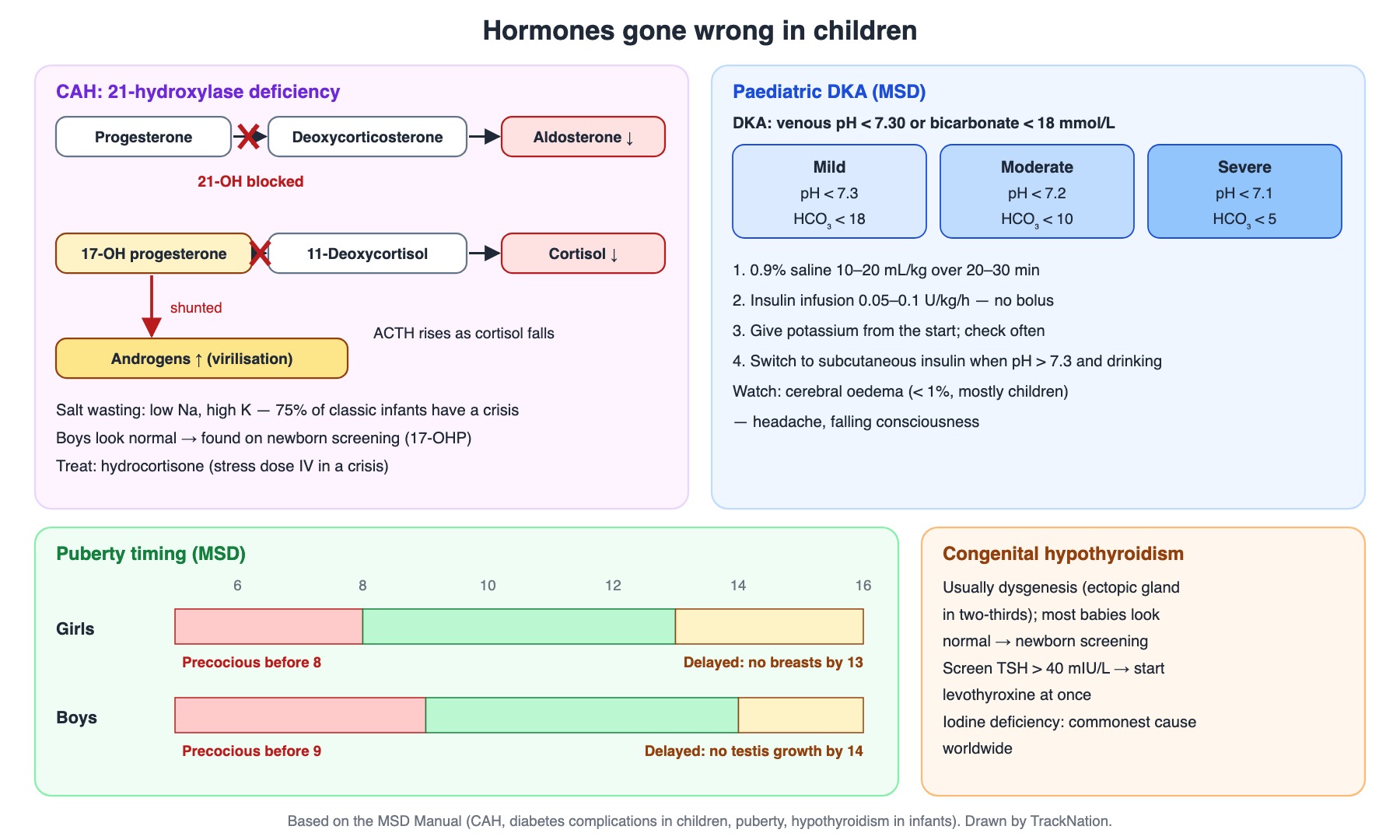
CAH steroid block, paediatric DKA, puberty timing and congenital hypothyroidism. Drawn by TrackNation.
Thyroid
Congenital hypothyroidism: usually thyroid dysgenesis — ectopic gland in two-thirds, otherwise absent or hypoplastic. Worldwide, iodine deficiency remains the commonest cause in children.
Most babies look normal and are found on newborn screening; untreated infants show hypotonia with protruding tongue, coarse face, jaundice and umbilical hernia.
Screen TSH > 40 mIU/L → start levothyroxine at once (after the confirmatory sample); once daily, closely monitored. Older children: treat if TSH > 10. Autoimmune thyroiditis peaks in adolescence.
Neonatal hyperthyroidism: rare (1–5% of babies of mothers with Graves) but life-threatening — maternal TSH-receptor antibodies cross over.
Congenital Adrenal Hyperplasia (21-Hydroxylase)
Block in CYP21A2 → low cortisol (and often aldosterone) → ACTH rises → precursors pile up (17-OH progesterone) and are shunted to androgens → virilisation.
Salt wasting: low sodium, high potassium; 75% of infants with classic disease have a salt-wasting crisis. Boys have normal genitals, so are often found only on newborn screening (17-OHP).
Treat with hydrocortisone — IV stress doses in a crisis.
Type 1 Diabetes and DKA
Type 1 diabetes: autoimmune beta-cell destruction; the commonest diabetes in children; polyuria, polydipsia, polyphagia, weight loss; screen for thyroid and coeliac disease.
DKA: venous pH < 7.30 or bicarbonate < 18; moderate pH < 7.2 / HCO₃ < 10; severe pH < 7.1 / HCO₃ < 5.
Treat: 0.9% saline 10–20 mL/kg over 20–30 min (faster boluses for shock); insulin 0.05–0.1 U/kg/h with no bolus; start potassium with the first fluids and hold insulin if K < 3.5; move to subcutaneous insulin when pH > 7.3 and drinking.
Cerebral oedema (< 1%, mainly children): headache, falling consciousness, sometimes respiratory arrest first. HHS (glucose > 600) is mostly type 2.
Growth and Puberty
GH deficiency: height < 3rd centile with slow growth — < 6 cm/yr before 4, < 5 cm/yr at 4–8, < 4 cm/yr before puberty; bone age > 2 years behind; read IGF-1 against bone age.
Precocious puberty: before 8 in girls, 9 in boys; GnRH-dependent (central) is commoner, especially in girls.
Delayed puberty: no breast development by 13 (girls) or testicular enlargement by 14 (boys); constitutional delay is commonest in boys and self-limiting.
Traps the Examiner Sets
Ectopic thyroid is the commonest dysgenesis; iodine deficiency the commonest cause worldwide.
CAH: low Na, high K, high 17-OHP; girls virilised, boys missed without screening.
No insulin bolus in paediatric DKA; potassium goes in early.
Precocious: 8 girls / 9 boys. Delayed: 13 girls / 14 boys.
Memory Hooks & Shortcuts
Shortcuts to lock in this article's numbers and lists. Each one only re-packages facts proven above.
🧠 Congenital hypothyroid: 'ectopic is epidemic' (two-thirds); TSH over 40 = treat today — thyroid
🧠 CAH 'Salt out, Potassium in, Sex hormones up' — CAH
🧠 DKA kids: 'Saline, Slow insulin, Supplement K — no Bolus' — DKA
🧠 Puberty '8-9 early, 13-14 late' (girls first) — puberty
🧠 GH deficiency growth '6-5-4' cm per year — growth
Rapid-Revision Cards
CH cause
Dysgenesis; ectopic in ⅔.
Worldwide cause
Iodine deficiency.
CH detection
Newborn screening.
CH treat
TSH > 40 → levothyroxine at once.
CH signs
Hypotonia, protruding tongue, jaundice, umbilical hernia.
Neonatal Graves
Maternal TRAb; 1–5%.
CAH enzyme
21-hydroxylase (CYP21A2).
CAH physiology
Cortisol ↓ → ACTH ↑ → androgens ↑.
Salt wasting
Na ↓, K ↑; 75% of classic infants.
CAH screen
17-OHP.
CAH Rx
Hydrocortisone (stress dose in crisis).
T1DM
Autoimmune; commonest in children.
DKA
pH < 7.30 or HCO₃ < 18.
Severe DKA
pH < 7.1, HCO₃ < 5.
DKA fluids
NS 10–20 mL/kg over 20–30 min.
DKA insulin
0.05–0.1 U/kg/h, no bolus; hold if K < 3.5.
Cerebral oedema
< 1%; headache, drowsy.
GH deficiency
< 6 cm/yr (< 4 y); bone age > 2 y behind.
Precocious
< 8 girls, < 9 boys; central commoner.
Delayed
No breasts by 13; no testis growth by 14.
Constitutional delay
Boys; self-limiting.
Sources
Facts in this article were checked against these documents.
MSD Manual Professional: Hypothyroidism and Hyperthyroidism in Infants and Children; CAH (21-Hydroxylase); Type 1 Diabetes and Complications in Children; GH Deficiency; Precocious and Delayed Puberty — Merck & Co., 2025–2026 (link)
Test Yourself: Practice Questions
Thirty questions in NEET PG style, many of them ward scenarios.
Practice Questions (NEET PG pattern)
Original questions written in the style of the exam: +4 for a correct answer, −1 for a wrong one. Every answer was checked against the sources listed above. NEET PG papers are not published by NBEMS, so these are not past-paper questions.
Q1. The commonest form of thyroid dysgenesis in congenital hypothyroidism is
(a) dyshormonogenesis
(b) hypoplasia
(c) agenesis
(d) ectopic thyroid
Show answer
Answer: (d) — Two-thirds.
Q2. Worldwide, the commonest cause of hypothyroidism in children is
(a) Hashimoto thyroiditis
(b) thyroid agenesis
(c) iodine deficiency
(d) drugs
Show answer
Answer: (c) — MSD.
Q3. Most babies with congenital hypothyroidism are detected by
(a) cretinism at 1 month
(b) goitre at birth
(c) newborn screening
(d) seizures
Show answer
Answer: (c) — Few signs early.
Q4. If the newborn screening TSH is above 40 mIU/L, you should
(a) wait for repeat results
(b) start levothyroxine at once after the confirmatory sample
(c) repeat at 6 months
(d) give iodine
Show answer
Answer: (b) — MSD.
Q5. Signs of untreated congenital hypothyroidism at 6 weeks include
(a) tachycardia and weight loss
(b) protruding tongue, coarse face, jaundice, umbilical hernia
(c) hypertension
(d) precocious puberty
Show answer
Answer: (b) — MSD.
Q6. Neonatal hyperthyroidism is caused by
(a) pituitary tumour
(b) thyroid agenesis
(c) iodine excess
(d) maternal TSH-receptor antibodies
Show answer
Answer: (d) — Mothers with Graves.
Q7. The enzyme deficient in the commonest form of CAH is
(a) 21-hydroxylase
(b) aromatase
(c) 11β-hydroxylase
(d) 17α-hydroxylase
Show answer
Answer: (a) — CYP21A2.
Q8. In 21-hydroxylase deficiency, virilisation is due to
(a) excess aldosterone
(b) excess cortisol
(c) precursors shunted into androgens
(d) maternal androgens
Show answer
Answer: (c) — ACTH drive.
Q9. Salt-wasting CAH causes
(a) hypercalcaemia
(b) hyponatraemia and hyperkalaemia
(c) hypernatraemia and hypokalaemia
(d) metabolic alkalosis
Show answer
Answer: (b) — Aldosterone deficiency.
Q10. Of infants with classic 21-hydroxylase deficiency, the share with a salt-wasting crisis is about
(a) 75%
(b) 100%
(c) 5%
(d) 25%
Show answer
Answer: (a) — MSD.
Q11. Boys with salt-wasting CAH are often diagnosed late because
(a) they are always mosaic
(b) they never lose salt
(c) their genitals look normal
(d) they have no ACTH rise
Show answer
Answer: (c) — Newborn screening helps.
Q12. The newborn screening marker for CAH is
(a) 17-hydroxyprogesterone
(b) IRT
(c) TSH
(d) phenylalanine
Show answer
Answer: (a) — MSD.
Q13. A salt-wasting crisis in CAH is treated with
(a) insulin
(b) IV stress-dose hydrocortisone
(c) spironolactone
(d) levothyroxine
Show answer
Answer: (b) — Plus fluids.
Q14. The commonest type of diabetes in children is
(a) MODY
(b) neonatal diabetes
(c) type 1
(d) type 2
Show answer
Answer: (c) — MSD.
Q15. Children with type 1 diabetes should also be watched for
(a) thyroid and coeliac disease
(b) osteoporosis only
(c) gout
(d) Wilms tumour
Show answer
Answer: (a) — Other autoimmune diseases.
Q16. DKA is defined by venous pH below
(a) 7.35 with normal bicarbonate
(b) 7.45
(c) 7.30 (or bicarbonate < 18)
(d) 7.0 only
Show answer
Answer: (c) — MSD.
Q17. Severe DKA is pH below
(a) 7.1 (bicarbonate < 5)
(b) 7.2
(c) 6.5
(d) 7.3
Show answer
Answer: (a) — MSD.
Q18. Initial fluid in paediatric DKA (MSD) is
(a) no fluid
(b) 0.9% saline 10–20 mL/kg over 20–30 min
(c) 5% dextrose 50 mL/kg
(d) 0.45% saline 100 mL/kg
Show answer
Answer: (b) — Faster for shock.
Q19. Insulin in paediatric DKA is started at
(a) 1 U/kg subcutaneous
(b) 0.1 U/kg bolus then 1 U/kg/h
(c) only after 24 hours
(d) 0.05–0.1 U/kg/h without a bolus
Show answer
Answer: (d) — MSD.
Q20. Insulin should be held in DKA if serum potassium is below
(a) 5.5 mEq/L
(b) 3.5 mEq/L
(c) 4.5 mEq/L
(d) 6 mEq/L
Show answer
Answer: (b) — Potassium goes in early.
Q21. A child in DKA develops headache and falling consciousness on treatment. Suspect
(a) meningitis
(b) hypoglycaemia only
(c) cerebral oedema
(d) stroke from polycythaemia
Show answer
Answer: (c) — < 1%, mostly children.
Q22. In GH deficiency, growth velocity before age 4 is below
(a) 2 cm/year
(b) 12 cm/year
(c) 10 cm/year
(d) 6 cm/year
Show answer
Answer: (d) — < 5 at 4–8; < 4 before puberty.
Q23. In GH deficiency, bone age is typically
(a) more than 2 years behind
(b) 1 month behind
(c) normal
(d) advanced
Show answer
Answer: (a) — MSD.
Q24. Precocious puberty in girls is sexual maturation before
(a) 8 years
(b) 10 years
(c) 6 years
(d) 12 years
Show answer
Answer: (a) — 9 in boys.
Q25. Precocious puberty in boys is maturation before
(a) 11 years
(b) 13 years
(c) 8 years
(d) 9 years
Show answer
Answer: (d) — MSD.
Q26. The commoner type of precocious puberty is
(a) GnRH-dependent (central)
(b) McCune–Albright
(c) adrenal tumour
(d) GnRH-independent
Show answer
Answer: (a) — Especially girls.
Q27. Delayed puberty in girls is no breast development by
(a) 18 years
(b) 16 years
(c) 10 years
(d) 13 years
Show answer
Answer: (d) — Boys: testes by 14.
Q28. Delayed puberty in boys is no testicular enlargement by
(a) 16 years
(b) 11 years
(c) 18 years
(d) 14 years
Show answer
Answer: (d) — MSD.
Q29. A healthy short 14-year-old boy with a family history of late growth most likely has
(a) Klinefelter
(b) CAH
(c) constitutional delay of puberty
(d) GH deficiency
Show answer
Answer: (c) — Self-limiting.
Q30. HHS in young people mainly occurs with
(a) CAH
(b) hypothyroidism
(c) type 1 diabetes
(d) type 2 diabetes
Show answer
Answer: (d) — Glucose > 600.
Active Recall
From memory: explain causes, screening and treatment of congenital hypothyroidism, the CAH block and its consequences, paediatric DKA definition, grades and treatment with cerebral oedema, GH deficiency criteria, and the age cut-offs for precocious and delayed puberty.