Communication Technologies for UPSC: Li-Fi, VLC, LEDs, Radar, LTE and VoLTE, 5G, 6G, BharatNet and Digital Bharat Nidhi
How UPSC Tests Communication Technologies
🎯 Exam priority: Tier-1/2. These questions ask what a communication technology uses and how it differs from its neighbour. UPSC asked: Li-Fi (2016); the difference between LTE and VoLTE (2019); Visible Light Communication (2020); how sodium lamps differ from LEDs (2021); and what radars can detect (2024). Mains asked the importance of the National LED Programme (2016) and the impact of the invention of blue LEDs (2021).
Two boxes: light-based technologies (LED, Li-Fi, VLC, radar) and mobile and broadband networks (4G, 5G, 6G, BharatNet).
Li-Fi, VLC, LEDs and Radar
Light, LEDs and radar
Technology | How it works | Exam fact |
Li-Fi | Data sent by modulating the light of LEDs | A wireless technology that uses light as the medium and can be several times faster than Wi-Fi (2016: both statements right) |
Visible Light Communication (VLC) | Uses visible light of about 375 to 780 nm | Faster than Bluetooth and free from electromagnetic interference, but short-range, not long-range (2020) |
LED versus sodium lamp | An LED is a semiconductor diode that emits light; a sodium lamp is a gas-discharge lamp | Sodium light is nearly monochromatic yellow and spreads in all directions; LEDs are directional, have better colour and last far longer, so statement 2 was wrong (2021) |
Blue LED | Needed to make white light from LEDs | Akasaki, Amano and Nakamura won the 2014 Nobel Prize in Physics; the Mains 2021 question asked how it affected daily life: cheap, efficient lighting, screens and low carbon emissions |
Radar | Sends radio waves and times the echo | Used to monitor precipitation and to track migrating birds and animals, but not to identify narcotics on passengers (2024) |
The National LED programme (UJALA, from 2015) distributes LED bulbs and tubelights at low cost to cut electricity use, and the Street Lighting National Programme replaces conventional street lamps with LEDs; LEDs use far less power for the same light and last much longer (Mains 2016).
4G, 5G, 6G and the 2025 Connectivity Numbers
Mobile networks: 4G to 6G
LTE (Long-Term Evolution) is commonly marketed as 4G and carries data; VoLTE carries voice calls as data over the LTE network. So LTE is not '3G' and VoLTE is not 'voice-only' (2019 PYQ).
5G has been rolled out in every State and Union Territory and is available in 99.9 per cent of districts, with population coverage of 85 per cent; 5.08 lakh 5G base transceiver stations had been installed by 31 October 2025. The median mobile download speed rose from 10.71 Mbps (2019) to 131.47 Mbps (October 2025). DoT re-farmed 687 MHz of spectrum for mobile services and opened additional 6 GHz spectrum for Wi-Fi.
Indigenous 4G stack: India became only the fifth country to develop its own. The radio network is from Tejas Networks, the core from C-DOT and the integration by TCS; BSNL deployed it, and the Prime Minister rolled it out on 27 September 2025. It is cloud-based and can be upgraded to 5G.
6G: the Bharat 6G Vision (March 2023) aims at global leadership by 2030, with the Bharat 6G Alliance of academia, industry and government and testbeds for terahertz and advanced optical communication; 100 5G Use Case Labs have been set up for applications.
Broadband and connectivity numbers (PIB, December 2025)
Measure | Figure |
Tele-density | 86.65 per cent (September 2025), up from 75.23 per cent in March 2014 |
Internet connections | 100.29 crore, from 25.15 crore in March 2014 |
Broadband connections | 99.56 crore, from 6.1 crore in March 2014 |
Data use per wireless subscriber | 24.01 GB a month, from 61.66 MB in March 2014 |
National Broadband Mission 2.0 | Launched on 17 January 2025 |
PM-WANI Wi-Fi hotspots mapped | About 3.15 lakh |
BharatNet: Phase I was completed in December 2017 with over 1 lakh gram panchayats connected; the amended BharatNet, with an outlay of ₹1.39 lakh crore, covers 2.65 lakh gram panchayats and villages beyond them on demand, and its assets are national assets.
Digital Bharat Nidhi: under the Telecommunications Act, 2023 the Universal Service Obligation Fund has been renamed Digital Bharat Nidhi, with a wider scope.
How UPSC Could Ask This Next
Technology contrasts: Li-Fi versus Wi-Fi, LTE versus VoLTE, radar versus lidar versus sonar.
Generations: what 5G adds (speed, latency, massive IoT) and what 6G will.
Programmes: BharatNet, NBM 2.0, Digital Bharat Nidhi, PM-WANI, the indigenous 4G stack.
Energy: LEDs and the UJALA programme.
Further Reading
NCERT Biology (Class 12) and Geography textbooks, the India State of Forest Report, the MoEFCC Annual Report, the Economic Survey and the official lists cited in this note — the primary sources behind every figure above.
Test Yourself: Practice Questions and PYQs
Twelve practice questions on light-based technologies and mobile and broadband networks, followed by the real UPSC Prelims questions and exact Mains questions.
Practice Questions
Q1. Li-Fi (Light Fidelity) transmits data using
(a) X-rays
(b) sound waves
(c) light from LEDs
(d) microwaves
Show answer
Answer: (c) — It is a wireless technology that can be several times faster than Wi-Fi.
Q2. Which of the following is true of Visible Light Communication?
1. It uses visible light of roughly 375 to 780 nm.
2. It is known as long-range optical wireless communication.
3. It causes no electromagnetic interference.
(a) 1 and 3 only
(b) 2 and 3 only
(c) 1, 2 and 3
(d) 1 and 2 only
Show answer
Answer: (a) — VLC is short-range.
Q3. LTE is commonly marketed as
(a) 5G
(b) 3G
(c) 4G
(d) 2G
Show answer
Answer: (c) — VoLTE carries voice as data over LTE.
Q4. VoLTE stands for
(a) Voice over Long-Term Evolution
(b) Virtual Online Learning Technology
(c) Video over Low-Throughput Ethernet
(d) Voice over Local Telephone Exchange
Show answer
Answer: (a) — UPSC's 2019 question showed that it is not voice-only technology.
Q5. Compared with sodium lamps, LED street lights
(a) have better colour quality and last longer
(b) emit light in all 360 degrees equally
(c) have shorter life spans
(d) emit nearly monochromatic yellow light
Show answer
Answer: (a) — UPSC's 2021 key: statement 2 (sodium lamps last longer) was wrong.
Q6. The 2014 Nobel Prize in Physics was awarded for the invention of
(a) the laser
(b) the optical fibre
(c) blue light-emitting diodes
(d) the transistor
Show answer
Answer: (c) — It made efficient white LED lighting possible.
Q7. For which of the following can radars be used?
1. Monitoring precipitation
2. Tracking the migration of animals
3. Identifying narcotics on passengers
(a) 3 only
(b) 1 and 2 only
(c) 2 and 3 only
(d) 1, 2 and 3
Show answer
Answer: (b) — UPSC's 2024 key: two of the three.
Q8. India became the ___ country in the world to develop its own indigenous 4G stack.
(a) second
(b) first
(c) tenth
(d) fifth
Show answer
Answer: (d) — It was built by Tejas Networks, C-DOT and TCS and deployed by BSNL.
Q9. The Bharat 6G Vision, launched in March 2023, aims at global leadership in 6G by
(a) 2047
(b) 2040
(c) 2025
(d) 2030
Show answer
Answer: (d) — The Bharat 6G Alliance brings together academia, industry and government.
Q10. The Universal Service Obligation Fund has been renamed
(a) Digital India Fund
(b) Telecom Development Fund
(c) Bharat Net Fund
(d) Digital Bharat Nidhi
Show answer
Answer: (d) — This was done under the Telecommunications Act, 2023.
Q11. 5G services are available in what share of India's districts, as per the 2025 review?
(a) 99.9 per cent
(b) 25 per cent
(c) 75 per cent
(d) 50 per cent
Show answer
Answer: (a) — Population coverage is 85 per cent.
Q12. The amended BharatNet project has an outlay of about
(a) ₹39,000 crore
(b) ₹1.39 lakh crore
(c) ₹5 lakh crore
(d) ₹13,900 crore
Show answer
Answer: (b) — It connects 2.65 lakh gram panchayats and villages beyond them on demand.
Q13. Visible Light Communication, used in Li-Fi, works in the band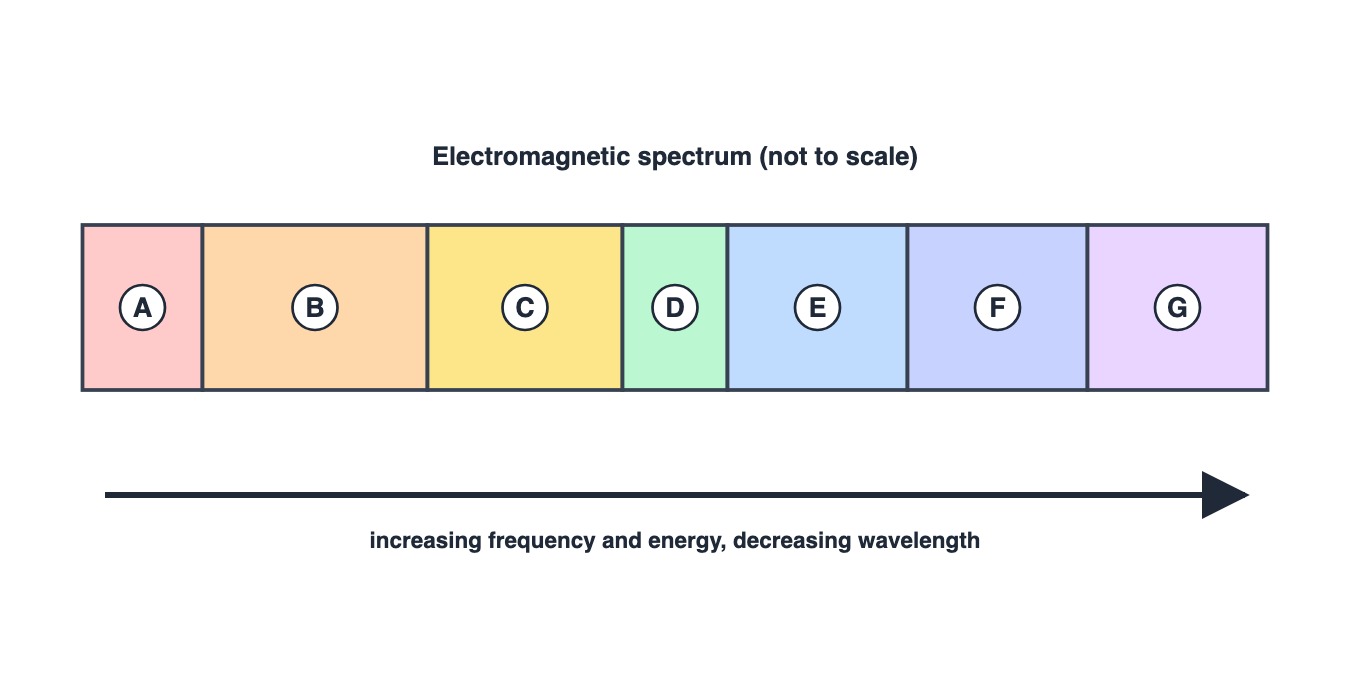
(a) F
(b) C
(c) A
(d) D
Show answer
Answer: (d) — VLC uses visible light of about 375 to 780 nm, the narrow band D.
Q14. The band with the shortest wavelength and highest energy, used in gamma irradiators for sterilising medical devices, is
(a) F
(b) E
(c) G
(d) A
Show answer
Answer: (c) — Gamma rays lie beyond X-rays at the high-frequency end. India's DAE runs gamma radiation processing facilities.
Q15. Band B, which includes the waves used in microwave ovens and many radars, is the
(a) ultraviolet band
(b) microwave band
(c) X-ray band
(d) infrared band
Show answer
Answer: (b) — In order of increasing frequency the bands are radio [A], microwave [B], infrared [C], visible [D], ultraviolet [E], X-ray (F) and gamma (G).
Q16. Ozone in the stratosphere absorbs most of the harmful radiation of band
(a) E
(b) G
(c) A
(d) C
Show answer
Answer: (a) — Ultraviolet-B radiation (band E) is absorbed by ozone, which is why ozone depletion raises skin-cancer risk.
UPSC Previous Year Questions (PYQs)
Real UPSC Prelims questions, checked against the official paper and answer key.
Q17. (2016) With reference to 'LiFi', recently in the news, which of the following statements is/are correct?
1. It uses light as the medium for high-speed data transmission.
2. It is a wireless technology and is several times faster than 'WiFi'.
Select the correct answer using the code given below.
(a) Both 1 and 2
(b) Neither 1 nor 2
(c) 1 only
(d) 2 only
Show answer
Answer: (a) — Li-Fi sends data by modulating the light of LEDs, and it is a wireless technology that can be several times faster than Wi-Fi. Both statements are right.
Q18. (2019) With reference to communications technologies, what is/are the difference/differences between LTE (Long-Term Evolution) and VoLTE (Voice over Long-Term Evolution)?
1. LTE is commonly marketed as 3G and VoLTE is commonly marketed as advanced 3G.
2. TE is data-only technology and VoLTE is voice-only technology.
Select the correct answer using the code given below.
(a) 1 only
(b) Neither 1 nor 2
(c) 2 only
(d) Both 1 and 2
Show answer
Answer: (b) — LTE is marketed as 4G, not 3G, and VoLTE carries voice as data over the LTE network, so neither statement is right.
Q19. (2020) With reference to Visible Light Communication (VLC) technology, which of the following statements are correct?
1. VLC uses electromagnetic spectrum wavelengths 375nm to 780 nm
2. VLC is known as long-range optical wireless communication.
3. VLC can transmit large amounts of data faster than Bluetooth
4. VLC has no electromagnetic interference
Select the correct answer using the code given below.
(a) 1, 2 and 4 only
(b) 2, 3 and 4 only
(c) 1, 2 and 3 only
(d) 1, 3 and 4 only
Show answer
Answer: (d) — Visible light communication uses visible light of about 375 to 780 nm, can send data faster than Bluetooth and causes no electromagnetic interference. It is a short-range technology, so statement 2 is wrong.
Q20. (2021) With reference to street-lighting, how do sodium lamps differ from LED lamps?
1. Sodium lamps produce light in 360 degrees but it is not so in the case of LED lamps.
2. As street-lights, sodium lamps have longer life span than LED lamps.
3. The spectrum of visible light from sodium lamps is almost monochromatic while LED lamps offer significant colour advantages in street-lighting.
Select the correct answer using the code given below.
(a) 1, 2 and 3
(b) 2 only
(c) 1 and 3 only
(d) 3 only
Show answer
Answer: (c) — A sodium lamp gives a nearly single-colour yellow light in all directions, while an LED is directional and gives better colour rendering. LEDs also last much longer than sodium lamps, so statement 2 is wrong.
Q21. (2024) Consider the following activities:
1. Identification of narcotics on passengers at airports or in aircraft
2. Monitoring of precipitation
3. Tracking the migration of animals In how many of the above activities can the radars be used?
(a) Only one
(b) Only two
(c) None
(d) All three
Show answer
Answer: (b) — Radar can monitor precipitation and track migrating birds and animals, but it cannot identify narcotics on passengers, which needs other detection methods. So two of the three.
Mains Practice Questions
Use these to frame full-length answers. You don't have to answer one exactly — they show the angles UPSC tests, so let them guide which points you cover.
Discuss in brief the importance of the National Programme on Light Emitting Diodes (LEDs).
The Nobel Prize in Physics of 2014 was awarded for the invention of blue LEDs. How has this invention impacted the everyday life of human beings?
Explain the differences between 4G, 5G and 6G and the opportunities and risks of India's indigenous telecom stack.
Assess BharatNet and the Digital Bharat Nidhi in bridging the rural digital divide.
Compare Li-Fi and Wi-Fi in terms of speed, range and security.
UPSC Mains — Previous Years’ Questions on this topic (last 10 years)
These are the actual GS Mains questions UPSC has asked on this theme — real proof of how, and when, it is tested. Try to write a full answer to each.
2021 (GS-III): The Nobel Prize in Physics of 2014 was jointly awarded to Akasaki, Amano and Nakamura for the invention of Blue LEDs in 1990s. How has this invention impacted the everyday life of human beings?
2016 (GS-III): Discuss in brief the importance of National Programme on Light Emitting Diodes (LEDs).