Energy Technologies for UPSC: Nuclear Fission and Fusion, PFBR, Three-Stage Programme, ITER, RTGs, Solar Pumps and EV Batteries
How UPSC Tests Energy Technology
🎯 Exam priority: Tier-1/2. Energy technology questions ask the working principle and a current number. UPSC asked: GL-10, an electric plane tested by NASA, and what the ITER fusion experiment would mean for India (2016); solar-powered water pumps (2020); radioisotope thermoelectric generators (2024); alternative powertrain vehicles, battery cathode elements and coal gasification (2025). Mains asked about the growth of nuclear science and the fast breeder programme (2017), the facts and fears of nuclear energy (2018), solar energy (2020), ITER (2025) and fast breeder versus thermal reactors and 'criticality' (2026).
Two boxes: nuclear energy (fission, fusion, India's programme) and other energy technologies (solar, storage, vehicles and gasification).
Nuclear Energy: Fission, Fusion, the Three-Stage Programme and PFBR
Nuclear energy
Idea | Explanation | India link |
Fission | A heavy nucleus splits and releases energy; a chain reaction is sustained by neutrons | Used in all operating power reactors |
Fusion | Light nuclei (hydrogen isotopes) fuse and release more energy per unit mass | ITER, a partner project in which India participates, aims to show fusion can give net energy; if it succeeds India could build fusion reactors for power (2016 PYQ), not use thorium sooner or improve fission efficiency |
Criticality | The point at which a fission chain reaction becomes self-sustaining | The 500 MWe Prototype Fast Breeder Reactor (PFBR) at Kalpakkam attained first criticality on 6 April 2026, built by BHAVINI with a design by IGCAR (secondary sources); it is not yet generating power |
Fast breeder reactor | Uses fast neutrons and a uranium-238 blanket to make more fissile plutonium than it burns; sodium-cooled | Stage 2 of India's three-stage programme. A thermal reactor uses slowed neutrons and a moderator and does not breed |
Three-stage programme | Stage 1: pressurised heavy water reactors on natural uranium. Stage 2: fast breeders using plutonium. Stage 3: thorium and uranium-233 reactors | Designed because India has modest uranium but large thorium reserves |
RTG | Heat from radioactive decay (for example Plutonium-238) turned into electricity without any chain reaction | Powers spacecraft, so it is not a miniature fission reactor (2024 PYQ) |
India's nuclear year (PIB, DAE; Economic Survey 2025-26)
Installed nuclear capacity is 8,780 MW, and the Central Electricity Authority projects 100 GW by 2047. The Nuclear Energy Mission (₹20,000 crore) aims for at least five indigenously designed small modular reactors by 2033, and the SHANTI Act (December 2025) opens the sector to private participation with a graded liability framework.
The Prime Minister laid the foundation stone of the four-unit Mahi Banswara plant (700 MWe PHWRs) in Rajasthan on 25 September 2025, to be built by an NPCIL-NTPC joint venture named ASHVINI. RAPP-7, the third indigenous 700 MWe PHWR of a series of 16, began commercial operation on 15 April 2025, and KAPS-3 and 4 at Kakrapar received licences for regular operation. The Atomic Energy Commission approved pre-project work for 10 more 700 MWe units beyond the 22.5 GW planned by 2032.
NPCIL generated a record 56,681 million units in 2024-25, avoiding about 49 million tonnes of CO2.
Spin-offs: an electronics-grade (99.8 per cent) Boron-11 enrichment facility at Talcher for semiconductors; India's first certified reference material for rare-earth ores, 'Ferrocarbonatite' (BARC B1401), the fourth in the world; and 40 gamma radiation processing facilities for food and medical-device sterilisation.
Solar, Storage, Vehicles and Gasification
Solar, storage and vehicles
Solar photovoltaic cells convert sunlight directly into electricity; unlike conventional plants, they burn no fuel and emit no greenhouse gas in operation (Mains 2020). India's solar capacity rose from 3 GW in 2014 to about 135.81 GW by December 2025, with 8 GW of rooftop capacity under PM Surya Ghar.
Solar water pumps: solar power can run surface and submersible pumps and centrifugal and piston pumps alike, so both limiting statements in the 2020 question were wrong. Under PM-KUSUM (Component B) more than 9.75 lakh stand-alone solar pumps had been installed by December 2025.
Electric vehicles: battery-electric, hydrogen fuel-cell and fuel cell-electric hybrid vehicles are all alternative powertrains (2025 PYQ). A fuel-cell vehicle emits only water vapour. In the battery, cobalt, lithium and nickel usually make up the cathode, while graphite is the usual anode (2025 PYQ).
Coal gasification turns coal into syngas (carbon monoxide and hydrogen), a feedstock for ethanol, methanol and ammonia (and so urea); nitroglycerine is not a gasification product (2025 PYQ: two of three).
GL-10 (Greased Lightning) is a NASA hybrid-electric vertical take-off aircraft prototype (2016 PYQ).
How UPSC Could Ask This Next
Working principles: fission versus fusion, breeder versus thermal, RTG, photovoltaic effect, fuel cell.
Programme facts: three-stage programme, PFBR, ITER, SHANTI Act, SMRs.
Materials: battery cathode and anode elements, thorium, Pu-238, Boron-11.
Scheme numbers: PM Surya Ghar, PM-KUSUM, 8,780 MW nuclear capacity.
Further Reading
NCERT Biology (Class 12) and Geography textbooks, the India State of Forest Report, the MoEFCC Annual Report, the Economic Survey and the official lists cited in this note — the primary sources behind every figure above.
Test Yourself: Practice Questions and PYQs
Twelve practice questions on nuclear and other energy technologies, followed by the real UPSC Prelims questions and exact Mains questions.
Practice Questions
Q1. In a nuclear reactor, a chain reaction becomes self-sustaining at the point called
(a) enrichment
(b) fusion
(c) decay
(d) criticality
Show answer
Answer: (d) — The PFBR at Kalpakkam reached first criticality on 6 April 2026.
Q2. India's three-stage nuclear power programme proceeds in which order?
(a) Thorium reactors, PHWRs, fast breeders
(b) Pressurised heavy water reactors, fast breeder reactors, thorium-based reactors
(c) Fast breeder reactors, PHWRs, thorium reactors
(d) Fusion reactors, breeders, PHWRs
Show answer
Answer: (b) — It is designed around modest uranium and large thorium reserves.
Q3. A fast breeder reactor differs from a thermal reactor in that it
(a) uses fast neutrons and breeds more fissile material than it consumes
(b) runs only on natural uranium
(c) uses nuclear fusion
(d) uses a heavy-water moderator to slow neutrons
Show answer
Answer: (a) — The PFBR is sodium-cooled and uses plutonium-uranium mixed oxide fuel.
Q4. Which of the following is the immediate advantage for India if the ITER experiment succeeds?
(a) It can build fusion reactors for power generation
(b) It gains a role in satellite navigation
(c) It can improve the efficiency of its fission reactors
(d) It can use thorium in place of uranium
Show answer
Answer: (a) — UPSC's 2016 key.
Q5. Radioisotope thermoelectric generators (RTGs)
1. are miniature fission reactors.
2. power the onboard systems of spacecraft.
3. can use Plutonium-238.
(a) 1 and 2 only
(b) 1 and 3 only
(c) 1, 2 and 3
(d) 2 and 3 only
Show answer
Answer: (d) — UPSC's 2024 key.
Q6. In an electric vehicle battery, which element usually forms the anode?
(a) Lithium
(b) Cobalt
(c) Nickel
(d) Graphite
Show answer
Answer: (d) — Cobalt, lithium and nickel usually make up the cathode.
Q7. Installed nuclear power capacity in India, per the Economic Survey 2025-26, is about
(a) 8,780 MW
(b) 878 MW
(c) 87,800 MW
(d) 100 GW
Show answer
Answer: (a) — The target is 100 GW by 2047.
Q8. The SHANTI Act, adopted in December 2025, consolidates the Atomic Energy Act, 1962 and the Civil Liability for Nuclear Damage Act, 2010 to
(a) end the nuclear programme
(b) ban imports of reactors
(c) set up a coal board
(d) enable private-sector participation in nuclear power
Show answer
Answer: (d) — It sets a graded liability framework without diluting victim compensation.
Q9. The four-unit Mahi Banswara nuclear plant in Rajasthan uses
(a) 700 MWe pressurised heavy water reactors built by the NPCIL-NTPC joint venture ASHVINI
(b) small modular reactors
(c) fast breeder reactors
(d) 1,000 MWe light-water reactors
Show answer
Answer: (a) — The foundation stone was laid on 25 September 2025.
Q10. Which of the following can solar power run?
1. Surface pumps
2. Submersible pumps
3. Centrifugal pumps
4. Piston pumps
(a) 1, 2, 3 and 4
(b) 1 and 3 only
(c) 1 and 2 only
(d) 2 and 4 only
Show answer
Answer: (a) — UPSC's 2020 key: both limiting statements were wrong.
Q11. India's first certified reference material for rare-earth ores, 'Ferrocarbonatite (BARC B1401)', is notable because it is the
(a) first in the world
(b) third in Asia
(c) second in India
(d) first in India and the fourth in the world
Show answer
Answer: (d) — It certifies thirteen rare earth elements.
Q12. The electronics-grade Boron-11 enrichment facility set up by DAE is at
(a) Tarapur
(b) Kalpakkam
(c) Kakrapar
(d) Talcher
Show answer
Answer: (d) — It is suitable for semiconductor applications.
Q13. The Prototype Fast Breeder Reactor at Kalpakkam belongs to stage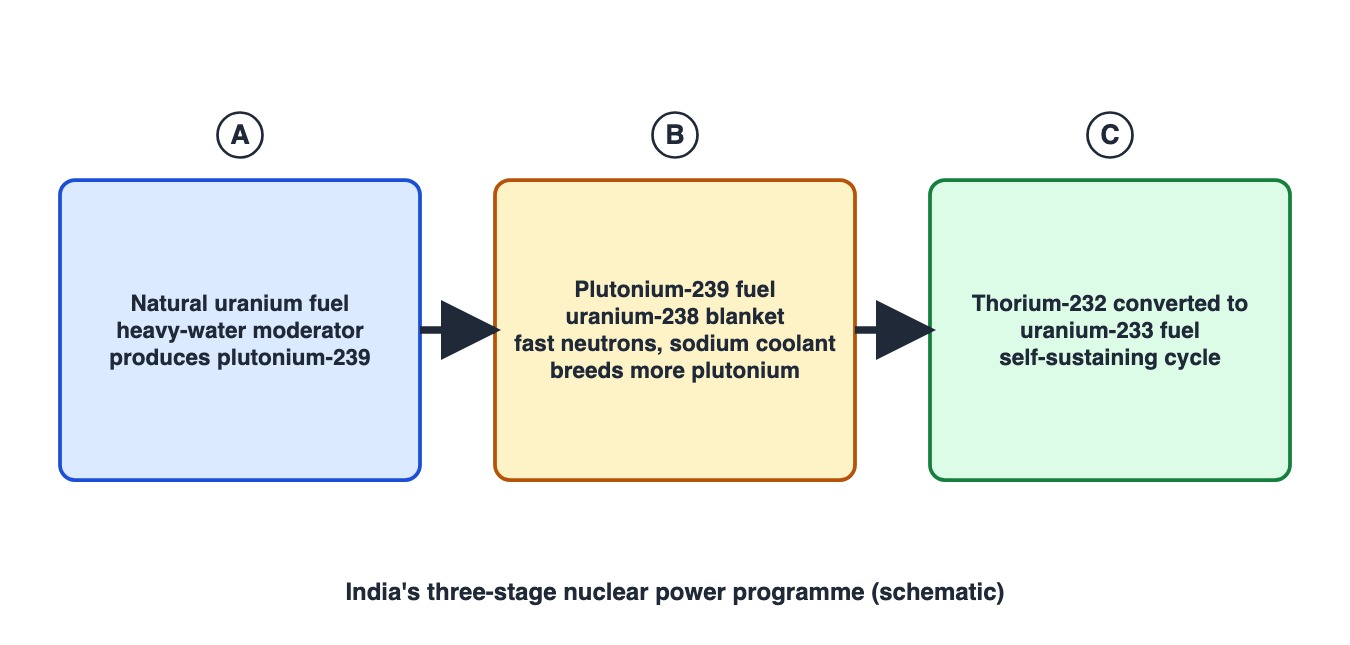
(a) B
(b) none of these
(c) C
(d) A
Show answer
Answer: (a) — Stage B uses plutonium fuel with a uranium-238 blanket, fast neutrons and a sodium coolant, as in the PFBR.
Q14. Stage C is designed to use India's abundant reserves of
(a) natural uranium only
(b) thorium
(c) deuterium
(d) coal
Show answer
Answer: (b) — India has modest uranium but large thorium reserves; thorium-232 is converted to fissile uranium-233 in the third stage.
Q15. The plutonium used as fuel in stage B is produced as a by-product in stage
(a) B only
(b) C
(c) none of these
(d) A
Show answer
Answer: (d) — The pressurised heavy water reactors of stage A, run on natural uranium, produce plutonium-239 in the spent fuel.
UPSC Previous Year Questions (PYQs)
Real UPSC Prelims questions, checked against the official paper and answer key.
Q16. (2016) What is 'Greased Lightning-10 (GL-10)', recently in the news?
(a) Solar-powered two-seater aircraft designed by Japan
(b) Reusable rocket designed by ISRO
(c) Electric plane tested by NASA
(d) Space observatory launched by China
Show answer
Answer: (c) — Greased Lightning GL-10 was a NASA prototype of a hybrid-electric aircraft that takes off and lands vertically, so it is an electric plane tested by NASA.
Q17. (2016) India is an important member of the 'International Thermonuclear Experimental Reactor'. If this experiment succeeds, what is the immediate advantage for India?
(a) It can build fusion reactors for power generation.
(b) It attained a global role in satellite-navigation.
(c) It can drastically improve the efficiency of its fission reactors in power generation.
(d) It can use thorium in place of uranium for power generation.
Show answer
Answer: (a) — ITER is a nuclear fusion experiment. If it succeeds, India, a partner, can go on to build fusion reactors for power generation. It does not bring thorium use, satellite navigation or better fission reactors.
Q18. (2020) With reference to solar water pumps consider the following statements:
1. Solar power can be used for running surface pumps and not for submersible pumps.
2. Solar power can be used for running centrifugal pumps and not the ones with piston.
Which of the statements given above is/are correct?
(a) 1 only
(b) Neither 1 nor 2
(c) 2 only
(d) Both 1 and 2
Show answer
Answer: (b) — Solar power can run surface and submersible pumps and centrifugal and piston pumps alike, so neither statement is correct.
Q19. (2024) With reference to radioisotope thermoelectric generators (RTGs), consider the following statements:
1. RTGs are miniature fission reactors.
2. RTGs are used for powering the onboard systems of spacecraft.
3. RTGs can use Plutonium-238, which is a by-product of weapons development.
Which of the statements given above are correct?
(a) 2 and 3 only
(b) 1, 2 and 3
(c) 1 and 3 only
(d) 1 and 2 only
Show answer
Answer: (a) — A radioisotope thermoelectric generator turns the heat of radioactive decay, for example of Plutonium-238, into electricity with no chain reaction, so it is not a miniature fission reactor. RTGs power spacecraft, and Pu-238 is a by-product of weapons-related programmes, so statements 2 and 3.
Q20. (2025) Consider the following types of vehicles :
1. Full battery electric vehicles
2. Hydrogen fuel cell vehicles
3. Fuel cell-electric hybrid vehicles
How many of the above are considered as alternative powertrain vehicles?
(a) All the three
(b) Only one
(c) Only two
(d) None
Show answer
Answer: (a) — Battery-electric, hydrogen fuel-cell and fuel cell-electric hybrid vehicles are all alternatives to a petrol or diesel engine, so all three.
Q21. (2025) In the context of electric vehicle batteries, consider the following elements:
1. Cobalt
2. Graphite
3. Lithium
4. Nickel
How many of the above usually make up battery cathodes?
(a) Only three
(b) All the four
(c) Only one
(d) Only two
Show answer
Answer: (a) — Cobalt, lithium and nickel usually make up the cathode of an electric vehicle battery, while graphite is the usual anode material. Three of the four.
Q22. (2025) Consider the following substances :
1. Ethanol
2. Nitroglycerine
3. Urea
Coal gasification technology can be used in the production of how many of them?
(a) None
(b) Only two
(c) All the three
(d) Only one
Show answer
Answer: (b) — Coal gasification produces syngas, a feedstock for fuels and chemicals such as ethanol, methanol and ammonia (from which urea is made). Nitroglycerine is made from glycerol with nitric and sulphuric acids, so it is not a gasification product. Two of the three.
Mains Practice Questions
Use these to frame full-length answers. You don't have to answer one exactly — they show the angles UPSC tests, so let them guide which points you cover.
Distinguish between a Fast Breeder Reactor and a thermal nuclear reactor. In the context of the prototype FBR at Kalpakkam, explain the term 'criticality' and its implications for India's clean energy future.
The fusion energy programme in India has steadily evolved. Mention India's contributions to ITER and the implications of its success for global energy.
With growing energy needs, should India keep expanding its nuclear energy programme? Discuss the facts and fears associated with nuclear energy.
Describe the benefits of deriving electric energy from sunlight in contrast to conventional energy generation. What initiatives has the Government offered?
Give an account of the growth and development of nuclear science and technology in India.
UPSC Mains — Previous Years’ Questions on this topic (last 10 years)
These are the actual GS Mains questions UPSC has asked on this theme — real proof of how, and when, it is tested. Try to write a full answer to each.
2026 (GS-III): Distinguish between a Fast Breeder Reactor (FBR) and a thermal nuclear reactor. In the context of first indigenously developed prototype FBR at Kalpakkam, explain the term 'criticality'. What are its implications for clean energy future of our country?
2025 (GS-III): The fusion energy programme in India has steadily evolved over the past few decades. Mention India's contributions to the international fusion energy project - International Thermonuclear Experimental Reactor (ITER). What will be the implications of the success of this project for the future of global energy?
2020 (GS-III): Describe the benefits of deriving electric energy from sunlight in contrast to the conventional energy generation. What are the initiatives offered by our Government for this purpose?
2018 (GS-III): With growing energy needs should India keep on expanding its nuclear energy programme? Discuss the facts and fears associated with nuclear energy.
2017 (GS-III): Give an account of the growth and development of nuclear science and technology in India. What is the advantage of fast breeder reactor programme in India?