Codes of Ethics, Codes of Conduct and Citizens' Charters for UPSC GS4: Sevottam, Work Culture, Efficiency vs Effectiveness and Public Funds
Codes of Ethics and Codes of Conduct
🎯 Exam priority: High-yield (Mains GS4). Asked in 2024 (suggest a model code of ethics, since India has a code of conduct but no code of ethics), 2025 (code of ethics for a value-based and compliance-based work culture; under-utilised and misused funds) and 2026 (efficiency vs effectiveness). Citizens' charters and Sevottam are standard material for service-delivery answers.
Code of ethics vs code of conduct
The 2nd ARC draws the distinction precisely: a code of ethics covers broad guiding principles of good behaviour and governance, while a code of conduct stipulates, precisely and unambiguously, a list of acceptable and unacceptable behaviour.
Code of ethics | Code of conduct | |
Nature | Values and principles (integrity, impartiality, service) | Specific rules: do's and don'ts |
Approach | Aspirational, value-based | Compliance-based, enforceable |
In India | None formally adopted for civil servants | AIS (Conduct) Rules 1968; Central Civil Services conduct rules (1964) |
Example | 'Act in the public interest' | 'Do not accept gifts above a set value without permission' |
History: a compendium of "do's and don'ts" in the 1930s; distinct rules in 1955; the enlarged 1964 rules after the Santhanam Committee; later additions such as courtesy, a ban on dowry, a ban on sexual harassment of women employees and a ban on employing children under 14 as domestic help. The ARC's criticism: the rules mostly catalogue undesirable activities, and there is no Code of Ethics.
A model code of ethics (2024)
Values: allegiance to the Constitution and the Preamble's ideals; integrity; impartiality and political neutrality; accountability and transparency; empathy for the weaker sections; dedication; economy in public spending.
Statutory basis: the ARC wants Public Service Values defined in law for all tiers of government, with transgression treated as misconduct inviting punishment, following Australia's Public Service Act of 1999.
Conflict of interest covered comprehensively in both codes (declaration, recusal, cooling-off periods).
Implementation: an ethics officer or authority to advise and enforce; training; confidential advice; annual reporting on compliance.
Organisation-specific codes for bodies with public interface, as the ARC recommends.
Citizens' Charters and Sevottam
Citizens' charters
A citizens' charter is a public statement of the entitlements of citizens to a specific service, the standards of the service, the conditions users must meet, and the remedies available if standards are not met.
Origin: launched in its present form in the UK in 1991 (first report released by Prime Minister John Major in 1992), to see public services "through the eyes of those who use them".
Six original principles: quality, choice, standards, value for taxpayers' money, accountability, and transparency (revised in 1998 into nine principles of service delivery).
India: after a 1996 national debate on responsive administration, the Chief Ministers' Conference of May 1997 decided to introduce charters, starting with sectors of large public interface (railways, telecom, post, PDS, hospitals, revenue, electricity). By February 2007 there were 115 Union and 650 State/UT charters.
Why they failed: the 4th Report found charters had fallen into disuse in many offices, their promises "pious declarations with no mechanism to enforce them"; a parliamentary committee quoted in the 12th Report noted they were not formulated through consultation. Other problems: one-size-fits-all formats, no remedy for breach, staff unaware of them.
Reforms: consult citizens and staff; specific, measurable standards; a compensation or remedy for failure; link to grievance redress; review periodically; and, the ARC adds, an organisation-specific approach since one size does not fit all.
Sevottam and the seven-step model
Sevottam (seva + uttam: service + excellence) is DARPG's service delivery excellence model, created because charters alone did not improve services. Its three modules: effective charter implementation; public grievance redress; and excellence in service delivery (managing the key ingredients and building capacity to keep improving). The ARC's seven-step model, drawing on IS 15700:2005, Sevottam and the UK's Customer Service Excellence model: define services and identify clients; set standards for each; develop capability; perform to standards; monitor performance; evaluate impact through independent means; and improve continuously.
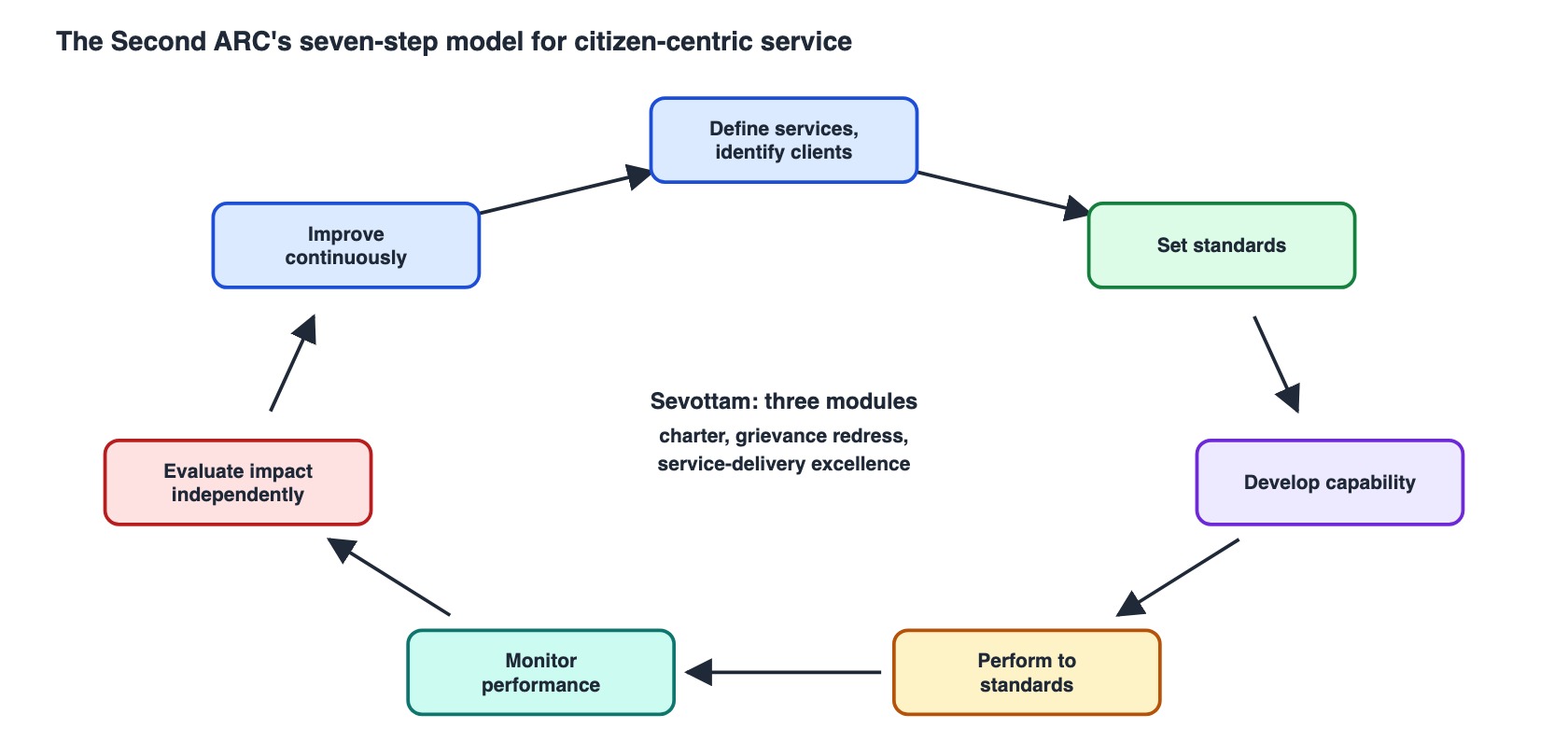
The Second ARC's seven-step cycle for citizen-centric service, with Sevottam's three modules at its centre.
Work Culture, Service Delivery and Public Funds
Work culture
An ethical work culture is value-based (people do right because they believe in it) and compliance-based (clear rules, monitoring and consequences). The 2025 question asked for both. Measures: a code of ethics with leaders modelling it; protection and rewards for honest staff; transparent postings and promotions; time-bound file disposal; grievance and whistleblower channels; team recognition; reasonable workloads; and zero tolerance for harassment. The ARC's point that values need institutions to survive (article 01) applies inside every office.
Efficiency vs effectiveness (2026)
Efficiency: doing things right | Effectiveness: doing the right thing | |
Focus | Inputs and process: cost, speed, procedure | Outcomes: did the citizen's problem get solved? |
Risk if alone | A perfectly processed file that helps no one | Good aims achieved wastefully or unfairly |
Example | Disbursing scheme money on time | Ensuring the money reached eligible people and changed outcomes |
Balance by setting outcome targets first, then designing the most efficient lawful process; measuring both (outcome indicators and process indicators); and reviewing with users. Productivity rises when the right things are done in the right way.
Quality of service delivery and utilisation of public funds (2025)
Why funds stay unspent or are misused: late release of funds, weak planning and capacity at the spending level, rush to spend at year-end, leakage, and diversion to purposes not intended.
Measures: outcome-based budgeting and tracking; real-time public financial management and direct benefit transfers; just-in-time release linked to utilisation; geotagging and third-party monitoring of assets; social audit; timely audit and action on audit findings; capacity building of local bodies; and personal accountability for unspent or misused funds.
The ethical point: public money is held in trust (article 12). The citizens' charter principle of "value for the taxpayers' money" makes waste a breach of duty, not just an inefficiency.
Further Reading
PIB press releases, ministry websites and annual reports, the Gazette of India, MEA and UN documents and the official sources named in each note — the primary sources behind every fact above.
Test Yourself: Practice Questions & PYQs
12 practice questions, then the GS4 questions on codes, charters and public funds.
Practice Questions
Q1. According to the 2nd ARC, a code of conduct differs from a code of ethics in that it
(a) applies only to ministers
(b) states only broad principles
(c) lists acceptable and unacceptable behaviour precisely
(d) has no enforcement
Show answer
Answer: (c) — A code of ethics covers broad guiding principles of good behaviour and governance.
Q2. The 2nd ARC's main criticism of India's conduct rules is that they
(a) are too short
(b) catalogue undesirable activities and there is no code of ethics
(c) apply only to the police
(d) were never enforced
Show answer
Answer: (b) — It wants Public Service Values defined in law.
Q3. The ARC recommends that transgression of Public Service Values be treated as
(a) misconduct inviting punishment
(b) grounds for promotion
(c) a matter for advice only
(d) a criminal offence in all cases
Show answer
Answer: (a) — It cites Australia's Public Service Act, 1999.
Q4. The citizens' charter in its present form was first launched in
(a) the USA in 1993
(b) the UK in 1991
(c) Australia in 1999
(d) India in 1997
Show answer
Answer: (b) — India's programme began after the Chief Ministers' Conference of May 1997.
Q5. Consider the following statements:
1. Value for taxpayers' money is a citizens' charter principle.
2. Choice is a citizens' charter principle.
3. Secrecy is a citizens' charter principle.
Which of the statements given above are correct?
(a) 1 and 2 only
(b) 2 and 3 only
(c) 1 and 3 only
(d) 1, 2 and 3
Show answer
Answer: (a) — 1 and 2 are correct. The six: quality, choice, standards, value, accountability, transparency.
Q6. A citizens' charter must state entitlements, service standards, conditions for users and
(a) the party in power
(b) the budget of the department
(c) the officer's salary
(d) remedies if standards are not met
Show answer
Answer: (d) — Remedies are what make a charter enforceable.
Q7. The 2nd ARC's 4th Report described the promises of many citizens' charters as
(a) over-ambitious
(b) legally binding contracts
(c) perfectly implemented
(d) pious declarations with no mechanism to enforce them
Show answer
Answer: (d) — Charters had fallen into disuse in many offices.
Q8. 'Sevottam' combines two Hindi words meaning
(a) truth and service
(b) service and excellence
(c) people and state
(d) service and duty
Show answer
Answer: (b) — It is DARPG's service delivery excellence model.
Q9. The three modules of the Sevottam model are
(a) planning, budgeting, auditing
(b) training, posting, promotion
(c) audit, vigilance, prosecution
(d) citizens' charter, grievance redress, service delivery excellence
Show answer
Answer: (d) — It was created because charters alone did not improve services.
Q10. Which standard does the ARC's seven-step model draw on, along with Sevottam?
(a) IS 456
(b) ISO 14001
(c) ISO 9000:1987
(d) IS 15700:2005
Show answer
Answer: (d) — And the UK's Customer Service Excellence model.
Q11. 'Doing the right thing' describes
(a) efficiency
(b) compliance
(c) effectiveness
(d) economy
Show answer
Answer: (c) — Efficiency is doing things right.
Q12. A work culture that combines belief in values with clear rules and consequences is
(a) only compliance-based
(b) laissez-faire
(c) both value-based and compliance-based
(d) only value-based
Show answer
Answer: (c) — The 2025 GS4 question asked how to build both.
Mains Practice Questions
Use these to frame full-length answers. You don't have to answer one exactly — they show the angles UPSC tests, so let them guide which points you cover.
Suggest a model code of ethics for civil servants in India.
Why have citizens' charters not delivered, and how can they be made effective?
How can an administrator balance efficiency and effectiveness?
UPSC Mains — Previous Years’ Questions on this topic (last 10 years)
These are the actual GS Mains questions UPSC has asked on this theme — real proof of how, and when, it is tested. Try to write a full answer to each.
2024 (GS-IV): "The 'Code of Conduct' and 'Code of Ethics' are the sources of guidance in public administration. There is code of conduct already in operation, whereas code of ethics is not yet put in place." Suggest a suitable model for code of ethics to maintain integrity, probity and transparency in governance.
2025 (GS-IV): It is said that for an ethical work culture, there must be code of ethics in place in every organisation. To ensure value-based and compliance-based work culture, what suitable measures would you adopt in your work place?
2025 (GS-IV): India is an emerging economic power as it has recently secured the status of fourth largest economy of the world as per IMF projection. However, in some sectors, allocated funds remain either under-utilised or misutilised. What specific measures would you recommend for ensuring accountability in this regard to stop leakages?
2026 (GS-IV): Efficiency is doing things right, while effectiveness is doing the right thing. How do you strike a balance between the two to enhance productivity?